Wanted: A Congregation, Part 3d: Launching the Sermon

by Ronald R Johnson

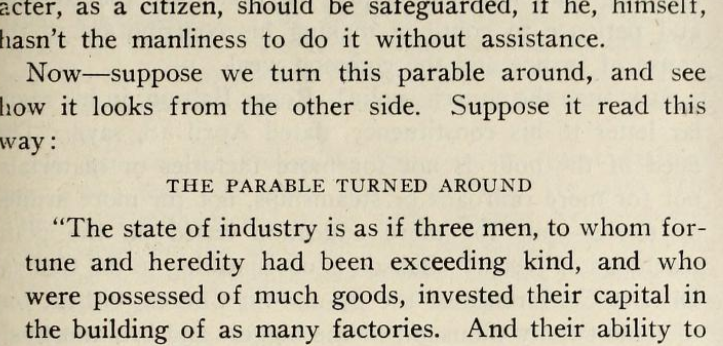
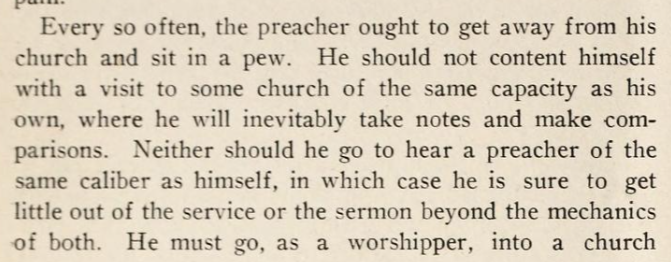
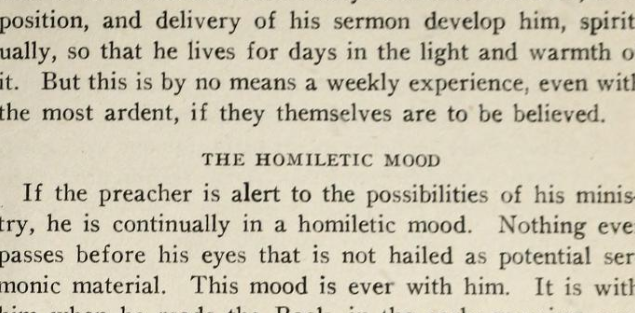
A page from Lloyd C. Douglas, “Wanted—A Congregation, Third Phase—The Sermon Sample,” in the August 26, 1920, issue of The Christian Century.

[The following is an excerpt from the third installment of Lloyd Douglas’s series about the fictitious minister, Rev. D. Preston Blue in the Christian Century during summer/fall 1920. The series was called, “Wanted – A Congregation!”and the third installment, dated 8/26/1920, was titled, “The Sermon Sample.”]

“Blue has resolved to begin no more sermons with the remark, ‘According to Usher,’ – so-and-so is this-that-or-some-other-thing. He has promised himself that he will never start another sermon with, ‘Scientists tell us that’ – whatever-it-is-that-they-tell-us. He has vowed himself a solemn pledge that he will never dig around again in a volume of canned stories for some tale wherewith to anaesthetize the saints. Never again will he spin a marine yarn about a shipwreck unless he is able to give the actual data. He is done with all disasters at sea that begin, ‘The story is told of a vessel foundered on the reef.’ No more will he attempt to point out a moral by telling a story of ‘a young man who broke his mother’s heart by his dissipation.’ No, sir; if he is going to deal with such a situation, he must make it glow with life and color, as did the Parable of the Prodigal – until, when he is well into it, his congregation knows that young fellow so well that they could almost draw a picture of him sitting among the hogs, ragged and ruined.

“Blue’s new trouble is to decide which is the very best of ten illustrations of a single point, instead of mooning over his dusty old books searching for some incident that may or may not have occurred back in 1842. Indeed, he is becoming so embarrassed with homiletic riches that he can’t pack everything into one sermon that properly belongs there. This leads him into the business of preaching most of his sermons in ‘series.’ It may take him three or four weeks to get through with one idea. For example, take the matter of shipwrecks. What causes shipwrecks? He had thought of preaching about it. He can do a sketchy job of outlining these causes in a single sermon, but he knows that there is material here for several sermons. He resolves to preach a series of sermons on ‘Shipwrecks.'”

[To be continued in my next post…]

Wanted: A Congregation, Part 3c: Automobiling and Religion

by Ronald R Johnson

A page from Lloyd C. Douglas, “Wanted—A Congregation, Third Phase—The Sermon Sample,” in the August 26, 1920, issue of The Christian Century.

[The following is an excerpt from the third installment of Lloyd Douglas’s series about the fictitious minister, Rev. D. Preston Blue in the Christian Century during summer/fall 1920. The series was called, “Wanted – A Congregation!”and the third installment, dated 8/26/1920, was titled, “The Sermon Sample.”]

“Since pretty nearly everybody in Centerville is interested in automobiles, Blue, after a long trip in his little car during his vacation, decides that he can do no better than preach a sermon on ‘The Courtesies of the Road,’ which he announces as of special interest to every man who drives a car. He has been in the ditch and has been dragged out at the end of a stranger’s rope. If he can’t find an illustration in that worthy to be mentioned in connection with the story of the Good Samaritan, he is a preacher who has no right to run a car! ‘Let your light so shine that men might see your good works,’ muses Blue as he waits, blinded by some discourteous fellow’s glare, fearful to go on lest he slip off the road. Indeed, as he figures on the possibilities of this theme, his little car becomes alive with illustrations – flat tires, flooded carburetor, defective ignition, overcharged battery, burned-out brakes! Blue begins to understand why all Palestine had followed him about who had made homiletic capital of everything he saw along the road – men building houses, children at play, farmers plowing, women baking, fishermen casting nets, fruit growers mulching a fig tree, camels being unloaded to pass a narrow gate, merchants driving bargains, threshers wielding flails, masons laying brick. Surely, if it did not undignify the Great Preacher to light up his sermons with illustrations about brooms, crumbs, chaff, pennies, dogs, birds, grass, yeast, mustard-seed, and manure, he, Blue, could at least afford to keep his eyes open for the significance of the little, homely facts in common experience.

“If this mention of Blue’s new interest in sermonic materials seems to be slightly off the subject of his great desire to recruit a large congregation, one may justify the digression on the ground that no amount of advertising is going to help Mr. Blue’s pulpit unless the preacher is prepared to interest his audience when he gets it. He recalls with humiliation the ingenuously brutal remark of his own small daughter who, when asked why she didn’t want to go to church, replied, ‘Oh, church is nothing but a lot of old men sleeping, and nice old ladies waving fans!’ That had been a pretty hard jolt – doubly shocking because of its strict adherence to the truth!”

[To be continued in my next post…]

Wanted: A Congregation, Part 3b: Samples of Sermons

by Ronald R Johnson

A page from Lloyd C. Douglas, “Wanted—A Congregation, Third Phase—The Sermon Sample,” in the August 26, 1920, issue of The Christian Century.

[The following is an excerpt from the third installment of Lloyd Douglas’s series about the fictitious minister, Rev. D. Preston Blue in the Christian Century during summer/fall 1920. The series was called, “Wanted – A Congregation!”and the third installment, dated 8/26/1920, was titled, “The Sermon Sample.”]

“Our friend Blue is becoming more and more convinced every day that the way to call the public’s attention to the alluring attractiveness of the gospel is to come before the people occasionally with an interesting sample of it. He has been practicing on the composition of sermon abstracts for the Monday papers. They are so readable that people are coming to look at them, now, with eagerness. Already there is an appreciable increase in his congregation due to the publicity his pulpit is receiving from this quarter. His little homilies in the papers deal with some one fact of common interest, introduced with a simple illustration chosen from people’s everyday experience.

“Moreover, he has decided that if this is a good method to pursue in print, it is no less correct in the pulpit. He discovers, with some chagrin, that he has been consistently ‘overshooting.’ His sermons have been made up of abstractions – true and edifying, but bromidic. Noting, now, the way the eyes of his auditors light up when he leads a sermon with some practical illustration, Blue has begun to cultivate a ‘homiletic mood.’ No event, however trivial, gets by him these days without giving a good account of itself as a possible illustration of some spiritual verity. The woman with the apple puts him on the track of a brilliant idea about concentrating people’s attention on a single concept and making that one concept so attractive that it needs no argument. Indeed, Blue is going about now with his eyes and ears open. He snaps the electric switch beside his study door and gets no light. What is the matter? Is the trouble in the lamp or up in the attic inside the fuse box, or down on Tenth Street at the powerhouse? Clearly it is not at the powerhouse, for the neighbor’s lamps are brightly burning. And while he hunts for the cause of the annoyance, he is evolving a perfectly corking illustration which he means to use as the lead to a sermon on ‘The Darkened Room.’ Nothing in the Bible to fit it? What is the matter with the Parable of the Virgins?

“Of course, he does not rush to his pulpit with this matter until he has had time to think it all through carefully. He goes down to the powerhouse and talks to the manager, explaining exactly why he wants to know all the causes of defective lamps, interrupted power, broken wires, and burned-out fuses. Incidentally, while learning something useful, he makes a new friendship.”

[To be continued in my next post…]

Wanted: A Congregation, Part 3a: Knowing the Value of Your Message

by Ronald R Johnson

Title page of Lloyd C. Douglas, “Wanted—A Congregation, Third Phase—The Sermon Sample,” in the August 26, 1920, issue of The Christian Century.

[The following is from the third installment in Lloyd Douglas’s series, “Wanted—A Congregation!” in the summer and fall of 1920. This installment, dated 8/26/1920, is titled, “Third Phase—The Sermon Sample.” The series is about the Reverend D. Preston Blue, who is on a campaign to enlarge his audience.]

“Late one afternoon when the Blues were sitting out on their front porch talking things over, a woman sauntered up the steps peeling an apple. She smiled pleasantly but said nothing; not even ‘how-de-do’ – just smiled and peeled. Neither did the Blues disturb the silence, so fascinated were they by the performance of the woman who was skinning the rind off that apple with a curiously shaped knife that turned work into play. After a moment, Mrs. Blue exclaimed: ‘Oh – do tell me where I can get a knife like that!’ ‘You may have this one,’ replied the woman, quietly – ‘for thirty-five cents.’ She took the money, left the knife, and, enroute to the gate, picked up two bags which she had parked behind a rosebush – a large bag and a small one. Said Mr. Blue as the gate clicked behind her, ‘The small bag is full of knives, and the large bag is full of apples – and the woman is full of wisdom.’

“Now it happens that this man, who is no other than our good friend, Rev. D. Preston Blue of the consuming ambition to preach to a large congregation, has been giving himself recently to a serious study of psychology – especially in its relation to the processes by which a demand may be created in the public mind for a thing of high value. For several minutes he was thoughtful after the agent had left, and then he said, half to himself, ‘That woman has a good head. She didn’t come up with a whole bagful of knives to make a long speech about their meritorious attributes. She didn’t muddle us with a lot of knives and arguments; she simply exhibited one knife – in operation.’

“‘Yes,’ responded Mrs. Blue, who guessed what was in her husband’s mind, ‘and she didn’t tell us what a good, kind man he was who owned the factory, or what kind of wood the handle is made of, or that she herself is selling them to support eleven starving children.’

“‘Exactly!’ approved D. Preston, nodding his head vigorously. ‘She knew the value of her merchandise and just let it sell itself by a demonstration.'”

[To be continued in my next post…]

Wanted: A Congregation, Part 2j: Jesus An Intuitive Psychologist

by Ronald R Johnson

Excerpt from Lloyd C. Douglas, “Wanted—A Congregation, Second Phase—Preacher and Newspaper,” Christian Century, August 19, 1920.

[This is from Part 2 of Lloyd C. Douglas, “Wanted – A Congregation!” This second installment was in the August 19, 1920, issue of The Christian Century. It was entitled, “Second Phase – Preacher and Newspaper.” He is talking about a minister who wants to enlarge his audience and is writing an abstract of his sermon for the local newspaper.]

“Again, the preacher may have been talking about ‘The Uses of Adversity.’ This is always an attractive line of homiletic thought. In his newspaper account of what he said, let the lead suggest some such thought as the following:

Because he had the good fortune to plane all the fingers off of his left hand in his father’s mill, one of the most brilliant lawyers of this country was able to put his energies to work where they would do the most good. The accident ruined him for the life of a mechanic; but he hadn’t been intended for a mechanic. Instead of sitting down to nurse his lumps, he got up and trained what he had left – his brains.

“Anybody in search of incidents similar to this will be bewildered over the wealth of materials at his disposal. They are all well worth telling. They have put more punch and renewed courage into the minds and hearts of the mentally, morally, and physically crippled than can be estimated in words or figures. The public may be depended upon to read all about the old lady who made candy; accidentally scorched the sugar; was on the point of pouring it out; hit upon a happy thought; poured the mess full of peanuts; made her fortune; lived happily ever after. Not very dignified? Well, how about this one? ‘In a city there was a judge who feared nobody, and a widow came to him, saying, “Avenge me of my adversary!” And he did not, for a while; afterward he decided, “I will avenge her, lest by her continual coming she weary me.”‘

“Indeed, this one is so good that a preacher could lead his sermon extract with it today – after this long lapse of time – and be sure of attention. Let all these good brothers who are trying to follow the Galilean Teacher pay careful heed to his processes of gaining and sustaining public interest. As an intuitive psychologist who ‘knew what was in man,’ he not only spoke authoritatively to the people of his own generation, but has furnished an example of the most effective methods by which life may be touched on its most sensitive nerves.

“Now that D. Preston Blue has had his first palatable taste of printer’s ink and has noticed the increased interest which the public is taking in his pulpit, he resolves to go a step further in the use of printed matter to recruit the crowd he means to have in his church, not once but every Sunday, rain or shine. Of that matter – its general scheme, the detail of its construction, the cost, the process of distribution, etc., a succeeding paper will endeavor to treat. D. Preston Blue has chopped up the piano box for kindling wood. He has resolved to find a crowd in Centerville.”

[In my next post, I’ll tell you about the third installment in the series, “Wanted – A Congregation!”]

Wanted: A Congregation, Part 2i: Putting the Graveyard in the Foreground

by Ronald R Johnson

Excerpt from Lloyd C. Douglas, “Wanted—A Congregation, Second Phase—Preacher and Newspaper,” Christian Century, August 19, 1920.

[This is from Part 2 of Lloyd C. Douglas, “Wanted – A Congregation!” This second installment was in the August 19, 1920, issue of The Christian Century. It was entitled, “Second Phase – Preacher and Newspaper.” He is talking about a minister who wants to enlarge his audience and is writing an abstract of his sermon for the local newspaper.]

“Or again, suppose the preacher has been talking about ‘the things for which we are remembered’ – not a half bad topic, by the way; though of course one would never think of announcing it in that fashion. Searching his notes for the ‘lead,’ the minister does not top his sermon abstract with a dissertation upon the graveyard; the tombstone toward which our footsteps are inevitably hastening; and the long grass growing in God’s Acre where that which is mortal of us will eventually rest while other people go on just as if nothing had happened, forgetting the departed pilgrim except for the two or three little things that he had chanced to do – deeds destined to live forever. No! And again, No! You cannot bait anybody to read a sermon that sets out in a hearse and ambles along to the cemetery. The public is obliged to make that trip often enough to satisfy all curiosity it has on the subject. If the preacher will talk about death, let him view it as a glorious beginning of something rather than discourse upon its less promising aspects. People do not relish a sermon that smacks of the undertaker’s suave instructions to the pallbearers, ‘Handles all down, please. Face the car, as I do. That’s very good – thank you. Take the third and fourth carriages, if you will. Very greatly obliged, I’m sure.’

“No; this preacher hunts for the one striking fact that had brightened the eyes of his audience, and he leads his sermon on ‘the things for which we are remembered’ somewhat after the following manner:

It was the worst road in Scotland. The supervisor told John Louden MacAdam that if he did not mend that road which made his estate almost impassable, he would be fined.

John Louden’s dignity was damaged. He had neglected that road because he was busy with more important matters. He was writing a monumental history of the MacAdam family.

But, required to repair his road, he decided to make one that would cast open shame upon all the roads of his neighbors who had made complaint.

He had all the clay hauled off the highway and the excavation filled with crushed stone and gravel. It was a good road.

Then he went back to his history of the MacAdams and spent the rest of his life celebrating their great deeds; but nobody remembered any other MacAdam but John Louden, and he is remembered not because he wrote a five-foot shelf of histories, but because he invented the macadamized road.

“The reader will go on and try to find out what all this leads to, it may be supposed. The preacher should have no trouble in coaxing him along into the next paragraph which deals with the little deeds rendered incidentally and the kindly words spoken casually – but saturated with that which makes for immortality.”

[To be continued in my next post…]

Wanted: A Congregation, Part 2h: Newspaper Style

by Ronald R Johnson

Excerpt from Lloyd C. Douglas, “Wanted—A Congregation, Second Phase—Preacher and Newspaper,” Christian Century, August 19, 1920.

[This is from Part 2 of Lloyd C. Douglas, “Wanted – A Congregation!” This second installment was in the August 19, 1920, issue of The Christian Century. It was entitled, “Second Phase – Preacher and Newspaper.” I am continuing where I left off in my most recent post. He is talking about a minister who wants to enlarge his audience but was taught nothing at seminary about reaching the surrounding community through the local newspaper.]

“If he is of an extremely practical sort in estimating his assets, this preacher can console himself with the thought that whenever he wishes to do so he can use the column of The Morning Star as if he were the editor himself. This is not a negligible consideration to any man who wishes to give his pulpit some publicity. All he lacks now is the ability to use this space in such a manner that the reader will shout, ‘Fine! We must go around and hear this man Blue!’ – instead of muttering, ‘What rot these preachers get off in their churches! What bewildering stupidity!’

“Speaking generally, if the preacher who has been given an opportunity to preach to the public through the newspaper does not contrive to grip his readers with the first line, he had better save his typewriter ribbon. However, in his anxiety to lead his copy with something clever to attract attention, he must not forget that he is not selling shaving soap, or advertising a circus, but attempting to spread the good news of salvation. To spread that good news, it is necessary that he shall be honest with his constituency. To be honest does not mean, necessarily, that he must be dull. Possibly a few illustrations will help here.

“The preacher has talked about the importance of living up to one’s best self – a not infrequent theme among us. Of course, no attempt is made here to phrase the subject for announcement. Any man who would advertise that he was going to preach on ‘Living Up to One’s Best Self’ has really accomplished nothing but a deepening conviction on the part of the public that he has nothing to unload of interest to a populace sated with good advice.

“Whatever he may call the sermon, however, for purposes of arousing interest, this is his thesis – ‘living up to one’s best self.’ He thinks it is good enough to be given to the general public through the press. As he glances over his notes prefatory to composing the abstract, he searches for the one striking incident, anecdote, or ‘human interest fact’ most likely to reach out and grab the casual reader. When his sermon appears in print, next morning, it does not lead with a stiff procession of platitudes, marching along in single file with their chins in the air and their skirts carefully clutched to avoid the mud, but with the simple statement of a concrete fact.

“A study of newspaper style will show that a proper name, in the first line, is not uncommon. The mention of dollars and cents is always attractive to the reader. It interests him to learn that somebody has made some money. He is not much less interested in learning how somebody else lost some money. In the present instance, the sermon abstract begins as follows:

Wedgwood could not afford to lose the $40.00 which he had been offered for the vase. He was just starting in the pottery business and needed the money. But the vase was imperfect, and he ordered it broken and thrown upon the scrap-pile; for he vowed that no man could ever buy a ‘Second’ at his shop. He was going to make no ‘seconds.’ It looked like poor business at first; but Josiah Wedgwood became the most famous potter in the world.

“Now, after that, the preacher can say almost anything he likes about the importance of living up to one’s best self and expect to retain the interest of a considerable percent of his readers. Is there anything claptrap about that? Is it any more undignified to begin with ‘A certain man had two sons; and the elder of them said to his father,’ etc.? Indeed, isn’t this about the same process? Is the preacher to be more dignified than his Master? Is the servant greater than his lord?”

[To be continued in my next post…]

Wanted: A Congregation, Part 2g: Preacher and Editor

by Ronald R Johnson

Excerpt from Lloyd C. Douglas, “Wanted—A Congregation, Second Phase—Preacher and Newspaper,” Christian Century, August 19, 1920.

[This is from Part 2 of Lloyd C. Douglas, “Wanted – A Congregation!” This second installment was in the August 19, 1920, issue of The Christian Century. It was entitled, “Second Phase – Preacher and Newspaper.” I am continuing where I left off in my most recent post. He is talking about a minister who wants to enlarge his audience but was taught nothing at seminary about reaching the surrounding community through the local newspaper.]

“Anybody who is not more than two-thirds blind needs not be informed that most people derive their information and form their opinions from the papers. It is to be doubted if responsibility for public opinion rests so heavily upon any other man as the editor. That being true, this important individual should receive some moral support. He is entitled to the intelligent cooperation of the preacher. When he strikes exactly the right note in an editorial, registering on the side of honor, justice, and morality, he has a right to expect that his good friend the minister will call him up or drop him a line of appreciation and encouragement; not a long-winded, piously-phrased homily which may produce precisely the opposite effect than the one intended, but a mere, ‘Bully work, Jim! You are doing fine business! The people who count are with you to the limit! More power to your elbow!’

“Not only does a little recognition like this have the effect of keeping the editor buoyed up to his task, but it serves as a deterrent in moments when he is strongly tempted to trim and hedge in some situation where the nasty little virtue of Prudence is admonishing him to ‘keep in right’ with Big Tom of the Steenth Ward.

“If the minister is not too far absent in the spirit, and habitually has his ear to the ground to detect impending seismic vibrations likely to disturb The Morning Star and cause the tripod thereof to wobble, he will happen in about this time and invite the editor out to lunch. Two dollars spent in this manner will sometimes bring larger returns than invested in a volume of Thirty Thousand Thoughts for the Theologian.”

[To be continued in my next post…]

Wanted: A Congregation, Part 2f: A Running Start

by Ronald R Johnson

Excerpt from Lloyd C. Douglas, “Wanted—A Congregation, Second Phase—Preacher and Newspaper,” Christian Century, August 19, 1920.

[This is from Part 2 of Lloyd C. Douglas, “Wanted – A Congregation!” This second installment was in the August 19, 1920, issue of The Christian Century. It was entitled, “Second Phase – Preacher and Newspaper.” I am continuing where I left off in my most recent post. He is talking about a minister who received a request from the local newspaper for an abstract of his sermon from the previous Sunday.]

“Now, the introduction to that sermon had cost the preacher many hours of labor. He had toiled over it until it was flawless; not a tool-mark in sight; smooth, euphonistic, rhetorically sound in wind and limb. Not on any account could he escape the temptation to repeat this introduction in his abstract. Of course, the introduction was historical. It had dealt with the dramatic incident of Israel’s abandonment of the national ideal in the building of the golden calf. To clear the way for that theatrical event, Mr. Blue had backed up about a score of years, into the Valley of the Nile, so that he might get a long, running start at the calf story.

“Confronted, now, with the necessity of boiling the whole sermon down to a scant nine inches of eight-point, instead of jumping into the very ruck of things and hurling red-hot chunks of his appeal at the public in the first paragraph, the only method his inexperience could suggest was to begin with the calf.

“We are forever lamenting that the public knows so little about the Bible. The public knows more about the Bible than we suspect. It does not understand the causes of biblical events very well, nor does it have much sense of sequence, but the majority of the reading public can recite the more stirring stories of the Bible with considerable fidelity to detail. It knows, for instance, the story of the golden calf. It knows it so well that the mere mention of that incident acts in the nature of a narcotic.

“Well; Mr. Blue had squandered his five hundred words in riotous introduction. He had told the story of Israel’s defection, but there was nothing in it – except possibly in the last few lines, which nobody reached but the proofreader – even vaguely suggestive of a modern application. The editor had found nothing in it, so far as he had gone, to warrant an attractive caption. In fact, he had labeled it, frankly, ‘The Golden Calf – Dr. Blue Recites Well-Known Story – Idol Worship.’ Think you that anybody would read it, after such a recommendation? Verily, a silly question.

“Our friend’s pride nearly bleeds to death when he reflects upon the matter. He had been given a chance to preach to every man in Centerville on Monday morning, and this is the way he had done it – by rehearsing the moral lapses of another country and another age, as if he were afraid to approach America’s and Centerville’s lapses by less than thirty-three hundred years and seven thousand miles! To be sure, this wasn’t true of him! Anybody hearing him on Sunday would have admired his fearlessness – but he kept it very carefully concealed from the public in his report on Monday.”

[To be continued in my next post…]

Wanted: A Congregation, Part 2e: Better Late Than Never

by Ronald R Johnson

Excerpt from Lloyd C. Douglas, “Wanted—A Congregation, Second Phase—Preacher and Newspaper,” Christian Century, August 19, 1920.

[This is from Part 2 of Lloyd C. Douglas, “Wanted – A Congregation!” This second installment was in the August 19, 1920, issue of The Christian Century. It was entitled, “Second Phase – Preacher and Newspaper.” I am continuing where I left off in my most recent post. He is talking about a minister who was contacted by the local newspaper and asked for an abstract of ]

“Very much in earnest over this matter, Mr. Blue proceeds to do what he ought to have done back in 1905 when he lived in Robinsonville. He subscribes for several periodicals published in the interest of writers and pores over their contents with zealous industry. He is surprised and delighted to learn that he may have easy access to a voluminous literature on the subject of composition. He is heartened to find that the rules for newspaper writing are very simple. For example: he discovers that the newspaper reporter tells his story in the first paragraph – just the bare fact that John Smith robbed William Brown’s hen-coop and was assessed a fine of $50 and thirty days in the workhouse. If the reader is consumed with curiosity to learn all the thrilling details of this event – Smith’s former record, Brown’s attitude toward his bereavement, the fate of the fowls, together with such facts and fancies as the reporter may see fit to make public – is it not written in the story, further down the page? Mr. Blue discovers that this is a hard-and-fast rule in newspaper writing, that the reporter must throw down all his salient facts in the first three or four lines.

“Judging his feeble efforts in composing ‘sermon abstracts’ for the Monday papers on rare occasions by this inviolable rule indicated above, Blue smiles wryly over the remembrance of the stuff he had submitted. If it was never read by anybody – small wonder. He can easily understand now why he is so seldom asked for reports of his sermons. He recalls the day when he had preached a really remarkable sermon on the general subject of the danger of losing a national ideal. Very few had heard it. He had announced it in the Saturday column of ‘church notices’ under the title, ‘The Golden Calf.’ Blue never had known how to compose a sermon theme, though one scarcely needs be told that. ‘The Golden Calf’ is sufficient to explain Blue’s ignorance on this subject. But it was a good sermon; and if it had been given a fair chance, it might have drawn a better audience.

“It was so strong, indeed, that a discerning auditor had called upon the editor of The Morning Star, requesting him to print an excerpt. The editor had telephoned Blue, asking for about five hundred words. Blue had consented, somewhat gingerly, to furnish the required copy.”

[But all did not go well for Blue, as Douglas will reveal in my next post…]

Design a site like this with WordPress.com
Get started