A page from Lloyd C. Douglas, “Saving the Minister’s Soul,” The Christian Century, 4/14/1921.
[The following is the conclusion of the article, “Saving the Minister’s Soul,” which Lloyd Douglas published in The Christian Century in the April 14, 1921, issue. He is speaking to fellow ministers about ways that they can find inspiration, despite their busy schedules. He writes:]
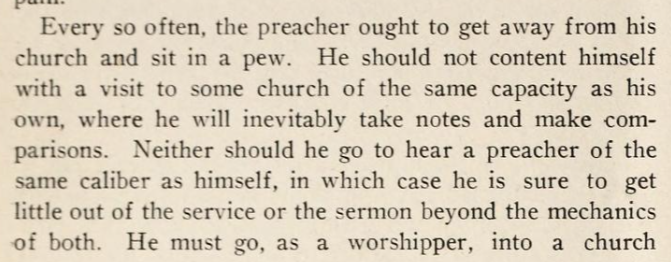
“Every so often, the preacher ought to get away from his church and sit in a pew. He should not content himself with a visit to some church of the same capacity as his own, where he will inevitably take notes and make comparisons. Neither should he go to hear a preacher of the same caliber as himself, in which case he is sure to get little out of the service or the sermon beyond the mechanics of both. He must go, as a worshipper, into a church equipped and manned so excellently that he will forget everything but his own soul, under the inspiration of the hour. His congregation at home should open the way for him to do this, not less than twice a year. They should not expect him to come back and report, either, on what he heard. He should do this for the sake of his own spiritual culture. Incidentally, the restoration of the joy of his own salvation will inevitably affect his preaching.
“If there was room for just one more movement – there is not; so let us have no further thought of that! – but if there was room for one more movement, perhaps it would be well to start something calculated to assist the preacher in the highly commendable business of cultivating his own soul. This is a live question! It would be interesting to learn of the various expedients to which busy ministers have resorted in their efforts to achieve spiritual culture. If we fail at this point, we fail fundamentally. If we never see or hear anything that inspires us, how may we expect to inspire others? If the light that is in us be darkness, how great is that darkness!”
A page from Lloyd C. Douglas, “Saving the Minister’s Soul,” The Christian Century, 4/14/1921.
[The following is from the article, “Saving the Minister’s Soul,” which Lloyd Douglas published in The Christian Century in the April 14, 1921, issue. He is speaking to fellow ministers about how they are kept so busy on their work that they have no time or opportunity to be inspired themselves. He writes of the busy pastor:]
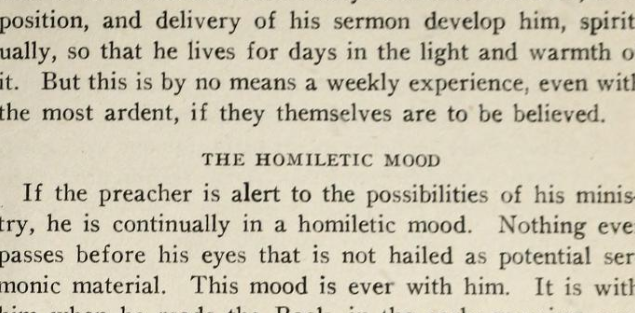
“If the preacher is alert to the possibilities of his ministry, he is continually in a homiletic mood. Nothing ever passes before his eyes that is not hailed as potential sermonic material. This mood is ever with him. It is with him when he reads the Book in the early morning, presumably for devotional reasons. It is very much on the job as he offers his prayers. And the better preacher he is, the more grave is the menace that his own spiritual life may be starved. He must contrive, somehow, to achieve soul-culture!
“Perhaps if he would make a resolution that one day of the week – Monday, say – he would refrain from assaying books, conversation, and natural phenomena with a view to their possible sermonic ore, reserving that day for his own private consumption, he might, after a while, consistently practice this habit.
“All America is afflicted with a psychosis which might be called ‘the busy bee.’ (Not the bee apis, but the bee bonnet.) Preachers have it about as badly as anybody. Worse than most. The good man is fearful that someone will think him idle, or of leisurely habits. He thinks he must be racing about, with wilted collar, either doing things or going through the motions of doing things, all the day long. When asked if he doesn’t reserve Monday as a rest day, he sighs and says, ‘Oh, dear, no! All days are alike to us! I’ve given up trying to save my Monday!’ He thinks this is as it should be.
“This is the gentleman who gets himself all excited telling his people that even practical, godless economics requires of mortals ‘one day’s rest in seven,’ and points to notable cases of nations that broke the rule and went heels-over-head to the bow-wows. Yes; everybody needs a rest-day but himself. Alas, poor man, he is too busy to knock off at all. Piffle! He can, and he must, make some provision for the salvation of his own soul. Let him name one day of the week to be sacred to the cultivation of his spirit.”
[Douglas will continue his essay in my next post…]
From Lloyd C. Douglas, “Wanted – A Congregation; Fifth Phase – Making Worship Worshipful,” in the 9/9/1920 issue of The Christian Century.
[The following is from the last installment of the series, “Wanted – A Congregation!” which Lloyd Douglas published in the Christian Century during the summer of 1920. This final essay is entitled, “Fifth Phase: Making Worship Worshipful,” and it was in the September 9th issue. Douglas is describing the new order of worship that Blue is going to institute at his church:]
“This paean of praise sweeps into a great crescendo, closing on a ‘seventh’ which is immediately followed by the dominant chord – the first syllable of ‘Praise God from Whom All Blessings Flow,’ in which everybody unites. Then the minister and the congregation sit down.
“Mr. Blue understands that his projected service of worship has now arrived at a very critical moment. Shall the doors be thrown open now, while the tardy tramp to their seats? It does not appear so. At this moment, the choir, without prelude or pause, bursts into its ‘praise anthem’ – ‘bursts’ because that is the way it must go into it! There must be no fussing for the place in the book, no tinkling introduction of a dozen measures; the choir must plunge into its praise anthem. And surely we have been richly endowed with such musical blessings! This should be one of the great events of the service – this anthem of praise. When it is done, the choir is seated. The service of worship – strictly speaking – is ended. Now let the tardy in, while the organist plays some incidental music, probably an improvisation of the score of the next hymn to be sung immediately before the sermon.
“Here follows the Scripture Reading, and after it the solo. Unless the solo is good, it should be left out. Until we can have inspiring solos, let us have none. Let us not permit our children to compare our church music with that of the moving-picture show, to our discredit. Then, the prayer.
“Blue has now arrived at the ‘announcements.’ Mentally he reviews the customary performance. Belated messages, turned in after the bulletin had gone to press, are now to be read: ‘The Ladies of Group Five have a very fine eggbeater for sale at the small price of Fifty Cents.’
“Here the preacher smiles foolishly and comments thereon. It is assumed, he says, that whenever Group Five – goodole Group Five – goes on the market with an eggbeater, it is some eggbeater – a veritable world-beater of an eggbeater, etc. (For shame!) He continues reading:
“‘These eggbeaters may be had from any member of Group Five or by telephoning Mrs. O. D. Liverus [Douglas means for us to pronounce this, “O deliver us!”] at her residence – number 9191-x.’
“It is this sort of drool from the pulpit that makes the intelligent and devout want to crawl under the seat, just through abject humiliation! But what is a man to do – Blue asks himself – when Mrs. O. D. Liverus comes down to the study before the service and hands me this note, saying, ‘I know I shouldn’t do this, but oh, Mr. Blue, Mr. Blue!’ Mr. Blue resolves that he will stand pat, hereafter, on his decision. ‘Positively no announcements will be read from the pulpit!’
“And suppose Mrs. Liverus gets angry! Well, it’s time the saints were getting over their touchiness. Christianity shouldn’t make people so edgy as all that. And when it does, there is something the matter with it.
“This brings us up to the church ‘offering.’ And, because the time is all gone, it brings us also to the close of this story. The writer hereby invites the editor to urge him to a chapter on ‘Church Finances’ – which is a live matter, and needs discussion.
“Oh, we’ll make a preacher out of this Blue fellow yet! For one thing, he is getting over his timidity. He has found out that he has a very important work to do and must not be influenced too much by traditions and customs, especially when said traditions and customs are bad.
“It is a red-letter day in the preacher’s experience when, after somebody has said, ‘Oh, but – Mis-ter B-loooo – we just nev-ver do it that way!’ he is able to reply, smilingly but confidently, ‘Oh, yes we do – from now on!’ There is excellent psychology in that. Instantly the preacher becomes worth more to that particular parishioner. Oh – there may be a little sulking; but it all comes out right in the end.
“It is a high spot in the discouraged preacher’s life when, after the choir director has looked over the projected order of worship and has remarked, ‘We simply cannot do it!’ – the minister is able to reply, ‘Well, we’re going to, nevertheless!'”
From Lloyd C. Douglas, “Wanted – A Congregation; Fifth Phase – Making Worship Worshipful,” in the 9/9/1920 issue of The Christian Century.
[The following is from the last installment of the series, “Wanted – A Congregation!” which Lloyd Douglas published in the Christian Century during the summer of 1920. This final essay is entitled, “Fifth Phase: Making Worship Worshipful,” and it was in the September 9th issue. Douglas is talking about the new order of worship that Blue is going to use in his church:]
“First, there was the invocation of God’s presence; then, the prayer that the people’s worship might be acceptable to Him. Now comes the minister’s ‘call to worship’ in the words:
“‘Seek ye the Lord while he may be found; call ye upon him while he is near. Let the wicked forsake his way and the unrighteous man his thoughts, and let him return unto the Lord, for he will have mercy; and to our God, for he will abundantly pardon.’
“During the reading of these words, the organ begins, with much feeling, but barely audible to the congregation, the beautiful score of Mendelssohn’s ‘If With All Your Hearts Ye Truly Seek Me.’
“And the congregation replies, reading from the printed order of worship on the bulletin, while the organ continues its accompaniment of the prayer for pardon, with slightly more volume:
“‘The sacrifices of God are a broken spirit; a broken and a contrite heart, O God, thou wilt not despise.’
“Following this plea for forgiveness and acknowledgement of pardon, the minister is to introduce the praise element in the words:
“‘O magnify the Lord with me and let us exalt his name together.’
“It is natural that the congregation should wish to reply:
“‘O come, let us sing unto the Lord. Let us make a joyful noise to the rock of our salvation.’
“By this time, the organ, suiting itself to the mood of praise, has been gaining in volume until the congregation is encouraged to read these words boldly, as becomes the text. And immediately the words are ended, the full choir breaks forth with a rendition of the passage:
“‘O give thanks unto the Lord, for he is good: for his kindness endureth forever. O come, let us worship and bow down; let us kneel before the Lord our Maker: for he is our God, and we are the people of his pasture and the sheep of his hand.’
From Lloyd C. Douglas, “Wanted – A Congregation; Fifth Phase – Making Worship Worshipful,” in the 9/9/1920 issue of The Christian Century.
[The following is from the last installment of the series, “Wanted – A Congregation!” which Lloyd Douglas published in the Christian Century during the summer of 1920. This final essay is entitled, “Fifth Phase: Making Worship Worshipful,” and it was in the September 9th issue. Douglas is talking about the Order or Worship, and he says, in reference to a male quartet:]
“To render this effectively will require a great deal of patient rehearsal by the quartet; but Blue knows that when these four men begin to realize the inspirational possibilities of this part of the service, they will gladly spend the time.
“You and I have a great deal to say about the wickedness of the stage, and doubtless there is even more that might be said on the same subject; but we should be ashamed when we remember that the stage is able to grip the public’s imagination because of the indefatigable zeal and patience with which the actors school themselves in their parts. Why, before a performance is actually presented, and during the last few days of rehearsal, these people toil for uninterrupted hours, pausing neither for meals nor sleep, that they may work together to produce the desired effect at certain psychological moments! And, sometimes, preachers go into the pulpit and try to read a hymn on the spur of the moment and bungle and fumble and haggle at it until the sensitive want to cry out in mingled pain and disgust. No less often, they do not know what the Scripture Lesson is to be until the opening hymn is being sung; and they get up and read it without any advance preparation whatsoever. More frequently, they haven’t the vaguest notion what the pastoral prayer is going to consider, or how it is going to consider it – a terra incognito, both as to form and content!
“Any preacher who in his practice of ophthalmology tries to remove the mote from the eye of the actor, while himself guilty of such blunders of indolence and indifference, had better desist until he is able to extract the two-by-four which interferes with his own vision. But that isn’t get on very fast with Blue’s new order of service, is it?”
[Douglas will continue his essay in my next post…]
From Lloyd C. Douglas, “Wanted – A Congregation; Fifth Phase – Making Worship Worshipful,” in the 9/9/1920 issue of The Christian Century.
[The following is from the last installment of the series, “Wanted – A Congregation!” which Lloyd Douglas published in the Christian Century during the summer of 1920. This final essay is entitled, “Fifth Phase: Making Worship Worshipful,” and it was in the September 9th issue. Douglas has just claimed that “non-conformist” churches have gotten too far away from beauty in their worship services, and he acknowledges that any attempt at making worship beautiful again might lead to the accusation of being “mystical.” He continues:]
“Yet this problem must be solved somehow. ‘Evolutionary momentum’ has been at work again. The service became so ornate that it met disaster and made an open bid for gross paganism four hundred years ago. Now it has become so denuded of its beauty that its stark ugliness repels. We preachers have become dreadfully poor psychologists. There is an instinctive heart-hunger for the mystical in worship that we have been unable to satisfy with our crude, bungling attempts at ritual and the rasping dissonances of the alleged music rendered by our untrained choirs. There has been entirely too much extemporaneous and ill-considered matter introduced into our ‘services of worship.’ Our ‘free’ pulpit prayers, for example, have been so very free that they jar unpleasantly on the sensitive ear of the naturally devout. Indeed, our public prayers are filled with impertinences that are only saved from being blasphemous by the fact that we know not what we do. We pick up disgusting tricks of addressing The Absolute in terms of a contemptuous familiarity. How often one hears preachers mouthing that raucous phrase whose vogue the reverential fail to comprehend, ‘Now, Lord, just send us’ – whatever-it-is – in the same inflection one uses when telephoning the butcher, ‘Now, Sam, just send us a few lean pork chops, this time, can’t you? No; no sausage today, thank you. Yes, that will be all, Sam. Thanks very much!’
“Now, this will not do! Some of us have been wondering what is the matter with our churches, and some of us have been berating the generation for its godlessness. Many of us may find, upon investigation, that we have disgusted our potential constituency with our unwitting want of reverence. Many a sensitive man would greatly prefer to take a book of essays with him to a shady bend in the river on Sunday morning than attend our church, whereas his whole soul cries out for a much closer contact with the divine than he can achieve by his communion with nature. But – it is a great deal better for that man’s spiritual welfare that he should go out Sunday morning and watch the river than to go to some church where the music is so ugly it positively frightens one, and the preacher talks to the Great Unseen as if he were chaffing with his next-door neighbor over the back fence. Let it be repeated: This will not do! We who have been committing these serious blunders must mend our ways!”
From Lloyd C. Douglas, “Wanted – A Congregation; Fifth Phase – Making Worship Worshipful,” in the 9/9/1920 issue of The Christian Century.
[The following is from the last installment of the series, “Wanted – A Congregation!” which Lloyd Douglas published in the Christian Century during the summer of 1920. This final essay is entitled, “Fifth Phase: Making Worship Worshipful,” and it was in the September 9th issue. Douglas has just said that the problem with most churches is that they ignored “the ‘incurably’ religious passion in men’s hearts for a beautiful, reverential, dignified and consistent means of church worship.” He goes on to explain:]
“There is a curious phenomenon in nature known to biology as ‘evolutionary momentum.’ A certain animal develops a tusk or a horn or a set of spines, for purpose of defense. By natural selection, only such members of the species survive as are best equipped with the peculiar protection. But, after an interminable length of time, this thing upon which the animal’s ancestors had relied for defense has so increased in length and weight that it becomes a serious menace. After that – Nemesis! By a process of ‘evolutionary momentum,’ the weapon becomes the machinery of his defeat who carries it. What was once a safeguard becomes a shackle. The virtue becomes a vice.
“When our forefathers repudiated the Vatican, they decided to pitch out of the church everything that was loose at both ends. True, many a dingy old tenet which might have been more honored by the breach than the observance was permitted to remain – but everything that had any color, form, or beauty was enrolled on Protestantism’s index expurgatorius. Gradually, the service of worship was denuded of its vestments, its historic symbolism, its awesome solemnities, its majestic music, its stately grandeur, its subtle appeal to the mystical quality of the human mind.
“Doubtless the whole business of ceremonialism and symbolism had been grossly exaggerated. One suspects that it was this overdevelopment of the ritual that had as much as anything to do with the great protest which sent such a flock of awkward fledglings fluttering out of the old nest. It was a typical case of ‘evolutionary momentum.’ Generation after generation, these embellishments had been added to the service of worship until the accretion of ornate rites toppled of its own weight. Thereupon, new tendencies arose, pledged to have no more of such nonsense. They kept the faith. At this point, they kept the faith!
“Our so-called ‘service of worship,’ in such churches as employ you and me to serve as their pastors, surely ought to satisfy the most exacting of our colonial fathers who had come to hate the sights, sounds, and scents of ritualistic worship. It is only rarely that the service of worship in a ‘non-conformist’ church excites a feeling of reverence. To be sure, many churches have not failed here. I am just talking about your church and mine. We know very well that our ‘service of worship’ needs the breath of life put into it! But how are we going to manage it without being accused of ‘mysticism’ or something else a very great deal worse?”
[Douglas’s essay will be continued in my next post…]
From Lloyd C. Douglas, “Wanted – A Congregation; Fifth Phase – Making Worship Worshipful,” in the 9/9/1920 issue of The Christian Century.
[The following is from the last installment of the series, “Wanted – A Congregation!” which Lloyd Douglas published in the Christian Century during the summer of 1920. This final essay is entitled, “Fifth Phase: Making Worship Worshipful,” and it was in the September 9th issue. There is a rumor that something is ailing the Church, Douglas says. He continues:]
“Regarded specifically, it is true that many churches have been unable to present a very attractive portrait of his life and love who spoke of a social commonwealth of souls in that gripping phrase – ‘The Kingdom.’ Possibly such failures may be traced to a large number of causes. At least three of these causes stand out rather prominently. One type of failure may easily be accounted for on the ground of an overemphasis upon some minor point of doctrine which has been permitted to grow so huge as to drain the very life of the cultus that produced it – like a monstrous sarcoma. It may have gone in for feet-washing as a necessary and important ceremonial rite, for example. At first, this performance may have had some real symbolic beauty – though the imagination of the writer is far too sluggish to understand what beauty could ever have been thus expressed to the occidental mind; he merely assumes that such may have been the case, at first. But once the ceremony had lost its pristine spontaneity, it must have become a heavy load to carry. The sect could not relax its grip upon its burden, however. What it had written, it had written! Presently, so far as that body of believers is concerned, there is nothing much to Christianity except to get one’s feet washed, and so large a volume of effort is required for the persistence of this rite that there is very little energy left for the main task. It is the old case of the tail wagging the dog. It is also like the steamboat of Lincoln’s story that had a ten-foot boiler and a twelve-foot whistle. Every time it whistled, it stopped. I fancy that the sacrament of feet-washing is now nearly enough passe to be safely mentioned as a case in point to cover a great many similar pathological conditions still present with us. Such deflections from the main task of the church account for part of her present discomfiture.
“A second type of failure may be explained on the ground of an untrained and ineffective leadership in the pulpit. No church can get on very well or for a very long time which willfully does violence to human intelligence. To endure, a church must be able to command the respect of thoughtful people. But this is a truism requiring no argument; at least not in this presence.
“The third and by far the most prevalent type of failure may be accounted for on the ground that the churches of this order have almost completely ignored the ‘incurably’ religious passion in men’s hearts for a beautiful, reverential, dignified and consistent means of church worship.”
From Lloyd C. Douglas, “Wanted—A Congregation, Fourth Phase—The Service of Worship,” in The Christian Century, 9/2/1920.
[The following is from the fourth installment in Lloyd Douglas’s series, “Wanted—A Congregation!” in the summer and fall of 1920. This installment, dated 9/2/1920, is titled, “Fourth Phase—The Service of Worship.” The series is about the Reverend D. Preston Blue, who is on a campaign to enlarge his congregation. This episode takes place after he has begun to succeed in building his audience. Douglas explains why it is necessary for latecomers not to be admitted during the ritualistic part of the service.]
“It is entirely unnecessary that there should be a steady tramp, tramp, tramp down the aisles during this impressive moment. The public does not value Christianity the more highly for being permitted to treat a church service with less respect than it is obliged to manifest in a playhouse. Therein lies one of the chief difficulties with the Protestant churches of America. They have consistently believed and practiced a series of logical fallacies with reference to the public mind.
“They have lacked the wisdom to understand that people are not especially attracted to any institution which they are permitted to treat disrespectfully. Not infrequently during the organ prelude, ‘dear old Brother Smithers’ snuggles up beside ‘dear old Major Welickedem’ and chatters audibly, to the annoyance of everybody within a range of fifty yards. Where else but in a Protestant church would such an absolutely unnecessary disturbance be tolerated? Not in the theater, surely. Nor at a concert. And why must the church put up with such annoyances? Oh, because it has consistently permitted almost any sort of a nuisance to nullify whatever opportunities were presented for an orderly, inspirational service of worship! But – someone exclaims – what is one to do? One must go to dear old Brother Smithers and tell him to cut it out. It can be said gently, tactfully, purringly – but it should be said. If the dear old fellow becomes incensed and withdraws to some other church, it will be a great deal better for his own soul than if he stayed where he was and habitually made a nuisance of himself. For, in church Number Two, he will not talk during the service, remembering what had happened at Number One.
“There must be no crying babies, shrieking all through the otherwise impressive moments of the service! Nowhere else but in a Protestant church would such an annoyance be permitted for a moment! What shall we do? We must tell the young mother that she is to be excused from her church duties until her baby is old enough to be placed in the church kindergarten where all small children are to be during the church service.
“You wonder why some of the finest, most earnest, most philanthropic people in your town are not in church on Sundays? Provide a service that appeals to the heart and is uninterrupted by petty annoyances which destroy every possibility for a reverential worship, and let it be known that you mean to have such a service every Sunday – and you may notice a change!
“No, sir; when the time comes in the service where silence is the order, close the doors, shut off the tramp of the tardy and the chatter of the thoughtless, and have silence!
“If some belated brother and his wife become offended because they are obliged to wait a few minutes in the vestibule, that is sufficient proof that the church, with its old way of doing things, hasn’t done very much for their souls, and it is high time something was tried! And if they get so angry they resolve never to come back, and go away and tell it all over the lot that they went to their dear old church, where their dear old fathers and mothers had been wont to come straggling down the aisle almost any time between ten-forty-three and eleven-thirty-five, and, bless you, weren’t permitted to go to their own seat just because their fool preacher had suddenly developed a crazy notion that the doors were to be closed through the opening service – well – what of that? Is that going to put the church out of business? Indeed, it is the very choicest advertising. No church would be able to purchase or devise a finer publicity medium than about half a dozen loquacious ex-members who had gone forth to spread the report that their church had gone in for a strict practice of reverence. Such a campaign is sure to bring out a select lot of splendid souls who will come next Sunday to see if, perchance, there is that something in your service for which they had sought, eagerly and in vain.”
[In my next post, I’ll tell you about Douglas’s fifth and final article in the series, “Wanted – A Congregation.”]
From Lloyd C. Douglas, “Wanted—A Congregation, Fourth Phase—The Service of Worship,” in The Christian Century, 9/2/1920.
[The following is from the fourth installment in Lloyd Douglas’s series, “Wanted—A Congregation!” in the summer and fall of 1920. This installment, dated 9/2/1920, is titled, “Fourth Phase—The Service of Worship.” The series is about the Reverend D. Preston Blue, who is on a campaign to enlarge his congregation. This episode takes place after he has begun to succeed in building his audience. He is explaining to his wife how he intends to improve the order of worship.]
“‘Now,’ said Blue, ‘the ritualistic service of worship begins. I don’t believe that we had better fumble around in the back of the book anymore for a responsive reading. We’ll print it in the bulletin, and let it make up in power whatever it lacks in former length. Anyway, these ‘readings’ in the back of the book weren’t built correctly. Most of them are too long, and too full of local color about the Jews.’
“The preacher smiled as he repeated a few of these passages for the edification of his wife. ‘What good does it do a crowd of able-bodied citizens of the United States in 1920 to stand up and read together about brotherhood being “like the precious oil upon the head; like the dew of Hermon,” or that purely parochial remark of an ancient people, “Before Ephraim, Benjamin, and Manasseh, stir up thy might.” And what possible benefit can accrue to anybody by reading aloud so misleading a passage as, “For we are consumed by thine anger, and by thy wrath are we troubled”? And so many of them have a curious trick of ending on an awkward phrase like, “Yes, the work of our hands, establish Thou it” – leaving one with the uncomfortable feeling of having come off and forgotten something, until the next event of the service mercifully blots the dissonance out of mind. No; we will not go to the back of the hymnal anymore – at least not until we can do so with better effect than is now in sight.
“‘After that first hymn, there is going to be a moment of silence – an impressive silence! The auditorium doors will be closed. The ushers will seat no more latecomers until the ritualistic service is concluded. The service isn’t operated for the sole purpose of accommodating the tardy anyway. If they will come late, they can do exactly as at the orchestral concert or the theater – wait until there is an intermission.’


 The Lloyd C Douglas Page