Remembering the life and work of the bestselling novelist
Author: Ronald R Johnson
I am a Christian author and philosophy professor who speaks and writes about everyday spirituality. I also write funny, suspenseful novels that aren't philosophical or religious... or are they? Learn more at www.ronaldrjohnson.com.
A page from Lloyd C. Douglas, “Saving the Minister’s Soul,” The Christian Century, 4/14/1921.
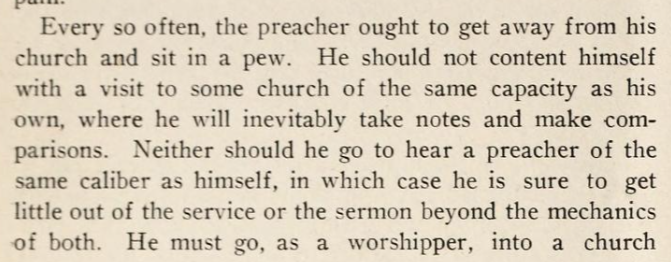
[The following is the conclusion of the article, “Saving the Minister’s Soul,” which Lloyd Douglas published in The Christian Century in the April 14, 1921, issue. He is speaking to fellow ministers about ways that they can find inspiration, despite their busy schedules. He writes:]
“Every so often, the preacher ought to get away from his church and sit in a pew. He should not content himself with a visit to some church of the same capacity as his own, where he will inevitably take notes and make comparisons. Neither should he go to hear a preacher of the same caliber as himself, in which case he is sure to get little out of the service or the sermon beyond the mechanics of both. He must go, as a worshipper, into a church equipped and manned so excellently that he will forget everything but his own soul, under the inspiration of the hour. His congregation at home should open the way for him to do this, not less than twice a year. They should not expect him to come back and report, either, on what he heard. He should do this for the sake of his own spiritual culture. Incidentally, the restoration of the joy of his own salvation will inevitably affect his preaching.
“If there was room for just one more movement – there is not; so let us have no further thought of that! – but if there was room for one more movement, perhaps it would be well to start something calculated to assist the preacher in the highly commendable business of cultivating his own soul. This is a live question! It would be interesting to learn of the various expedients to which busy ministers have resorted in their efforts to achieve spiritual culture. If we fail at this point, we fail fundamentally. If we never see or hear anything that inspires us, how may we expect to inspire others? If the light that is in us be darkness, how great is that darkness!”
A page from Lloyd C. Douglas, “Saving the Minister’s Soul,” The Christian Century, 4/14/1921.
[The following is from the article, “Saving the Minister’s Soul,” which Lloyd Douglas published in The Christian Century in the April 14, 1921, issue. He is speaking to his fellow ministers about how they can find inspiration even in their busy lives. He writes:]
“In every congregation, there are a few elderly folk who are living on the income of spiritual capital amassed in days before we became too busy to take counsel of our hearts. I used to know a little old lady who was blind; that is, her physical organs of sight were not functioning. The eyes of her soul were very keen. I looked forward with keen delight to the next visit in her humble home. She always expressed gratitude that the minister called so frequently and stayed a while; but I never brought her anything to be compared with the treasures I carried away. Some of these fine old saints are prepared to do great things for us if we approach them properly. How often we rush in, pat them on the shoulder, tell them what a whale of a sermon we preached last Sunday, wish them well, and run away – tatting up another good deed done to ‘the sick and imprisoned’ – when, by sitting quietly at their feet and encouraging them to do the talking, we might have come away with a fresh sense of the glory of the human spirit and the desirableness of a life that is ‘hid with Christ in God.’
“If we only stopped long enough to think about it, the bereaved have rich treasures for us of an inspirational character. How little we make use of them, for our own good, in the moments when grief has fairly transfigured their lives! How we do imagine that we must, ourselves, do all the talking, apparently never dreaming that it is our business, at such times, to stand with bowed head and expectant heart, waiting for a message lifted up on the wings of pain.”
[Douglas will continue his essay in my next post…]
A page from Lloyd C. Douglas, “Saving the Minister’s Soul,” The Christian Century, 4/14/1921.
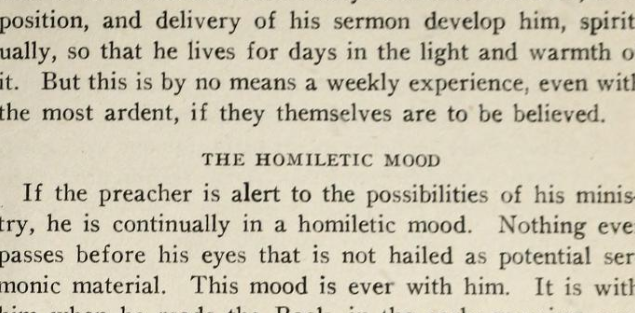
[The following is from the article, “Saving the Minister’s Soul,” which Lloyd Douglas published in The Christian Century in the April 14, 1921, issue. He is speaking to fellow ministers about how they are kept so busy on their work that they have no time or opportunity to be inspired themselves. He writes of the busy pastor:]
“If the preacher is alert to the possibilities of his ministry, he is continually in a homiletic mood. Nothing ever passes before his eyes that is not hailed as potential sermonic material. This mood is ever with him. It is with him when he reads the Book in the early morning, presumably for devotional reasons. It is very much on the job as he offers his prayers. And the better preacher he is, the more grave is the menace that his own spiritual life may be starved. He must contrive, somehow, to achieve soul-culture!
“Perhaps if he would make a resolution that one day of the week – Monday, say – he would refrain from assaying books, conversation, and natural phenomena with a view to their possible sermonic ore, reserving that day for his own private consumption, he might, after a while, consistently practice this habit.
“All America is afflicted with a psychosis which might be called ‘the busy bee.’ (Not the bee apis, but the bee bonnet.) Preachers have it about as badly as anybody. Worse than most. The good man is fearful that someone will think him idle, or of leisurely habits. He thinks he must be racing about, with wilted collar, either doing things or going through the motions of doing things, all the day long. When asked if he doesn’t reserve Monday as a rest day, he sighs and says, ‘Oh, dear, no! All days are alike to us! I’ve given up trying to save my Monday!’ He thinks this is as it should be.
“This is the gentleman who gets himself all excited telling his people that even practical, godless economics requires of mortals ‘one day’s rest in seven,’ and points to notable cases of nations that broke the rule and went heels-over-head to the bow-wows. Yes; everybody needs a rest-day but himself. Alas, poor man, he is too busy to knock off at all. Piffle! He can, and he must, make some provision for the salvation of his own soul. Let him name one day of the week to be sacred to the cultivation of his spirit.”
[Douglas will continue his essay in my next post…]
A page from Lloyd C. Douglas, “Saving the Minister’s Soul,” The Christian Century, 4/14/1921.
[The following is from the article, “Saving the Minister’s Soul,” which Lloyd Douglas published in The Christian Century in the April 14, 1921, issue. He is speaking to his fellow ministers about how they are kept so busy on their work that they have no time or opportunity to be inspired themselves. He writes of the busy pastor:]
“Increasingly has he become enslaved to all the church machinery bequeathed to him by energetic predecessors, plus all the modern conveniences which he himself has installed, in the way of organizations, ‘to assist him in his work.’ Sometimes, when he sits down for a moment before the grate to catch his breath from the exacting labors of the day and contemplates that he must now hurry to the church, with all speed, to meet the executive committee of the Sunny Sons of Something-or-Other – knowing full well that he must adroitly suggest the business to come before the body, hypnotize some Sunny Son into making a motion and another into the act of supporting it and all of them into passing it; and that the outcome of the event will be a smilingly unanimous resolution empowering him to go out, single-handedly, and do whatever it was that he might have done at one-tenth the time and bother without supervising these parliamentary calisthenics – he wonders whether he hasn’t fed both hands, up to the very shoulders, into the rapacious maw of his own machine!
“But it is quite too late to remedy much of this. He has made his bed, and now he must lie in it. He has surrounded himself with cabinets, bureaus, commissions, principalities and powers – The Tri-Mu Fraternity, The Best-You-Can-Do Club, The Merry Matrons, and the Over-the-Tops – from which he may no more readily disengage himself than a mid-August fly with all six legs knee-deep in stickemfast.
“Thus engaged, weekdays, in parish and community duties which leave but little time unmortgaged, the good man is really in as serious need of spiritual rejuvenation on Sunday, the day of rest, as the most jaded beast of burden who appears before him at that time in the sanctuary. But – may he not derive much spiritual uplift from his own sermons? – someone pertinently inquires. Well, let us look into that for a moment.
“Sermon manufacture is a business. It is not exactly the same kind of business as selling gingham, shingling a roof, digging a sewer, or excising a tumor; but it is a business, and if the preacher doesn’t make a business of it his days will not be long in the land as a preacher. It is not an unusual experience for a minister to be so aflame with his subject that the research, composition, and delivery of his sermon develop him spiritually, so that he lives for days in the light and warmth of it. But this is by no means a weekly experience, even with the most ardent, if they themselves are to be believed.”
[Douglas will continue his essay in my next post…]
A page from Lloyd C. Douglas, “Saving the Minister’s Soul,” The Christian Century, 4/14/1921.
[The following is from the article, “Saving the Minister’s Soul,” which Lloyd Douglas published in The Christian Century in the April 14, 1921, issue. He is speaking to fellow ministers about how they never get to hear any sermons other than their own. He has just described a typical conference of ministers, in which nuts-and-bolts presentations and requests for money predominate. He writes:]
“If this matter has been overstated, the exaggeration may easily be pointed out and denied by fellow-craftsmen who have failed to observe that the end and aim of most of our ‘inspirational’ conference addresses is fiscal rather than cardiac. One must never forget – and one isn’t at all likely to be permitted to forget – that it takes money, and lots of it, to operate the kingdom, as modernly constituted; but it also takes something else that money cannot buy. It is of this somewhat [in]tangible but highly important ‘something else’ that we need to think seriously these days.
“In the course of his daily activities, the preacher – commonly and erroneously presumed to possess singular opportunities for the culture of his own soul – is almost as beset with secular duties as the busiest man of affairs in his congregation. No cloistral seclusion is permitted him, and it is uncertain he would avail himself of such insular protection were it offered. The nature of his ministerial labors has altered so completely within the past two decades that he is no longer in the mood for that peculiar type of spiritual culture which distinguished our predecessors of a generation past. The modern minister gets little opportunity to develop what our elders used to call ‘piety,’ and so infatuated has he become with the newer features of his business that the very term ‘piety’ is not the most popular word in his working vocabulary. He shies off, uncomfortably, when he meets it, suspecting it of distasteful designs upon the length of his countenance and the manner of his speech or dress.”
[Douglas will continue his essay in my next post…]
A page from Lloyd C. Douglas, “Saving the Minister’s Soul,” The Christian Century, 4/14/1921.
[The following is from the article, “Saving the Minister’s Soul,” which Lloyd Douglas published in The Christian Century in the April 14, 1921, issue. He is speaking to fellow ministers about how they never get to hear any sermons other than their own. He writes:]
“Occasionally we attend conferences with our fellow ministers and selected groups of devout laymen; but there the program consists mostly of the mere buttons-and-pins of church methods, the discussion of administrative problems, and consideration of workaday statistical reports. Not infrequently it turns out the that promised ‘inspirational address’ with which the conference was to reach its ennobling climax deftly maneuvers its way from the pulpit to the receipt of custom, where it attains to such magnificence of appeal that the baskets are passed again – this time in the interest of some undeniably worthy cause that had come ‘to the parting of the ways,’ and was ‘facing an hour of crisis,’ and ‘now throws down an heroic challenge to the sacrificial courage of the red-blooded!’ And so forth. Ad lib.
“But even this drench of distress on behalf of an excellent movement, involving the re-reconstruction of the preacher’s puny purse to the jeopardized philanthropy, does very little to assuage his heart-hunger for spiritual nourishment. To be sure, the traveling secretary of the bankrupt board tells him that the most effective spiritual tonic known to the profession is self-administered by the act of turning one’s pockets wrongsideout; but the preacher, however salutary may be the moral results of charity, or sweet the uses of adversity, still longs for some genuine inspiration, just once, that doesn’t find its ultimate goal in his jeans.”
[Douglas will continue his essay in my next post…]
A page from Lloyd C. Douglas, “Saving the Minister’s Soul,” The Christian Century, 4/14/1921.
[The following is from the article, “Saving the Minister’s Soul,” which Lloyd Douglas published in The Christian Century in the April 14, 1921, issue. He is speaking to his fellow ministers. He writes:]
“Our profession seems pretty thoroughly committed to the belief that hearing the gospel preached week after week is so excellent a safeguard and stimulus to correct living that public morality is greatly influenced by the Christian pulpit. Sometimes the doubt is expressed that people who habitually deny themselves the moral and spiritual uplift from the pulpit may order their lives as becomes good Christian citizens. If this proposition has a leg to stand on, what is to become of us who never have a chance to hear the gospel preached, except as we ourselves interpret it, from one year’s end to the next?
“It is not the object of this writing to imply that preachers, as a class, are misbehaving themselves; for such is not the case. Although our ministerial ordination guarantees no immunity against the common weaknesses of mankind, the public expects us to exhibit a high-grade morality. That this demand has been met in a manner fairly satisfactory is evident from the respect generally accorded the clergy as leaders in the moral life of their communities. Once in a while, we are rasped to spluttering indignation over the front-page prominence given to the story of a moral lapse committed by some weak brother whose name had never meant anything until it had contrived to associate itself with odium; but, if we only stop to reason, this is a sort of awkward, left-handed compliment to our vocation. It means that ministers habitually carry themselves with such circumspection that a mistake on the part of any one of them, however obscure, deserves to be played up as sensational news. Were such delinquencies frequent, they would not startle the public; neither would they earn widespread advertisement.
“But it is not the purpose of this paper to discuss the preacher’s morals so much as to inquire somewhat concerning the means at hand for the conservation and development of his spiritual capacities and aspirations. As for the majority of us, we rarely have a chance to hear anything that inspires us to higher thinking or nobler action. Such advices are customarily offered on the first day of the week, at a time when we ourselves are busy with our well-meant, though sometimes ineffective, endeavors to build up a stronger consciousness of human-divine contacts in the souls of our parishioners. We are simply agents and jobbers of spirituality, ourselves menaced with spiritual insolvency due to lack of inspirational income plus a steady drain of expense at that point; starved in the very process of retailing to the ultimate consumer the finest provisions we can lay hands upon – sometimes blissfully unconscious of the pernicious anemia that has sapped our spiritual vigor.”
[Douglas will continue his essay in my next post…]
The title page of Lloyd C. Douglas, “Saving the Minister’s Soul,” The Christian Century, 4/14/1921.
[The following is from an article Lloyd Douglas published in The Christian Century on April 14, 1921, under the title, “Saving the Minister’s Soul.” He writes:]
“So steady a character as the Tarsan [St. Paul] once candidly admitted that, having preached to others, it was by no means certain he himself might not become a castaway. These were brave words coming from the self-confessed pioneer of an exalted moral code engaged in its first struggles to gain a following. It would have been easy for Paul to say to his congregation, ‘I have discovered two forces at work in you – virtue and vice; so inextricably mixed that, even when you would do good, evil is present!’ It was quite another matter when he declared, ‘I find two laws within me – a law of my mind and a law of my members, and these two laws at war; o wretched man that I am!’
“The present-day preacher who would thus phrase repentance in the first person singular might give his congregation an uneasy moment for fear he was about to make some startling disclosure of moral turpitude. It is considered much more becoming in him to speak of sinfulness in the third person; or, at most, in the second person. It is assumed that he himself bears a charmed reputation and inviolate character, safe as Caesar’s wife from the ordinary frailties of the race.”
[Douglas will continue his essay in my next post…]
An excerpt from “The Bread Problem,” an editorial in the February 17, 1921, issue of The Christian Century, written anonymously by Lloyd C. Douglas.
[This is the conclusion of an editorial, “The Bread Problem,” which Douglas wrote without a by-line for The Christian Century’s February 17, 1921, issue. After briefly surveying the problem of hunger in the aftermath of the First World War, he narrated Christ’s first temptation in the wilderness, to make bread out of stones. He writes:]
“From that scene in the Jeshimon Wilderness, Anno Domini 30, let us return and take another glance at what we have before us in the early spring of 1921. Exactly how did our world get into its present miseries? We say that is an economic question. But is it? Well – say that the immediate cause of it was the war. Well – how did the world get itself head-over-ears in war? By walking in the ways of righteousness and brotherhood? By efforts at spiritual culture? By reliance upon his guidance who continually endeavors to attract our attention to the truth about human relationships? No; we got into war – the whole brood of nations – excusing nobody, laying the blame at every door impartially – through indifference to the cultivation of those principles which Jesus said would make for permanent peace!
“Even now – with so ghastly and complete a demonstration of the fact that war solves no problems whatsoever; that war not only wastes while it is waged but leaves a slimy trail behind it through uncounted years – there are plenty of us advocating more costly armies, more big gunboats, more deadly poison gas! In all the welter and wreckage – face to face with the problem of the world’s starvation – still – still – ‘armi virumque cano!’ [‘I sing of arms and men’: the opening line of Virgil’s Aeneid.]
“Fully satisfied that organized greed and diabolical selfishness have not only foisted war upon the world, time after time, but have stood by to loot the pockets of its victims while they went forth hypnotized to death by appeals to their patriotism, still do we sit, complacently, declaring that the world’s chief difficulty is ‘a problem in economics.’ Economics? Nonsense! The world’s problem, today, is a spiritual problem! Humanity’s soul must be saved!
“What may we do about it? There is much that we can do. We can turn the searchlight in upon ourselves to see how far we, as individuals, are menaced by this temptation to believe that our own problems are questions in economics! Do I live by bread alone? What inspired to my choice of a life work – bread alone? For what reasons have I gathered friends about me – that they may use me, or I them? Have I cultivated them for bread alone? Is success, to my thinking, the sort of thing that has cornered some market; stacked up corn in warehouses against years of idleness; nailed down natural resources to make them inaccessible to other hands as fully entitled to them as myself?
“We do well who, through these Lenten days, assay the ore of our own characters and assist other people to test the quality of their motives to see if, perchance, we who have talked so volubly and knowingly of humanity’s great needs – the causes of its distress; the reasons of its hunger – may not be housing and arming the forces which make these problems more and more acute and perplexing.
“The Master found the complex problem of the world a simple spiritual problem at its root. Taking counsel of the God in his own heart, he found that man does not live by bread alone, but by the discernment and acceptance of his will who ‘standeth behind our lattice, keeping watch over his own.'”
[This last sentence was probably a quotation from memory (and therefore not quite accurately) of a line from James Russell Lowell’s 1845 poem, “The Present Crisis.” The poet complains of:
“Truth forever on the scaffold, Wrong forever on the throne,— Yet that scaffold sways the future, and, behind the dim unknown, Standeth God within the shadow, keeping watch above his own.”
This same poem contains the all-important line, “New occasions teach new duties; Time makes ancient good uncouth.” Douglas would quote that line repeatedly throughout the 1940s, very much aware that it was necessary to stop Hitler’s armies, despite everything he said in this 1921 editorial.]
An excerpt from “The Bread Problem,” an editorial in the February 17, 1921, issue of The Christian Century, written anonymously by Lloyd C. Douglas.
[The following is from an uncredited editorial that Lloyd Douglas wrote for The Christian Century under the heading, “The Bread Problem,” which appeared in the February 17, 1921, issue. He has just finished talking about world hunger following the aftermath of the First World War. He writes:]
“In this penitential period of 1921, we turn naturally to the story of our Lord’s temptation which provides a reason and a setting for this Lenten season. And we find, to our surprise, that the ancient narrative is vital, vascular, directly apropos of our present anxiety.
“The temptation followed the baptism immediately. Rising from the water, bearing in his soul heaven’s confirmation of his messiahship, Jesus went into the wilderness. Apparently he felt that he was not ready to face the crowd whom John had astonished with the announcement that the Messiah was among them, or any crowd, until he had struggled further through the problems vexing the world he had come to save.
“The first question thrust into the active consciousness of the young Galilean, after his voluntary exile into the wilderness, was essentially this: ‘What do men live by?’ At the moment, he was able to answer the question promptly, decisively. So far as he was concerned, the greatest thing in the world was bread! Because he happened to be hungry, the world’s problem seemed to be a clear case of economics! The cry of his people and the call of his own appetite united to tempt him to command the very stones at his feet to be transformed into bread!
“We need not debate whether this narrative is wholly, or in part, allegorical. Of course, we are fully conscious of our power to turn stones into bread – at least so long as the saltpeter beds of Chili continue to provide our wheat fields with the nourishment that makes them productive. [Douglas is referring to fertilizer.] If we are minded to let the Master have the power to do the same, by processes unknown to any but himself, there is no reason why he should be deterred from it by our lack of faith. If anyone sees it simply as an allegory, the lesson still stands inviolate. Those who cannot help viewing it this way rightly resent the charge that they fail to catch the point of the story.
“The point at issue was this: Is humanity’s problem a question in economics? Jesus thought it through and decided in the negative. Man does not live by bread alone. Man lives through his discovery and acceptance of the will of God.
“From that scene in the Jeshimon Wilderness, Anno Domini 30, let us return and take another glance at what we have before us in the early spring of 1921.”
[Douglas will continue his editorial in my next post…]