The Bread Problem, Part 3

by Ronald R Johnson

An excerpt from “The Bread Problem,” an editorial in the February 17, 1921, issue of The Christian Century, written anonymously by Lloyd C. Douglas.

[This is the conclusion of an editorial, “The Bread Problem,” which Douglas wrote without a by-line for The Christian Century’s February 17, 1921, issue. After briefly surveying the problem of hunger in the aftermath of the First World War, he narrated Christ’s first temptation in the wilderness, to make bread out of stones. He writes:]

“From that scene in the Jeshimon Wilderness, Anno Domini 30, let us return and take another glance at what we have before us in the early spring of 1921. Exactly how did our world get into its present miseries? We say that is an economic question. But is it? Well – say that the immediate cause of it was the war. Well – how did the world get itself head-over-ears in war? By walking in the ways of righteousness and brotherhood? By efforts at spiritual culture? By reliance upon his guidance who continually endeavors to attract our attention to the truth about human relationships? No; we got into war – the whole brood of nations – excusing nobody, laying the blame at every door impartially – through indifference to the cultivation of those principles which Jesus said would make for permanent peace!

“Even now – with so ghastly and complete a demonstration of the fact that war solves no problems whatsoever; that war not only wastes while it is waged but leaves a slimy trail behind it through uncounted years – there are plenty of us advocating more costly armies, more big gunboats, more deadly poison gas! In all the welter and wreckage – face to face with the problem of the world’s starvation – still – still – ‘armi virumque cano!’ [‘I sing of arms and men’: the opening line of Virgil’s Aeneid.]

“Fully satisfied that organized greed and diabolical selfishness have not only foisted war upon the world, time after time, but have stood by to loot the pockets of its victims while they went forth hypnotized to death by appeals to their patriotism, still do we sit, complacently, declaring that the world’s chief difficulty is ‘a problem in economics.’ Economics? Nonsense! The world’s problem, today, is a spiritual problem! Humanity’s soul must be saved!

“What may we do about it? There is much that we can do. We can turn the searchlight in upon ourselves to see how far we, as individuals, are menaced by this temptation to believe that our own problems are questions in economics! Do I live by bread alone? What inspired to my choice of a life work – bread alone? For what reasons have I gathered friends about me – that they may use me, or I them? Have I cultivated them for bread alone? Is success, to my thinking, the sort of thing that has cornered some market; stacked up corn in warehouses against years of idleness; nailed down natural resources to make them inaccessible to other hands as fully entitled to them as myself?

“We do well who, through these Lenten days, assay the ore of our own characters and assist other people to test the quality of their motives to see if, perchance, we who have talked so volubly and knowingly of humanity’s great needs – the causes of its distress; the reasons of its hunger – may not be housing and arming the forces which make these problems more and more acute and perplexing.

“The Master found the complex problem of the world a simple spiritual problem at its root. Taking counsel of the God in his own heart, he found that man does not live by bread alone, but by the discernment and acceptance of his will who ‘standeth behind our lattice, keeping watch over his own.'”

[This last sentence was probably a quotation from memory (and therefore not quite accurately) of a line from James Russell Lowell’s 1845 poem, “The Present Crisis.” The poet complains of:

“Truth forever on the scaffold, Wrong forever on the throne,—
Yet that scaffold sways the future, and, behind the dim unknown,
Standeth God within the shadow, keeping watch above his own.”

This same poem contains the all-important line, “New occasions teach new duties; Time makes ancient good uncouth.” Douglas would quote that line repeatedly throughout the 1940s, very much aware that it was necessary to stop Hitler’s armies, despite everything he said in this 1921 editorial.]

What About Lent? Part 7

by Ronald R Johnson

A page from Lloyd C. Douglas, “What About Lent?” in The Christian Century, 2/3/1921.

The following is the conclusion of an article by Lloyd C. Douglas in the February 3, 1921, issue of The Christian Century. The title of the article is, “What About Lent?” Douglas has been just been saying that he holds church services every afternoon during Holy Week, and that he handles them topically. He writes:

“For example: Let the general theme of the addresses [all week] be phrased: ‘Suffered Under Pontius Pilate.’ On Monday, the theme might be, ‘The Indictment.’ Pilate asks, ‘Art thou a King?’ That is the indictment. It fits like a glove to the business one was doing on the day before, when the Palm Sunday pageantry was displayed.

“On Tuesday (all of these topics have to do with Pilate’s attitude toward Jesus – Pilate the cold-blooded, self-contained, dispassionate businessman) the topic might be, ‘A Problem of Jurisdiction.’ This deals with the story of Pilate’s sending his prisoner to Herod. He hoped to prove that the adjudication of the case was none of his business. A curious little twist is given to the story when it is noted that ‘Pilate and Herod, who had been previously at enmity, became friends that day.’ Pilate the gentleman strikes hands with Herod, roue and sot. Pilate despised Herod – but today they find common cause.

“On Wednesday a good theme is, ‘A Compromise Settlement.’ Pilate advises the crowd to ‘scourge him and let him go.’ If Jesus was guilty, he should be punished; if innocent, he should be acquitted. Pilate is willing to trim. It all gets back to the old query, ‘What will you do with Jesus?’

“On Thursday the topic might be phrased, ‘A Judgment Affirmed.’ This has to do with Pilate’s remark to the priests, ‘What I have written, I have written.’ After it is too late, Pilate bucks up and reveals a vestige of moral courage. After it is too late, Nicodemus ben Gorion and Joseph of Arimathaea appear as pallbearers. It is a great text – ‘What I have written.’

“Good Friday seems to take care of itself. There should be a program of penitential music, an address on the significance of the sacrifice on Golgotha, a stirring appeal to the courage and devotion of every man who has claimed fealty to Christ. Care must be exercised not to let this service become a mere lugubrious funeral of the Lord. Seeing he is not dead, that manner of memorial is out of drawing. A great theme for that day is, ‘Ye need not weep for me!'”

What About Lent? Part 6

by Ronald R Johnson

A page from Lloyd C. Douglas, “What About Lent?” in The Christian Century, 2/3/1921.

The following is from an article by Lloyd C. Douglas in the February 3, 1921, issue of The Christian Century. The title of the article is, “What About Lent?” Douglas has been offering ways that Protestant ministers can make the most of Lent. He writes:

“All of the sermons and mid-week addresses of this period should be clustered around this central idea of self-search, self-examination, spiritual appraisal. Great advantage is gained by printing and distributing a calendar of all these services, showing that they are all of a piece, and all pertaining to Lent. One can build a program that has cumulative value, reaching its high point in the celebration of Holy Week.

“We miss much who do not hold daily services during Holy Week. Unless local conditions absolutely prohibit the plan, it is best to have these meetings late afternoons. There should be excellent music, meditative and devotional of mood. The address should be brief. The congregation should be asked to do little or nothing but sit and think and pray. We have been making mistakes who have considered it necessary to every service that our people should sing hymns and read responsively. Occasionally – during Holy Week, for example – it is better to give them nothing to do but listen and meditate. In the writer’s program for the coming Holy Week, the congregation has nothing to say or do at all. A penitential ritual (homemade, for we are not ritualists) is to be rendered by two choirs, one in the choir box consisting of a mixed chorus of sixteen voices, the other in the rear of the balcony composed of a male quartet acting as an obligato accompaniment to a soprano soloist. In answer to the question that has just come to the reader’s mind – ‘Does this not involve large expense?’ – it may be said that, in our own case, these people are contributing their daily services through Holy Week without financial recompense.

“As to the addresses of Holy Week, it is better for the minister to make them himself rather than call in local colleagues who are unable to establish such continuity of thought as may be achieved by one speaker. The most frequent treatment during this Week is a consideration of the events in Jesus’ life, day by day through the crucial period. This proves quite perplexing. On Wednesday, there is practically nothing to be said; on Thursday and Friday one is positively embarrassed by the abundance of materials. It is better to plan a series of addresses, topically.”

[Douglas will conclude this essay in my next post…]

What About Lent? Part 5

by Ronald R Johnson

A page from Lloyd C. Douglas, “What About Lent?” in The Christian Century, 2/3/1921.

The following is from an article by Lloyd C. Douglas in the February 3, 1921, issue of The Christian Century. The title of the article is, “What About Lent?” Douglas has been saying that Lent has spiritual possibilities even for Protestants. He writes:

“It will be well for us to consider how we may make something profitable and helpful of Lent for our people who have not been trained to observe the season – not even to the extent of going through the motions of celebrating it. Perhaps the caution should be extended to the zealous young minister who feels the importance of doing this thing to the limit and has it in mind to hold daily services all the way from Ash Wednesday to Easter, that forty days are a very great many! He may begin his campaign with much enthusiasm, but before he has arrived at the end of the season, he will feel that instead of commemorating the forty-day fast of the Master in Jeshimon, he has been emulating the period spent by Moses in the Wilderness of Paran. In offering this suggestion, we speak that which we do know.

“This isn’t something that a church may hurl itself into, in one season, with utter abandon. If you have never observed Lent at all in your church, do not plan a lot of extra meetings, but keep the Lenten idea to the fore in all the meetings that you would customarily hold. A series of three sermons, on the first three Sundays of Lent, dealing with the temptations of Jesus, will serve to establish the idea that we are in a season of the year when such meditation is timely.

“Practically inexhaustible are the spiritual resources in this story. The preacher can afford to sit down over it for a whole day and study it in the light of present-day problems. It makes a delightful setting for a series of three sermons because it falls apart naturally into as many distinct propositions. The Wilderness Temptation comes first – temptation on low levels, a frank appeal to appetite. The City Temptation follows -temptation to get into the hurly-burly of the crowd, to take the short-cut to success, to win one’s way at a leap, to gamble with Providence. No less alluring and dangerous is the Mountain-Top Temptation – temptation to dream of glory and honor achieved by other processes than the simple, friendly, hand-to-hand contact with men as brethren.”

[Douglas will continue his essay in my next post…]

What About Lent? Part 4

by Ronald R Johnson

A page from Lloyd C. Douglas, “What About Lent?” in The Christian Century, 2/3/1921.

The following is from an article by Lloyd C. Douglas in the February 3, 1921, issue of The Christian Century. The title of the article is, “What About Lent?” Douglas has been saying that the seasons themselves put people in the appropriate mood for each part of the church calendar, but the local pastor is often harried by outside forces to preach about something entirely unrelated to the season the church is celebrating (Great Literature Day, Camp Sunday, etc.). Douglas writes:

“Days and days and days! If it may not be too impudent, I should like to assume the role of soothsayer long enough to predict that we have now passed the crest of these ‘days,’ and that our good friends with the causes and movements and drives and campaigns – good, bad, and indifferent – are presently to discover that they have overdone it. The good old preacher-pitcher has been carried once too often to the campaign-well. He is ‘gone broke.’ And that is a fact.

“Lent begins next week. What are we going to do about it? Most of us who plan the programs for our non-liturgical churches organize classes during this season for the instruction of young people in the fundamentals of Christianity as interpreted by our own denominations. This is as it ought to be. Many of us make special evangelistic efforts. More and more, our churches are coming to think of the pre-Easter weeks as a season of recruiting. But it is to be doubted if many of us are making proper use of this period for the deepening of the springs of spiritual life in the hearts of mature and confessed Christians.

“The preacher who fails to see and utilize the possibilities of Lent is standing in his own light. He may be reluctant to observe the season lest he infringe upon the exclusive privilege of the liturgical churches, but no denomination enjoys a monopoly of Lent. He may fear the indictment that he is ‘headed toward Rome’ – an ancient bugaboo that has cost us heavily who have sacrificed so much of the beauty of holiness in our awkward efforts to avoid doing anything that was ever practiced by historic Christianity previous to 1517. Again, he remembers the ungodly travesty of Lenten observance in the upper ether of ‘high sassiety’ where the self-abnegation of this penitential season seems to enjoin no more rigorous discipline than the refusal to have lemon in one’s tea at the bridge party; and where fasting means laying up, for a few days, in some sanitarium, to take medicinal baths wherewith to recuperate from the winter’s over-gorging and loss of sleep. But good things will be counterfeited; and the better they are, the more likely to be imitated.”

[Douglas will continue his essay in my next post…]

What About Lent? Part 2

by Ronald R Johnson

A page from Lloyd C. Douglas, “What About Lent?” in The Christian Century, 2/3/1921.

The following is from an article by Lloyd C. Douglas in the February 3, 1921, issue of The Christian Century. The title of the article is, “What About Lent?” Douglas writes:

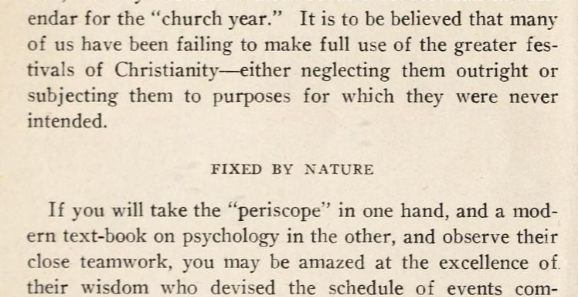
“If you will take the ‘periscope’ in one hand and a modern textbook on psychology in the other, and observe their close teamwork, you may be amazed at the excellence of their wisdom who devised the schedule of events commonly known as the ‘church year.’ There was nothing ‘hit-or-miss’ about the makeup of this calendar. These canny church fathers did not sit in council to determine whether it would be more convenient to observe a more ‘penitential season’ in June than in December. No; that matter was out of their jurisdiction. It was something that had been settled by Nature, and they simply obeyed her voice. It is a known fact that the budding spring inevitably lures men to introspection. At that season they search their hearts, take invoice of their spiritual capacities, and seek whatever art forms are more familiar to them in an endeavor to make articulate the vague longings of their souls. Of old, they fasted at this season, and took counsel of holy men in cloisters. Of late, some write spring poetry, hungrily seek the art galleries, and patronize orchestral concerts. It is a season when everybody grows restless, dissatisfied with the apparent futility of his business, rebellious against the narrow boundaries of his experience, eager to escape the tyranny of material things to make adventure with the more ambitious quest of what, for him, serves as the Ultima Thule, Summum Bonum, Utopia – or whatever you like that stands for the High Spot.

“So, we may conclude that the season of self-search is fixed by Nature. Christianity is not unique in respect to the time of its penitential period. All the other great religions understand this psychology quite as well, and some of them have followed the suggestion much more effectively. Christianity, so inextricably tangled with the best of progressive civilization that men debate whether it is Christianity blazes the way for science, commerce, and the arts, or vice versa, should have a care that it does not develop into an urbane, artificial, indoor kind of religion. It began out in the open, under the guidance of one who frequently had no pillow but the turf; and we do well who would give all the fresh air and sunshine to its health. When Nature suggests a mental and spiritual mood – and historic Christianity stamps its O.K. upon the suggestion – we are wise who follow the hint.

“It is quite difficult for the present-day minister in America to obey his natural impulses and suggestions of the ‘church year’ in making a program of sermons and services to suit the season. In his desire to be a good citizen, he feels obliged to comply with every request of local, state, and national reform and philanthropic societies when they solicit his backing of their movements to the extent of observing their ‘days.’ No sooner has he planned his schedule for a vigorous evangelistic appeal through January than along comes ‘National Thrift Week’ – backed by the local Chamber of Commerce. Will he not be so good as to preach, on the Sunday preceding the ‘drive,’ emphasizing the importance of saving pennies that they may grow up into dollars. He dislikes to decline. Perhaps he really can contribute something to this cause – especially on the subject of frugality, a matter with which he has had much experience. He can talk ably of pennies. In the course of his business he sees such a lot of them.”

Into the Wilderness

by Ronald R Johnson

A page from the sermon “The Wilderness,” preached by Lloyd C Douglas at the First Congregational Church of Ann Arbor on 2/15/1920. In Sermons [5], Box 3, Lloyd C. Douglas Papers, Bentley Historical Library, University of Michigan. © University of Michigan.

Lloyd Douglas is about to tell the story of Christ’s temptations in the wilderness. This is from a sermon entitled, “The Wilderness,” preached by Lloyd C. Douglas at the First Congregational Church of Ann Arbor on February 15, 1920. (In Sermons [5], Box 3, Lloyd C. Douglas Papers, Bentley Historical Library, University of Michigan. © University of Michigan.)

“One does not rightly understand the setting of this scene,” he says, “unless one is acquainted with another figure in the sacred drama: one John the Baptist. Owing to the fact that this rugged character is cut down in young manhood, paying with his life the costly price of speaking his mind candidly in the court of Herod Antipas, we see so little of him that he is likely to escape observation. Nobody can hope to become fully conversant with the mission of Jesus, however, unless he acquaints himself with this young hermit who plays a part so significant in the life of the Galilean.

“From his youth, John believed that the religion of his fathers faced a crisis and demanded a reform. He never thought of himself as a revolutionist or reformer. He was the forerunner of a reformer. His priestly father, Zacherias, had consecrated him in childhood to the Nazarite order, one of the most severely austere monastic sects ever established; and, in pursuance of that vow, the young Judean had left home at a tender age, to live the life of a recluse.

“Twenty miles east of Jerusalem, flanking the Dead Sea, there was and is an arid waste, in area about half the size of Washtenaw County [the county in which Douglas and his listeners are gathered], where such scraggy vegetation as survived the rigors of the climate only added to the unattractiveness of the sun-drenched, windswept waste of jagged rocks. There, John the Baptist spent most of his life, wandering up and down the parched ravines, shouting, ‘Prepare ye the way of the Lord’ — which any modern businessman would say was poor advertising, inasmuch as nobody ever went into the Jeshimon Wilderness except an occasional caravan en route from Engedi to Joppa.

“Be that as it may, the time came when thousands made the pilgrimage into the wilderness to hear the hermit preach, and vast numbers, infected by his contagious enthusiasm for a revival of the real spiritual interests of the Hebrew monotheism, believed his words and were baptized with water — a brand-new ceremony by which John welcomed his disciples into the rejuvenated kingdom of the heart. At length, as his influence increased and the crowds grew larger, he was persuaded to move northward, out of the dreary, bleak Jeshimon Wilderness into the more pleasant and accessible meadows along the Jordan River, where he continued his preaching and baptizing until one day a stranger appeared, a young man of quiet dignity and great personal charm, and when John saw him, he exclaimed:

“‘This is He!’

“Jesus was baptized that day in the presence of a mystified throng of thousands. They surveyed him with rapt interest; for John had said, ‘This is He of whom I spoke, the latchet of whose shoes I am not worthy to unloose. Behold your prophet, priest, and king!’

“One expects Jesus to make an inaugural address. The time was ripe for it, and the audience was at hand. One expects him to go at once to the Holy City, the glint of whose towers and turrets shone resplendent in the afternoon sun.

“He does neither of these things. Without a word, he emerges from the river and strides rapidly southward toward the Jeshimon Wilderness. He wished to be alone. The great moment had arrived for the inception of his ministry. But he wanted to get away by himself to examine his credentials and take stock of his spiritual resources before beginning his work.

“Thus was Jesus led up of the Spirit into the wilderness for forty days, a period of self-search which we celebrate in the Lenten season, just now at hand.”

[All of this was merely an introduction to Douglas’s sermon. I’ll tell you about that in my next post.]

Design a site like this with WordPress.com
Get started