The Conservation of Moral Leadership

by Ronald R Johnson

The title page of “The Conservation of Moral Leadership,” Sermons [4], Box 3, Lloyd C. Douglas Papers, Bentley Historical Library, University of Michigan. Copyright University of Michigan.

The date is October 19, 1919. Lloyd C. Douglas is preaching at the First Congregational Church of Ann Arbor, addressing the question, “what elements are really essential to the building of a faith, at once fearless in its appeal to the intellect and satisfying in its answer to the instinctive demands of the emotions”? He’s speaking to a congregation partly made up of university people (students, grad students, professors, and administrators), but also made up of people from the town, including some of the principal businessmen. They have chosen him as their pastor because they agree with what he’s trying to do: preach a gospel that appeals to the mind just as much to the emotions.

The rhetorical question he’s asking today is: What are the basic elements of such a gospel?

(The title of his sermon is “The Conservation of Moral Leadership,” and it can be found in Sermons [4], Box 3, Lloyd C. Douglas Papers, Bentley Historical Library, University of Michigan. © University of Michigan.)

“In the first place,” he says, “the Christian religion grounds its life on the conviction that the universe is neither an accident nor the product of a blind necessity…. It rather considers all reality as the continuous activity of one who knows exactly what He is doing, and why.” (The first element is God as Father of us all, in other words.)

Second: ” …this establishes among us a common brotherhood. It declares that the strong and the weak, the civilized and the barbarian, the cultured and the ignorant, are bound together by ties which cannot be broken, and which it is decidedly perilous to ignore.” (So the second element is the brotherhood of man.)

“In the third place: Christian philosophy is considerably more than a system of ethics or metaphysics. It is an historical system of faith, of worship, and of practice which traces its origin to the life and teachings of a man whose character it regards as the highest embodiment of ideal living”: Jesus.

And finally: “The Christian philosophy, which begins with God’s Fatherhood, involving man’s brotherhood, and the Mastership of Jesus, who viewed this life as a training-school for future achievements of a higher order, finds it quite impossible to permit death to assume any other place than that of porter at the gates of another world.” (So the fourth element is belief in life after death.)

If you’re at all familiar with Lloyd C. Douglas the novelist, you may be surprised at how unoriginal this answer is. Douglas had a lot of interesting things to say throughout his career as a minister and especially in his writings, but it doesn’t take more than a glance at this sermon to see that, in the fall of 1919, he had not yet developed his ideas. It would take him most of the 1920s to accomplish that; at this point he was still saying many of the same things that other modernists of the period were saying. Christian religion for him was, in essence, a faith in God as Father, the Brotherhood of Man, the centrality of Jesus, and belief in life after death.

This is the core of Douglas’s sermon, but I have to be honest: on this occasion his remarks are not well organized. He talks about a variety of topics, but he doesn’t clearly tie them all together. In fact, I can’t see how the title, “The Conservation of Moral Leadership,” relates to the any of the things he says in the body of the sermon. On at least one other occasion (1/4/1920) he admitted that he was required to submit the titles of his sermons so far in advance (in order to be announced in the newspapers and printed in the bulletin) that his thoughts sometimes went in a different direction from the one he had in mind when he chose the title. Since his sermon the previous week was about the leadership responsibilities of young people in the years to come, he probably had this sermon in mind as a follow-up to that one, explaining how their leadership could be “conserved” by pursuing the kind of religion he was going to describe. Whatever his intentions were, he didn’t end up making them clear.

Despite all this, there are a few “quotable quotes” scattered throughout the sermon, and some of them are worth talking about. I’ll do that over the next few posts.

The Mission of Lloyd C Douglas

by Ronald R Johnson

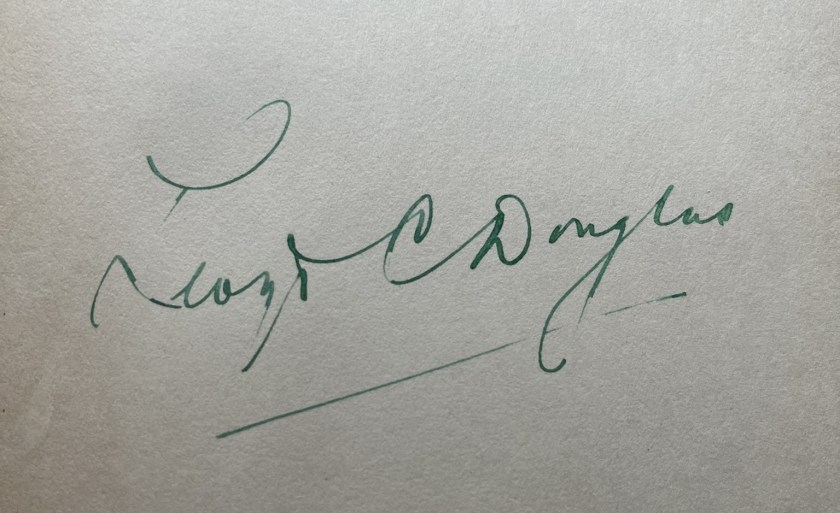
Autograph on first page of a customer copy of Forgive Us Our Trespasses.

Although it’s true that the phenomenal success of the 1929 novel Magnificent Obsession changed the life of its author, it was a delayed reaction. Not until he sat down to write Forgive Us Our Trespasses in the summer of 1932 did Lloyd Douglas realize how greatly his life would change. As I told you in previous posts, he had wanted his next novel to be a satire on the state of modern art, with emphasis (apparently) on the New Fiction of the 1920s; but instead, he wrote another novel like Magnificent Obsession, in which the story was based on a portion of the Sermon on the Mount. As he neared retirement from full-time ministry (which he planned to do in the summer of 1933), he had imagined himself as a mainstream novelist, not as a writer of Christian fiction.

His embarrassment comes through in an unpublished essay that he had intended for the Ladies’ Home Journal in early 1933. (All quotations in this post are from that essay, “Adventures in Parables,” which is filed under “Addresses and Articles,” Box 3, Lloyd C Douglas Papers, Bentley Historical Library, University of Michigan. The University of Michigan holds copyright to this document.)

“More or less by accident,” Douglas wrote, “I have become an author of goody-goody stories in which the characters are tiresomely decent and everything turns out happily in the end. This is an offense to modern art in letters, and if I knew to whom apologies should be offered, perhaps I might solicit such shriving as the transgression demands.”

He was joking, but he really did feel like he had been caught trespassing in literary territory. In that sense, the title Forgive Us Our Trespasses was more appropriate than people realized.

“My main trouble, in the opinion of the literary critics,” he continued, “is that I broke all the rules of novel-composition through ignorance. That’s what makes my position in the world of letters so embarrassing. The only woman at the dinner party who dares plant her elbows on the table and hold the squab in her fingers is the lady whose social experience is beyond the reach of query or cavil. If Maggie O’Flaherty did such a thing, the whole solar system would be set back two minutes due to time out for recovery.”

To understand the next example, you have to bear in mind that this was the Great Depression, and Roosevelt wasn’t president yet. At the very moment he wrote this piece, banks all over the country were closing. Douglas wrote, “The only man in town who can afford to wear a greasy old hat is the banker. (Pardon me. I was momentarily thinking of earlier times when bankers had money. If you can think of another word here for ‘banker,’ give him the old hat with our envious felicitations.)”

Then he got to the point:

“The only writer who can take the risk of breaking the laws in respect to the composition of fiction is the sanctioned, seasoned, spurred veteran; which I am not.

“Nobody in these frugal days should waste ink, stamps, and sarcasm in notifying me that Magnificent Obsession and Forgive Us Our Trespasses are, technically, about as bad as stories could be without exposing themselves to censorship in the cause of sound literary production. Perhaps I am too naive to know just how bad they are, but I have a general idea.”

He was being too hard on himself. Although a case can be made that this or that aspect of his first two novels could have been improved, critics with credentials – especially those based in New York – had good things to say about both novels. As I noted in a previous post, there were only a few writers in local newspapers (Kansas City, for example, and Birmingham, Alabama) who trashed Magnificent Obsession, and that trend continued with Forgive Us. But Douglas didn’t consider either of those books literary masterpieces, and that’s why he was embarrassed when some people did criticize them on literary grounds.

“I have only one defense to fall back upon,” he said, “when the really competent critics complain that my stories are shocking examples of How Not to Write a Novel. I am fully aware of it. I do not think of myself as a novelist at all. These things I have written are probably not novels. Perhaps they are modern parables.”

Again, he was conceding too much. They were novels; they just weren’t the kind that was in vogue after the literary revolution of the 1920s. They were “purpose novels”: novels in which the thesis was more important than the plot. And yet his first two books demonstrate that he understood plotting and did it with skill. His only real problem was this: that he was a writer of purpose novels in a day when that genre was considered a thing of the past.

There’s something he’s not telling us in this essay, however. The truth is, he had always aspired to be a novelist – not a writer of purpose novels but of real ones – ones in which the story was everything. Through all his years as a minister, he had waited patiently for that day, when he could shed the clerical collar and WRITE. But when his moment came, his incoming mail convinced him that God had other ideas. As much as he wanted to be “the sanctioned, seasoned, spurred veteran” writer of modern novels, he chose the path he felt his people needed.

This was the mission of Lloyd C. Douglas: to write “modern parables” for people who desperately needed the guidance such stories could provide. When he composed Forgive Us Our Trespasses, he had to make a choice. Would he follow his heart and be the novelist he had always dreamed of being, or would he do what he discerned the Spirit of God calling him to do? Knowing how much it meant to him, I believe it was a gut-wrenching decision. But he chose what he perceived to be his calling. And the rest is history.


This is as much as I can tell you, in these blog posts, about Douglas’s life story. The biography that I’ve written picks up here (1932) and covers the rest of his life, until his death in 1951. If you would like to know more about that book, I send a free monthly newsletter to Lloyd Douglas fans, updating them on the progress of my research and writing. I invite you to fill out the form below, and I will be glad to add you to my list.

In the meantime, future posts at this site will delve more deeply into the documents in the Lloyd Douglas archive: his sermons, speeches, published articles, and interviews. Stay tuned!

← Back

Thank you for your response. ✨

Release

by Ronald R Johnson

Although he never flaunted it, Lloyd Douglas knew his New Testament Greek. And that was probably why he chose the working title, Release, for his next novel,in the summer of 1932.

Luke 6:37 is usually translated into English as, “Forgive, and you will be forgiven,” but a literal translation would be “Release, and you will be released.” The Greek verb is apoluō, which means “to release.” It also means “to forgive,” because that is one example of how you can “release” someone. The point Douglas wanted to emphasize in this new novel was that, in releasing others, we ourselves are released.

Here is how he explained his thesis to Ira Rich Kent, the Managing Editor at Houghton Mifflin Publishing Company on 7/26/1932 (from Box 1, Lloyd C. Douglas Papers, Bentley Historical Library, University of Michigan):

“This book is not in any sense a sequel to Magnificent Obsession…. The thesis of M.O. was, briefly: How to get what you want, and be what you would like to be, through a practice of a Galilean principle of secret philanthropy.

“The thesis of the present work is: how to get free of the encumbrances which block the way to the expansion of personality.

“The most common of these encumbrances is hatred – prejudice, toxic frustrations, cancerous might-have-beens, bottled-up injustices.”

Notice that his examples go beyond just hatred to include disappointment and frustration that has been “bottled-up.” The title Release has even more meaning in this regard. He continues:

“The solution – to be cryptically disclosed through a process not at all homiletic, but by a device capable of sustaining reader interest – is based on the only comment the Lord offered on ‘the Lord’s Prayer’: If ye forgive men their trespasses, your Heavenly Father will forgive yours.

“Trespasses, in this book, are considered as ‘invasions of rights.’ My ‘Major Personality’ has a right to energies which He has invested in me. I cannot hope to succeed in a large way unless I concede and honor His right to the control of such power.

“My freedom to enjoy; to savor life; to get out of it all that is in it for me by putting into it all that I possess, depends upon my willingness to put myself into complete harmony with His design for me.

“I cannot hope to do this unless I free myself of the encumbrances that weight me down.

“At this point, there arises a quite definite proposal of NEGOTIATION. If I sincerely forgive all who have made life difficult for me, I have offered the credentials necessary for this FREEDOM.

“All this sounds didactic and brittle, as I attempt to explain it; but it will not appear so in the book.”

That part about “negotiation” will almost certainly appear foreign to Christians. We place our trust in Jesus, not in any sort of “negotiations” or “credentials” we may bring. The thing to remember here is that Douglas isn’t talking about salvation, and he’s not using orthodox vocabulary. He’s talking about unleashing one’s potential in one’s daily pursuits, and he’s using the vocabulary of the ordinary person out in the world. His congregations were filled with people who professed to be Christians but who had never done the things Jesus talked about. He’s trying to get them beyond talking about it and actually doing it. And he’s starting at Square One.

In the book (Chapter 15), he has the character Julia explain it this way (and she seems to be referring to Matthew 18 here):

This little piece [of scripture]… doesn’t whine at all. It doesn’t ask you to whimper for mercy.

It’s just a business proposition same as if you owed a thousand dollars to Mr. Smith, and ten other people owed you a hundred dollars apiece, and Mr. Smith said, ‘Pay me that thousand dollars,’ and you said, ‘I can’t – with all these people owing me.’

And Mr. Smith said, ‘I don’t need the money so much, but I like you and want to be friends with you, and as long as you are owing me you’ll be keeping away from me for fear I’ll ask you for it and make you ashamed. And it won’t do any good for me to tell you just to keep the money and forget it, because that would make you ashamed, too, and you would always feel in debt. So – I’ll make you a proposition. If you will cancel all the debts of these people who owe you, and are afraid to face you, so that they can afford to cancel the debts of the people who owe them, I’ll call it square with you. Then we can all be good neighbors again, and nobody will be afraid of anyone else, or shy, or ashamed.’

This all sounds so much more sensible to me, dear, than the way they talk about it at the meetings. It’s just as if God wanted us to do business with Him about these things that have kept us strangers.

Houghton Mifflin published the book in November 1932 under the title, Forgive Us Our Trespasses. Douglas had thought it would be a clever satire of modern art, but it ended up being much more. And, in writing it, he found his mission in life. I’ll tell you about that in my next post.

Mencken

by Ronald R Johnson

H. L. Mencken, from Britannica Online.

I’ve been telling you about the tentative plans Lloyd Douglas made sometime around 1930-31 for his next novel, after Magnificent Obsession. He wanted to write a satire about modern art, and apparently it was going to focus on 1920s fiction. As I showed in my last post, it was going to include some of his firsthand impressions of daily life in Greenwich Village, where starving young artists sat in gloomy eating establishments, trying to think up the next big thing.

I’ve also been telling you that his ideas for this next novel changed over time, as the success of Magnificent Obsession, and especially the letters he received from readers, convinced him that his job wasn’t finished. People had questions that he couldn’t answer neatly in mere correspondence. So he took the ideas he had been working on and reshaped them into a novel that would answer some of those questions.

It was around this time that he began talking about the main character of the novel. He wanted the protagonist to grow up “full of poison from his neck to his heels.” He would be modeled after the best-known cynic in America at the time: Baltimore Sun columnist H. L. Mencken.

I don’t think Douglas fully understood Mencken. It would have been hard for anyone in Douglas’s position to be sympathetic toward Mencken, especially since Mencken was so rabidly anti-Christian and anti-middle class.

James D. Hart writes in The Oxford Companion to American Literature (4th edition, 1965) that Mencken was “best known for… aggressive iconoclasm… especially during the decade following the First World War [the 1920s, in other words], when he exhibited a savagely satirical reaction against the blunders and imperfections of democracy and the cultural gaucheries of the American scene…. His critical views were widely influential… although he aroused much popular antagonism” (p. 541).

Vernon Louis Parrington, near the end of his massive three-volume work, Main Currents in American Thought: An Interpretation of American Literature from the Beginnings to 1920 (NY: Harcourt Brace and Company, 1930), grouped Mencken with “the younger intellectuals” who offered “a searching criticism of the triumphant middle class, its ideals and its habitat, the town and the city; the repressive tyrannies of its herd mind; the futility of its materialism” (Volume 3, p. 376).

The Macmillan Company’s Literary History of the United States (Third Edition), says of Mencken’s Prejudices: “Mencken’s major quarrels are two: with the Christian moral code whether in its pure state or in a diluted state, and with government by the people, whether under a democratic or communistic form” (1144). Mencken thought the American people were a bunch of “boobs,” and he put his faith in a literary elite that consisted of people he helped make famous – guys like Theodore Dreiser, Sinclair Lewis, and James Branch Cabell.

Mencken was the person Douglas modeled his main character after. “I do not think that Mr. Mencken will sue me for slander,” he wrote, “because (a) he will not read the book, and (b) he is too self-consciously omniscient to identify any other portrait of himself than one he might draw; but Dinny Brumm [the hero of the novel] develops into that sort of a person” (LCD to Ira Rich Kent, 7/26/1932). And for Douglas, that meant a person who was “full of poison.”

Douglas’s main problem was getting readers to have sympathy for someone like that. His solution was in two parts: showing readers Dinny’s difficult life growing up, and then giving him star power. “I had thought to make [him] a thin-necked little puke as a child,” Douglas confided – take that, Mencken! – “but I have changed my mind” (LCD to his daughter Betty, 5/16/1932). A month later, he said, “Now he is a ham-handed, overgrown young rake-hell that can hardly keep his shirt on…. I think he will make a larger appeal in the new form” (LCD to Betty, 6/20/1932).

In college, for example, he’d be good on the football field because practice sessions would give him permission to knock the hell out of the rich kids on his team—the Pullman Boys who rode to school in style while he had to sit in Coach Class, the fraternity members who looked down on “barbs” like him. He’d be the crowd favorite in his English Composition course because his biting humor would go over the professor’s head but all the students would catch the joke. He and the college president’s daughter, Joan Braithwaite, would fall in love, but his scathing editorial mocking “the Greeks” (privileged members of fraternities) would also insult her, as the leader of a sorority. He’d get kicked out of school for giving a religious conservative a black eye. And he’d rise to fame as a syndicated columnist because intelligent people all around the nation would love to see him take down the powerful, the self-important, and the dim-witted.

Bob Willett, at Willett, Clark & Colby, planned to publish the book and kept asking about it, but Douglas didn’t want to work with Willett again. The Chicago publisher hadn’t advertised Magnificent Obsession very much outside The Christian Century, and Douglas was sure he wouldn’t promote a second book any more effectively.

Since, years earlier, Douglas had published two non-fiction books with Charles Scribner’s Sons, he decided to give them another try. He met with a “Mr. Perkins” in February 1932 after sending him five rough chapters of the new novel. The meeting went well, apparently, because Perkins asked Douglas for the right of refusal on the book. Douglas did not commit. During their meeting, he learned that Perkins was “a close friend and ardent admirer” of Mencken, a fact which convinced Douglas that Perkins wouldn’t support the new novel with much enthusiasm. That may have been true; however, it’s also unclear whether Douglas realized who this man was. Maxwell Perkins was the editor who not only discovered F. Scott Fitzgerald, Ernest Hemingway, and Thomas Wolfe, but also worked hard to get their manuscripts into shape. Douglas might have benefited from that kind of attention, but it is also quite probable that he would have felt stifled. He thought it was a bad fit, and he was probably right.

Although Douglas kept some of the satire he had originally intended for the book, by 1932 he had changed its focus. I’ll tell you about that in my next post.
Greenwich Village

by Ronald R Johnson

In my last post, I told you about the plans Lloyd Douglas had for his next novel, sometime around 1930-31. It was going to be a satire about modern art and was probably going to focus on the New Fiction of the 1920s. There is reason to believe that some of the book was going to take place in the bohemian artist’s colony at Greenwich Village, in New York.

In their biography of their father, Douglas’s daughters say that they lived in The Village for a short time. As I mentioned in earlier posts, Douglas had sent them to Paris for a year to study. After Lloyd and Besse moved to Montreal in 1929, the girls came “home” and joined them there. The following summer (1930), the girls moved to New York and rented an apartment in Greenwich Village, “hard by the Third Avenue elevated.” Betty, the oldest, “had a good position in the personnel department of a big Brooklyn store” (Shape of Sunday, 240); Virginia was “acting as secretary to an author” (p. 236). It’s not clear whether this “author” had ever had a book published, or why he needed a secretary, but it is clear that he didn’t have any money. He promised to pay Virginia “when his book comes out” (p. 237).

Concerned about the things his daughters wrote in their letters home, Douglas went down to New York to see for himself how they were doing. He was appalled at the poor conditions under which they were living. They were young and carefree and thought it was all rather fun, but he didn’t like it at all. He said nothing about it while he was there, however. He just listened and observed.

“He was very polite in his comments about our living quarters,” Virginia wrote later. “After all, we were in Greenwich Village, a place he had always read about longingly, and the artistic atmosphere was undoubtedly there. Betty and I took him to cellar eating-places where candles stuck into bottles glowed dimly in the gloom. We introduced him to our friends – most of whom were out of work and talked scathingly of the ones who had given up their art and gone home to help Father in the store.

“‘Oh, if I could only think of some novelty to catch the public fancy,’ they would groan. ‘Look at the chap who invented the Eskimo Pie: simply ice cream with chocolate around it. He’s made millions'” (p. 237).

Douglas wanted to meet Virginia’s “employer,” but she was equally determined to prevent such a meeting. The man was not only destitute but also deeply depressed, and he spoke rather casually about killing himself. On Douglas’s last day in New York, however, he and Virginia were in a restaurant at a table next to a window, and the starving artist suddenly appeared, watching them. Douglas insisted that he come in and join them, and the two men seemed to hit it off. But it only seemed that way. When Douglas was alone with Virginia afterwards, he called an end to her “employment” (pp. 237-239). And after he got home, he wrote her a letter (LCD to daughter Virginia, November 1930):

LCD to daughter Virginia, November 1930. In LCD Correspondence, Box 1, Lloyd C Douglas Papers, Bentley Historical Library, University of Michigan.

“There is a well-established theory that real art is produced in such kennels,” he wrote, referring to the apartment in which they were living. “I don’t know enough about Art to be in a position to pass on that.” This was typical of Douglas: he liked to make fun of his “country boy” upbringing and to pretend he was unsophisticated. “What little scribbling I have done has amounted to nothing; or next to nothing.” He was talking about Magnificent Obsession. In November of 1930 there was still no reason to consider the book a success. “I make no pretense of understanding how people ought to feel; how cold and miserable they ought to be; how empty of gut; how full of ideals; how frowsy of hair; how out at the seat of the pants one should be in order to make The Great Contribution to Reality.”

But as a parent, he had some strong opinions about the place. Betty was now engaged to be married, but Douglas wanted Virginia to come home to Montreal.

Still, the time she had spent in New York wasn’t a complete write-off. “It has probably been good for you to have had this experience,” he said. “You can make notes on it and come home and write a story. Ye gods – what a lot of firsthand information that ought to go into a novel!”

It’s unclear whether Virginia ever did write a story about Greenwich Village, but Douglas did. This is probably how he got the idea for his satire on modern art. At any rate, the novel he did end up writing was about an aspiring novelist living in The Village. “What a lot of firsthand information ought to go into a novel!” he said.

Meanwhile, Back in Montreal…

by Ronald R Johnson

I’ve spent the past few weeks writing posts about how the novel Magnificent Obsession quietly worked its way from obscurity in November 1929 to the Top 25 Bestsellers in April 1931, and upwards from there. But meanwhile, the book’s author, Dr. Lloyd C. Douglas, was busy working as Senior Minister of St. James United Church of Montreal. Because his job kept him busy, and because he was living in Canada, Douglas felt somewhat remote from what was happening. Within the publishing world, his star was rising; but his day-to-day life went on almost as normal.

Almost.

He still had to prepare sermons and visit sick people. He still had to do all the things a pastor normally does. But his incoming mail increased dramatically, as people from all over North America wrote to him about his novel. The things they said, and the questions they asked, convinced him that the publication of Magnificent Obsession had started something he couldn’t walk away from. As he wrote later in his “Author’s Foreword” to Doctor Hudson’s Secret Journal, “the author became aware that he had not completed his task.” [All quotations that follow are from this “Foreword.”]

As strange as it may seem, he hadn’t realized that before. Magnificent Obsession was an experiment. He took what started out as a secular novel (Salvage) and added a religious thesis to it (Exploring Your Soul) in hopes of reaching a larger audience. But up until now (1930-31), he hadn’t given much thought to what would happen next. What if he did reach a larger audience? What if they needed help applying the thesis to their lives? What if they wanted to know more about the gospel?

As I said, he hadn’t anticipated those questions. He did enjoy writing Magnificent Obsession, and he wanted to do another novel, although his work at St. James kept him too busy to follow through on that wish. But he had no intention of writing another book like Magnificent Obsession. Douglas tried never to repeat himself. His next novel would be about the world of art, with emphasis on contemporary literature. He had some opinions about that, especially now that he himself had published a novel.

But his incoming mail kept nagging at him. “Do you honestly believe in this thing,” people asked him, “or were you just writing a story?” Well, he did believe in it, but he wanted his next novel to be just a story. He had some jokes he wanted to put into it… some rather droll remarks that his more sophisticated readers would enjoy… some critical comments about the state of literature today.

But his mail kept increasing. As he admitted later, “The task of dealing sympathetically with this strange correspondence became a grave responsibility. No stock letter, done on a mimeograph, would serve the purpose. It was necessary that individual replies be sent to all earnest inquirers. One dared not risk the accusation that, having advocated an expensive and venturesome technique for generating personal power, the author was thereafter too busy or lazy to care whether anybody benefitted by such investments.”

So he wrote to them, one-by-one. “Some of the questions were practically unanswerable,” he says, “but it wasn’t quite fair to limit one’s reply to a laconic ‘I don’t know.’ Frequently one’s counsel was pitiably inadequate, but not because it was coolly casual or thoughtlessly composed.”

Here, then, was a busy pastor, daydreaming about writing another novel in his spare time – just for fun – but instead spending all his available time corresponding with people who were prompted by his latest novel to ask for his help with their spiritual lives.

Whether he liked it or not, the shape of that next novel started to change. It would still be about the arts; the main character would be an aspiring young novelist living in “The Village” with other aspiring young artists. But instead of it being a satire as he had originally planned, it was slowly turning into a story about the young man’s soul. And as the story changed, Douglas’s future changed with it. He began to realize that the road ahead did not go in the direction he had envisioned.

Publishing Miracle 13: The Call to Action

by Ronald R Johnson

In this series I have listed a number of factors that called the public’s attention to the novel Magnificent Obsession after its publication in 1929. Once people became aware of the book, then there were some distinctive features of it that kept them reading and talking about it. But the book did more than that: it also gave them something to do.

Nancy Ashford comes right out and says this in Chapter 11 when she tells Bobby Merrick that, if Doctor Hudson’s journal were to be published, “People would pronounce it utterly incredible, of course; but they would read it – and heartily wish it were true. And I have a notion they would be sneaking off to make experiments, no matter how they might have giggled when discussing the theory with their friends.”

Magnificent Obsession isn’t just a novel; it’s an invitation to try the thing yourself, and see what happens.

Nancy continues, “I wish I could tell you… you know why I cannot… about the quite startling experiences I myself have had lately…” She can’t tell him because it’s all about serving others and not bragging about it to anybody. But it’s implied that she has done a deed of kindness and has hidden up that secret for her and God alone, and her prayer-life has become more constructive as a result. This isn’t your typical novel. Most of them don’t give the reader something to try after they’re done reading.

But Douglas goes one step further: he hints that he would welcome a letter from them, telling him the results of their experiments.

In Chapter Thirteen, Merrick shares Doctor Hudson’s “secret” with Montgomery Brent, and Brent says he’s going to try it. “May I write to you, sometimes, and report?” Brent asks.

Merrick says, “Glad to have you. But you needn’t try to tell me what you’re doing for anybody else. That’s your affair. Write and tell me if it works – but not what you did to make it work. Do you get me?”

And that’s exactly what readers did. As Douglas tells us in his “Author’s Foreword” to Doctor Hudson’s Secret Journal, “After a while, letters began to arrive from persons who said they had tried it, and it worked; though they were careful not to be too specific in reporting their adventures, aware that if they told they would be sorry” (p. ix). Of course, not everyone had positive results. “A few lamented the cost of unrewarded experiments and denounced the whole idea as a lot of hooey.” He adds, “The task of dealing sympathetically with this strange correspondence became a grave responsibility” (p. x).

This, perhaps more than anything else, is what made Magnificent Obsession stand out from other novels: it created a community. People “tried” the book’s thesis and corresponded with Douglas about the results. And he wrote back. For the rest of his life, much of his time was spent answering letters like these. Douglas says, “A single post might contain inquiries from a high school boy, a college professor, a farmer’s wife, a physician, a pious old lady, an actress, a postman, a preacher, and a sailor…. I suppose that if all these letters were compiled and printed, they would fill several volumes as large as the novel which evoked them.”

There is evidence that Douglas considered doing something along that line. Around 1932-33, he wrote a To-Do List about these letters, then folded it up and stuck it in the back inside pocket of his Forgive Us Our Trespasses scrapbook. In the To-Do List he said he was going to “Take off mailing addresses from letters,” and then “Letters will be stored.” He seems to have had some long-range plans for them, but he doesn’t mention what he had in mind.

On a personal note, this “Strange Correspondence” is the first thing I looked for when I began studying Douglas’s private papers at the University of Michigan in 2005. Rather than a biography of Douglas, I initially wanted to write the story of this community-building that he did through letter writing. Unfortunately, other than fan letters from GIs during WWII (to which I do devote a chapter in my Douglas biography), Douglas’s daughters did not donate his fan mail to the university archives.

However, the main point I want to make today is that Magnificent Obsession prompted readers to go out and “try” the book’s thesis – and apparently many of them did. In that respect, it was more than a novel. For many people, reading it was a life-changing experience.

Publishing Miracle 11: The Coded Message

by Ronald R Johnson

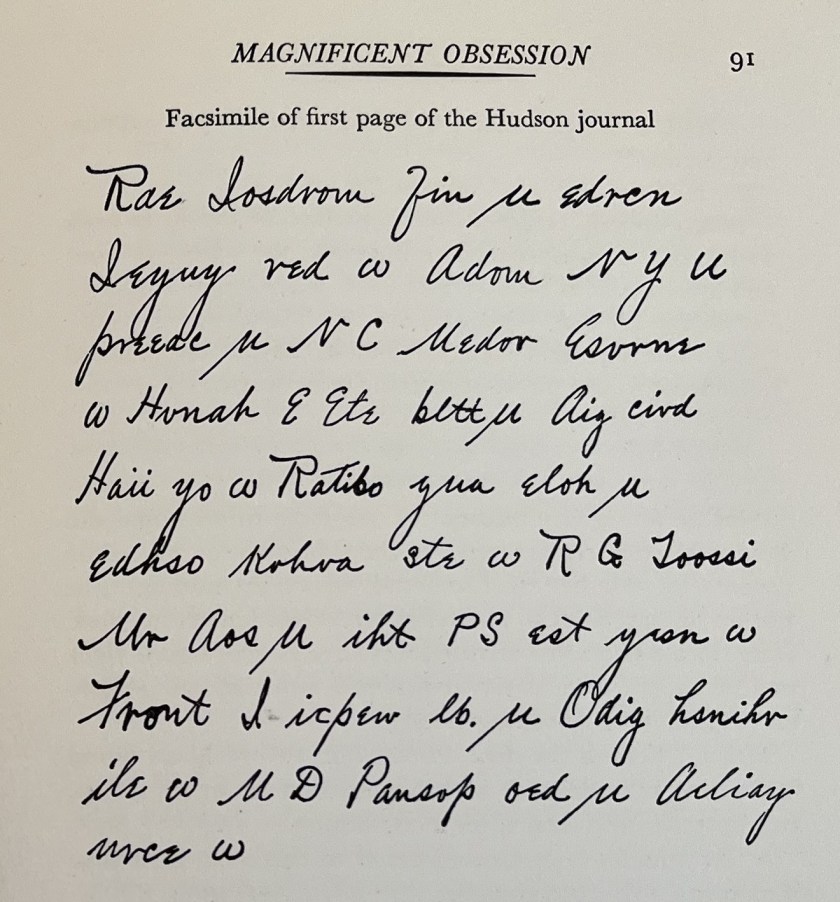
One interesting feature of the novel Magnificent Obsession is the fact that Doctor Hudson’s journal was written in code, to prevent people from discovering his secret too easily. When Nancy Ashford presents the diary to Bobby Merrick, he is determined to crack the code. Here is the first page of it:

In Douglas’s Magnificent Obsession scrapbook, there is at least one critic who complains that the code is easy and that it takes Merrick much longer than necessary to decipher it. Personally, I wouldn’t even know where to start.

Nancy and Bobby figure out one thing immediately: Dr. Hudson used the last letter of the Greek alphabet, omega, to indicate the end of a line, and he used the Greek letter mu to indicate the halfway point. This was a clue to divide each line into two, like so:

As an example of Douglas’s skill as a storyteller, he has Merrick work on the puzzle so late into the night that he falls asleep at his desk. The next morning when the butler comes to call him to breakfast, he finds him like this, then goes down to the kitchen and tells the cook, “You lost your bet!”

“Drunk again?”

“Quite!”

After the accident that saved his life at the expense of Dr. Hudson’s, Merrick has sworn off alcohol. This is a humorous scene that shows the household staff jumping to conclusions, just like we all do in real life.

Later on, having no better ideas, Merrick tries separating the letters and shifting the second half of the line slightly to the right…

Although I still wouldn’t have seen it, Merrick realizes that the key is to take the first letter from the top line, the second from the bottom line, the third from the top, and so on. He comes up with this:

“Reader, I consider you my friend…”

This is just the beginning, of course. He still has to decipher the whole journal in order to learn the secret that Dr. Hudson worked so hard to conceal. But this is just one example of the way Douglas keeps us in suspense.

When reviewers mentioned the code, they usually included it as one of the interesting features of the book. Some complained about it, however.

From The Congregationalist: “Dr. Douglas does, however, make a certain concession to the present age in surrounding rather simple and elemental Christian facts and experiences with an element of mystery and the occult. Our own judgment is that the diary of the famous surgeon which figures so prominently in the story would have been made both artistically and spiritually more effective if it had been plainly presented in simple English rather than in the unique code which, without the key that Dr. Douglas supplies, would have been difficult to decipher. However, Dr. Douglas probably knows his age and the unreadiness of the sophisticated to appreciate simple things simply stated.”

Lighten up! True, Douglas used the coded diary as a way of getting his audience interested, but there’s also a more basic truth here: a coded diary is fun. Douglas wanted us to enjoy reading Magnificent Obsession, and judging from the reviews in his scrapbook, many people did.

The message that Merrick deciphers is based on a page of scripture that is talked about but never entirely revealed. And that is another reason why Magnificent Obsession became “a publishing miracle.” I’ll tell you about that in my next post.

Publishing Miracle 8: The Jules Verne Touch

by Ronald R Johnson

I am retracing the steps by which the novel Magnificent Obsession became a bestseller. I’ve already mentioned the support the book received from local newspapers and from people within the medical profession. Today we’ll see how those two factors intersected: a development in medical technology mirrored an important series of events in the novel, and this fact was reported in at least one newspaper.

In the novel, Dr. Merrick is trying to decrease mortality during brain surgery by inventing a tool that simultaneously cuts brain tissue and cauterizes the area around it, preventing bleeding. He has the general idea, but he can’t quite figure out how to place the vacuum tubes. This is all crucial to the plot because, as he meets the requirements of Dr. Hudson’s “theory” (or in other words, does what Jesus teaches in the opening verses of Matthew 6), he has a moment of clarity in which he sees the details that have been eluding him. Not only does he build the device and revolutionize brain surgery, but he also experiences the reality of God in the process.

Douglas didn’t make this up off the top of his head. In an interview with the Montreal Gazette (reported 11/25/1932), he said, “I started Magnificent Obsession while I was in California, before I came to Montreal. There I knew Dr. Carl Wheeler Rand, who is considered the most eminent brain surgeon on the west coast. I went to him and told him I had a strong desire to have a character in my book invent some surgical device and asked him if any work was being done along that line. He said that tentative experiments had been made with an electric cautery, but they had never been successful. He added that if I used the idea, it was possible there would be a few surgeons who would be interested in the fact.” Then he added, “Dr. Rand gave me nothing by way of detail, and when young Dr. Merrick thought in his dream of rearranging his vacuum tubes, it was my own idea.”

The Gazette interviewed Douglas because of a news item that had come to them over the wire from Des Moines, Iowa, where a man named Paul C. Rawls had demonstrated for local surgeons a device just like the one Merrick invents in Magnificent Obsession. The Gazette quoted the dispatch from Des Moines as saying, “Paul C. Rawls, the inventor who was granted a patent yesterday, explained how the use of vacuum tubes enabled him to obtain higher frequency electric current, thereby making possible the new knife.”

In their headline, the Gazette claimed that Douglas had “the Jules Verne touch.” They were referring to the science fiction writer whose novels anticipated many technological breakthroughs.

Below is a copy of the first page of Mr. Rawls’s patent. Click here for the link to Patent Number 1,945,867 on Google Patents. Below is an image of the diagram included with that patent.

What mystifies me about all this is that, in 1926, three years before the publication of Magnificent Obsession, Dr. Harvey Cushing invented a device which (if I am not mistaken) fits the same general description. As Elizabeth H. Thomson notes in her biography, Harvey Cushing: Surgeon, Author, Artist (New York: Henry Schuman, 1950), Cushing realized as a medical student at Harvard in 1894 that bleeding would have to be controlled before brain surgery could be done successfully (p. 62). By 1910 he had begun using silver clips (p. 171), which helped somewhat; but he kept working on the problem.

Thomson writes: “In the autumn of 1926, Cushing used for the first time an electric cautery apparatus in a brain operation. In general surgery and in genito-urinary surgery, high-frequency currents had been used for some time in dealing with both benign and malignant growths, but it was Cushing who established their value in neurological surgery. With the cooperation of Dr. W. T. Bovie, a physicist with the Harvard Cancer Commission who had previously developed apparatus for dealing with cancerous growths, he experimented with currents and equipment until they had one current that would cut tissue without attendant bleeding and another that would coagulate a vessel which might have to be cut during the course of an operative procedure” (pp. 247-248).

There is no mention of vacuum tubes, but the device itself sounds very much like the one Merrick invents in Douglas’s novel. This in no way diminishes Douglas’s reputation as a novelist, but if we’re going to talk about the real-world invention of this device, it seems to me that Dr. Cushing beat P. C. Rawls. However, based on Douglas’s conversation with Dr. Carl Wheeler Rand, which I presume took place in 1928 when Douglas was writing the novel, Dr. Rand and his West Coast associates had so far been unable to reproduce Dr. Cushing’s work with complete success.

What this means for Douglas is that he was aware of the problem that brain surgeons were trying to solve in the last years of the 1920s, and he built that problem and its likely solution into his novel. This made his novel current and fresh and based on facts – something you don’t normally get from a novel.

Below, also from Douglas’s Magnificent Obsession scrapbook, is a clipping about a doctor in Boston demonstrating a similar device. This clipping doesn’t say whether it’s the one invented by Harvey Cushing (in Boston) or the one invented by P. C. Rawls, or maybe a third invention. At any rate, it’s another instance that shows how current Douglas’s novel was, and why so many health professionals were interested in his book.

Publishing Miracle 4: The Women

by Ronald R Johnson

In my last post, I told you how members of the clergy in North America helped boost sales of the novel Magnificent Obsession after its publication in 1929; but they weren’t the only ones spreading the word. Women’s groups were also helpful. In Douglas’s list of important influencers, he names twice as many women reviewers as he does ministers:

*Mrs. Ada Turnbull, Monmouth, IL
*Mrs. Buena Mimms, Ocala, FL
*Mrs. R. C. Richey, Memphis, TN (at home of Mrs. W. L. Meux at Whitehaven)
*Mrs. M. R. Elikan, Bellaire, OH
*Mrs. Abe Levin, Youngstown, OH
*Mrs. J. H. Davis, Birmingham, AL
*Miss Sue Reese, Salisbury, NC
*Mrs. Charles Gilliam, Warsaw, IN
*Mrs. Theodore A. Switz, East Orange, NJ
*Mrs. Cox, Marion, IL
*Mrs. Danna Sellenberger, Kokomo, IN
*Mrs. Alex Woldert, Tyler, TX
*Mrs. Judson Geppinger, Hamilton, OH
*Mrs. Jerome Lewis, East St. Louis, IL
*Mrs. John Whiteman, Ardmore, OK
*Mrs. Harry W. McGhee, Brownwood, TX
*Mrs. W. E. Smith, Elkhart, IN
*Miss Althea Montgomery, Dean of Women of the Junior College, Washington, IA
*Mrs. Leroy Flanegin, Peoria, IL
*Mrs. E. N. Stone, Chickasha, OK
*Mrs. Wm. B. Mathews, Newport News, VA
*Mrs. Myrna Moore, Oklahoma City, OK
*Mrs. John Garvin, Toronto, ON (Canada)
*Mrs. T. G. Landers, East St. Louis, IL
*Mrs. Lawrence Ely, member of the Westmoorland College Faculty, San Antonio, TX
*Mrs. L. J. Wathen, Dallas, TX
*Mrs. Telis Miller, Hickory, NC
*Mrs. F. E. Ornsby, Cedar Rapids, IA
*Mrs. W. P. Johnson (at Mrs. Frank R. Mayers), Lake Worth, FL
*Mrs. Bessie Kagay, Effingham, IL
*Mrs. Clyde Young, Fort Collins, CO
*Mrs. Harvey Tuel, Rogers, AR
*Mrs. Gable, Richmond, IN
*Mrs. Sophyl Ozersky Levin, Youngstown, OH
*Mrs. James S. King, St. Paul, MN
*Mrs. Clyde Hickerson, Russellville, AR
*Fannie Lou Morgan, Oklahoma City, OK
*Mrs. Odell R. Blair, Buffalo, NY
*Mrs. R. T. Fiske, Buffalo, NY
*Mrs. Wm. B. Gramlich, Kenton, OH
*Mrs. W. K. Royal, Portland, OR
*Mrs. Edward E. Draper, Troy, NY (broadcast over WOKO, Port of Albany, weekly program called “Current Bookshelf”)

Some of the reviews were given at churches, others at libraries, still others at community groups. One was called “The Housekeepers’ Book Club.” Here are a few clippings about them from Douglas’s Magnificent Obsession scrapbook. Note that this first one makes a mistake on the name of his book:

Some of these groups were very much into culture, reviewing Douglas’s book in the same afternoon as a study of Shakespeare…

And not all of these reviews were positive. One said that, from an artistic standpoint, the book was “negligible,” but the subject matter was important. Another said that the novel was more “rational” than “Christian.”

Women also wrote reviews in local newspapers. Some of these were the paper’s usual book reviewers, while others were columnists who took time out to write about Douglas’s book. As you may have noticed in the list of names above, one woman in New York had a local radio program for book reviews, and she did a segment on Douglas’s novel.

I am especially impressed, however, with a review written by a woman for a denominational paper, The Western Baptist. Her name was Jennie S. Hill, and I’m impressed because she picked up on things that few others – even among male reviewers – noticed.

“There is no padding,” she says, “no unnecessary description, while every trifling incident is vital to the story.” (Some might disagree with her, but Douglas wouldn’t have. He tried very hard to write his stories in a way that condensation of any kind would damage its integrity. I credit Miss Hill with recognizing how important this was to Douglas, even if I can’t defend every little detail of the book.)

“Then there is no ‘villain’ in the plot,” she continues. “One feels that the people are just ordinary people, some with more strength of mind than usual, but no single character so unusual as to be called impossible.” (Jennie Hill was the first person to acknowledge this fact in print: that Douglas found a way to make his stories suspenseful without demonizing any of his characters or turning them into villains. That is, in my mind, one of his great accomplishments, and very few reviewers seem to have noticed, even after he had written a number of novels that way. Many years later, a literature professor named Carl Bode would call it one of Douglas’s weaknesses, saying that his characters were too good. But Jennie Hill understood what Douglas was trying to do: portray humans as they appear to us in our own daily lives, not as “good guys” or “bad guys,” but as ordinary people trying to make their way in the world.)

Miss Hill also deserves credit for pinpointing one of the main weaknesses of Magnificent Obsession from the standpoint of communicating Douglas’s message: “The only criticism that could truthfully be made is that difficulties [within the story] are too often solved by the use of money. It is very human to conclude that money can do everything, and though that is decidedly untrue, the lessons that the author would teach would have been made more clear had not the possession of so much money really dimmed the motives of his chief character.” As she said a little earlier in her essay, the real point of the book is “the subduing of one’s own life in order to help someone else to raise his own standing. But to understand it, one must read the book.”

I’ve been analyzing what Noel Busch called “a publishing miracle,” telling you step-by-step how Magnificent Obsession became so well-known. This is one of the steps: women talked about it within their social circles and helped create “buzz.”

But their efforts were amplified by the local newspapers. In the early twentieth century, the life of the community was considered newsworthy in a way that is no longer true in the twenty-first century. I’ll discuss that in my next post.

Design a site like this with WordPress.com
Get started