Thirsty Fish

by Ronald R Johnson

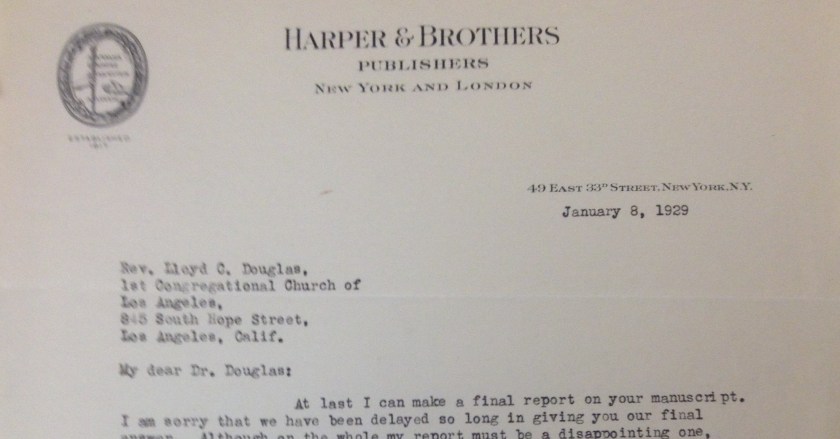
I told you in my last post that Eugene Exman, Religion Editor at Harper and Brothers, was working with the Literary Department in the fall of 1928 to get Douglas’s novel Salvage accepted for publication. In November, Douglas told Exman he had come up with a much better title for the book.

LCD to Eugene Exman, 11/15/1928. In LCD Correspondence 1926-1930, Box 1, Lloyd C Douglas Papers, Bentley Historical Library, University of Michigan. The University of Michigan holds copyright to this item.

“Not at any time have I been entirely satisfied with the name Salvage,” he told Exman. “By the time I had reached the third chapter, the book had outgrown the ‘salvage’ concept.” (And there was a reason for that: because the novel Salvage had now been combined with the thesis of his non-fiction book, Exploring Your Soul, making it an entirely different story than he had originally planned.) “I have hit upon a title now that will be sufficiently cryptic to be intriguing to the reader’s curiosity and yet significant enough to be entirely comprehensible to him in due time. I am calling the book…”

(Drum roll, please…)

“…Thirsty Fish.”

Exman must have blinked a few times before responding. “I must confess frankly that it doesn’t register at all with me.”

Nor with me. There is nothing in his private papers that tells us what the proposed title meant to him. Obviously, a thirsty fish is an oxymoron, for a fish lives in water. In reference to Bobby Merrick, the hero of the novel, was Douglas implying that he was surrounded by material wealth but was poor in spiritual things? Or that the spiritual help he needed most was all around him and he didn’t know it? We simply don’t have enough evidence to guess what Douglas had in mind.

The nearest thing to a clue comes from Douglas’s novel Forgive Us Our Trespasses, although that’s getting way ahead of the story. Near the end of that book, Dinny Brumm gets the idea for a novel called Thirst. It’s based on Ecclesiastes 12:6, in which the Hebrew writer advises remembering God before the time of adversity, “Or ever the silver cord be loosed, or the golden bowl be broken, or the pitcher be broken at the fountain, or the wheel broken at the cistern.” (Douglas was quoting from the King James Version.) The idea here is that the person becomes thirsty even unto death, because he no longer has a way to draw water from the well. But that seems like a very different idea from the image of a thirsty fish.

At any rate, Exman never forgot it. Years later, when he wrote an official company history, he included Douglas and his book as a comical sidenote and livened up the story by claiming that, from the very start, Douglas had sent him the manuscript with it already titled as Thirsty Fish (Eugene Exman, The House of Harper: One Hundred and Fifty Years of Publishing (New York: Harper & Row, 1967), 223.)

Meanwhile, Exman and his associates got down to work reading the updated manuscript. As I mentioned in a previous post, Douglas was in trouble. To avert disruption from a core group of conservatives in his congregation in Los Angeles, he had resigned, effective January 1929. He didn’t have any other positions lined up, and both of his daughters were now studying in Europe. He needed an income – immediately. The new book became more important than ever…

X-Man

by Ronald R Johnson

In the summer of 1928, after Lloyd Douglas had combined his novel Salvage with the non-fiction material he had been working up in Exploring Your Soul, he reached out to his most recent publisher to tell them what he was doing.

Douglas’s non-fiction book, Those Disturbing Miracles, had been published by Harper and Brothers the previous year. Since its release, Harper’s Religion Editor had died and was replaced by Eugene Exman, a young man who had recently earned a Masters degree in Religion from the University of Chicago; his mentor had been Shailer Mathews. Because of the influence Mathews had on Douglas early in his career, it seemed like a good fit. (For more information on Exman, see Stephen Prothero, God, the Bestseller: How One Editor Transformed American Religion a Book at a Time (San Francisco: HarperCollins, 2023).)

Exman was very interested in what Douglas was doing. But there was a problem. Because the book was technically a novel and he was the Religion Editor, he had to refer the manuscript to the Literary Department. And that’s where the problem came into sharper focus: what genre was this book?

It comes down to this: publishing is a business, and it costs money to print books and distribute them to bookstores. Publishers have to believe that they will recoup their losses before they agree to publish a book. In the case of Douglas’s earlier books, they fit neatly under the heading, “Non-fiction, Religious,” and his publishers knew exactly who would buy them: ministers. All they had to do was add up the number of ministers in North America who could reasonably be expected to buy the book, and that would tell them (roughly) how much revenue the book would earn. It wouldn’t be much, but that was to be expected for religious non-fiction.

In the case of this new book, however, it wasn’t clear who would buy it… or whether anyone would. In September 1928, Exman reported to Douglas that there was “a divergence of opinion” among the members of the Literary Department, “and this divergence of opinion [about the book] largely centers on the sale possibility it has…. We all agree that your manuscript does have literary merit,” he said, but they worried that it would not sell enough copies: “in its present form we cannot be sure that it is good enough to get out of the class of ‘just another novel.’” Despite that evaluative term “good enough,” the focus was on sales. “If… you could indicate in a conservative way what demand there would be for the book [in cities] where you have friends, that would also be of distinct help to us in making a final decision as to its publication.”

On an internal memo, William H. Briggs from the Literary Department confirmed that this was the main consideration. After typing a list of suggestions for improvement from a literary standpoint, he then wrote in pen, beside his initials, an estimate of potential sales: 500 to the religious trade and 1000 to members of Douglas’s past congregations. If it was going to be presented to the public as a novel, then their goal was to sell at least ten thousand copies. Beneath this he wrote “general trade” (the general public, in other words) but was unable to make an estimate. That was the point at issue. In order for the book to reach the sales goal, it would have to appeal to the public. Douglas had written the book with a wider audience in mind, but the editors at Harper were uncertain whether the general public would be interested in such a book.

This was the main issue. If Harper did agree to publish the book, would it be most successful if packaged as a non-fiction religious book just like his others, or as a novel? Exman told Douglas that he was strongly in favor of publishing it one way or the other, and that he would push to have it released as a religious work of non-fiction if it came down to that, but he advised Douglas to make the narrative changes that Briggs and others had suggested.

Over the next two months, Douglas made some of the requested improvements. He also changed the name of the story…

The Open Door at The Christian Century

by Ronald R Johnson (www.ronaldrjohnson.com)

Lloyd Douglas didn’t win the Christian Century’s essay contest in the summer of 1920; he took second place. But it didn’t matter…

From the July 22, 1920, issue of The Christian Century, p. 22. Available online at The Online Books Page.

…because his participation in the contest had excited the interest of the editor, Charles Clayton Morrison, and Morrison invited Douglas to submit another article to the Century – right away. “Our readers will be particularly interested in an article from you just now when their attention has been put on the qui vive [on the alert] by your taking one of the honors in the series,” Morrison said. “I hope you will feel not only free, but strongly prompted, to write for us at any time.”

Letter from Charles Clayton Morrison to Lloyd C Douglas, July 22, 1920. In 1918 Scrapbook, Lloyd C Douglas Papers, Box 5, Bentley Historical Library, University of Michigan.

Douglas accepted the invitation immediately. And he didn’t just send one article; he sent Part One of a three-part series. It was called, “Wanted: A Congregation,” and it was some of the finest writing he had ever done up to that time.

Letter from Charles Clayton Morrison to Lloyd C Douglas, August 3, 1920. In 1918 Scrapbook, Lloyd C Douglas Papers, Box 5, Bentley Historical Library, University of Michigan.

Upon receiving the first installment, Morrison gushed, “You write splendidly.” He wasted no time publishing it, even announcing it on the front cover (August 5, 1920), and he encouraged Douglas to send the other two installments as soon as possible.

Notice that Douglas now shares the front cover with John Spargo.

Douglas did better than that: he sent three more installments. But first he asked the editor’s permission. Morrison wrote back pretending to be “quite offended that you felt any inhibition at all in the matter of writing a fourth installment when you were prompted to do so.” He wasn’t really offended; he was delighted that Douglas had been “prompted,” either by his Muse or by the Spirit, to add another installment to the series. “The chances are 102 per cent that whatever you write will be available [he probably means ‘accepted’] for publication in The Christian Century.”

So… now Douglas not only had a series running in the Century, but he also had an open invitation from the editor to send him an article anytime, and to expect to see it published in that magazine.

Elesha J Coffman has written, “In 1920, the Century was not yet a magazine that other papers envied or a place where writers could make their names. By the end of the decade, through savvy and serendipity, it would be both.” (The Christian Century and the Rise of the Protestant Mainstream (NY: Oxford University Press, 2013), p. 63.)

That being the case, Douglas and the Century grew up together, for his frequent contributions beginning in 1920 made his non-fiction writing well-known among America’s Protestant clergy, and at the end of that decade, The Christian Century would play a major role in making him a world-famous novelist.

For a free PDF copy of the booklet, The Secret Investment of Lloyd C. Douglas, fill out the form below:

← Back

Thank you for your response. ✨

Lloyd C Douglas, Contestant

by Ronald R Johnson (www.ronaldrjohnson.com)

I’ve been telling you about the essay contest that Lloyd Douglas entered at The Christian Century during the Spring/Summer of 1920. The contest was prompted by John Spargo’s article, “The Futility of Preaching,” published May 20, 1920, in the Century.

Douglas’s response, “Preaching and the ‘Average Preacher'” was published anonymously, along with the essays of five other contestants, on July 1, 1920. The issue included a ballot for readers to choose the three best essays.

From the July 1st, 1920, issue of The Christian Century, p. 28. Available online at The Online Books Page.

Meanwhile, the Century’s editor, Charles Clayton Morrison, asked John Spargo to read the six anonymous essays and write a follow-up article in response. Spargo’s reply was published in the July 22nd issue. Notice how Morrison took a single submission (Spargo’s initial article published May 20th) and kept his readers interested in that one article all the way through July and beyond. He paired this with an advertising campaign that told potential readers what was happening. It was this kind of maneuvering that made the Century grow into a successful magazine.

For the most part, Spargo’s reply was general, telling his readers more about himself and his views. He only got angry at one of the contestants. Guess who!

Of course, in this discussion, as in every other, we have the quibbler who is less concerned to establish the essential truth than to score debating points. Shall I confess that I was amused by the sophomoric intensity of one of the writers in his attempt to demonstrate that my use of the term ‘average preacher’ was unscientific and an evidence of the fact that my views were not entitled to serious consideration?

John Spargo, “More about Preaching and the Ministry,” The Christian Century, July 22, 1920.

Amused? I don’t think so. His irritation is clearly displayed in his next remarks:

Of course, this is the characteristic spirit of the Medieval schoolmen that made theology such a terrible incubus upon religion. In the practical affairs of life, this good brother, not animated by sectarian dogmatism or pride, would not think of invoking such a rule. If his neighbor declared the day to be an ‘average’ one, he would not demand that the statement be accompanied by a statistical analysis of the meteorological records. Similarly, if a brother minister declared that he had a good ‘average’ congregation, the writer in question would not think of demanding verification of the statement in statistical terms. I emphasize my reference to this quite incidental and essentially irrelevant criticism because it illustrates the vicious narrowness of a mind fostered by ecclesiasticism. The plain, forthright speech and straight and direct thinking characteristic of honest men in their ordinary intercourse and business relations do not suit a certain familiar type of theologian or an equally familiar type of ecclesiastic.

Ibid

Ouch! He’s right, up to a point: his use of the term “average minister” wasn’t as important as Douglas made it out to be, and Douglas did use it to “score debating points.” But this wasn’t Douglas at his best. On any other occasion, Lloyd Douglas was nothing like the Medieval schoolmen, nor was he guilty of “the narrowness of mind fostered by ecclesiasticism.” It’s unfortunate that these two gifted men were pitted against each other so that it was practically impossible for them to appreciate each other’s talents.

Meanwhile, readers were now encouraged to await the results of the vote, in which they would discover exactly how many “debating points” each of the anonymous contestants had won.

To be continued…

For a free PDF copy of the booklet, The Secret Investment of Lloyd C. Douglas, fill out the form below:

← Back

Thank you for your response. ✨

Douglas and the Contributors’ Club

by Ronald R Johnson (www.ronaldrjohnson.com)

In my last post, I told you that Lloyd Douglas wrote anonymously for the Atlantic Monthly as part of the Contributors’ Club. Here’s a summary of each of the essays he published.

An Interrupted Homily (November 1917)

His youngest daughter, Virginia, shows him a shoebox containing “trained ants.” Douglas listens carefully but can’t quite understand the difference between “trained” and “untrained” ants. After she leaves, he wonders (by analogy) what practical difference there is between Christians and non-Christians if the United States and Britain truly are “Christian nations.”

International Pitch (November 1918)

Douglas tells about a conversation he had with a musicologist. “C is always C, no matter what else may change in the world,” the scholar tells him. And this leads Douglas to think about how greatly the world is changing as WWI comes to an end.

By-Products of Higher Education (June 1919)

Douglas describes an eccentric older woman from Ann Arbor who has a habit of popping in on lectures at the University of Michigan and asking the young professors challenging questions.

Accidental Salvation (September 1919)

An angry man who mistreats his wife and kids is walking around the house in his bare feet when he steps on a needle. Pulling it out of his foot, he discovers that the tip of it is missing and assumes it’s traveling in his bloodstream and will cause his death at any moment. The following morning, surprised to have survived the night, he begins putting his affairs in order and, among other things, becomes a good husband and father. His wife never tells him she found the tip of the needle in the carpet the next day. (Years later, Douglas would rewrite this as a Christmas story called Precious Jeopardy.)

Barrel Day (May 1924)

Beginning with a local (Akron, Ohio) custom of libraries putting barrels outside for people to return their overdue books no-questions-asked, Douglas daydreams about starting a new “Barrel Day” custom in which people return things they’ve borrowed from each other and have kept so long that they’d be ashamed to admit it now.

As you can see from the example above, the Contributors’ Club just ran these essays one after the other without by-lines. We know that Douglas wrote these five essays because his scrapbooks contain not only the copies of them but also the acceptance letters from the editor, Ellery Sedgwick.

And there’s another piece of evidence. In the 1980s a couple of researchers actually went through all the magazine’s check stubs to see who received payment for these anonymous contributions. They gave Douglas credit for all five of the essays he included in his scrapbooks. (Philip B Eppard and George Monteiro, A Guide to the Atlantic Monthly Contributors’ Club (Boston: G. K. Hall & Co., 1983).)

But even though he didn’t get to see his name in the Atlantic, Douglas was proud to be part of the Contributors’ Club (I found it in at least one of his bios); and rightly so. It made him part of an elite group, and he received helpful feedback in his writing. He didn’t always accept the advice he was given, but it was still good for him to hear it. On “Accidental Salvation,” Sedgwick thought the last sentence was weak. He suggested that Douglas replace it with something more “snappy.” Douglas did change the last sentence, but not to the editor’s liking. Sedgwick went ahead and published it, but he told Douglas he thought it could’ve been better. Take it from me: when you get a comment like that from an editor, it sticks with you! And you think about it the next time you write something similar. Knowing Douglas’s sensitivity to his audiences, I’m quite sure he took Sedgwick’s criticism to heart, and it made him much more aware of concluding each of his stories and essays in a way that would be emotionally satisfying to his readers.

But there was another periodical that played a more important role in Douglas’s life. I’ll tell you about that in the next post.

For a free PDF copy of the booklet, The Secret Investment of Lloyd C. Douglas, fill out the form below:

← Back

Thank you for your response. ✨

A New Start

by Ronald R Johnson (www.ronaldrjohnson.com)

Lloyd C Douglas, circa 1911-1912. From a promotional brochure in his 1909-1915 scrapbook.

Something happened to Lloyd Douglas between 1912 and 1913. In the previous post I told you that, in 1912, he invested secretly in Roger Zombro by writing anonymous ads for him in the Daily Illini. Neither of the two men ever mentioned it, but I have a lot of evidence to back up that hypothesis. (I have included it in the booklet The Secret Investment of Lloyd C Douglas, available upon request.) Of all the evidence I have gathered, the most important is this: Douglas’s writing style changed between 1912 and 1913, the exact period during which the anonymous “Zom” ads began running in the student newspaper.

Douglas had always been a powerful writer, but his earlier essays were intense. His sense of humor shined through, too, but overall he came across as a very serious young man. In the fall of 1913, though, he began displaying a more relaxed, whimsical style that would characterize his writing for the rest of his life. He was still a powerful writer, but he exercised that power in a new way: through a nonchalant, humorous presentation somewhat like that of Mark Twain. Prior to this, he reached out and grabbed you by the lapels with his writing, but now he disarmed you with humor and casually persuaded you. I believe it was his anonymous work on the “Zom” ads that gave him this breezy new way of expressing himself; but even if I’m wrong about the cause, the effect is obvious. In 1913, Douglas found his voice as a writer.

And there was something else: prior to this, Douglas’s writing was religious. It was church-oriented. In 1913, he put that behind him. He spoke as one who was deeply acquainted with the day-to-day lives of real people, both students and faculty. He focused on the things that mattered to his readers.

We see his new style exhibited in a weekly column he wrote in the Daily Illini called “The Sunday Sermonette” (later changed to “The Weekly Sermonette”). He doesn’t sound like a young man anymore; he sounds like a wise older man with a sense of humor and a very light touch. There were flaws in these “sermonettes” – they were often paternalistic and somewhat patronizing – but they were popular and down-to-earth, and they set a course for all of his future writing. For example, when he moved to Ann Arbor, Michigan, in 1915, he started writing a weekly column in one of the local newspapers called, “The Saturday Sunset Sermonette,” aimed more at the townspeople than the students. The “sermonettes” in the Daily Illini set the pattern.

Here are some examples from the Daily Illini column:

On writing home to Mother: “If you wish to make a distinct hit with her, tell her how you are faring as to creature comforts. Since you came upon this planet, her chief concern has been your physical well-being. She was always glad, of course, when you exhibited any interest whatever in the development of your mind or the culture of your soul; but her first thought for you has always been cast in terms of food, clothes, shelter. Tell her where you are living. Draw a map of the house, showing the position of your room. Draw a diagram of the room, indicating doors, windows, closet, registers, book-cases – where you sit when you study, etc.” (“The Letter Home,” Daily Illini, Sunday, September 28, 1913, p. 4).

On rags-to-riches stories: “Reacting against an ancient notion that a man must be hereditarily rich and influential to achieve greatness, book markets of our country are glutted with biographies of eminent men who came up into positions of trust and honor from homes of poverty…. In view of the highly prosperous state of our civilization, perhaps it might be just as well to ease up a bit now on advice for the poverty-stricken and make some effort to provide an inspirational pabulum upon which the rich man’s son may feed” (“Washington,” Daily Illini, Sunday, February 22, 1914, p. 4).

On hanging out with the crowd: “The student who fails to provide for an occasional hour by himself becomes about as original and inventive in his thought and speech as the funnel of a phonograph” (“The Man Himself,” Daily Illini, Sunday, October 5, 1913, p. 4).

On rushing around campus, taking oneself too seriously: “Many people here, students and others, are afflicted with a ‘busy’ bee. They maintain the breathless attitude of one who leaps from an engagement brimful of crisis to another even more fraught with fearful consequences…. Cold-blooded as it sounds to say it, the world was hobbling along – handicapped, to be sure, but managing to struggle painfully along – before any of us arrived and it is… possible that the world may continue to do business when the grass is a foot high over the place where our tired bodies rest from their frenzied scramble to attend to so many important things at once” (“How Doth the Little Busy Bee?” Daily Illini, Sunday, April 26, 1914, p. 4).

These are just a few examples. A little later (the 1914-1915 school year), he also began writing “Pen Portraits” of the university’s top administrators. As with the “Zom” ads, he published them anonymously – only this time his identity was revealed. I’ll tell you about it in my next post.

To receive a free PDF of the booklet, The Secret Investment of Lloyd C. Douglas, fill out the form below:

← Back

Thank you for your response. ✨

What Douglas Wanted Most

by Ronald R Johnson (www.ronaldrjohnson.com)

Sometime while he was pastor at Luther Place Memorial Church in Washington, DC (between Fall 1909 and Summer 1911), Lloyd Douglas preached a sermon that must have puzzled his parishioners (Lloyd C Douglas, The Living Faith (Boston: Houghton Mifflin, 1955), pp. 14-21).

He claimed that the local congregation was like the Bethesda Pool in the fifth chapter of the Gospel of John. Paralyzed people gathered on porches around the pool because it was rumored that an angel sometimes stirred up the waters, giving them momentary healing powers; the first to wade in would be made whole. Of course, those most in need were never able to reach the water first. “Some of our churches are like that Pool of Bethesda,” he argued. “They are handsomely equipped…. But there seems to be such a noticeable lack of provision for bringing in just the people who are in such obvious need of its curative agencies.”

It was not enough for the churches to welcome visitors, he said. There had to be a way to get the gospel out to people rather than just trying to bring them in. The members of Luther Place Memorial Church must have wondered what Douglas was talking about, because Douglas’s predecessor, Dr. J.G. Butler, had been very effective at reaching out to the larger community, not only by being chaplain of both the House and the Senate, but also by mentoring young black men who were called to ministry. The church even had a health clinic run by one of Butler’s sons, who was a doctor. So why was Douglas saying that the church needed to find a way to get its “curative agencies” out to the people who needed it most?

Because Douglas wasn’t talking about social programs. He was talking about accessing the power of God and putting it to work in our lives, and he was saying that the church had not yet found a way to get this access out to the people who would never come to church. For him, the gospel was not so much about church attendance as about harnessing divine energies to make the world a better place. The mission of the church was to get that power into people’s hands – even people who did not attend church. In his sermon on the Bethesda Pool, he said that, if he knew how to accomplish this, then “by next week I would be figuring in headlines an inch high in a thousand metropolitan papers.” Although this was an expression of youthful hyperbole, it shows just how important this issue was to Douglas. He wanted to articulate a gospel that would have practical effects in everyday life, and he insisted on taking that message to the larger public.

Although no one who heard that sermon probably realized it, he was telling them the thing he wanted to accomplish above all else. And the missing puzzle piece was this: he wanted to reach people outside the church through his writing.

Although his parents groomed him for the ministry from a young age, he seems to have sensed an even deeper calling to be a writer. Nor did he just want to publish sermons and religious essays. For as far back as his scrapbooks take us, he was kicking around the idea of writing something for the mass reading public, and what he had in mind was fiction. In his letters to friends and family, he made light of this aspiration, calling himself “a scribbler” and speaking as though his passion for writing were an addiction.

In a letter to his cousin Edith Kirkwood in 1910 (while he was pastor at Luther Place), he said, “Lately I have revived an old slumbering passion for writing yarns. Not long ago I sold a small ornament off my desk to Eddie Bok [an editor] and the sight of that check, with its beautiful corrugated edges – albeit it was not for more than two figures – started up my old trouble; and the gnawing at my vitals… has compelled me to scribble some more. God help the preacher who isn’t content to stick to his parish duties!… I have a lot of old mummies in my ecclesiastical museum who would feel that Hell had opened up its maw (and its paw, for that matter) to embrace me, were the news to out that I had disgraced the profesh and besmirched the cloth by writing fiction. I shall spare them the discomfort by seeing to it that nobody finds out. I am now on the hunt for a satisfactory nom-de-plume…” (Quoted in Virginia Douglas Dawson and Betty Douglas Wilson, The Shape of Sunday: An Intimate Biography of Lloyd C Douglas (Boston: Houghton Mifflin, 1952), p. 66.)

In 1910 he was willing to keep his fiction writing a secret by using a pen name, but a year later, when the YMCA offered him a job and a chance to say “Good riddance” to the “old mummies,” that seemed like a better plan. As it turned out, he didn’t tell his employers at the Y that he was writing fiction, either, but that was all right; his fiction wasn’t good enough to display yet. At this phase in his life, he had a lot to learn about the craft of writing fiction. The point is this: his devotion to “scribbling” went so deep, he couldn’t beat the addiction, even though he felt guilty about indulging in it while being a man of the cloth. But deep down, he always believed he was going to make it as a writer. It may seem like a small thing, but take a look at the opening page of his very first scrapbook in 1903.

That’s more than a signature; if I’m not mistaken, he was practicing his autograph – the same one he used years later to sign copies of his bestselling novels. Here’s a signed copy of the inside page of Forgive Us Our Trespasses, published almost thirty years later, in 1932. It is practically identical:

Lloyd Douglas the Author was always there in germinal form, even while he was working so hard to establish himself as a minister. And he obviously felt those two things were incompatible, at least in the minds of some of his parishioners.

Over the past several blog posts, I’ve addressed the question, “Why did Douglas resign his important post at Luther Place Memorial Church to work for the YMCA?” So far I’ve answered this question in bits and pieces, but now I’m ready to pull it all together into a coherent explanation.

Douglas resigned for many reasons, most of which he kept concealed. He wanted to go back to school and get the kind of education he could only get from a state university. At that institution, he wanted to rethink his theology and align it with the latest, most up-to-date information available. Pursuant to this goal, he wanted to leave the Lutheran Church and start fresh with some other denomination. And he wanted to do all this not only so that he could preach again, but – more importantly – because he wanted to write something… probably fiction. He couldn’t quite put his finger on it. If anyone had asked him in 1911, he would have been incapable of telling them what he had in mind. But he did have something in mind, and he sensed that he would never bring it to full expression unless he could shed his current social limitations and start over.

And that’s why Lloyd C Douglas moved his family west to Champaign, Illinois in the Fall of 1911. He had great hopes. But he was taking a tremendous risk.

For a free PDF of the booklet, The Secret Investment of Lloyd C Douglas, fill out the form below:

← Back

Thank you for your response. ✨

Design a site like this with WordPress.com
Get started