The Godless Girl

by Ronald R Johnson

Samuel “Bozo” Johnson (Eddie Quillan) declaring himself an unbeliever by placing his hand on the head of a monkey, while Judy, the Godless Girl (Lina Basquette), looks on. From https://silentfilm.org/the-godless-girl/.

In the summer of 1928, De Mille released his last silent movie: The Godless Girl. The “girl” mentioned in the title was busily winning her fellow high school students away from God, inviting them to clandestine meetings in which they would publicly declare themselves unbelievers while placing one hand on the head of a monkey. This was, of course, a comical reference to the theory of evolution, which De Mille thought should not be taught in the public schools.

After seeing this film, Lloyd Douglas preached a sermon about it on August 26, 1928, at the First Congregational Church of Los Angeles. (It’s included in “Sermons [1],” Box 3, Lloyd C Douglas Papers, Bentley Historical Library, University of Michigan.)

Douglas described the scene:

“We have here the dramatic spectacle of a large hall, secretly secured, stealthily approached, up a half-dozen flights of rickety stairs, a hall crowded with high school youngsters. This is not offered as an unusual and inexplicable thing that happened somewhere, once, under strange and unaccountable circumstances. No: this is offered as a fair and normal sample of what is going on in high schools of this country.

“The meeting is presided over by a young fanatic, the Godless Girl, who frantically points to a drawing on the wall, replete with ridicule of God, and everybody interested in God. Converts are urged to come forward and take the pledge to abjure God and religion. This they do by putting one hand in the air, in the conventional sign of taking an oath, and the other hand laid upon the head of a monkey, which is the symbol and talisman and fetish of the new order that has staked its claim to knowledge of life on a materialistic biology.

“Now, it is exactly at this point that I, as a believer in an intelligent appraisal of the Christian religion, want to raise an indignant protest. For several years, the people who have been earnestly endeavoring to offer to our youth a system of religious belief which they can hold with intellectual self-respect, have been under heavy fire at the hands of the literalists and tradionalists, who interpret all scientific knowledge in terms of monkeys. If I don’t believe that Jehovah stacked up a pile of dirt and called it a man, and then took a rib from the man and called it a woman, then, perforce, I am an infidel who thinks his forefathers were chimpanzees.

For one, I am all tired of the monkey talk, and the monkey talkers! And the spectacle of a great roomful of eager, serious-minded high school boys and girls pledging their open hostility to God and religion by putting their hands on a monkey’s head, and swearing allegiance to a monkey gospel, is not only willfully and meanly untrue to the facts, but encourages the silly notions of certain classes of well-meaning but uninformed persons, that an intellectual appraisal of religion is, after all, consonant with atheism.

Later in the film, the principal characters are in a reformatory. As Douglas says:

A Bible figures in the scene. The girl who kisses it and makes soft eyes at it is religious. The girl who impatiently tosses it on the floor is an atheist. Here you have a specious form of heathenism—relic of the old obsolescent notion that the Bible… is a fetish. You don’t have to know anything about it—who wrote it and why—all you need to do is hug it and kiss it, make eyes at it – a type of benighted paganism that this age really should have outgrown!

This was Douglas’s main complaint. While he was trying to reach young people by appealing to their intelligence, so very many ministers and laypeople (aided by movies like this one) were declaring war on science, on education, and on the free exercise of the human mind. The problem, he said, “is not atheism at all… The modern student’s difficulty is complete indifference to the kind of religion that is to be had in the typical church.

Nobody can tell me that the youngsters think they have outgrown a need of religion, or emancipated themselves from God. Their seeming air of indifference is due to the fact that they have been invited by the churches to take their pick, whether they will accept a jumble of legends inherited from ancient Jewry as an adequate interpretation of life’s origin, meaning, and destiny, or repudiate the whole business and call themselves atheists! They would sincerely like to know whether they are permitted to have a religion.

“Permitted to have a religion”! That was the issue. More and more, the most vocal proponents of Christianity in America were forcing young people to choose between the things they were learning in high school and college, or the truths of the Bible as interpreted by those who had never been educated. If those young people found it impossible to deny what they had seen with their own eyes in the laboratory, then they were being told they could not call themselves Christians.

A little minority of churches is attempting to show them that they can; that spiritual energies are real; that a man can lay hold upon the power of the presence of God, and make use of that human-divine contact in every endeavor of his life and still pursue his work in the laboratories with a deep respect for the truths of modern science.

But mighty little encouragement do these churches receive. On the one hand they are bombarded by the so-called Fundamentalists who, apparently, would rather see the children lost to the church and indifferent to religion than to budge an inch from the mouldering wall of sixteenth-century dogmatism. On the other hand, they are misinterpreted by a casual public that has been fed up on talk of monkeys and the high importance of kissing Bibles… until it’s not much wonder if an intellectual estimate of religion, these days, is hard to arrive at.

This was the crux of Douglas’s complaint. The sermon ended up in the newspaper, and a reporter asked De Mille what he thought of Douglas’s remarks. I’ll tell you about his response in my next post.


Lloyd Douglas’s Criticism of The King of Kings

by Ronald R Johnson

A still from The King of Kings. From The Autobiography of Cecil B De Mille (Englewood Cliffs, NJ: Prentice-Hall, 1959).

Although Lloyd Douglas initially spoke highly of Cecil B De Mille’s The King of Kings in 1927, a year later his remarks were a bit more negative. And what he disliked about the film tells us more about him than about the film itself. During a sermon he preached on 8/26/1928 at the First Congregational Church of Los Angeles, he said,

“It was a very beautiful and very impressive picture… But – when it was all done – the sum total of it was a confirmation of the quite general belief that Jesus was essentially a magician. A morose, anaemic, death-bound juggler, who performs amazing feats of magic – mostly to the advantage of other people, and done in the utmost kindness, to be sure – but, an oriental juggler, nevertheless, whose ministry was punctuated with inexplicable deeds which brought vast crowds about him to see him do tricks.

“Now, the sad part about this type of appraisal of the character of Jesus is that instead of bringing him closer to the average man, and encouraging discipleship to his theory of living, it has the effect of making Jesus more remote” (from “Sermons [1], Box 3, Lloyd C Douglas papers, Bentley Historical Library, University of Michigan).

Douglas then went on to illustrate this point:

He stills the storm with a word of command. Very good: I cannot do that, so we will check that item off as being impossible for me… He asks me to follow him; to be like him; to do as he does – but I cannot do that, so he and I have nothing in common at that point.

Water into wine? Not for me. I can’t do it!

Paying taxes by catching a fish with money in its mouth? Not for me – it isn’t that easy – for me.

‘Be thou healed,’ says Jesus to the blind man… But not for me, or you. It’s not that easy. We have to build big hospitals, and train surgeons, and raise huge budgets to attend to our altruism and works of human rehabilitation.

‘Lazarus – come forth!’ shouts Jesus when his friend is dead and four days in the tomb. But not for you, or me. It isn’t that simple. How passionately we wish we could make our voices heard by our dear departed! But no, we must console ourselves with our hope and faith, believing where we cannot see!

No – the Christ who is able to offer helpfulness to us in our perplexities must stake his claims to our discipleship on the likeness between his life and ours – his powers and ours – his difficulties and ours. Discipleship must be predicated upon our points of likeness, rather than upon our points of dissimilarity. If I follow Jesus, it is because we have much in common.

He must be portrayed as a norm of human character, so linked with God, spiritually, that he makes adequate use of divine power – exactly the same use that any man may make of divine power who confidently seeks it, and righteously employs it.

If these examples sound familiar, they should. This is very close to Dr. Bruce McLaren’s remarks in Chapter 18 of Salvage, as I mentioned in a previous post. Like his fictional character, Douglas believed that emphasis on Christ’s miracles was counterproductive, from the standpoint of daily discipleship. He stated again that he had nothing against De Mille himself: “However I might be inclined to disagree with Mr. DeMille in his appraisal of Jesus, I have the deepest respect for his motive. It is obvious that he would like to make a genuine contribution to the religious thought and Christian idealism of the public. If the average preacher were to go to a tiny fraction of the pains and research and consecration that Mr. DeMille invested in the making of that impressive picture of the Life of Christ, our churches would leap forward into a larger influence.”

But…

The trouble was: Jesus was not presented as an ideal type of spiritual energy in action, in the normal conduct of life, and common affairs of daily duty, where our human problems reside; but he was portrayed as one who possessed a power to which no one of us has access. Indeed, if the calm logic of the drama be considered, the picture was likely to send a man out of the theatre saying: Well, that settles it! If that was Jesus, then he and I can never possibly get together… He and I are not in the same category… And I cannot conceive why I should be invited or expected to follow him, or be like him, or indulge any hope that I might avail myself of the spiritual power he possessed.

Douglas’s disagreement, of course, was not with De Mille but with the traditional view of Jesus. Through his own life experience, Douglas had come to believe that Jesus’ teachings were much more important than any of the stories of his deeds. Christians, he felt, had for too long neglected Christ’s teachings because of their focus on his miracles. Douglas was trying to bring about a course correction in Christian life. Although he admired De Mille’s movie-making, he found it necessary to disagree with his approach.

In the summer of 1928, however, while Douglas was writing Salvage (the novel that would be retitled later as Magnificent Obsession), De Mille released a film aimed at young people, a group very dear to Douglas’s heart. It was called The Godless Girl, and it dramatized De Mille’s belief that the public schools were being taken over by atheists. Central to the film’s message was the claim that the theory of evolution was of Satanic origin. When Douglas saw this movie, he couldn’t keep quiet, and De Mille got involved. I’ll tell you about that in my next two posts.

The Gospel According to De Mille

by Ronald R Johnson

Book cover from The Autobiography of Cecil B De Mille (Englewood Cliffs, NJ: Prentice-Hall, 1959).

I’ve been telling you about the work Lloyd Douglas was doing on his novel, Salvage, during the summer of 1928. But that same summer he also clashed swords publicly with filmmaker Cecil B DeMille. I’ll tell you about their public disagreement in a later post, but for the next two posts I want to give you some background, for Douglas had already written about DeMille a year before they ended up in the newspaper together.

In the summer of 1927, De Mille’s The King of Kings was in theaters around the country. It was a two-and-a-half hour silent film, but for its day it was quite a spectacle.

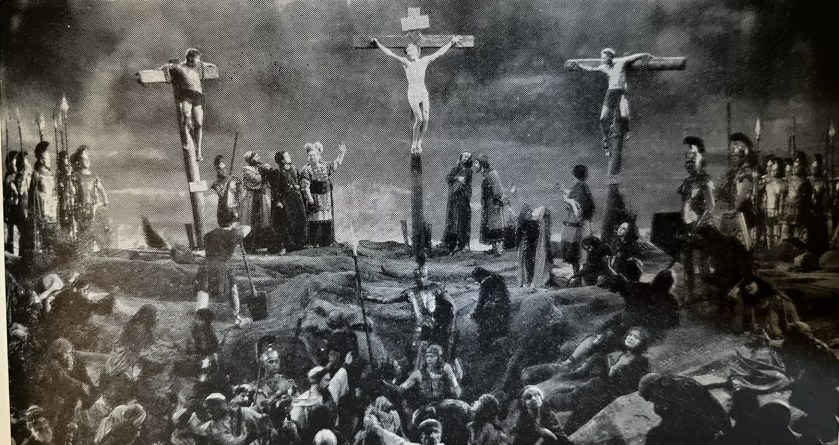
A still from De Mille’s 1927 film, The King of Kings. From The Autobiography of Cecil B De Mille (Englewood Cliffs, NJ: Prentice-Hall, 1959).

Much of the dialogue was straight from the scriptures, and the chapter-and-verse citations were even included; but the scriptural context was often disregarded. Events and quotations were all jumbled up, like a weird black-and-white dream. After Jesus cleanses the temple, the crowd tries to make him king (confusing that scene with events in John 6), so he escapes to the top of the temple and then (again out of order) is tempted by the Devil. Early in the film, Simon Peter speaks to a young boy and says something straight out of one of the Epistles of Peter – written decades later.

The way Christ is introduced is interesting, but also a bit confusing. We see his disciples talking to him, but we don’t see him. Then a blind child is brought to him to be healed, and the screen goes black, showing us what the child sees. When the child’s eyes open, we see a bright light, which dissolves into the smiling face of the well-known silent-movie actor, H. B. Warner. It takes a moment to realize that he’s actually supposed to be Jesus. “Oh… okay then.”

It’s also rather distracting, at Christ’s crucifixion, to note that the thieves on either side of him aren’t nailed to their crosses; they’re just tied to them, and they don’t look like they’re going to die anytime soon.

But still, for its time it was quite a spectacle. Lloyd Douglas thought so, too. He wrote an article about it in The Christian Century (Lloyd C Douglas, “The Gospel According to De Mille,” Christian Century, 7/14/1927). The fact that Douglas was the pastor of the First Congregational Church of Los Angeles made the essay seem like on-location reportage, although it wasn’t.

Of DeMille himself, Douglas was highly complimentary: “Not only does this man know his New Testament, but he has ransacked the entire lore of that era. If the average preacher gave himself with as deep concern to the business of revitalizing the story of Jesus and his times, churchgoing would be vastly more rewarding.”

Of the film’s depiction of Jesus, however, Douglas was critical: “One is conscious, throughout the whole spectacle, that one is seeing the traditional Roman Catholic conception of a Christ who has come to earth primarily to die. Let all the people about him do or leave undone whatsoever they will; befriend or harass; condemn or crown; he is here to die—and everybody is waiting, nervously, for the tragedy. Jesus, in the picture, moves about slowly and sadly, with the air of one already unjustly convicted. Now and again, there is a gesture of futility more reminiscent of Omar Khayyam than Jesus of Nazareth…. The shadow does not lift….

“Persons who think of Jesus as the world’s master teacher, chiefly concerned with the spread of a new message of hope and joy, the promotion of victorious idealism, the development of a broader altruism, the building of a kingdom of heroes, are not quite content with so supine and languid a Christ as the abstracted, detached, time-marking, sighing Jesus who dominates the stage in ‘King of Kings.’”

Douglas liked the film’s depiction of the miracles. He felt it demonstrated just how ridiculous it was to picture Jesus as a worker of wonders. He hoped that “Persons who have been uncertain whether the magician-Jesus is quite adequate to deal with the baffling problems of these modern times, in which there is so little room for necromancy in the thought of intelligent people, will be encouraged by ‘The King of Kings’ to make a fresh examination of the essential character of Christ.”

Overall, Douglas gave the movie high marks, considering the fact that De Mille’s views were conservative and Douglas’s were liberal. Over the next several months, however, he became more critical of the film. I’ll talk about that in my next post.

Design a site like this with WordPress.com
Get started