Over the past several weeks I’ve been sharing Lloyd Douglas’s articles in The Christian Century during the summer and fall of 1920. He had made his debut in the July 1st issue, and the editor, Charles Clayton Morrison, had urged him to send another submission while his name was fresh in the memory of the Century’s readers. Douglas did even better: he sent a five-part series called “Wanted – A Congregation!”
After the first two installments, Morrison printed the following response:
From the Letters to the Editor in the Christian Century, 8/26/1920.
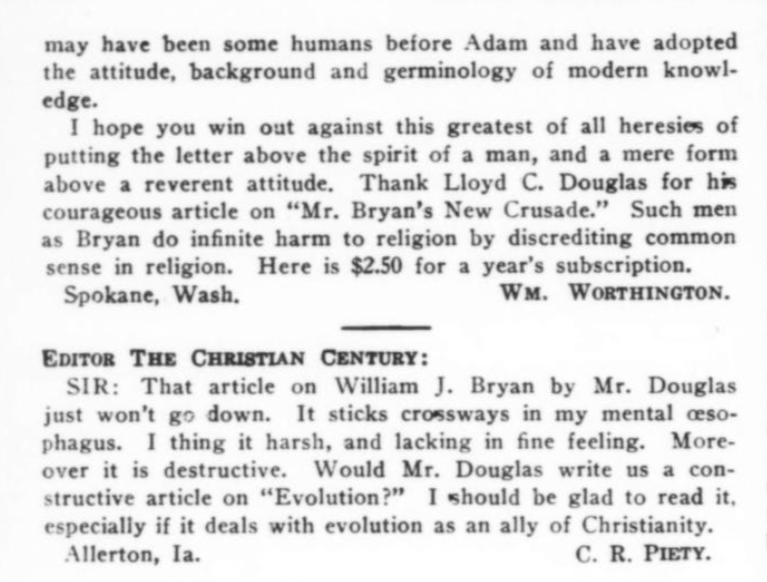
In November, Douglas fired off an article criticizing the politician William Jennings Bryan for speaking against science in general and evolution in particular at the University of Michigan, where Douglas was the resident Congregationalist minister. That article prompted a couple of letters from readers:
From the Letters to the Editor at the Christian Century, 12/23/1920.
Because Morrison was eager to publish controversial material that would increase readership, he was happy to print Douglas’s articles and especially liked his spicy way of arguing his points. In the coming months, Douglas would continue to accommodate the editor’s desire for hard-hitting essays. I’ll tell you about more of them in my next posts.
From Lloyd C. Douglas, “Mr. Bryan’s New Crusade,” published in The Christian Century, 11/25/1920.
[The following is the conclusion of Lloyd Douglas’s essay, “Mr. Bryan’s New Crusade,” published in The Christian Century on November 25, 1920. He writes:]
“A few days ago this eminent lecturer spoke to a large audience of laymen in Chicago. The chance was his to make a notable contribution to that convention. What does it get from him? Why – the monkey jokes, of course! And the red cow! It is to be presumed that hundreds of laymen, going home from that convention under the impression that they had heard a great scientist speak his mind about evolution, will be on the alert now to detect the slightest deflection from orthodoxy on the part of their pastors. Let the good brother phrase his remarks in the language of modern scholarship, insisting upon a faith that may be held without damage to one’s intellectual self-respect, and he takes a chance of hearing unfavorably from the deacon who has just returned from the convention where ‘Darwinism’ – and all things scientific – had been weighed and found wanting.
“I write this partly to relieve my feelings, but mostly because there is no doubt in my own mind that we ministers, who have thought our way through these problems at no little cost of time and effort, should refuse any longer to tolerate such presentations of religion as that indicated above, if we may by any possibility put a stop to it! For Mr. Bryan to speak in any presence concerning the relation of religion and science is a piece of presumption! King David prayed, ‘Keep back thy servant also from presumptuous sins!’ David apparently considered this a serious offense – presumption. And David, being something of an expert on sinning, surely ought to be an authority.
“One is not forgetting that Mr. Bryan is a great and good man who means well and is loved devotedly by great masses of people. He has it in him to make a large contribution to religion. But however rich and active may be the wine of his faith and his enthusiasm, he really ought to stop trying to vend it in the old bottles. Oh – oh – but how fearfully old are the bottles!”
From Lloyd C. Douglas, “Mr. Bryan’s New Crusade,” published in The Christian Century, 11/25/1920.
[The following is a continuation of Lloyd Douglas’s essay, “Mr. Bryan’s New Crusade,” published in The Christian Century on November 25, 1920. He writes:]
“Every year, in most of our great universities, the student is asked to state his religious convictions at the time of his registration. He is requested to name the denomination to which he belongs, or the denomination he prefers, if not a member. After the cards had been handed to me, this year, which belonged to my denomination, it occurred to me that some interest might attach to a comparison of these registration cards with those of last year. I would see how many students who registered last year as of the faith of which I am an adherent were registered this year as ‘without religious convictions.’ The investigation showed no case of the kind. To the contrary, there were sixty-nine students who stated last year that they were without religious convictions who announced, this fall, that they were adherents of our faith. It is not true that the freshman inevitably comes to the university to surrender his faith. But it is true that many a chap is obliged to come into a university community to find his faith!
“Mr. Bryan does not know this. Nobody ever told him. He never inquired. He would not believe it if he were told. He doesn’t want to believe it. It would dampen his enthusiasm about the awful effects of modern science upon Christian faith. Then he would lose heart for the monkey jokes. And the monkey jokes must be told. And the red cow – the same old red cow – must she not still eat green grass and give white milk to yield yellow butter?”
[Douglas will conclude his essay in my next post…]
From Lloyd C. Douglas, “Mr. Bryan’s New Crusade,” published in The Christian Century on 11/25/1920.
[The following is a continuation from Lloyd Douglas’s essay, “Mr. Bryan’s New Crusade,” published in The Christian Century on November 25, 1920. He writes:]
“The total result of the Bryan address to his university audience was disgust on the part of religious people – both faculty and students – disgust over the speaker’s intellectual immorality, to say nothing of the crass impudence displayed by such an exhibition of ignorance before an audience of that character. But the really serious fact about the performance resided in the effect produced upon the students who never go to church, manifest no interest in religion, and who think of Christian faith with as little knowledge of its present-day claims as Mr. Bryan has of biology – which is next to nothing. This type of student understands that Mr. Bryan is a widely known and generally recognized religious leader in the country – frequent spokesman before ecclesiastical conclaves, and a general defender of the faith. The student is informed, from this respected quarter, that, to be a Christian, he must repudiate that which his own eyes have seen in the laboratory and believe certain ancient dogmas which he cannot hold without the sacrifice of his intellectual self-regard. It is extremely doubtful if Mr. Bryan will ever be invited to speak before this group again. But the damage is done!
“While we are on the subject – how much truth is there, after all, about the deplorable loss of religious faith which Mr. Bryan notices in academic circles? Let us see. Many people who do not know the facts are persuaded to believe that the typical freshman comes to the university firm in the faith of his fathers, fresh from Sunday School, convinced that the Bible is to be accepted as a textbook on geology, anthropology, astronomy, and all the rest of the natural sciences. After he has been here for a year or two, he loses his faith, becomes a cynic and a scoffer, flaunts his atheism or his infidelity, and repudiates religion as of no further use to him. What are the facts about this matter?”
[Douglas, having spent the past decade on major Midwestern college campuses, will give his answer in my next post.]
A page from Lloyd C. Douglas’s article, “Mr. Bryan’s New Crusade,” in the November 25, 1920 issue of The Christian Century.
[The following is from Lloyd Douglas’s essay, “Mr. Bryan’s New Crusade,” published in The Christian Century on November 25, 1920. He writes:]
“A few days ago, Mr. Bryan lectured, on a Saturday night, in the auditorium of a great Midwestern university [probably the University of Michigan, where Douglas was the Congregational minister]. No monkeys appeared in the lecture. Indeed, it was a good address – old, commonplace, but acceptable. There was a large crowd. The students were enthusiastic. The Students’ Christian Association pressed the speaker to stay over and talk, in the same place, on Sunday noon. He consented. The word was quickly passed about the campus. There were five thousand persons present, next day. Fully three-fourths of them were students. The faculties were largely represented. It was understood that Mr. Bryan was to speak about the claims of religion upon the life of youth. It was a brilliant opportunity for a really great contribution to be made to the lives of many hundreds of young men and women. As I look back over many similar opportunities afforded celebrated speakers to set the cause of religion squarely before the face of the college man, I do not remember ever having seen such a crowd, in such a receptive mood! One envied this rare spirit his chance to do valiant service for Christianity that day. What came of it? The monkey talk!
“How this good man could ever have gained the consent of his own mind to commit the almost incredible impertinence of reading the old misquotations, spinning the old yarns, and assailing ‘Darwinism’ in the presence of hundreds of youngsters who understood enough about evolution to know that the speaker knew nothing about it whatsoever – yes; and in the presence of scientists who had made a life job of research in this field – how he could have done it, I do not understand; but he did it. He went further. He deplored the subversive effects of science on Christian faith; explained to the students that science was the enemy of faith; excoriated scientific men, advanced scholarship, modern learning, and generally anathematized higher education. All this was by way of preface to a statement of his belief in the verbal inspiration of the Bible. Adam was the first man. He was made of the dust of the ground. The Bible said so. Apparently nobody has ever gone to the bother of asking Mr. Bryan how he accounts for the fact that wherever explorers have gone they have found men boasting an ancestry easily traceable to remote periods whole millenniums before navigation was discovered or effected.
“A considerable volume of water has passed under the bridge, in the realm of science, since Mr. Bryan first came out as a biologist. Practically the whole theory of evolution has been rephrased during that time. Perhaps the genial ex-secretary of state is unaware of that fact. Surely he must be unaware of it, for his lectures still carry opportunities for the introduction of the same old stories, the same old misquotations, and the same old attacks against ‘Darwinism.’ His references to evolution have not grown an inch or gained a pound for twenty years. Meanwhile, let it be repeated, science has been busy. Mr. Bryan may have wished to inform himself upon this subject, or he may not; but science has been assiduously devoting itself to a sincere and honest investigation of the known facts.
“One of the interesting features of modern scholarship in this field – which may come as a shock to Mr. Bryan, should he ever have this matter brought to his attention – is the fact that the present-day scientist has long since left off talking of evolution in terms of ‘Darwinism.’ Mr. Bryan rarely speaks of evolution: his designation for it is ‘Darwinism.’ Ah – how he does put Darwin on the grille! Cannot some friend inform him, for his own sake, that Charles Robert Darwin is related to evolution, in the thought of the scholar, exactly as Robert Fulton is related to steam navigation, and as Langley is related to aeronautics, and as Dr. Harvey is related to present-day surgery? Of course, it used to make very little difference to the typical lecture audience whether Mr. Bryan was sure of his facts or not. But increasingly the American people have had opportunities to inform themselves about matters of a scientific nature, and the good man seriously underrates the intelligence of his audiences.”
A page from Lloyd C. Douglas’s article, “Mr. Bryan’s New Crusade,” in the November 25, 1920 issue of The Christian Century.
[This is a continuation of the essay, “Mr. Bryan’s New Crusade,” by Lloyd C. Douglas, published in The Christian Century on November 25, 1920. Douglas mentions that three-time presidential candidate William Jennings Bryan had long ago started making fun of Darwin’s theory of evolution in his public addresses. Douglas continues:]
“So fully guaranteed to excite merriment in any crowd was this playfulness that the lecturer apparently could not resist the temptation of presenting it despite its irrelevancy to the subject under discussion. How weary he must have become reciting over and over, day after day, year by year, the same old monkey jokes! But the public would have them. How it must have rasped his sensibilities to repeat, again and again, the jaded pleasantry to the effect that if others wished to claim a chimpanzee for their grandfather, it was none of his affair – but as for him, etc., etc. And the cow – do you not remember? – the red cow that ate green grass and gave white milk from which they churned yellow butter? All of which disproved Darwinism.
“Now, Mr. Bryan is not a clown. At heart, he is serious, earnest, and self-respecting, as is sufficiently proved by the fact that he has consistently championed the things that make for better and nobler living. He really couldn’t go on telling and retelling these jokes about evolution indefinitely and retain his own self-esteem. So, he grew serious about the matter. But nobody can speak seriously on this profound subject without study. Only a skillfully trained biologist could trust himself to talk about evolution before an intellectual audience. Mr. Bryan, however, not having gone into this subject quite far enough to discover just how extensive was this field of science, and not being required to check his data because of the unexacting nature of the typical audience, talked of this theory with a degree of self-assurance utterly inexplicable on any other ground than that nobody had ever done him the kindness to take him aside and whisper a friendly admonition in his ear. He was to be forgiven, for it was a clear case that he knew not what he did.”
[I will continue Douglas’s essay in my next post…]
The title page of Lloyd C. Douglas’s article, “Mr. Bryan’s New Crusade,” in the November 25, 1920 issue of The Christian Century.
Over the past several weeks, I’ve been sharing Lloyd Douglas’s series, “Wanted – A Congregation!” as it appeared over five installments in The Christian Century during the summer of 1920. Now that he had made a name for himself at the Century, he continued to be a frequent contributor throughout the first half of that decade. His next article, which appeared in the November 25, 1920, issue, was about three-time presidential candidate William Jennings Bryan. It was entitled, “Mr. Bryan’s New Crusade.”
It was prompted by Bryan’s recent public appearance at the University of Michigan, where he (apparently) ridiculed the theory of evolution. It made Douglas so mad, he wrote the following essay.
“Monkeys are funny animals. A joke about a monkey is good for a hearty laugh anywhere. The very word ‘monkey’ will provide a smile, even if nothing should be predicated of the subject. Vaudeville actors understand that when all other tricks fail to provide suitable entertainment, is there not the time-tried monkey joke? Certain popular lecturers have always known that no Chautauqua crowd on a hot afternoon in July is too dull, stupid, or sleepy to react promptly under a few carefully chosen words relative to this little animal which seems to symbolize humor – though so inexpressibly sad of countenance.
“Elderly readers will recall that a long time ago, the Hon. William J. Bryan began employing this interesting this interesting and amusing device to entertain his vast audiences from the lecture platform. His own use of the monkey was made in connection with satire and ridicule hurled at the Darwinian theory of evolution. Anybody who had seriously read Charles Robert Darwin’s theory of ‘the descent of man’ was in a position to know that Mr. Bryan was taking great liberties with this celebrated scientist’s hypothesis but saw no reason why the lovable and good-natured lecturer shouldn’t be permitted license to distort, misquote, and otherwise incorrectly present the Darwin belief, if it was understood that he was doing it only in play and for the sole purpose of raising a laugh.”
Does it sound like Douglas approved of that? Just wait. His essay will continue in my next post.
On October 19, 1919, Lloyd C. Douglas was speaking at the First Congregational Church of Ann Arbor on the subject of “The Conservation of Moral Leadership,” and for a brief moment in that sermon he touched on the question, “Is Christianity Opposed to the Theory of Evolution?”
Lloyd Douglas was never one to shy away from controversial topics if he felt they needed to be addressed. He wouldn’t argue with people, but he would state his opinion boldly.
In this sermon, Douglas says, “Christian philosophy – if we may deal with its elemental propositions – makes no effort to account for the exact process by which mankind came into existence. The old Hebrew religion, out of which Christianity emerged under the leadership of the young Jewish Nazarene, did account for the creation of man on the ground of a miracle. There was a collection of these creation legends which were pieced together and assumed a fairly definitive narrative, with only minor discrepancies. Jesus knew this Hebrew creation story, for it was taught Him as a child. It was presented to Him as a fundamental doctrine which, to disbelieve, made one an infidel.
“If Jesus believed it at all, He did not consider it an important matter. If He had considered it important, He would have said so. The only fact about man’s creation worth noting was the fact that he had been created, undeniably for a high purpose. Nothing else about his creation mattered.
“Whether God is to bring the human race up, through ages of discipline, by a process of patient evolution or is to create him as he is now, by divine fiat, is a non-essential.
“The ancients who tried to explain the process were doubtless seeking an easy way for God to do it – the way they might have attempted to do it, had they been God.
“The indisputable fact is that nobody knows, or has ever known, the process by which God dignified one genus of the animal order to the point of endowing it with spiritual gifts and graces. It is a practically sure venture that the early Hebrews did not know, who believed the earth to be the center of the universe, around which the sun revolved.”
Although Douglas was a Christian minister, he did not think it was necessary to defend the Old Testament or even to believe in its teachings. He didn’t even think it was necessary to believe everything in the New Testament. He considered the Bible a library of books in which the writers did their best to make sense out of life and grappled especially with the idea of God and their relationship to God. For Douglas, to follow Jesus meant to do the things Jesus taught. In that sense, he was a minimalist: nothing else in the Bible mattered as much as the things Jesus said.
To be a Christ-follower, in Douglas’s opinion, did not require a person to believe that God made the sun stand still at Joshua’s command, nor did it require him to believe that the earth and its inhabitants were created just as described in the first two chapters of Genesis. He thought Christians should not tell scientists how to do their job, for there was nothing in the teachings of Jesus that disagreed with the theory of evolution. Douglas recognized no fundamental difference between the teachings of Jesus and the theory of evolution, despite the fact that there were plenty of Christian ministers saying otherwise.
From the Los Angeles Examiner, Thursday, 8/30/1928. In Burton Funeral Scrapbook, Box 6, Lloyd C Douglas Papers, Bentley Historical Library, University of Michigan.
Several days after Lloyd Douglas gave his congregation a negative review of Cecil B De Mille’s new film, The Godless Girl, a local reporter asked De Mille for his reaction (Harry Lang, “Atheism Exists in Schools Here, Declares De Mille,” Los Angeles Examiner, 8/30/1928). I will quote from the article at length:
‘ATHEISM?—’
Cecil B. DeMille… yesterday sat at that great desk of his, under the stained glass window of his studio sanctum, and said his say:
‘—so long as atheism remains a belief, a man has a perfect right to believe as he pleases. For myself, I believe in God. I think, if a man doesn’t believe in God, that he’s partially blind and partially deaf. He may think the same about me because I DO believe in God. But those are just our personal beliefs, and we’re entitled to them—I to mine, and he just as honorably to his.
‘But when atheism becomes a profession, and when the professional atheist sneaks into our schools and tries to cram his propaganda into the minds of our school children—now, that’s something else again!
‘And if you don’t think they’re doing just that—’
DeMille pointed to the report of a sermon delivered here last Sunday by the Rev. Lloyd C. Douglas of the First Congregational Church.
‘Doctor Douglas says there’s no such thing as atheism in our schools, among our children. Now, I have the highest respect for Doctor Douglas and his sincerity and honesty—but he doesn’t know anything at all about atheism!
‘Why, one of our big schools right here in Los Angeles has in its student body no less than 269 pupils, every one of them paying dues as a member of a national atheistic society! Even if Doctor Douglas doesn’t know that, it’s a point that the principal of that school knows!’
This picture of DeMille’s – ‘The Godless Girl,’ now showing at the Biltmore Theater – deals with the planting of the seeds of atheism in public schools of America, through an insidious, outside-financed propaganda system.
Indeed! De Mille believed that there was an organization of professionals recruiting students just like the unions were doing in the factories. “Professional atheists,” he called them.
The article continues:
‘Whether you like the picture or not is one thing,’ [De Mille] tells you. ‘But remember this, the picture is true; it is fact. When Doctor Douglas or anyone else says that such things as I show there do not exist, he doesn’t know whereof he speaks.
‘Atheism is a menace in our schools today. I don’t think, mind you, that the youth of today want to be atheists. I think they are as fine and as spiritually inclined as the youth of any other age. I think they are more genuine. But the times are different. They miss, at home, the element of spirituality. I remember my dad—he used to sit every evening and on Sundays and discuss spiritual matters. There weren’t, in those days, any movies, any dances, any night clubs, any automobiles, any radio.
(So… movies have a demoralizing effect on young people? Is that what he’s saying? Should movie theaters be banned, then? Probably not what he had in mind.)
De Mille continued:
‘The lack of that spirit in the home of today gives the professional atheist his great chance. It is at that—the professional atheist—that I aim. The sincere atheist won’t try to inflict his beliefs on your child or my child; it is the paid professional who is the danger, the menace.
‘They laughted, remember, at Trotsky and Lenin. But later nobody laughed!’
In De Mille’s fanciful view of the situation, high school students were being brainwashed by these professionals, who were busy recruiting them and turning them against God. And it was easy to understand how this could happen: as students were taught the theory of evolution, their minds would naturally be more receptive to atheism. Or so De Mille seemed to think.
The article concluded with De Mille emphasizing one more time:
‘Atheism IS a menace in our schools today! And who was it that said, ‘Where there is no God…’’
Over in the corner, the press agent prompted: ‘Proverbs, Mr. DeMille.’
‘Yes,’ concluded Cecil DeMille. ‘It was Solomon who said it – wise old chap – ‘Where there is no God, the people perisheth!’’
That wasn’t what the scripture passage said, but it didn’t really matter. At issue was De Mille’s claim that cadres of “professional atheists” had declared war on the nation’s schools and were even now infiltrating them. And there was simply no way that anyone was going to change his mind. In his autobiography, years later, he started to come in Douglas’s direction. In retrospect, he said, “what seems most dated to me now about The Godless Girl is the high school atheist club. More youngsters of today are more indifferent about God than belligerent toward Him. I wonder which is the more godless of those two attitudes” (De Mille, Autobiography, p. 287). Ironically, this is what Douglas was trying to tell him: that high school students weren’t under assault from “professional atheists” trying to capture their souls but were, instead, being made indifferent to religion because of most churches’ unwillingness to face the facts of modern life.
Instead of being glum about it, like De Mille seems in his autobiography, Douglas was trying to do something about it. But it got him into trouble with a powerful core group of conservatives among the members of his congregation. To conservatives, De Mille’s stand was heroic; for Douglas to oppose him was just one more indication that it was time for him to go. So the conservatives in the congregation made their move weeks later…
Samuel “Bozo” Johnson (Eddie Quillan) declaring himself an unbeliever by placing his hand on the head of a monkey, while Judy, the Godless Girl (Lina Basquette), looks on. From https://silentfilm.org/the-godless-girl/.
In the summer of 1928, De Mille released his last silent movie: The Godless Girl. The “girl” mentioned in the title was busily winning her fellow high school students away from God, inviting them to clandestine meetings in which they would publicly declare themselves unbelievers while placing one hand on the head of a monkey. This was, of course, a comical reference to the theory of evolution, which De Mille thought should not be taught in the public schools.
After seeing this film, Lloyd Douglas preached a sermon about it on August 26, 1928, at the First Congregational Church of Los Angeles. (It’s included in “Sermons [1],” Box 3, Lloyd C Douglas Papers, Bentley Historical Library, University of Michigan.)
Douglas described the scene:
“We have here the dramatic spectacle of a large hall, secretly secured, stealthily approached, up a half-dozen flights of rickety stairs, a hall crowded with high school youngsters. This is not offered as an unusual and inexplicable thing that happened somewhere, once, under strange and unaccountable circumstances. No: this is offered as a fair and normal sample of what is going on in high schools of this country.
“The meeting is presided over by a young fanatic, the Godless Girl, who frantically points to a drawing on the wall, replete with ridicule of God, and everybody interested in God. Converts are urged to come forward and take the pledge to abjure God and religion. This they do by putting one hand in the air, in the conventional sign of taking an oath, and the other hand laid upon the head of a monkey, which is the symbol and talisman and fetish of the new order that has staked its claim to knowledge of life on a materialistic biology.
“Now, it is exactly at this point that I, as a believer in an intelligent appraisal of the Christian religion, want to raise an indignant protest. For several years, the people who have been earnestly endeavoring to offer to our youth a system of religious belief which they can hold with intellectual self-respect, have been under heavy fire at the hands of the literalists and tradionalists, who interpret all scientific knowledge in terms of monkeys. If I don’t believe that Jehovah stacked up a pile of dirt and called it a man, and then took a rib from the man and called it a woman, then, perforce, I am an infidel who thinks his forefathers were chimpanzees.
For one, I am all tired of the monkey talk, and the monkey talkers! And the spectacle of a great roomful of eager, serious-minded high school boys and girls pledging their open hostility to God and religion by putting their hands on a monkey’s head, and swearing allegiance to a monkey gospel, is not only willfully and meanly untrue to the facts, but encourages the silly notions of certain classes of well-meaning but uninformed persons, that an intellectual appraisal of religion is, after all, consonant with atheism.
Later in the film, the principal characters are in a reformatory. As Douglas says:
A Bible figures in the scene. The girl who kisses it and makes soft eyes at it is religious. The girl who impatiently tosses it on the floor is an atheist. Here you have a specious form of heathenism—relic of the old obsolescent notion that the Bible… is a fetish. You don’t have to know anything about it—who wrote it and why—all you need to do is hug it and kiss it, make eyes at it – a type of benighted paganism that this age really should have outgrown!
This was Douglas’s main complaint. While he was trying to reach young people by appealing to their intelligence, so very many ministers and laypeople (aided by movies like this one) were declaring war on science, on education, and on the free exercise of the human mind. The problem, he said, “is not atheism at all… The modern student’s difficulty is complete indifference to the kind of religion that is to be had in the typical church.
Nobody can tell me that the youngsters think they have outgrown a need of religion, or emancipated themselves from God. Their seeming air of indifference is due to the fact that they have been invited by the churches to take their pick, whether they will accept a jumble of legends inherited from ancient Jewry as an adequate interpretation of life’s origin, meaning, and destiny, or repudiate the whole business and call themselves atheists! They would sincerely like to know whether they are permitted to have a religion.
“Permitted to have a religion”! That was the issue. More and more, the most vocal proponents of Christianity in America were forcing young people to choose between the things they were learning in high school and college, or the truths of the Bible as interpreted by those who had never been educated. If those young people found it impossible to deny what they had seen with their own eyes in the laboratory, then they were being told they could not call themselves Christians.
A little minority of churches is attempting to show them that they can; that spiritual energies are real; that a man can lay hold upon the power of the presence of God, and make use of that human-divine contact in every endeavor of his life and still pursue his work in the laboratories with a deep respect for the truths of modern science.
But mighty little encouragement do these churches receive. On the one hand they are bombarded by the so-called Fundamentalists who, apparently, would rather see the children lost to the church and indifferent to religion than to budge an inch from the mouldering wall of sixteenth-century dogmatism. On the other hand, they are misinterpreted by a casual public that has been fed up on talk of monkeys and the high importance of kissing Bibles… until it’s not much wonder if an intellectual estimate of religion, these days, is hard to arrive at.
This was the crux of Douglas’s complaint. The sermon ended up in the newspaper, and a reporter asked De Mille what he thought of Douglas’s remarks. I’ll tell you about his response in my next post.