In the summer of 1928, after Lloyd Douglas had combined his novel Salvage with the non-fiction material he had been working up in Exploring Your Soul, he reached out to his most recent publisher to tell them what he was doing.
Douglas’s non-fiction book, Those Disturbing Miracles, had been published by Harper and Brothers the previous year. Since its release, Harper’s Religion Editor had died and was replaced by Eugene Exman, a young man who had recently earned a Masters degree in Religion from the University of Chicago; his mentor had been Shailer Mathews. Because of the influence Mathews had on Douglas early in his career, it seemed like a good fit. (For more information on Exman, see Stephen Prothero, God, the Bestseller: How One Editor Transformed American Religion a Book at a Time (San Francisco: HarperCollins, 2023).)
Exman was very interested in what Douglas was doing. But there was a problem. Because the book was technically a novel and he was the Religion Editor, he had to refer the manuscript to the Literary Department. And that’s where the problem came into sharper focus: what genre was this book?
It comes down to this: publishing is a business, and it costs money to print books and distribute them to bookstores. Publishers have to believe that they will recoup their losses before they agree to publish a book. In the case of Douglas’s earlier books, they fit neatly under the heading, “Non-fiction, Religious,” and his publishers knew exactly who would buy them: ministers. All they had to do was add up the number of ministers in North America who could reasonably be expected to buy the book, and that would tell them (roughly) how much revenue the book would earn. It wouldn’t be much, but that was to be expected for religious non-fiction.
In the case of this new book, however, it wasn’t clear who would buy it… or whether anyone would. In September 1928, Exman reported to Douglas that there was “a divergence of opinion” among the members of the Literary Department, “and this divergence of opinion [about the book] largely centers on the sale possibility it has…. We all agree that your manuscript does have literary merit,” he said, but they worried that it would not sell enough copies: “in its present form we cannot be sure that it is good enough to get out of the class of ‘just another novel.’” Despite that evaluative term “good enough,” the focus was on sales. “If… you could indicate in a conservative way what demand there would be for the book [in cities] where you have friends, that would also be of distinct help to us in making a final decision as to its publication.”
On an internal memo, William H. Briggs from the Literary Department confirmed that this was the main consideration. After typing a list of suggestions for improvement from a literary standpoint, he then wrote in pen, beside his initials, an estimate of potential sales: 500 to the religious trade and 1000 to members of Douglas’s past congregations. If it was going to be presented to the public as a novel, then their goal was to sell at least ten thousand copies. Beneath this he wrote “general trade” (the general public, in other words) but was unable to make an estimate. That was the point at issue. In order for the book to reach the sales goal, it would have to appeal to the public. Douglas had written the book with a wider audience in mind, but the editors at Harper were uncertain whether the general public would be interested in such a book.
This was the main issue. If Harper did agree to publish the book, would it be most successful if packaged as a non-fiction religious book just like his others, or as a novel? Exman told Douglas that he was strongly in favor of publishing it one way or the other, and that he would push to have it released as a religious work of non-fiction if it came down to that, but he advised Douglas to make the narrative changes that Briggs and others had suggested.
Over the next two months, Douglas made some of the requested improvements. He also changed the name of the story…
On November 4, 1928, at the First Congregational Church of Los Angeles, Lloyd Douglas read to his congregation the following message:
“I have a brief announcement to make which will come in the nature of a surprise to a great many people, friends and members of this church, who may have been scarcely aware that, throughout my two years here, there has been developing a left wing [it would have been more accurate to say ‘right wing’], increasingly out of sympathy with my administration.
“From the first I have been aware of this opposition; but, hoping it might be placated, I continued, happy in such service as I was enabled to render the church, believing the stress might soon be relieved.
“Upon my return from abroad, I learn that the minority has become quite aggressive and outspoken. Were there any principles involved, I might be persuaded to contend for them. There are no principles at issue. What storm there is, centers about myself. The natural solution is that I eliminate myself, and the confusion will be abated.
“I have never been party to a church quarrel. It does not seem to me that the church is the place for them. Anybody who, seeing a church row in the offing, can think of a good way to head it off, should be called blessed, I think, by both factions, if he suggests his remedy. I now crave that blessing. Rather regretfully, grateful to the very considerable majority who have been loyal and cooperative, and without any bitterness toward those who have not seen eye to eye with me, I offer my resignation to take effect on the last day of January.
“We now have three months left to us to demonstrate what sort of people we are. The persons in the church who wish for other leadership will presently have it. As for my friends, I trust they will realize how important it is that the church should carry on with a minimum of friction. I want my friends to be identifiable by the well-bred calmness with which they accept my decision, and the resoluteness of their refusal to discuss it.
“What we have had here is just one of those little predicaments which are apt to arise when there has been a maladjustment. Nobody in particular to blame; most of it arising out of temperamental incompatibility.
“Let us spend these next three months working together like Christians, and give the Los Angeles public a pleasant and perhaps unusual illustration of what the Lord was talking about in the Sermon on the Mount.”
He made it sound so easy. But his daughter Virginia wonders what was really going through his mind. She writes:
I can only imagine what he did. He must have dropped his head to his hands and let sweep over him the exact details of his predicament. A man must have moments of despair when alone he faces a future that seems totally black. Then fear must rush in and overwhelm him for a few moments no matter how he struggles to retain his grasp upon the strong hand of his faith…. Daddy must have had to look squarely at his future, without benefit of retouching. He had given up his job and was stranded in the West when all his connections were in the East; he was fifty-one years old, past the height of his career, many would say; his daughters were in Europe, requiring money to keep them there or bring them home; [and] the novel…
Dawson and Wilson, The Shape of Sunday, pp. 218-219.
Yes, the novel! The one he had been working on so hard for the past several months: Salvage (which would later be retitled, Magnificent Obsession). All his hopes now were pinned on that novel. But things weren’t turning out as well as he had hoped…
An undated photograph of Lloyd C Douglas, from sometime in the late 1920s. In “LCD Photographs,” Box 4, Lloyd C Douglas Papers, Bentley Historical Library, University of Michigan.
By the fall of 1928, Lloyd Douglas had been pastor at the First Congregational Church of Los Angeles for two years. His congregation was divided. Many people liked him and appreciated the kind of ministry he was trying to bring, but there was a core group that was unhappy with him. Their complaints included the fact that his wife, Besse, didn’t lead Bible studies like other ministers’ wives did, and his two college-age daughters (Betty and Virginia) didn’t attend Sunday School.
Having been a PK himself (a Preacher’s Kid, that is), he had always been protective of his wife and daughters, refusing to make them behave in expected ways just because he happened to be a minister. In 1927, however, he had succumbed to pressure and had given his daughters a choice: either attend Sunday School or join the choir. So they joined the choir (Dawson and Wilson, The Shape of Sunday, pp. 201-202). But as a long-term solution, he had a better idea: in the fall of 1928 he sent them to Paris. It was something he had always wished he could do, and Virginia says it meant more to him than it did to them, but they went to Paris for a year of study, to soak up European culture, and they enjoyed it very much (pp. 207-208, 213-214). Reading Virginia’s account, it seems to me that, above all, he wanted to protect them from criticism by the core group of members that disapproved of them; sending them away to Europe was a wonderful strategy for getting them out of the picture.
In early fall 1928, he was scheduled to give a series of lectures in Hawaii, so another minister covered for him while he and Besse sailed to the Pacific. While he was gone, discontent grew. Virginia writes, “When Daddy returned from his series of lectures in Honolulu, he discovered that the unpleasant little group in the church who had been opposing him had organized themselves and appointed a spokesman. This man came to call the first evening of Daddy’s return. After polite and smiling preliminaries, he delivered his message. ‘I’m afraid we are going to have trouble raising our budget this year, Dr. Douglas.’
“‘And I am the reason?’ queried Daddy.
“The man did not say no” (pp. 215-216).
In other words, this man, who had no authority within the local congregation, was claiming the equivalent of a vote of no-confidence for Douglas. But, of course, there had been no vote, and if there had been, things might have turned out differently.
To understand what happened next, however, it is helpful to look back at an article Douglas had published seventeen years earlier in The Congregationalist and Christian World. (It’s in the April 22, 1911 issue of that magazine.) It was a lively, humorous retelling of the story of Jonah from the Old Testament. In that story, there is a storm at sea, and Jonah determines that it’s all his fault. He tells the crew to throw him overboard. Commenting on this, Douglas wrote:
I have frequently wondered why some people in the churches, who surely cannot fail of seeing that they are storm-centers and the cause of all manner of tribulation and discomfiture to the other passengers, have not the courage and grace to say, ‘If I am the fault of this disturbance, do pitch me out!’ And upon this, all the people should lend a willing hand and accept this magnanimous proposal; after which there would probably be a calm.
I suppose most people’s reaction would be to say, “Yes, throw the troublemakers out. Get rid of the people who are making it difficult for Douglas to do his work.” But Douglas didn’t react that way. He said, “Then I shall resign.”
And that’s what he did. The very next Sunday.
There were those in the congregation who wanted him to stay and fight, but Douglas had always said, throughout his ministry, that there was nothing more disappointing than the sight of so-called Christians fighting over their religion. It didn’t matter who was right; the fact that they would fight about it at all was disrespectful to the God both sides claimed to serve.
So Douglas resigned. His announcement the next Sunday was rather unusual. I’ll tell you about that in my next post.
From the Los Angeles Examiner, Thursday, 8/30/1928. In Burton Funeral Scrapbook, Box 6, Lloyd C Douglas Papers, Bentley Historical Library, University of Michigan.
Several days after Lloyd Douglas gave his congregation a negative review of Cecil B De Mille’s new film, The Godless Girl, a local reporter asked De Mille for his reaction (Harry Lang, “Atheism Exists in Schools Here, Declares De Mille,” Los Angeles Examiner, 8/30/1928). I will quote from the article at length:
‘ATHEISM?—’
Cecil B. DeMille… yesterday sat at that great desk of his, under the stained glass window of his studio sanctum, and said his say:
‘—so long as atheism remains a belief, a man has a perfect right to believe as he pleases. For myself, I believe in God. I think, if a man doesn’t believe in God, that he’s partially blind and partially deaf. He may think the same about me because I DO believe in God. But those are just our personal beliefs, and we’re entitled to them—I to mine, and he just as honorably to his.
‘But when atheism becomes a profession, and when the professional atheist sneaks into our schools and tries to cram his propaganda into the minds of our school children—now, that’s something else again!
‘And if you don’t think they’re doing just that—’
DeMille pointed to the report of a sermon delivered here last Sunday by the Rev. Lloyd C. Douglas of the First Congregational Church.
‘Doctor Douglas says there’s no such thing as atheism in our schools, among our children. Now, I have the highest respect for Doctor Douglas and his sincerity and honesty—but he doesn’t know anything at all about atheism!
‘Why, one of our big schools right here in Los Angeles has in its student body no less than 269 pupils, every one of them paying dues as a member of a national atheistic society! Even if Doctor Douglas doesn’t know that, it’s a point that the principal of that school knows!’
This picture of DeMille’s – ‘The Godless Girl,’ now showing at the Biltmore Theater – deals with the planting of the seeds of atheism in public schools of America, through an insidious, outside-financed propaganda system.
Indeed! De Mille believed that there was an organization of professionals recruiting students just like the unions were doing in the factories. “Professional atheists,” he called them.
The article continues:
‘Whether you like the picture or not is one thing,’ [De Mille] tells you. ‘But remember this, the picture is true; it is fact. When Doctor Douglas or anyone else says that such things as I show there do not exist, he doesn’t know whereof he speaks.
‘Atheism is a menace in our schools today. I don’t think, mind you, that the youth of today want to be atheists. I think they are as fine and as spiritually inclined as the youth of any other age. I think they are more genuine. But the times are different. They miss, at home, the element of spirituality. I remember my dad—he used to sit every evening and on Sundays and discuss spiritual matters. There weren’t, in those days, any movies, any dances, any night clubs, any automobiles, any radio.
(So… movies have a demoralizing effect on young people? Is that what he’s saying? Should movie theaters be banned, then? Probably not what he had in mind.)
De Mille continued:
‘The lack of that spirit in the home of today gives the professional atheist his great chance. It is at that—the professional atheist—that I aim. The sincere atheist won’t try to inflict his beliefs on your child or my child; it is the paid professional who is the danger, the menace.
‘They laughted, remember, at Trotsky and Lenin. But later nobody laughed!’
In De Mille’s fanciful view of the situation, high school students were being brainwashed by these professionals, who were busy recruiting them and turning them against God. And it was easy to understand how this could happen: as students were taught the theory of evolution, their minds would naturally be more receptive to atheism. Or so De Mille seemed to think.
The article concluded with De Mille emphasizing one more time:
‘Atheism IS a menace in our schools today! And who was it that said, ‘Where there is no God…’’
Over in the corner, the press agent prompted: ‘Proverbs, Mr. DeMille.’
‘Yes,’ concluded Cecil DeMille. ‘It was Solomon who said it – wise old chap – ‘Where there is no God, the people perisheth!’’
That wasn’t what the scripture passage said, but it didn’t really matter. At issue was De Mille’s claim that cadres of “professional atheists” had declared war on the nation’s schools and were even now infiltrating them. And there was simply no way that anyone was going to change his mind. In his autobiography, years later, he started to come in Douglas’s direction. In retrospect, he said, “what seems most dated to me now about The Godless Girl is the high school atheist club. More youngsters of today are more indifferent about God than belligerent toward Him. I wonder which is the more godless of those two attitudes” (De Mille, Autobiography, p. 287). Ironically, this is what Douglas was trying to tell him: that high school students weren’t under assault from “professional atheists” trying to capture their souls but were, instead, being made indifferent to religion because of most churches’ unwillingness to face the facts of modern life.
Instead of being glum about it, like De Mille seems in his autobiography, Douglas was trying to do something about it. But it got him into trouble with a powerful core group of conservatives among the members of his congregation. To conservatives, De Mille’s stand was heroic; for Douglas to oppose him was just one more indication that it was time for him to go. So the conservatives in the congregation made their move weeks later…
Samuel “Bozo” Johnson (Eddie Quillan) declaring himself an unbeliever by placing his hand on the head of a monkey, while Judy, the Godless Girl (Lina Basquette), looks on. From https://silentfilm.org/the-godless-girl/.
In the summer of 1928, De Mille released his last silent movie: The Godless Girl. The “girl” mentioned in the title was busily winning her fellow high school students away from God, inviting them to clandestine meetings in which they would publicly declare themselves unbelievers while placing one hand on the head of a monkey. This was, of course, a comical reference to the theory of evolution, which De Mille thought should not be taught in the public schools.
After seeing this film, Lloyd Douglas preached a sermon about it on August 26, 1928, at the First Congregational Church of Los Angeles. (It’s included in “Sermons [1],” Box 3, Lloyd C Douglas Papers, Bentley Historical Library, University of Michigan.)
Douglas described the scene:
“We have here the dramatic spectacle of a large hall, secretly secured, stealthily approached, up a half-dozen flights of rickety stairs, a hall crowded with high school youngsters. This is not offered as an unusual and inexplicable thing that happened somewhere, once, under strange and unaccountable circumstances. No: this is offered as a fair and normal sample of what is going on in high schools of this country.
“The meeting is presided over by a young fanatic, the Godless Girl, who frantically points to a drawing on the wall, replete with ridicule of God, and everybody interested in God. Converts are urged to come forward and take the pledge to abjure God and religion. This they do by putting one hand in the air, in the conventional sign of taking an oath, and the other hand laid upon the head of a monkey, which is the symbol and talisman and fetish of the new order that has staked its claim to knowledge of life on a materialistic biology.
“Now, it is exactly at this point that I, as a believer in an intelligent appraisal of the Christian religion, want to raise an indignant protest. For several years, the people who have been earnestly endeavoring to offer to our youth a system of religious belief which they can hold with intellectual self-respect, have been under heavy fire at the hands of the literalists and tradionalists, who interpret all scientific knowledge in terms of monkeys. If I don’t believe that Jehovah stacked up a pile of dirt and called it a man, and then took a rib from the man and called it a woman, then, perforce, I am an infidel who thinks his forefathers were chimpanzees.
For one, I am all tired of the monkey talk, and the monkey talkers! And the spectacle of a great roomful of eager, serious-minded high school boys and girls pledging their open hostility to God and religion by putting their hands on a monkey’s head, and swearing allegiance to a monkey gospel, is not only willfully and meanly untrue to the facts, but encourages the silly notions of certain classes of well-meaning but uninformed persons, that an intellectual appraisal of religion is, after all, consonant with atheism.
Later in the film, the principal characters are in a reformatory. As Douglas says:
A Bible figures in the scene. The girl who kisses it and makes soft eyes at it is religious. The girl who impatiently tosses it on the floor is an atheist. Here you have a specious form of heathenism—relic of the old obsolescent notion that the Bible… is a fetish. You don’t have to know anything about it—who wrote it and why—all you need to do is hug it and kiss it, make eyes at it – a type of benighted paganism that this age really should have outgrown!
This was Douglas’s main complaint. While he was trying to reach young people by appealing to their intelligence, so very many ministers and laypeople (aided by movies like this one) were declaring war on science, on education, and on the free exercise of the human mind. The problem, he said, “is not atheism at all… The modern student’s difficulty is complete indifference to the kind of religion that is to be had in the typical church.
Nobody can tell me that the youngsters think they have outgrown a need of religion, or emancipated themselves from God. Their seeming air of indifference is due to the fact that they have been invited by the churches to take their pick, whether they will accept a jumble of legends inherited from ancient Jewry as an adequate interpretation of life’s origin, meaning, and destiny, or repudiate the whole business and call themselves atheists! They would sincerely like to know whether they are permitted to have a religion.
“Permitted to have a religion”! That was the issue. More and more, the most vocal proponents of Christianity in America were forcing young people to choose between the things they were learning in high school and college, or the truths of the Bible as interpreted by those who had never been educated. If those young people found it impossible to deny what they had seen with their own eyes in the laboratory, then they were being told they could not call themselves Christians.
A little minority of churches is attempting to show them that they can; that spiritual energies are real; that a man can lay hold upon the power of the presence of God, and make use of that human-divine contact in every endeavor of his life and still pursue his work in the laboratories with a deep respect for the truths of modern science.
But mighty little encouragement do these churches receive. On the one hand they are bombarded by the so-called Fundamentalists who, apparently, would rather see the children lost to the church and indifferent to religion than to budge an inch from the mouldering wall of sixteenth-century dogmatism. On the other hand, they are misinterpreted by a casual public that has been fed up on talk of monkeys and the high importance of kissing Bibles… until it’s not much wonder if an intellectual estimate of religion, these days, is hard to arrive at.
This was the crux of Douglas’s complaint. The sermon ended up in the newspaper, and a reporter asked De Mille what he thought of Douglas’s remarks. I’ll tell you about his response in my next post.
A still from The King of Kings. From The Autobiography of Cecil B De Mille (Englewood Cliffs, NJ: Prentice-Hall, 1959).
Although Lloyd Douglas initially spoke highly of Cecil B De Mille’s The King of Kings in 1927, a year later his remarks were a bit more negative. And what he disliked about the film tells us more about him than about the film itself. During a sermon he preached on 8/26/1928 at the First Congregational Church of Los Angeles, he said,
“It was a very beautiful and very impressive picture… But – when it was all done – the sum total of it was a confirmation of the quite general belief that Jesus was essentially a magician. A morose, anaemic, death-bound juggler, who performs amazing feats of magic – mostly to the advantage of other people, and done in the utmost kindness, to be sure – but, an oriental juggler, nevertheless, whose ministry was punctuated with inexplicable deeds which brought vast crowds about him to see him do tricks.
“Now, the sad part about this type of appraisal of the character of Jesus is that instead of bringing him closer to the average man, and encouraging discipleship to his theory of living, it has the effect of making Jesus more remote” (from “Sermons [1], Box 3, Lloyd C Douglas papers, Bentley Historical Library, University of Michigan).
Douglas then went on to illustrate this point:
He stills the storm with a word of command. Very good: I cannot do that, so we will check that item off as being impossible for me… He asks me to follow him; to be like him; to do as he does – but I cannot do that, so he and I have nothing in common at that point.
Water into wine? Not for me. I can’t do it!
Paying taxes by catching a fish with money in its mouth? Not for me – it isn’t that easy – for me.
‘Be thou healed,’ says Jesus to the blind man… But not for me, or you. It’s not that easy. We have to build big hospitals, and train surgeons, and raise huge budgets to attend to our altruism and works of human rehabilitation.
‘Lazarus – come forth!’ shouts Jesus when his friend is dead and four days in the tomb. But not for you, or me. It isn’t that simple. How passionately we wish we could make our voices heard by our dear departed! But no, we must console ourselves with our hope and faith, believing where we cannot see!
No – the Christ who is able to offer helpfulness to us in our perplexities must stake his claims to our discipleship on the likeness between his life and ours – his powers and ours – his difficulties and ours. Discipleship must be predicated upon our points of likeness, rather than upon our points of dissimilarity. If I follow Jesus, it is because we have much in common.
He must be portrayed as a norm of human character, so linked with God, spiritually, that he makes adequate use of divine power – exactly the same use that any man may make of divine power who confidently seeks it, and righteously employs it.
If these examples sound familiar, they should. This is very close to Dr. Bruce McLaren’s remarks in Chapter 18 of Salvage, as I mentioned in a previous post. Like his fictional character, Douglas believed that emphasis on Christ’s miracles was counterproductive, from the standpoint of daily discipleship. He stated again that he had nothing against De Mille himself: “However I might be inclined to disagree with Mr. DeMille in his appraisal of Jesus, I have the deepest respect for his motive. It is obvious that he would like to make a genuine contribution to the religious thought and Christian idealism of the public. If the average preacher were to go to a tiny fraction of the pains and research and consecration that Mr. DeMille invested in the making of that impressive picture of the Life of Christ, our churches would leap forward into a larger influence.”
But…
The trouble was: Jesus was not presented as an ideal type of spiritual energy in action, in the normal conduct of life, and common affairs of daily duty, where our human problems reside; but he was portrayed as one who possessed a power to which no one of us has access. Indeed, if the calm logic of the drama be considered, the picture was likely to send a man out of the theatre saying: Well, that settles it! If that was Jesus, then he and I can never possibly get together… He and I are not in the same category… And I cannot conceive why I should be invited or expected to follow him, or be like him, or indulge any hope that I might avail myself of the spiritual power he possessed.
Douglas’s disagreement, of course, was not with De Mille but with the traditional view of Jesus. Through his own life experience, Douglas had come to believe that Jesus’ teachings were much more important than any of the stories of his deeds. Christians, he felt, had for too long neglected Christ’s teachings because of their focus on his miracles. Douglas was trying to bring about a course correction in Christian life. Although he admired De Mille’s movie-making, he found it necessary to disagree with his approach.
In the summer of 1928, however, while Douglas was writing Salvage (the novel that would be retitled later as Magnificent Obsession), De Mille released a film aimed at young people, a group very dear to Douglas’s heart. It was called The Godless Girl, and it dramatized De Mille’s belief that the public schools were being taken over by atheists. Central to the film’s message was the claim that the theory of evolution was of Satanic origin. When Douglas saw this movie, he couldn’t keep quiet, and De Mille got involved. I’ll tell you about that in my next two posts.
Book cover from The Autobiography of Cecil B De Mille (Englewood Cliffs, NJ: Prentice-Hall, 1959).
I’ve been telling you about the work Lloyd Douglas was doing on his novel, Salvage, during the summer of 1928. But that same summer he also clashed swords publicly with filmmaker Cecil B DeMille. I’ll tell you about their public disagreement in a later post, but for the next two posts I want to give you some background, for Douglas had already written about DeMille a year before they ended up in the newspaper together.
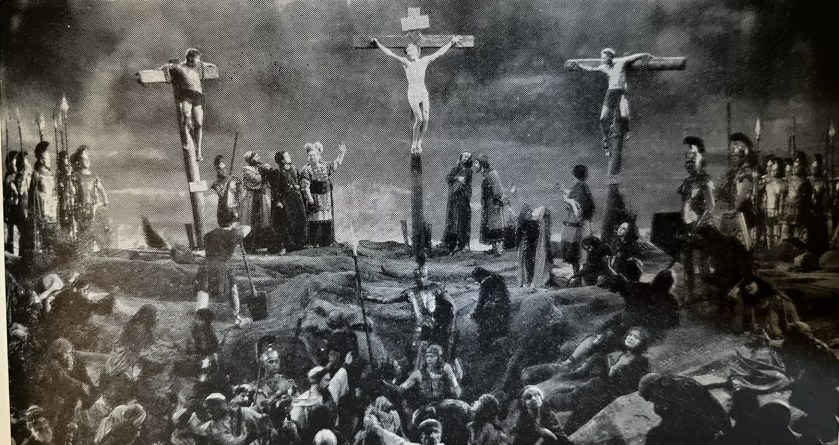
In the summer of 1927, De Mille’s The King of Kings was in theaters around the country. It was a two-and-a-half hour silent film, but for its day it was quite a spectacle.
A still from De Mille’s 1927 film, The King of Kings. From The Autobiography of Cecil B De Mille (Englewood Cliffs, NJ: Prentice-Hall, 1959).
Much of the dialogue was straight from the scriptures, and the chapter-and-verse citations were even included; but the scriptural context was often disregarded. Events and quotations were all jumbled up, like a weird black-and-white dream. After Jesus cleanses the temple, the crowd tries to make him king (confusing that scene with events in John 6), so he escapes to the top of the temple and then (again out of order) is tempted by the Devil. Early in the film, Simon Peter speaks to a young boy and says something straight out of one of the Epistles of Peter – written decades later.
The way Christ is introduced is interesting, but also a bit confusing. We see his disciples talking to him, but we don’t see him. Then a blind child is brought to him to be healed, and the screen goes black, showing us what the child sees. When the child’s eyes open, we see a bright light, which dissolves into the smiling face of the well-known silent-movie actor, H. B. Warner. It takes a moment to realize that he’s actually supposed to be Jesus. “Oh… okay then.”
It’s also rather distracting, at Christ’s crucifixion, to note that the thieves on either side of him aren’t nailed to their crosses; they’re just tied to them, and they don’t look like they’re going to die anytime soon.
But still, for its time it was quite a spectacle. Lloyd Douglas thought so, too. He wrote an article about it in The Christian Century (Lloyd C Douglas, “The Gospel According to De Mille,” Christian Century, 7/14/1927). The fact that Douglas was the pastor of the First Congregational Church of Los Angeles made the essay seem like on-location reportage, although it wasn’t.
Of DeMille himself, Douglas was highly complimentary: “Not only does this man know his New Testament, but he has ransacked the entire lore of that era. If the average preacher gave himself with as deep concern to the business of revitalizing the story of Jesus and his times, churchgoing would be vastly more rewarding.”
Of the film’s depiction of Jesus, however, Douglas was critical: “One is conscious, throughout the whole spectacle, that one is seeing the traditional Roman Catholic conception of a Christ who has come to earth primarily to die. Let all the people about him do or leave undone whatsoever they will; befriend or harass; condemn or crown; he is here to die—and everybody is waiting, nervously, for the tragedy. Jesus, in the picture, moves about slowly and sadly, with the air of one already unjustly convicted. Now and again, there is a gesture of futility more reminiscent of Omar Khayyam than Jesus of Nazareth…. The shadow does not lift….
“Persons who think of Jesus as the world’s master teacher, chiefly concerned with the spread of a new message of hope and joy, the promotion of victorious idealism, the development of a broader altruism, the building of a kingdom of heroes, are not quite content with so supine and languid a Christ as the abstracted, detached, time-marking, sighing Jesus who dominates the stage in ‘King of Kings.’”
Douglas liked the film’s depiction of the miracles. He felt it demonstrated just how ridiculous it was to picture Jesus as a worker of wonders. He hoped that “Persons who have been uncertain whether the magician-Jesus is quite adequate to deal with the baffling problems of these modern times, in which there is so little room for necromancy in the thought of intelligent people, will be encouraged by ‘The King of Kings’ to make a fresh examination of the essential character of Christ.”
Overall, Douglas gave the movie high marks, considering the fact that De Mille’s views were conservative and Douglas’s were liberal. Over the next several months, however, he became more critical of the film. I’ll talk about that in my next post.
(In recent posts, I’ve been telling you about the novel that would become known as Magnificent Obsession. When Lloyd Douglas was writing it in 1928, however, the working title was Salvage. In a future post, I’ll talk about the name change.)
The eighteenth chapter of Douglas’s book, Salvage, was remarkable for at least three reasons.
For one thing, he was poking fun at himself. The spotlight in this chapter is on the Reverend Doctor Bruce McLaren, a feisty minister of Scottish descent, who is modeled after fellow Scotsman Lloyd C. Douglas, D.D. This is remarkable because McLaren, although he is said to be “a good sport,” is also a somewhat comical figure. He is so well-educated, he preaches over the heads of his parishioners (as Douglas himself was doing at his church in Los Angeles, or so his critics claimed). McLaren is a modernist all the way.
“The whole business of institutionalized religion,” he says, “demands reappraisal! It appalls me to contemplate what must be the future of the Church when all the people who are now fifty and up are in their graves! This oncoming generation, now in its adolescence, is not in the least way concerned about organized religion. Religious enough, instinctively, I dare say; but out of sorts with the sects; weary of their bad-mannered yammering at one another over matters in which one man’s guess is as good as another’s, and no outcome promised either in faith or conduct, no matter whose guess is right!”
A little later, McLaren says, “A Christ who can help us to a clearer perception of God needs to be a personality confronted with problems similar to our ours, and solving them with knowledge and power to which we also have access – else he offers us no example at all. But here we have a majority of the churches trying to elicit interest in him because he was supernaturally born, which I wasn’t; because he turned water into wine, which I can’t; because he paid his taxes with money found in a fish’s mouth, which – for all my Scotch ingenuity – I can’t do; because he silenced the storm with a word and a gesture, whereas I must bail the boat; because he called back from the grave his friend who had been dead four days, while I must content myself with planting a rosebush and calling it a closed incident! What we want is a Christ whose service to us, in leading us toward God, is not predicated upon our dissimilarities, but upon our likenesses!”
Now… these are the very same things Douglas had been saying for a long time, almost word-for-word, in sermons, speeches, and articles. But when McLaren says them, we’re supposed to grin. For he’s right, up to a point; but he’s also missing the most important thing – the thesis of the whole book – and we know that Bobby Merrick is about to set him straight.
This reflects an important change in Douglas’s thinking, either just before or during his writing of the non-fiction book, Exploring Your Soul.
“I wonder if we modernists,” McLaren says later, “are not somewhat in the predicament of Moses, who had enough audacity to lead the slaves out of their bondage, but lacked the ingenuity to take them on into a country that would support them. We’ve emancipated them; but – they’re still wandering about in the jungle, dissatisfied, hungry, making occasional excursions into paganism and experimenting with all manner of eccentric cults, longing for the spiritual equivalent of their repudiated superstitions – sometimes wishing they were back in the old harness!”
“It’s worthwhile to have fetched them out of that,” says Bobby. “It ought to be equally interesting to lead them on. They mustn’t go back! But they will – if they’re not pointed to something more attractive than the jungle you say they’re in.”
How, exactly, can McLaren lead his people forward? By practicing what Bobby Merrick has just taught him: a message that goes beyond modernism.
In May of that same year (1928), Douglas published an article in the Christian Century entitled, “The Seeming Impotence of Christianity.” In it he asked:
May not the chief difficulty of the churches lie in the fact that we have all been interpreting Christianity in terms of metaphysics to a generation that does its thinking in terms of kinetic energies? Even modernism, for all its twentieth-centuryness, has made no more of a contribution at this point…. The modernist refutes the metaphysics of the fundamentalist by proposing another metaphysics. Both schools are equally absorbed in speculative thought, one hoping to show the public that the other is an infidel, the other hoping to show the public that the one is an ignoramus, but neither of them interested in showing the public that Christianity is a dynamic energy….
In the field of physical energies, it is common knowledge with our boys and girls that an ampere is the current produced by one volt acting through the resistance of one ohm; that a horsepower equals 746 volts-ampere; that a calorie is the heat required to raise a gram of water one degree centigrade. But what the soul can do, under given conditions, by reliance upon and utilization of divine power in fortifying against disappointments, encountering grief, and resisting the demands of appetite, is not only unknown but undiscussed. What manner of vital connection an aspiring soul may practically establish with its Source; under what circumstances spiritual power may be definitely guaranteed; whether prayer may be made a workable pursuit, and, if so, for whom, how, where, and when—these matters are spoken of with vagueness, albeit sung about with pious fervor. This generation has not been trained to think of power as something that should be set to music but set to work.
This is not to mean, however, that the present public is utterly without a spiritual aspiration. An increasing number of yearning people are possessed of the belief that there are certain spiritual energies in existence which, if practically utilized, could extend the reach of a man’s soul exactly as physical dynamics have multiplied the capacities of his eye, ear, and hand. That there is an unseen power, accessible to mankind, is not considered a mere chimera…
Lloyd C Douglas, “The Seeming Impotence of Christianity,” Christian Century, 5/24/1928, pp. 664-667.
This is the second thing that’s remarkable about the eighteenth chapter of Douglas’s novel: in it, Bobby Merrick claims that God can be approached in a manner that mimics applied science.
“Isn’t the modern school just substituting a new metaphysic for the old one?” Merrick asks McLaren. “Our generation is doing all its thinking in terms of power, energy, dynamics – the kind you read about, not in a book, but on a meter! Why not concede the reality of supernormal assistance, to be had under fixed conditions, and encourage people to go after it?”
Douglas’s emphasis here is on the “fixed conditions” – on doing what Jesus taught. To state the matter in religious terms, Merrick shares his testimony with the McLarens. But it’s not the typical tale of sorrowing over one’s sins and asking forgiveness; it’s a story about how he did what Jesus said… and received the promised results.
After the book’s publication, some conservative Christians would balk at the “pseudo-scientific” overtones of the story, but Douglas was really just putting his faith in Christ on the line. He was saying (although not in these exact words), “Do you believe in Jesus’ promises? If so, why be upset if someone follows his teachings and gets the promised results? Why be angry just because they didn’t come to him by following your four-step process? If they come to Jesus by doing what he himself said, how can that be wrong?”
The third thing that’s remarkable about the eighteenth chapter is that Douglas addresses an issue that every college freshman faces in Philosophy 101: the so-called “proofs for the existence of God.”
I’m a philosophy professor. I teach the “proofs.” And I see firsthand how irrelevant they are to people’s day-to-day lives. Students don’t resolve their doubts about the existence of God by having the matter “proven” or “disproven.” In fact, most people in this world never find intellectual resolution, one way or the other. They either believe, or they don’t. “We’ll find out when we die,” they say.
In the eighteenth chapter of the novel Salvage, however, Douglas claimed that resolution was possible.
When McLaren says that God is only “an hypothesis,” Merrick says, rather shyly, “I’m afraid I don’t accept that.”
“Oh – Doctor Merrick!” says Mrs. McLaren. “You don’t mean to say that you do not believe in God at all!”
“I mean that I do not think of God as an hypothesis.”
“But – my dear fellow,” says McLaren, “we really have no hard and fast proofs, you know!”
“Haven’t you?” asks Bobby. “I have.”
The text says: “The two forks in use by the McLaren family were simultaneously put down upon their plates. ‘Er – how do you mean – proofs?’ queried his guest.”
Of the three, this is perhaps the most remarkable feature of this chapter: that Lloyd Douglas claims we can go beyond just believing in God, then finding out if we were right only after we die. Douglas claims that, if we do what Jesus says, we’ll find out now. The things he promises will happen. We’ll come into daily contact with the Living God… and we’ll know.
I can’t speak for anybody else, but I can tell you about my own case: when I read this chapter just before starting my junior year of college, I was thunderstruck – not because I wanted to have that experience for myself, but because I already had; I just didn’t realize that it was intellectually permissible to say so. For me, the reading of this chapter was life-changing.
As I explained in an earlier post, Douglas’s novel Salvage was meant to be in line with the New Fiction of the 1920s, especially the works of Sinclair Lewis. Douglas had already written the first two chapters that way. There would be no moral. In the New Fiction, novels weren’t supposed to have morals. Characters were introduced; they were thrown into a set of realistic contemporary problems; and they must either sink or swim – and, in many cases, the protagonists of the New Fiction would end up sinking. Douglas was too much of an optimist to let that happen to the characters in Salvage, but he was also attuned to the type of novels being written in the 1920s, and he knew there could be no heavy-handedness on his part. He must let his characters “work out their own salvation” (as he said in a letter to his cousin Edith Kirkwood, 11/16/1932, in “Correspondence, Undated,” Box 1, Lloyd C Douglas Papers, Bentley Historical Library, University of Michigan).
Up until January 1928, they didn’t.
Douglas checked in on them periodically throughout 1927 but was disappointed to discover they had made no progress since he had last looked in on them. None of them knew what to do; they just sat there waiting for him to tell them. “As if I knew,” he said later (“Pygmalion,” The Kiwanis Magazine, December 1938).
Granted, he had nudged Bobby Merrick a bit in Chapter Two, by way of the head nurse Nancy Ashford, until Merrick decided to devote his life to medicine. But after that, Merrick was supposed to be on his own. To Douglas’s disappointment, he needed more help than that.
On January 20, 1928, Douglas’s daughter Betty suggested that he base the rest of the novel on the subject he had preached about that morning. Although Betty may not have known this, her suggestion amounted to taking the work he had done over the past few months on his non-fiction project, Exploring Your Soul, and inserting it into the as-yet unwritten chapters of Salvage.
This posed a technical issue: how to take information from one book and insert it seamlessly into another book, especially when one was non-fiction and the other was a novel. Douglas’s solution to this problem was ingenious: he turned the non-fiction material into a coded diary, which Merrick and Nancy Ashford would decipher and discuss.
But there was a much bigger technical issue with Betty’s proposal: it would mean making the rest of the story “didactic.” In other words, it would point toward some lesson that the reader was supposed to learn. Ever since the onset of the New Fiction in the 1920s, that was no longer deemed acceptable by the arbiters of literary taste.
Like any good novelist in the 1920s, Douglas did not want to be labeled “old-fashioned.” He had never been old-fashioned in his preaching, and he certainly didn’t want to be an old-fashioned novelist. Besides, in the literary world of the 1920s, that would mean the kiss of death. Douglas had no intention of ruining his reputation before he had even begun.
So he used a number of literary devices to avoid the problems of earlier didactic novels. Instead of quoting scripture, he makes the scripture lesson a mystery to be solved; and when Bobby and Nancy are on the point of quoting an actual Bible verse, he cuts them off mid-sentence. The characters draw attention to the fact that they are about to learn a scripture lesson, and they protest loudly. And rather than making them learn against their will, Douglas has them try the experiment that the scripture suggests. Yes, one could say that the end result was “a didactic novel,” but it was brilliantly conceived, and executed with a playfulness that is absent from the didactic novels of any earlier age.
But there is another technical issue that Douglas didn’t take seriously at all: the fact that the first two chapters of the book lead the reader in one direction, and the rest of the book, from Chapter Three onward, goes in another. He left the first two chapters the way he had written them prior to January 20. He didn’t find it necessary to rewrite them in light of his new idea.
In Chapter Three, Dr. Hudson’s young widow, Helen, puzzles over the conversations she is having with people who have come to pay their respects to her late husband. Dr. Hudson has done much good in the lives of many people, but he has sworn them to secrecy. All these people share a strange vocabulary. Those to whom he loaned money, for example, say that he wouldn’t let them pay him back. “I have used it all up myself,” he told them.
This is the real beginning of the novel, as Douglas conceived it from January 1928 onward. This is what the book is all about.
You might reply, “Oh, but don’t the first two chapters introduce the characters and prepare us for what’s coming?” My answer is, “Yes and no. They introduce the characters, but rather than preparing us for what’s coming, they give us a different set of expectations.”
Let me show you why I think this is a problem.
I’m jumping ahead of the events I’m narrating, but here are two representative samples of how the book would later be reviewed in newspapers and journals. Can you spot the interpretive dilemma these samples illustrate?
Sample One: “a young waster… is saved from drowning at the cost of the life of a famous brain surgeon” (The Congregationalist).
Sample Two: “Surgeon number 1 leaves a manuscript in cipher behind him when he dies and surgeon number 2 translates it, assisted by a nurse” (Winnipeg Tribune).
I ask you: Which of these two summaries has captured the essence of the novel?
Based on Douglas’s intentions from January 1928 onward, I would have to say that Sample Two wins the prize; but most summaries of the book agree with Sample One instead. In fact (although this is also jumping ahead), the book would be converted to the silver screen not once, but twice (in 1935 and again in 1954), and in both cases the moviemakers would assume that Sample One was the essence of the book (as well as the last three chapters).
In other words, the first two chapters attract so much attention to themselves, it becomes very difficult for readers to understand what Douglas was actually trying to do. As it turns out, many people got the message. But many others didn’t.
Then again, Douglas would go to great lengths to make his meaning clear, even devoting an entire chapter to emphasizing the purpose of the book. I’m referring to Chapter Eighteen, and that will be the subject of my next post.
Lloyd Douglas circa 1926. From Akron 1926 Scrapbook, Lloyd C Douglas Papers, Bentley Historical Library, University of Michigan.
On Sunday, January 20, 1928, Douglas preached the third sermon in his series entitled, “Exploring Your Soul.” His topic was “Your Soul: How to Develop Its Peculiar Capacities.”
We don’t have a copy of the sermon. It wasn’t included along with the previous two weeks in The Living Faith, a compilation of his sermons that his daughters published after his death. It’s also not filed with the many sermons that his daughters boxed up and donated to the University of Michigan’s Bentley Historical Library. All that we know about the sermon comes from his daughter Virginia’s narration of the events of that day, in the book she cowrote with her sister Betty, The Shape of Sunday: An Intimate Biography of Lloyd C Douglas by His Daughters. So I’ll let Virginia tell the story. About the sermon series, she writes:
“He had long been trying to convince people of the very real power of religion as a working energy in their lives if they would only experiment with it. He wanted them to think of it as a positive force – the ‘dynamics of Christian faith,’ he called it. The clues to this energy lay in the New Testament. Taking for example the words of Jesus – ‘Take heed that ye do not your alms before men, to be seen of them’ – he explained what power could be stored in the personality of anyone who heeded that advice, the power of secret altruism known only to one’s God” (p. 211).
She continues:
The sermons were particularly vivid and clearly illustrated. I remember during the third and last Sunday of the series [I think this is an error; a fourth sermon was scheduled for the following week] the huge crowd strained in their attention as though they were hearing some wonderful secret of living and feared to miss a word of it. Even I was impressed, and moving out with the thoughtfully departing throng said to myself, ‘I shall try that,’ and wondered how to begin.
Our lunch was late that Sunday because so many people had crowded up to the front of the church after the service, waiting to shake Daddy’s hand and thank him. He came home tired but exhilarated.
‘Well,’ he said, ‘no matter what the old guard think of me, there seem to be many people who are grateful and yearning for that kind of talk.’
We were having cold ham that day. I remember all the details of the table, for it was a meal which registered a milestone in our lives. Mother sat down at her place and said, ‘I was helped by your sermon today, Lloyd. I think for the first time I understand exactly what was meant by the idea of secret altruism.’
Betty and I murmured that we too had felt a personal tug and had been inspired by the sermon. It was unusual for us to make such intimate revelations and Daddy was touched.
He took up the carving things and started to serve the ham. ‘The idea has been there in the Bible a long time,’ he said, ‘but its simplicity disguises its power. Once you try it, you realize you have laid hold of something. I wish I could get the meaning across to more people. If I have a message, it’s probably that.’
‘Why don’t you put it into your novel,’ said Betty, calmly buttering a piece of bread.
Daddy seemed transfixed with the carving knife and fork in his hands. Seconds passed and we three looked at him, waiting. Then Mother said excitedly, ‘Is that it, Lloyd?’
He nodded but his face forbade us to say more. It occurs to me now that perhaps he was gratefully acknowledging the power of some of his own secret altruisms. We ate our meal almost in silence. Daddy was far away (pp. 211-212).
The novel Betty was referring to was Salvage, about the rich young playboy whose life was saved at the expense of a great surgeon. For several months, Douglas had been stuck at the beginning of Chapter Three, unsure how to proceed. Betty was suggesting that he incorporate the thesis of his sermon into that novel.
It is unclear whether Betty or Virginia realized that their father had also been working on a non-fiction book, Exploring Your Soul, and that his sermon series was based on that book. In fact, he had been writing it as “a three-cornered dialogue.” As he held the carving implements in his hand, his imagination must have been working on a way to take the dialogue he had already written and insert it into the novel, Salvage. Who would present the thesis? And who would play the other two roles of the dialogue?
Before long, he had at least part of the answer: Dr. Hudson would be the one presenting the thesis. After his death, it would be revealed that he had spent his life doing altruistic deeds in secret. Bobby Merrick would learn about this and follow in his footsteps.
Virginia remembers the days that followed:
We asked Daddy questions about his story and often he was not able to answer them. ‘If the doctor’s philanthropies were all secret how is the young man [Bobby Merrick] ever to learn about them?’
‘Perhaps he kept a diary,’ Daddy suggested. ‘In code,’ he added, seeing our doubtful faces (p. 213).
One indication of a skilled novelist is his ability to take an idea that seems doubtful on the face of it and get his readers to believe it. Over the next several months, Douglas would rewrite his “three-cornered dialogue” as the story of Bobby Merrick and the head nurse, Nancy Ashford, decoding the secret diary of Doctor Hudson and debating its contents.





 The Lloyd C Douglas Page