Praying from the Pulpit As If Ordering Pork Chops from the Butcher

by Ronald R Johnson (www.ronaldrjohnson.com)
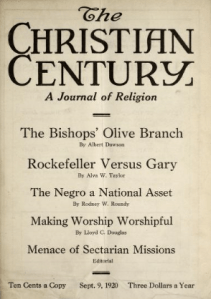
In the summer and fall of 1920, Lloyd Douglas published a series of articles in Christian Century magazine called, “Wanted – A Congregation.” The series was aimed at ministers who were discouraged because they had low attendance at their church services. Throughout his life, Douglas was blessed with well-attended churches. In fact, while he was at the First Congregational Church of Ann Arbor, the congregation voted to build a new structure because there was not enough room for the crowds that wanted to hear him. He published this series during his tenure at that church.

The passage quoted below is from the 5th article in the series: “Wanted – A Congregation, Fifth Phase – Making Worship Worshipful,” published in the Christian Century on September 9, 1920:

“We preachers have become dreadfully poor psychologists. There is an instinctive heart-hunger for the mystical in worship that we have been unable to satisfy with our crude, bungling attempts at ritual and the rasping dissonances of the alleged music rendered by our untrained choirs. There has been entirely too much extemporaneous and ill-considered matter introduced into our ‘services of worship.’ Our ‘free’ pulpit prayers, for example, have been so very free that they jar unpleasantly on the sensitive ear of the naturally devout. Indeed, our public prayers are filled with impertinences that are only saved from being blasphemous by the fact that we know not what we do. We pick up disgusting tricks of addressing The Absolute in terms of a contemptuous familiarity. How often one hears preachers mouthing that raucous phrase whose vogue the reverential fail to comprehend, ‘Now, Lord, just send us’ – whatever-it-is – in the same inflection one uses when telephoning the butcher, ‘Now, Sam, just send us a few lean pork-chops, this time, can’t you? No; no sausage, today, thank you. Yes – that will be all, Sam. Thanks – very much!’

“Now, this will not do! Some of us have been wondering what is the matter with our churches; and some of us have been berating the generation for its godlessness. Many of us may find, upon investigation, that we have disgusted our potential constituency with our unwitting want of reverence. Many a sensitive man would greatly prefer to take a book of essays with him to a shady bend in the river, on Sunday morning, than attend our church; whereas his whole soul cries out for a much closer contact with the divine than he can achieve by his communion with nature. But – it is a great deal better for that man’s spiritual welfare that he should go out, Sunday morning, and watch the river, than to go to some church where the music is so ugly it positively frightens one, and the preacher talks to the Great Unseen as if he were chaffing with his next-door neighbor over the back fence. Let it be repeated – this will not do! We who have been committing these serious blunders must mend our ways!”

From “Wanted – A Congregation, Fifth Phase – Making Worship Worshipful,” Christian Century, September 9, 1920, Volume 37, Number 37, pp. 14-17.

For a free PDF copy of the booklet, The Secret Investment of Lloyd C Douglas, fill out the form below:

← Back

Thank you for your response. ✨

Against a Parochial View of God

by Ronald R Johnson (www.ronaldrjohnson.com)

The controversial side of Lloyd C Douglas…

From a farewell sermon entitled, “Five Years of Akron,” delivered at the First Congregational Church of Akron on October 31, 1926. (He was on his way to a pastorate in Los Angeles.) This is reprinted in Living Faith, pp. 77-92:

I have attempted to present an idea of Deity which portrays Him as a conscious kinetic energy, speaking to the world through all the media of His creation; not a parochial Jehovah, or Zeus, or Apollo, especially concerned with the welfare of any particular class of people at any particular time in history – but a Universal Father of all mankind.

And, because I have so believed, I have made no effort to disguise my opinion that every alleged quotation of God’s voice, reported in holy books (ours or any other’s) which reveals Him as a parochial God, or engaged in any thought or action not consonant with the thoughts and acts of a cosmic and universal God – is no more to be believed or credited, because written several thousand years ago by some pious shepherd, than if it were to have been written yesterday afternoon on some preacher’s typewriter.

For a free PDF copy of the booklet, The Secret Investment of Lloyd C Douglas, fill out the form below:

← Back

Thank you for your response. ✨

What is the Gospel Doing for You?

by Ronald R Johnson (www.ronaldrjohnson.com)

Quotable Quotes from Lloyd C. Douglas

From a sermon entitled, “Christianity – The Cult of Adventure,” preached at the First Congregational Church of Los Angeles on Sunday, July 15, 1928, and reprinted in The Living Faith, pp. 62-76.

What is this gospel doing for you? Is it developing your personality, and empowering you with larger capacity for making and keeping friends? Does it help you do honest business more successfully? Does it make your home harmonious? Does it make you a better companion at the breakfast table? Does it make your automobile safer for pedestrians on the street? Does it open your purse to the call of poverty? Does it make you humble with your opinions?

Does it inspire you to see more beauty in art and nature and the hearts of common men and women? Does it make you passionately eager to put something into the world that will square, at least in part, for what you are taking out of it? Does it move you to a genuine interest in the welfare of other people, no matter how far apart they may be from you, in code and manners, belief and morals, aims and hopes?

Does it enable you to understand how all things do work together for good, in sunshine and shadow, in joy and pain, in calm serene and stress and storm, to them that love God?

For a free PDF copy of the booklet, The Secret Investment of Lloyd C Douglas, fill out the form below:

← Back

Thank you for your response. ✨

A Prayer for Insight

by Ronald R Johnson (www.ronaldrjohnson.com)

Lloyd Douglas wrote out the prayers he uttered in worship, because he did not want to make them up on the spur of the moment. They were meant to be thought-provoking, as well as to lead the congregation in prayer. Here is one of them, reprinted in The Living Faith, p. 299:

We beseech Thee to make known to us more and more clearly each day the duties we are expected to perform if we are to fulfill our destiny. We plead for that serenity of spirit which trusts confidently that Thy will may and must and can be done on earth as it is done in heaven.

For a free PDF copy of the booklet, The Secret Investment of Lloyd C Douglas, fill out the form below:

← Back

Thank you for your response. ✨

They Kept This Secret for Over a Hundred Years…

by Ronald R Johnson (www.ronaldrjohnson.com)

In his novel, Magnificent Obsession, Lloyd Douglas encouraged his readers to invest in the lives and talents of other people, but to do it secretly. By empowering others and doing it secretly, he claimed, we could strengthen our relationship with God in ways that would be visible in our personal and professional lives. Many of his readers wrote to him asking whether he truly believed what he was saying or was he just writing a story?

The answer is that he not only believed it; he lived it.

The obvious question is, If he spent his life investing secretly in other people, then how would we ever know… since he (and his beneficiaries) kept it a secret?

I’ve been studying the life and works of Lloyd Douglas for many years, and I believe I have uncovered one of the investments he made while he was working at the University of Illinois from 1911 t0 1915. A young man named Roger Zombro had recently set up shop as a clothing merchant on Green Street, just off campus. Lloyd Douglas had no money, but he made a huge – and clever – investment in Zombro’s future… an investment that changed both of their lives. As far as I can tell, neither of them ever broke their silence about it. What Douglas did has remained a secret for over 100 years. It’s a remarkable story.

I tell about it – and I share the detective work I did to uncover it – in a 32-page booklet entitled, The Secret Investment of Lloyd C Douglas. To get a free copy of this PDF document, please fill out the form below. I can’t wait to share this fascinating story with you. And I’d love to hear what you think about it.

← Back

Thank you for your response. ✨

On Following Jesus’ Teachings without Following Jesus

by Ronald R Johnson (www.ronaldrjohnson.com)

Although Lloyd Douglas emphasized the importance of following Jesus’ teachings, he did not believe it was possible to do so without the support and guidance of the Teacher. In These Sayings of Mine, p. 38, he says this:

We have no record of any attempt on the part of Jesus to exalt his message by self-deprecation. He and his words were one. They had been supernormally conveyed to him, he declared, and he was the living exponent and example of their truth. Whoever accepted his teachings, accepted him. Whoever accepted him, accepted them. There could be no such thing as an effective practice of his principles independent of a close and vital relation to his personality; and, in pursuance of that relationship, he said: ‘Ye are my friends if ye do whatsoever I command you.’

For a free PDF copy of the booklet, The Secret Investment of Lloyd C Douglas, fill out the form below:

← Back

Thank you for your response. ✨

What to Do with “Everyday” Life

by Ronald R Johnson (www.ronaldrjohnson.com)

One of the things I find so interesting about Lloyd Douglas is the insight he had early in his ministry (only eight years after graduating from seminary) that Christians in modern times were being forced to choose between two very different approaches to the world: the mindset and intellectual habits of “everyday life” in twentieth century society vs. the mindset and intellectual habits of the ancient Greek world. He got this idea from Shailer Mathews, Chair of the Religion Department at the University of Chicago, when Douglas and his wife attended a lecture series by Mathews on the east coast sometime between 1909 and 1911.

Douglas believed that faith in Christ should not require people to abandon the mindset and intellectual habits that served them well in their jobs Monday through Friday. He was thinking here of professionals especially. The state universities were increasingly producing waves of graduates who were taught to question assumptions, consider alternatives, and put ideas to the test. These habits were not only making the workforce more productive; they were also changing the way people lived their personal lives. On Douglas’s view, there was nothing either irreligious or antireligious about this way of approaching things; what made this new approach a threat to Christian religion was the fact that the church’s leadership was still largely committed to the mindset and intellectual habits that were common during the days of Christ: that is, the ancient Greek and Hebrew worldviews.

Douglas saw it as his personal and professional mission to divest Christian faith of the old secular philosophies and worldviews that had wrapped themselves around it and were threatening to choke the life out of it. There was nothing in the teachings of Jesus, he thought, that required people to believe in Aristotelian cosmology or biology or any other kind of -ology. Yet he saw leaders of the faith railing against the latest scientific discoveries because those leaders were still stuck in the old ways of viewing the universe and its history. Christ’s message, he felt, was for all time, and must not have its future tied so closely to ancient ways of thinking.

He therefore chose to spend ten years (1911-1921) ministering at two universities (the University of Illinois and the University of Michigan), where, he says, “I daily faced the new problem of a readjustment in religious thought, to make it consonant with the more recent disclosures of the philosophical and religious world.” (This is from a sermon, “Five Years of Akron,” preached at the First Congregational Church of Akron on October 31, 1926, and printed in The Living Faith, p. 80.) His objective was not to force the gospel to fit the culture, but to clear away the old cultural vestiges that were still clinging so tightly to Christian faith.

I believe that we Christians in America are still largely unaware of the problem that he saw so clearly one hundred years ago. That is one of the reasons why I feel it is so worthwhile – and even vitally important – for us to hear his voice again.

For a free PDF copy of the booklet, The Secret Investment of Lloyd C Douglas, fill out the form below:

← Back

Thank you for your response. ✨

The Family Drudge

by Ronald R Johnson (www.ronaldrjohnson.com)

Quotable Quotes from Lloyd C. Douglas

From Invitation to Live, chapter 4.

Dean Harcourt of Trinity Cathedral is commiserating with young Katharine Drake on the misfortune of becoming ‘the family drudge.’

‘In many a home,’ the Dean was saying, ‘some one member of the family carries the whole load; serves as the official clock-watcher, tells them when it is time to get up, when it is time to start if we are to catch the 8:19 car; serves as the official calendar, telling them that next Tuesday is Emma’s birthday, and we mustn’t forget that the Chester wedding is on the nineteenth; serves as the official errand-boy, whose duty it is to turn the night-latch on the door, put out the porch-light, check the furnace, call the cat, and drape a towel over the birdcage. Nobody knows or cares how you happened to be appointed to these thankless positions; but, once you’re recognized as the incumbent, there’ll be no other nominations as long as you live…

‘Sometimes people come to talk with me about the flatness and staleness of their lives, and how difficult it is for them to achieve happiness; and mostly it turns out that they have been harried by just such trifling cares. It wasn’t the costly renunciations that wore them down. It wasn’t the big sacrifices that made them unhappy. It was the aggregate of all the small things they were expected to do. It may not be much of a care to cover the canary every night; but you’ll find that the same person who covers the canary rebaits the mousetrap, tightens the tap that someone left running in the kitchen, puts the half-filled milk bottle back into the refrigerator, and closes the window in the pantry. The official bird-cover-up-er is the same person who tells Grandma it is time for her pill, and Father that he has a loose button on his overcoat. I maintain that whenever one member of the household discovers that he has been appointed – for life – as the family drudge, he should resign without delay, for the sake of the whole tribe.’

For a free PDF copy of the booklet, The Secret Investment of Lloyd C Douglas, fill out the form below:

← Back

Thank you for your response. ✨

The Kind of Religion We Need

by Ronald R Johnson (www.ronaldrjohnson.com)

Quotable Quotes from Lloyd C. Douglas

From an article entitled, “That 100th Sheep,” published in The Lutheran Observer, July 6, 1906.

(A word of advice: read this passage a phrase at a time, pausing just as you would if you were reading it from the pulpit.)

A religion must now be taught that means more than Sunday and solemnity and hymn-books and the church confession; something vital, virile, living, to be harnessed to every day of the week; not an ideality, not a theory, not a multiplication of complexities; but a seven-day-in-the-week affair that can be passed over the counter in the store and through the wicket at the bank and along the keen-edged tools in the shop. A Gospel must be preached whose warp will stand the strain of being woven into the woof of every-day living on the slow-plodding loom of human experience; and any other doctrine than this will not make the church evangelical, or assist in the restoration of That One-Hundredth Sheep.

For a free PDF copy of the booklet, The Secret Investment of Lloyd C Douglas, fill out the form below:

← Back

Thank you for your response. ✨

The Importance of Sportsmanship within the Church

by Ronald R Johnson (www.ronaldrjohnson.com)

Quotable quotes from Lloyd C. Douglas

From a farewell sermon entitled, “Five Years of Akron,” delivered at the First Congregational Church of Akron on October 31, 1926. (He was on his way to a pastorate in Los Angeles.) This is reprinted in Living Faith, pp. 77-92.

He’s summarizing some of the things he tried to teach them during his time as their pastor:

I have talked considerably about the value of Christian sportsmanship. I saw no good in churches that quarrel – either within their own ranks or with others outside their gates. I proclaimed that whatever spirit it was that made people mean, and critical, and captious, and fault-finding, and petulant – you could be sure it was not the Holy Spirit; that if their lives were haunted with the shades of outworn fears and inexcusable ignorances and moldy superstitions – you could be sure their grisly ghost was not the Holy Ghost.

For a free PDF copy of the booklet, The Secret Investment of Lloyd C Douglas, fill out the form below:

← Back

Thank you for your response. ✨

Design a site like this with WordPress.com
Get started