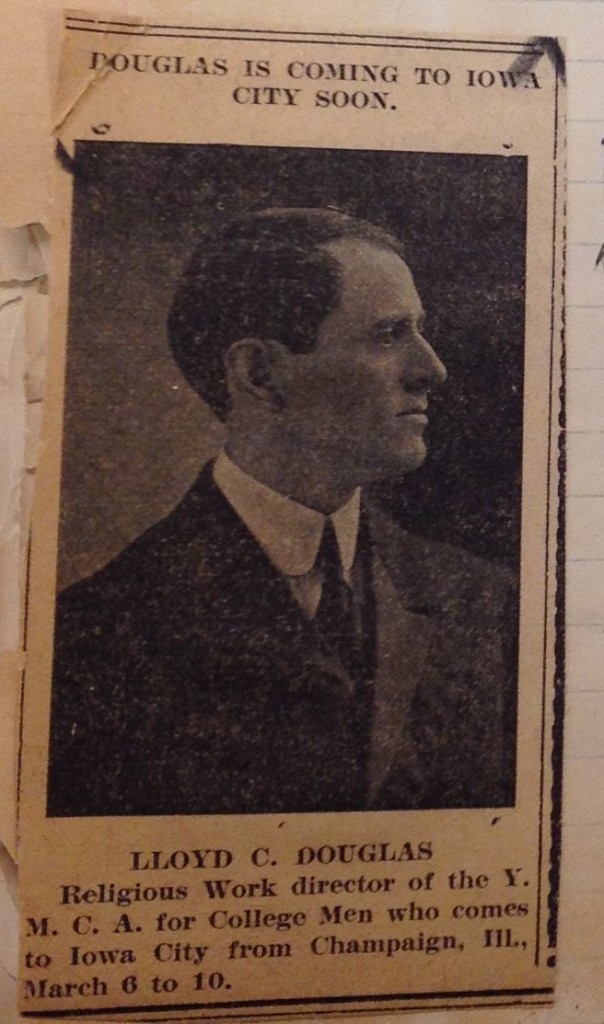
Douglas Is Coming!

by Ronald R Johnson (www.ronaldrjohnson.com)

As part of his contract with the University of Illinois YMCA in 1911, Lloyd Douglas agreed to give a series of lectures at some of the other universities in the region. Between March and November of 1912, he spoke at the University of Iowa, Simpson College (at Indianola, Iowa), and Milliken University (in Decatur, Illinois). The Y at each location did its utmost to get male students interested (the women had their own YWCA-sponsored meetings at the same time – yes, they were segregated), and some of the promotional materials are amusing. They treat Douglas like a celebrity.

From the Iowa City Citizen, undated, in Douglas’s 1909-1915 Scrapbook, Douglas Papers, Box 5, Bentley Historical Library, University of Michigan.
The Simpsonian, undated. In Douglas’s 1909-1915 Scrapbook.
From the Decatur Herald, undated. In Douglas’s 1909-1915 Scrapbook.

That’s a lot of hype, but Douglas was equal to it. His scrapbook contains clippings from both the college and city newspapers, and they all raved.

From the Simpsonian: “It is sufficient to say that Douglas made a deep impression on the religious life of Simpson men – and that is saying much in a school like this, where religious appeal is so familiar that, to use Douglas’s own expressive phrase, ‘people’s souls become grooved and calloused’ with well-meant but ineffective religious effort.” (Milliken was a Methodist college.)

From the Decatur Herald: “Interest was not allowed to lag at any moment…”

From the Iowan: “A body of over two hundred students listened to one of the most fascinating addresses of its kind last evening at the natural science center by Lloyd C. Douglas…”

From the Iowa City Citizen: “Mr. Douglas delivered another of his stirring addresses last evening.”

From the Simpsonian again: “The results of the meetings show very clearly that the average college man, even though of no special religious tendencies, can be made to feel a genuine interest in Christianity if it is presented to him in a sane, rational, and unprejudiced manner. The power to do this Mr. Douglas possesses in a remarkable degree.”

Rev. H. F. Martin sent this report to the Lutheran Observer regarding the series of lectures at the University of Iowa: “The editor of the ‘Daily Citizen’ remarked to [Rev. Martin] that within his knowledge no religious campaign among the students had ever made such an impress as this one.”

Perhaps the most significant statement, viewed from our vantage point today, came from Professor Edward Diller Starbuck, a pioneer in the field of Psychology of Religion, who taught at the University of Iowa: “Mr. Douglas is, in my opinion, just the man for us. He has thought his world through until he can speak of the deeper things of the spiritual life without compromise and with perfect candor. University life has been sadly in need of just such a message as he is giving, which is profoundly spiritual and at the same time is in accord with a modern world-view.”

In my own opinion, Starbuck was a bit too generous. Douglas had only gotten started “thinking his world through” and arriving at a workable theology. But Starbuck was right about this much: the modern state universities were “sadly in need” of a message that was “profoundly spiritual and at the same time [was] in accord with a modern world-view.” I would argue that we’re still in need of such a message. Most evangelists are anti-intellectual, and most Christian intellectuals are not evangelists. Douglas was trying to bring those two things together, and Starbuck saw that he was on the right track.

In my next post I’ll talk about the message that Douglas delivered in these lectures, and I’ll explain why he was really just getting started.

To receive a free PDF of the booklet, The Secret Investment of Lloyd C. Douglas, fill out the form below:

← Back

Thank you for your response. ✨

Behind the Scenes

by Ronald R Johnson (www.ronaldrjohnson.com)

At the University of Illinois, Lloyd Douglas worked at the new YMCA Building on the northwest corner of Wright and John streets, at the western edge of campus. He taught classes, wrote anonymous articles about the Y for the Daily Illini (the student-run newspaper), tried to get students to join the Y, and organized events featuring visiting speakers (most notably the organization’s leader, John Mott). Although he was busy, he was surprisingly low-key. He wasn’t in the news nearly as much as he had been as a pastor in North Manchester, in Lancaster, and in Washington, DC.

And there was a reason for that: Douglas had taken this job to get out of “active ministry” for a while and think things over. But he wasn’t the kind of man who needed to get completely away from it all in order to ruminate; rather, he did his best thinking when he knew he had to answer to the public, especially on a deadline. He no longer had to compose two sermons each week (for a.m. and p.m. services on Sundays), but he still wrote articles for religious periodicals (The Congregationalist now, instead of the Lutheran Observer), and he still taught classes at the YMCA and spoke at “smokers” designed to increase YMCA membership. (The university Y shamelessly imitated the fraternities, inviting young men to come and see a “lantern show” of Ben-Hur, for example, and hear an inspiring talk by Lloyd Douglas while enjoying a dessert and cigar.)

The newly-erected YMCA Building at the University of Illinois. Note the horse hooked up to the hitching post. From The Promise of Association: A History of the Mission and Work of the YMCA at the University of Illinois, 1873-1997 (Champaign, IL: University YMCA, 1997)
The same structure today. It’s no longer the YMCA Building, though; it’s Illini Hall. I took this picture in February 2015. There were no horses parked out in front.

But he wasn’t nearly as much in the public eye as he had been from 1903 to 1911. He spent time at the library across the street (that’s not a church steeple in the image below; it’s the campus library)…

…and he soaked up the campus culture. He spent most of his time with students, of course, but he was especially impressed with the faculty. Years later he wrote, “I had some exceptional opportunities to develop along the line of a liberal interpretation of religion during my work at the University of Illinois, where I came constantly in contact with a forward-looking group of very intelligent people who comprised the first sizable party of persons I had ever known who were both mentally solvent and religiously inclined. Up until that time only an occasional man of my acquaintance had qualified as [a] high grade intellectual and disposed toward a devout interpretation of religion. I discovered that it was possible for a man to be both religious and preserve his intellectual morality” (Douglas to Dr. Frank C. Ransdell, December 15, 1927. In Douglas Papers, Correspondence 1926-1930, Box 1, Bentley Historical Library, University of Michigan).

The most important work Douglas did at the University of Illinois was behind the scenes. He talked to people, and listened, and studied, and thought. Our best glimpse of the shifts in his theology comes from newspaper articles about the series of lectures he delivered at other universities during the second semester of the 1911-1912 school year. I’ll tell about that in the next post.

To receive a free PDF of the booklet, The Secret Investment of Lloyd C. Douglas, fill out the form below:

← Back

Thank you for your response. ✨

Leaving the Lutheran Church

by Ronald R Johnson (www.ronaldrjohnson.com)

The Augsburg Confession

Lloyd Douglas resigned as pastor of Luther Place Memorial Church in July 1911, effective September 1. He told his congregation he was leaving to serve the YMCA at the University of Illinois. And that was true, but it was only part of the truth. Another part of it was that he felt an immediate need to leave the denomination.

Douglas had been a Lutheran all his life. When he was very young, his father A.J. Douglas was a Lutheran pastor. Prior to that, A.J. had been an attorney and then a school superintendent, and he had met and married the wife of his old age – Lloyd Douglas’s mother – when she was teaching at his school. Lloyd Douglas had siblings who were a generation older than he was; they were A.J.’s children from a previous marriage, and their mother had died, leaving A.J. a widower until he met Lloyd’s mother. A.J. had promised the Lord that he would be a minister, but he didn’t make good on that promise until he was old. As compensation, he groomed his youngest son for the ministry. A.J. took the boy with him as he made his rounds to see his parishioners and to preach at the multiple small-town churches under his charge. From as far back as Douglas could remember, he had sat beside his father in their horse-and-carriage as A.J. went on his rounds, and together they parsed Greek words and talked in depth about the ministry. The Lutheran ministry.

So it was no small matter sometime in 1911 when Lloyd Douglas turned to his wife on the way home from Luther Place one day and said, “Besse, I’m going to get out of the church.” Besse told their daughters the story years later: “I was terribly shocked,” she said. “He had talked that way before, but this time I felt he really meant it. The first thing I thought was, ‘What will his mother say?'” (Virginia Douglas Dawson and Betty Douglas Wilson, The Shape of Sunday: An Intimate Biography of Lloyd C Douglas (Boston: Houghton Mifflin, 1952), p. 72.) (His father had already died.)

Predictably, his mother wasn’t too keen on the idea. Nor were Besse’s parents, the Reverend and Mrs. Porch, also of the Lutheran Church.

But Douglas had to break free, especially now. For in the summer of 1911, the General Synod of the Lutheran Church in America had its annual convention, and they passed constitutional amendments that Douglas could not tolerate.

The conference was held at – of all places – Luther Place Memorial Church in Washington, DC. The meetings began Wednesday, June 7 and ended Sunday, June 11. Tickets were needed in order to attend the opening session on Wednesday, which featured speeches by President William Howard Taft, House Speaker Champ Clark, and Rev. Lloyd C Douglas. The legislation that bothered Douglas so much was passed on Friday, June 9.

It had to do with the Augsburg Confession, a detailed statement of faith that was written by Philip Melanchton in 1530. For our purposes, the content of that document doesn’t matter. What matters is that the members of the conference affirmed that “the unaltered Augsburg Confession” is “a ‘correct exhibition of the faith and doctrine’ of the church as founded upon the Scriptures” (Evening Star, Friday, June 9, 1911, p. 3). In the years prior to this, the Lutheran Church in America had treated the Augsburg Confession as “substantially correct,” leaving its ministers free to interpret the scriptures for themselves, without regard to whether their interpretations matched those of the Confession. But this subtle change in verbiage (that the Confession was a “correct exhibition of the faith and doctrine”) now meant that the Augsburg Confession was just as authoritative as the Bible.

Milton Valentine, the editor of the Lutheran Observer who had done so much to help Douglas in his ministerial career, had now, in the past two years, had a chance to meet him in person, since Douglas had moved to the East Coast. During the time that Douglas served as pastor of Luther Place, he and Valentine met on more than one occasion and deepened their friendship. It was Valentine, more than anyone else, who understood why Douglas resigned from Luther Place. He didn’t know all of the factors involved, but he rightly guessed this much of it.

Just after Douglas resigned, Valentine wrote to him. He began by congratulating him, then stated his true feelings: “My regret is that this work will take you out of active connection with the General Synod, where we are so badly in need of men who have knowledge of the times in which they live and are in sympathy with its movements – not theological pedants, obscurantists, but men with their faces forward.” Then he suggested that the constitutional changes made at the church conference were the real reason Douglas was leaving: “From what I know of your mental makeup and habits of thought, I feel that the recent meeting of the General Synod has not been without its influence in your decision to take up this new work. I do not know when the outlook was more discouraging in the General Synod.” He stopped short of asking Douglas to confirm his guess, but he was right.

From Douglas’s very first sermons and published articles, we see in him a note of confidence that was only possible because he felt totally at liberty to think for himself and to share his thoughts with others. Freedom of thought and of expression were things he had always taken for granted. The constitutional changes made at the church conference threatened those freedoms. And Douglas needed intellectual freedom now more than ever. I’ll explain why in my next blog post.

For a free PDF of the booklet, The Secret Investment of Lloyd C Douglas, fill out the form below:

← Back

Thank you for your response. ✨

Talkin’ ’bout the Y….MCA

by Ronald R Johnson (www.ronaldrjohnson.com)

In July 1911, Lloyd Douglas surprised his congregation by resigning his post at the Luther Place Memorial Church, just blocks from the White House, to work for the YMCA at the University of Illinois. As I told you last time, he did his best to convince both his congregation and the press corps that it was a natural career step for him to take, but of course it was not.

To understand why people were willing to accept his story, however, you need to know a little bit more about the Y.

The Young Men’s Christian Association began in London, England, in 1844. As one history states, “The original idea behind the YMCA was to create an association of men that could counter the perceived threats of the emerging industrial, urban order to individual Christian faith and character. Through prayer meetings, Bible study, missions work, the keeping of a reading room with a library of ‘wholesome’ materials, and a variety of classes and lectures, the London Association sought to strengthen the faith of young men, to rescue them from the city’s innumerable temptations and vices” (The Promise of Association: A History of the Mission and Work of the YMCA at the University of Illinois, 1873-1997 (Champaign, IL: University YMCA, 1997), p. 18).

The idea caught on, and the organization spread to a number of other countries, including the United States. The first YMCA “associations,” as they were called, had nothing to do with athletics. They were part of a movement to help young men sustain their Christian faith in an urban, industrialized environment. Early on, a female branch was established called the YWCA.

One wing of the Y movement, in the United States at least, focused on colleges and universities. In fact, the Student Volunteer Movement for Foreign Missions (SVM) grew out of the Y in 1888. The young man who was put in charge of SVM, John R Mott, had just graduated from college two years earlier, and after another two years (1890), he was made Senior Student Director of the YMCA, at the age of 25. (Information about Mott comes from C. Howard Hopkins, John R Mott, 1865-1955: A Biography (Grand Rapids: Eerdmans, 1979).)

This tells us a few important things: (1) that the YMCA was heavily involved in Christian evangelism; (2) that, as the name suggests, it was a youthful organization, run by young people; (3) that it considered America’s college students an important part of its mission field; and (4) that it wanted to enlist college students in global missions, as well.

John R Mott

You probably have never heard the name “John R Mott” before, but it’s much more probable that you’ve heard the slogan he created, because it worked its way effectively from SVM to the Y, and then on to churches and denominations all over the English-speaking world. His slogan was: “The Evangelization of the World In This Generation.”

It was a heady ambition: to bring the message of Christ to everyone, all over the globe, for the first time in history. And behind this goal was the hope that, in doing so, they would be preparing the world for Christ’s return.

To accomplish this daring goal, Mott built the student wing of the YMCA into an organization run by dynamic young preachers, and he sent them around to the nation’s colleges and universities to hold rallies and crusades. Lloyd Douglas was one of the men he chose.

Just after Douglas accepted the call to join the YMCA, Mott wrote to him and said, “I can appreciate what a sacrifice it will be for your church to release you at this time. I cannot, however, regard it as other than a clearly Providential leading which has influenced you to decide to go to this strategic field. From the point of view of the church, your action is most timely. Those State universities of the West are fast becoming the largest universities in the country. They wield an enormous influence. They have been seriously neglected on the moral and religious side. Nothing could be more important for the Christian Church in America during the next half generation than to make them strongholds and propagating centers for a pure and aggressive Christianity.”

Douglas made sure that his congregation read that letter. He also gave it to the press corps, and almost all of them published it. The evangelization of students all along the Mississippi Region of the YMCA was indeed important work, especially when it was viewed as a “strategic” part of Mott’s plans for winning the whole world to Christ.

But Douglas was no evangelist. He was a preacher, yes, and he aimed his preaching especially at young people. But he never tried to convert anyone, nor did he lead even one of his own parishioners through the Sinner’s Prayer, as far as we know. That wasn’t his style, nor was it consistent with his theology.

As at least one of the DC papers noted, the Y had been trying to get him on board for some time, and he had consistently turned them down. I suspect that they became especially interested in him after he and Dr. Clarence Barbour, who was on the Y’s international committee, shared the podium at a DC event on May 8, 1911. But something happened in June that changed Douglas’s mind, and suddenly he saw the job at the YMCA as a life saver.

For by the end of June, Douglas wanted out of the Lutheran Church – immediately.

I’ll tell you more about that in my next blog post.

For a free PDF of the booklet, The Secret Investment of Lloyd C Douglas, fill out the form below:

← Back

Thank you for your response. ✨

Design a site like this with WordPress.com
Get started