Mencken

by Ronald R Johnson

H. L. Mencken, from Britannica Online.

I’ve been telling you about the tentative plans Lloyd Douglas made sometime around 1930-31 for his next novel, after Magnificent Obsession. He wanted to write a satire about modern art, and apparently it was going to focus on 1920s fiction. As I showed in my last post, it was going to include some of his firsthand impressions of daily life in Greenwich Village, where starving young artists sat in gloomy eating establishments, trying to think up the next big thing.

I’ve also been telling you that his ideas for this next novel changed over time, as the success of Magnificent Obsession, and especially the letters he received from readers, convinced him that his job wasn’t finished. People had questions that he couldn’t answer neatly in mere correspondence. So he took the ideas he had been working on and reshaped them into a novel that would answer some of those questions.

It was around this time that he began talking about the main character of the novel. He wanted the protagonist to grow up “full of poison from his neck to his heels.” He would be modeled after the best-known cynic in America at the time: Baltimore Sun columnist H. L. Mencken.

I don’t think Douglas fully understood Mencken. It would have been hard for anyone in Douglas’s position to be sympathetic toward Mencken, especially since Mencken was so rabidly anti-Christian and anti-middle class.

James D. Hart writes in The Oxford Companion to American Literature (4th edition, 1965) that Mencken was “best known for… aggressive iconoclasm… especially during the decade following the First World War [the 1920s, in other words], when he exhibited a savagely satirical reaction against the blunders and imperfections of democracy and the cultural gaucheries of the American scene…. His critical views were widely influential… although he aroused much popular antagonism” (p. 541).

Vernon Louis Parrington, near the end of his massive three-volume work, Main Currents in American Thought: An Interpretation of American Literature from the Beginnings to 1920 (NY: Harcourt Brace and Company, 1930), grouped Mencken with “the younger intellectuals” who offered “a searching criticism of the triumphant middle class, its ideals and its habitat, the town and the city; the repressive tyrannies of its herd mind; the futility of its materialism” (Volume 3, p. 376).

The Macmillan Company’s Literary History of the United States (Third Edition), says of Mencken’s Prejudices: “Mencken’s major quarrels are two: with the Christian moral code whether in its pure state or in a diluted state, and with government by the people, whether under a democratic or communistic form” (1144). Mencken thought the American people were a bunch of “boobs,” and he put his faith in a literary elite that consisted of people he helped make famous – guys like Theodore Dreiser, Sinclair Lewis, and James Branch Cabell.

Mencken was the person Douglas modeled his main character after. “I do not think that Mr. Mencken will sue me for slander,” he wrote, “because (a) he will not read the book, and (b) he is too self-consciously omniscient to identify any other portrait of himself than one he might draw; but Dinny Brumm [the hero of the novel] develops into that sort of a person” (LCD to Ira Rich Kent, 7/26/1932). And for Douglas, that meant a person who was “full of poison.”

Douglas’s main problem was getting readers to have sympathy for someone like that. His solution was in two parts: showing readers Dinny’s difficult life growing up, and then giving him star power. “I had thought to make [him] a thin-necked little puke as a child,” Douglas confided – take that, Mencken! – “but I have changed my mind” (LCD to his daughter Betty, 5/16/1932). A month later, he said, “Now he is a ham-handed, overgrown young rake-hell that can hardly keep his shirt on…. I think he will make a larger appeal in the new form” (LCD to Betty, 6/20/1932).

In college, for example, he’d be good on the football field because practice sessions would give him permission to knock the hell out of the rich kids on his team—the Pullman Boys who rode to school in style while he had to sit in Coach Class, the fraternity members who looked down on “barbs” like him. He’d be the crowd favorite in his English Composition course because his biting humor would go over the professor’s head but all the students would catch the joke. He and the college president’s daughter, Joan Braithwaite, would fall in love, but his scathing editorial mocking “the Greeks” (privileged members of fraternities) would also insult her, as the leader of a sorority. He’d get kicked out of school for giving a religious conservative a black eye. And he’d rise to fame as a syndicated columnist because intelligent people all around the nation would love to see him take down the powerful, the self-important, and the dim-witted.

Bob Willett, at Willett, Clark & Colby, planned to publish the book and kept asking about it, but Douglas didn’t want to work with Willett again. The Chicago publisher hadn’t advertised Magnificent Obsession very much outside The Christian Century, and Douglas was sure he wouldn’t promote a second book any more effectively.

Since, years earlier, Douglas had published two non-fiction books with Charles Scribner’s Sons, he decided to give them another try. He met with a “Mr. Perkins” in February 1932 after sending him five rough chapters of the new novel. The meeting went well, apparently, because Perkins asked Douglas for the right of refusal on the book. Douglas did not commit. During their meeting, he learned that Perkins was “a close friend and ardent admirer” of Mencken, a fact which convinced Douglas that Perkins wouldn’t support the new novel with much enthusiasm. That may have been true; however, it’s also unclear whether Douglas realized who this man was. Maxwell Perkins was the editor who not only discovered F. Scott Fitzgerald, Ernest Hemingway, and Thomas Wolfe, but also worked hard to get their manuscripts into shape. Douglas might have benefited from that kind of attention, but it is also quite probable that he would have felt stifled. He thought it was a bad fit, and he was probably right.

Although Douglas kept some of the satire he had originally intended for the book, by 1932 he had changed its focus. I’ll tell you about that in my next post.

Meanwhile, Back in Montreal…

by Ronald R Johnson

I’ve spent the past few weeks writing posts about how the novel Magnificent Obsession quietly worked its way from obscurity in November 1929 to the Top 25 Bestsellers in April 1931, and upwards from there. But meanwhile, the book’s author, Dr. Lloyd C. Douglas, was busy working as Senior Minister of St. James United Church of Montreal. Because his job kept him busy, and because he was living in Canada, Douglas felt somewhat remote from what was happening. Within the publishing world, his star was rising; but his day-to-day life went on almost as normal.

Almost.

He still had to prepare sermons and visit sick people. He still had to do all the things a pastor normally does. But his incoming mail increased dramatically, as people from all over North America wrote to him about his novel. The things they said, and the questions they asked, convinced him that the publication of Magnificent Obsession had started something he couldn’t walk away from. As he wrote later in his “Author’s Foreword” to Doctor Hudson’s Secret Journal, “the author became aware that he had not completed his task.” [All quotations that follow are from this “Foreword.”]

As strange as it may seem, he hadn’t realized that before. Magnificent Obsession was an experiment. He took what started out as a secular novel (Salvage) and added a religious thesis to it (Exploring Your Soul) in hopes of reaching a larger audience. But up until now (1930-31), he hadn’t given much thought to what would happen next. What if he did reach a larger audience? What if they needed help applying the thesis to their lives? What if they wanted to know more about the gospel?

As I said, he hadn’t anticipated those questions. He did enjoy writing Magnificent Obsession, and he wanted to do another novel, although his work at St. James kept him too busy to follow through on that wish. But he had no intention of writing another book like Magnificent Obsession. Douglas tried never to repeat himself. His next novel would be about the world of art, with emphasis on contemporary literature. He had some opinions about that, especially now that he himself had published a novel.

But his incoming mail kept nagging at him. “Do you honestly believe in this thing,” people asked him, “or were you just writing a story?” Well, he did believe in it, but he wanted his next novel to be just a story. He had some jokes he wanted to put into it… some rather droll remarks that his more sophisticated readers would enjoy… some critical comments about the state of literature today.

But his mail kept increasing. As he admitted later, “The task of dealing sympathetically with this strange correspondence became a grave responsibility. No stock letter, done on a mimeograph, would serve the purpose. It was necessary that individual replies be sent to all earnest inquirers. One dared not risk the accusation that, having advocated an expensive and venturesome technique for generating personal power, the author was thereafter too busy or lazy to care whether anybody benefitted by such investments.”

So he wrote to them, one-by-one. “Some of the questions were practically unanswerable,” he says, “but it wasn’t quite fair to limit one’s reply to a laconic ‘I don’t know.’ Frequently one’s counsel was pitiably inadequate, but not because it was coolly casual or thoughtlessly composed.”

Here, then, was a busy pastor, daydreaming about writing another novel in his spare time – just for fun – but instead spending all his available time corresponding with people who were prompted by his latest novel to ask for his help with their spiritual lives.

Whether he liked it or not, the shape of that next novel started to change. It would still be about the arts; the main character would be an aspiring young novelist living in “The Village” with other aspiring young artists. But instead of it being a satire as he had originally planned, it was slowly turning into a story about the young man’s soul. And as the story changed, Douglas’s future changed with it. He began to realize that the road ahead did not go in the direction he had envisioned.

Publishing Miracle 13: The Call to Action

by Ronald R Johnson

In this series I have listed a number of factors that called the public’s attention to the novel Magnificent Obsession after its publication in 1929. Once people became aware of the book, then there were some distinctive features of it that kept them reading and talking about it. But the book did more than that: it also gave them something to do.

Nancy Ashford comes right out and says this in Chapter 11 when she tells Bobby Merrick that, if Doctor Hudson’s journal were to be published, “People would pronounce it utterly incredible, of course; but they would read it – and heartily wish it were true. And I have a notion they would be sneaking off to make experiments, no matter how they might have giggled when discussing the theory with their friends.”

Magnificent Obsession isn’t just a novel; it’s an invitation to try the thing yourself, and see what happens.

Nancy continues, “I wish I could tell you… you know why I cannot… about the quite startling experiences I myself have had lately…” She can’t tell him because it’s all about serving others and not bragging about it to anybody. But it’s implied that she has done a deed of kindness and has hidden up that secret for her and God alone, and her prayer-life has become more constructive as a result. This isn’t your typical novel. Most of them don’t give the reader something to try after they’re done reading.

But Douglas goes one step further: he hints that he would welcome a letter from them, telling him the results of their experiments.

In Chapter Thirteen, Merrick shares Doctor Hudson’s “secret” with Montgomery Brent, and Brent says he’s going to try it. “May I write to you, sometimes, and report?” Brent asks.

Merrick says, “Glad to have you. But you needn’t try to tell me what you’re doing for anybody else. That’s your affair. Write and tell me if it works – but not what you did to make it work. Do you get me?”

And that’s exactly what readers did. As Douglas tells us in his “Author’s Foreword” to Doctor Hudson’s Secret Journal, “After a while, letters began to arrive from persons who said they had tried it, and it worked; though they were careful not to be too specific in reporting their adventures, aware that if they told they would be sorry” (p. ix). Of course, not everyone had positive results. “A few lamented the cost of unrewarded experiments and denounced the whole idea as a lot of hooey.” He adds, “The task of dealing sympathetically with this strange correspondence became a grave responsibility” (p. x).

This, perhaps more than anything else, is what made Magnificent Obsession stand out from other novels: it created a community. People “tried” the book’s thesis and corresponded with Douglas about the results. And he wrote back. For the rest of his life, much of his time was spent answering letters like these. Douglas says, “A single post might contain inquiries from a high school boy, a college professor, a farmer’s wife, a physician, a pious old lady, an actress, a postman, a preacher, and a sailor…. I suppose that if all these letters were compiled and printed, they would fill several volumes as large as the novel which evoked them.”

There is evidence that Douglas considered doing something along that line. Around 1932-33, he wrote a To-Do List about these letters, then folded it up and stuck it in the back inside pocket of his Forgive Us Our Trespasses scrapbook. In the To-Do List he said he was going to “Take off mailing addresses from letters,” and then “Letters will be stored.” He seems to have had some long-range plans for them, but he doesn’t mention what he had in mind.

On a personal note, this “Strange Correspondence” is the first thing I looked for when I began studying Douglas’s private papers at the University of Michigan in 2005. Rather than a biography of Douglas, I initially wanted to write the story of this community-building that he did through letter writing. Unfortunately, other than fan letters from GIs during WWII (to which I do devote a chapter in my Douglas biography), Douglas’s daughters did not donate his fan mail to the university archives.

However, the main point I want to make today is that Magnificent Obsession prompted readers to go out and “try” the book’s thesis – and apparently many of them did. In that respect, it was more than a novel. For many people, reading it was a life-changing experience.

Publishing Miracle 11: The Coded Message

by Ronald R Johnson

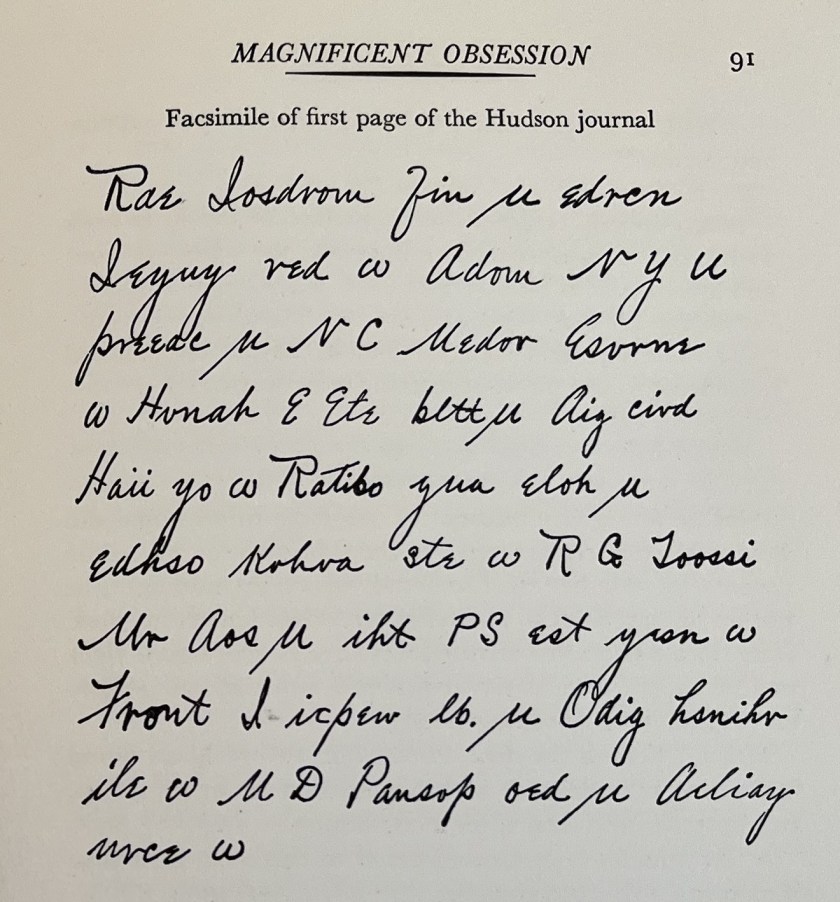
One interesting feature of the novel Magnificent Obsession is the fact that Doctor Hudson’s journal was written in code, to prevent people from discovering his secret too easily. When Nancy Ashford presents the diary to Bobby Merrick, he is determined to crack the code. Here is the first page of it:

In Douglas’s Magnificent Obsession scrapbook, there is at least one critic who complains that the code is easy and that it takes Merrick much longer than necessary to decipher it. Personally, I wouldn’t even know where to start.

Nancy and Bobby figure out one thing immediately: Dr. Hudson used the last letter of the Greek alphabet, omega, to indicate the end of a line, and he used the Greek letter mu to indicate the halfway point. This was a clue to divide each line into two, like so:

As an example of Douglas’s skill as a storyteller, he has Merrick work on the puzzle so late into the night that he falls asleep at his desk. The next morning when the butler comes to call him to breakfast, he finds him like this, then goes down to the kitchen and tells the cook, “You lost your bet!”

“Drunk again?”

“Quite!”

After the accident that saved his life at the expense of Dr. Hudson’s, Merrick has sworn off alcohol. This is a humorous scene that shows the household staff jumping to conclusions, just like we all do in real life.

Later on, having no better ideas, Merrick tries separating the letters and shifting the second half of the line slightly to the right…

Although I still wouldn’t have seen it, Merrick realizes that the key is to take the first letter from the top line, the second from the bottom line, the third from the top, and so on. He comes up with this:

“Reader, I consider you my friend…”

This is just the beginning, of course. He still has to decipher the whole journal in order to learn the secret that Dr. Hudson worked so hard to conceal. But this is just one example of the way Douglas keeps us in suspense.

When reviewers mentioned the code, they usually included it as one of the interesting features of the book. Some complained about it, however.

From The Congregationalist: “Dr. Douglas does, however, make a certain concession to the present age in surrounding rather simple and elemental Christian facts and experiences with an element of mystery and the occult. Our own judgment is that the diary of the famous surgeon which figures so prominently in the story would have been made both artistically and spiritually more effective if it had been plainly presented in simple English rather than in the unique code which, without the key that Dr. Douglas supplies, would have been difficult to decipher. However, Dr. Douglas probably knows his age and the unreadiness of the sophisticated to appreciate simple things simply stated.”

Lighten up! True, Douglas used the coded diary as a way of getting his audience interested, but there’s also a more basic truth here: a coded diary is fun. Douglas wanted us to enjoy reading Magnificent Obsession, and judging from the reviews in his scrapbook, many people did.

The message that Merrick deciphers is based on a page of scripture that is talked about but never entirely revealed. And that is another reason why Magnificent Obsession became “a publishing miracle.” I’ll tell you about that in my next post.
That Remarkable 18th Chapter

by Ronald R Johnson

(In recent posts, I’ve been telling you about the novel that would become known as Magnificent Obsession. When Lloyd Douglas was writing it in 1928, however, the working title was Salvage. In a future post, I’ll talk about the name change.)

The eighteenth chapter of Douglas’s book, Salvage, was remarkable for at least three reasons.

For one thing, he was poking fun at himself. The spotlight in this chapter is on the Reverend Doctor Bruce McLaren, a feisty minister of Scottish descent, who is modeled after fellow Scotsman Lloyd C. Douglas, D.D. This is remarkable because McLaren, although he is said to be “a good sport,” is also a somewhat comical figure. He is so well-educated, he preaches over the heads of his parishioners (as Douglas himself was doing at his church in Los Angeles, or so his critics claimed). McLaren is a modernist all the way.

“The whole business of institutionalized religion,” he says, “demands reappraisal! It appalls me to contemplate what must be the future of the Church when all the people who are now fifty and up are in their graves! This oncoming generation, now in its adolescence, is not in the least way concerned about organized religion. Religious enough, instinctively, I dare say; but out of sorts with the sects; weary of their bad-mannered yammering at one another over matters in which one man’s guess is as good as another’s, and no outcome promised either in faith or conduct, no matter whose guess is right!”

A little later, McLaren says, “A Christ who can help us to a clearer perception of God needs to be a personality confronted with problems similar to our ours, and solving them with knowledge and power to which we also have access – else he offers us no example at all. But here we have a majority of the churches trying to elicit interest in him because he was supernaturally born, which I wasn’t; because he turned water into wine, which I can’t; because he paid his taxes with money found in a fish’s mouth, which – for all my Scotch ingenuity – I can’t do; because he silenced the storm with a word and a gesture, whereas I must bail the boat; because he called back from the grave his friend who had been dead four days, while I must content myself with planting a rosebush and calling it a closed incident! What we want is a Christ whose service to us, in leading us toward God, is not predicated upon our dissimilarities, but upon our likenesses!”

Now… these are the very same things Douglas had been saying for a long time, almost word-for-word, in sermons, speeches, and articles. But when McLaren says them, we’re supposed to grin. For he’s right, up to a point; but he’s also missing the most important thing – the thesis of the whole book – and we know that Bobby Merrick is about to set him straight.

This reflects an important change in Douglas’s thinking, either just before or during his writing of the non-fiction book, Exploring Your Soul.

“I wonder if we modernists,” McLaren says later, “are not somewhat in the predicament of Moses, who had enough audacity to lead the slaves out of their bondage, but lacked the ingenuity to take them on into a country that would support them. We’ve emancipated them; but – they’re still wandering about in the jungle, dissatisfied, hungry, making occasional excursions into paganism and experimenting with all manner of eccentric cults, longing for the spiritual equivalent of their repudiated superstitions – sometimes wishing they were back in the old harness!”

“It’s worthwhile to have fetched them out of that,” says Bobby. “It ought to be equally interesting to lead them on. They mustn’t go back! But they will – if they’re not pointed to something more attractive than the jungle you say they’re in.”

How, exactly, can McLaren lead his people forward? By practicing what Bobby Merrick has just taught him: a message that goes beyond modernism.


In May of that same year (1928), Douglas published an article in the Christian Century entitled, “The Seeming Impotence of Christianity.” In it he asked:

May not the chief difficulty of the churches lie in the fact that we have all been interpreting Christianity in terms of metaphysics to a generation that does its thinking in terms of kinetic energies? Even modernism, for all its twentieth-centuryness, has made no more of a contribution at this point…. The modernist refutes the metaphysics of the fundamentalist by proposing another metaphysics. Both schools are equally absorbed in speculative thought, one hoping to show the public that the other is an infidel, the other hoping to show the public that the one is an ignoramus, but neither of them interested in showing the public that Christianity is a dynamic energy….

In the field of physical energies, it is common knowledge with our boys and girls that an ampere is the current produced by one volt acting through the resistance of one ohm; that a horsepower equals 746 volts-ampere; that a calorie is the heat required to raise a gram of water one degree centigrade. But what the soul can do, under given conditions, by reliance upon and utilization of divine power in fortifying against disappointments, encountering grief, and resisting the demands of appetite, is not only unknown but undiscussed. What manner of vital connection an aspiring soul may practically establish with its Source; under what circumstances spiritual power may be definitely guaranteed; whether prayer may be made a workable pursuit, and, if so, for whom, how, where, and when—these matters are spoken of with vagueness, albeit sung about with pious fervor. This generation has not been trained to think of power as something that should be set to music but set to work.

This is not to mean, however, that the present public is utterly without a spiritual aspiration. An increasing number of yearning people are possessed of the belief that there are certain spiritual energies in existence which, if practically utilized, could extend the reach of a man’s soul exactly as physical dynamics have multiplied the capacities of his eye, ear, and hand. That there is an unseen power, accessible to mankind, is not considered a mere chimera…

Lloyd C Douglas, “The Seeming Impotence of Christianity,” Christian Century, 5/24/1928, pp. 664-667.

This is the second thing that’s remarkable about the eighteenth chapter of Douglas’s novel: in it, Bobby Merrick claims that God can be approached in a manner that mimics applied science.

“Isn’t the modern school just substituting a new metaphysic for the old one?” Merrick asks McLaren. “Our generation is doing all its thinking in terms of power, energy, dynamics – the kind you read about, not in a book, but on a meter! Why not concede the reality of supernormal assistance, to be had under fixed conditions, and encourage people to go after it?”

Douglas’s emphasis here is on the “fixed conditions” – on doing what Jesus taught. To state the matter in religious terms, Merrick shares his testimony with the McLarens. But it’s not the typical tale of sorrowing over one’s sins and asking forgiveness; it’s a story about how he did what Jesus said… and received the promised results.

After the book’s publication, some conservative Christians would balk at the “pseudo-scientific” overtones of the story, but Douglas was really just putting his faith in Christ on the line. He was saying (although not in these exact words), “Do you believe in Jesus’ promises? If so, why be upset if someone follows his teachings and gets the promised results? Why be angry just because they didn’t come to him by following your four-step process? If they come to Jesus by doing what he himself said, how can that be wrong?”


The third thing that’s remarkable about the eighteenth chapter is that Douglas addresses an issue that every college freshman faces in Philosophy 101: the so-called “proofs for the existence of God.”

I’m a philosophy professor. I teach the “proofs.” And I see firsthand how irrelevant they are to people’s day-to-day lives. Students don’t resolve their doubts about the existence of God by having the matter “proven” or “disproven.” In fact, most people in this world never find intellectual resolution, one way or the other. They either believe, or they don’t. “We’ll find out when we die,” they say.

In the eighteenth chapter of the novel Salvage, however, Douglas claimed that resolution was possible.

When McLaren says that God is only “an hypothesis,” Merrick says, rather shyly, “I’m afraid I don’t accept that.”

“Oh – Doctor Merrick!” says Mrs. McLaren. “You don’t mean to say that you do not believe in God at all!”

“I mean that I do not think of God as an hypothesis.”

“But – my dear fellow,” says McLaren, “we really have no hard and fast proofs, you know!”

“Haven’t you?” asks Bobby. “I have.”

The text says: “The two forks in use by the McLaren family were simultaneously put down upon their plates. ‘Er – how do you mean – proofs?’ queried his guest.”

Of the three, this is perhaps the most remarkable feature of this chapter: that Lloyd Douglas claims we can go beyond just believing in God, then finding out if we were right only after we die. Douglas claims that, if we do what Jesus says, we’ll find out now. The things he promises will happen. We’ll come into daily contact with the Living God… and we’ll know.

I can’t speak for anybody else, but I can tell you about my own case: when I read this chapter just before starting my junior year of college, I was thunderstruck – not because I wanted to have that experience for myself, but because I already had; I just didn’t realize that it was intellectually permissible to say so. For me, the reading of this chapter was life-changing.

Design a site like this with WordPress.com
Get started


