Publishing Miracle 2: The Christian Century

by Ronald R Johnson

In a previous post I said that Lloyd Douglas must have felt he was going back to square one when he submitted his manuscript of Magnificent Obsession to Willett, Clark & Colby, a two-year-old company that was run by the same people who published The Christian Century. But it is safe to say that Douglas’s novel wouldn’t have been nearly as successful if it had been brought out by a name-brand publisher.

The Christian Century, having a vested interest in the success of Magnificent Obsession, advertised the book prominently and kept doing so – relentlessly – for the next few years. And since, as Douglas later said, they were taking the funds from one pocket of their trousers and putting it into the other, they could afford to do this. Douglas would later complain that Willett did very little publishing outside The Christian Century, but (as I’ll show in the next post) it was immensely beneficial to the book to receive such lavish attention from the Century.

Here is a full-page ad from the October 23, 1929, issue:

They didn’t include ads in every issue after that, but when they did, there were usually two of them: one from the publisher and another from “The Christian Century Book Service” (a book club tailored to the needs of clergy and lay leaders). Here’s the Book Service ad from November 13, 1929:

Ministers and laypeople who subscribed to The Christian Century were reminded again and again about Douglas’s novel over the many months that followed. And they kept it current, creating new ads whenever a prominent minister wrote something favorable about the book.

In the June 11, 1930, issue, under the headline, “LIFTED UP THEIR HEADS,” the publisher wrote, “In the rapid coming and going of many books, these books have lifted up their heads and will not be put down. The reading public discerns their value – and buys them.” Five books are listed, including Magnificent Obsession.

At this point, they were exaggerating. Willett, Clark & Colby was a very small fish in a big pond, and they had only been in business for a few years. Their claim to have published five books of importance was just hype. Even Magnificent Obsession wasn’t selling that well yet. Its first printing, in November 1929, was of 3,000 copies. Those sold quickly, so Willett ran a second printing of 3,000 that same month. But despite their claim in June 1930 that the book had “lifted up its head,” there were, at that point, only 6,000 copies in existence. It wasn’t until August that they ran a third printing of 3,000. After that, however, things took off. Their ads became increasingly newsy, announcing each new printing with mounting excitement:

Third printing, August, 1930
Fourth printing, October, 1930
Fifth printing, January, 1931
Sixth printing, March, 1931

Testimonials by respected ministers were printed. Reviews from increasingly important newspapers were excerpted. And now it was no longer just hype. In the April 29, 1931, issue of the Century, the publisher ran a full-page ad with the headline, “SUCCESSFUL!” Immediately under this, they printed the following quotation.

“A book which was published in November, 1929, has for some time been appearing on the best seller lists of mid-western stores, and this month its percentage brought it up among the leading twenty-five books of fiction. This is MAGNIFICENT OBSESSION, by Lloyd C. Douglas….”

from Publishers’ Weekly, April 18, 1931

“Publishers’ Weekly,” the ad explained, “is the recognized book trade journal. Its ‘best seller’ records are compiled from reports issued by bookstores all over the country.”

The ad continues:

“Hundreds of subscribers to THE CHRISTIAN CENTURY have already read this amazing story by the pastor of St. James United Church, Montreal, Canada. Ministers in all parts of this country have taken MAGNIFICENT OBSESSION into the pulpit and have broadcast its message to their congregations. It has become a best seller in many cities, and the demand for copies, after eighteen months, is increasing! (The average life of most books of fiction is but a few weeks.)”

This was all true. In terms of sales, most books do what they’re going to do within weeks of publication; or at any rate, publishers expect immediate results and do not give long-term support to most books. Magnificent Obsession surprised people in the industry by climbing up to the bestseller lists slowly, over the course of a year and a half. That was due, in large part, to the fact that the publisher kept hammering away at subscribers of The Christian Century, reminding them about the book. The ad concludes:

“The publishers believe that every subscriber to The Christian Century, layman as well as minister, would profit by the reading of MAGNIFICENT OBSESSION. Order a copy from your bookstore today…”

And, of course, as the novel climbed farther and farther up the NY bestseller lists, the ads in the Century kept announcing that fact, along with news of subsequent printings:

Seventh printing, May, 1931
Eighth printing, July, 1931,

…and the current demand for copies is greater than ever before!” says one ad.

What’s ironic is that those “hundreds of subscribers” mentioned in the April 29, 1931, ad were the key to the book’s success. It all started with the advertising, but the “publishing miracle” was largely due to the response of Christian Century readers.

[To be continued…]

Anatomy of a Publishing Miracle

by Ronald R Johnson

In November 1929, just after the crash of the New York Stock Exchange, a gaudy-colored book with an enigmatic title was released to the world by a little-known publishing company in Chicago, far from all the action. It would take a year and a half for the industry to notice its appearance, but another year later they’d treat the book as a phenomenon. Noel Busch, in an article for Life Magazine, called Magnificent Obsession “a publishing miracle.”

There was little about the book that would attract readers. The publisher’s description on the cover was completely unhelpful. “A novel of strong color and varied interests,” they said, “dealing with strange, transforming life forces.” If books are truly judged by their covers, this one might have turned off a lot of people. What was the book about? And why should we care?

The inside flyleaf was more effective. It elaborated on the theme of mystery…

“Within the first third of the book,” it said, “you come to this…”

‘I wonder what was on that page.’

He laughed. ‘That was what Hudson wanted to know. Now it’s your question – and mine.’ He gripped her arm in strong fingers. ‘And – no matter how stiffly we revolt against this thing, we’re sure to be sneaking back to it.’

She nodded without looking up. ‘It’s likely to make us as nutty as he was!’

Bobby strolled to the window… ‘I can’t afford to dabble in such stuff! You can go into it if you want to. I’m out!’

Nancy’s voice was husky.

‘You’ll not be able to get away from it! You’re too far in! It’s got you! … A form of insanity, maybe; but you may as well come along – first as last!’

It reads like a detective novel. What have they gotten into? Sounds dangerous. And sexy. A man, a woman. He grips her arm. She has a husky voice. The whole thing has a seductive quality, drawing us in. What the woman says to the man is really meant for us: “It’s got you! You may as well come along…”

But first we have to become interested enough to pick up the ugly orange book and read the flyleaf. (Sorry. Maybe you like orange. Maybe it made people want to pick it up and read it. It certainly was “a book of strong color.” My own opinion, however, is that it would have appeared gaudy, especially since bookstores at first displayed it in their Religion section, where only ministers and very religious people tended to browse.)

The fact that the book became both a bestseller and a classic (and is still in print a century later) is indeed a “publishing miracle.” But thanks to Douglas’s scrapbooks and correspondence, we can analyze how it all unfolded. Over the next dozen posts, I’ll give a detailed explanation: the anatomy of a publishing miracle.

Harper’s Verdict

by Ronald R Johnson

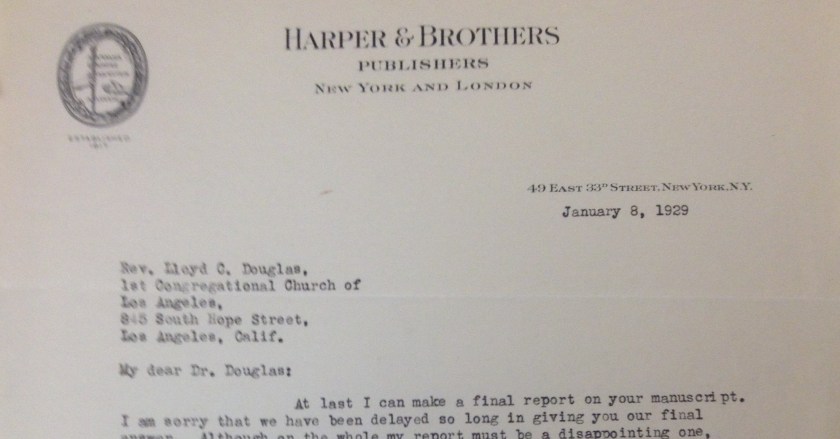
Eugene Exman to LCD, 1/8/1929. In LCD Correspondence 1926-1930, Lloyd C Douglas Papers, Box 1, Bentley Historical Library, University of Michigan. The University of Michigan holds copyright.

Over the last dozen posts I’ve been talking about Lloyd Douglas’s work on a novel called Salvage during the summer of 1928 (what would later become known as Magnificent Obsession) and of Harper & Brothers’ attempts to make sense out of it. Douglas had put two very different genres together: a novel (specifically, a hospital drama) and a non-fiction treatise about the first few verses of Matthew 6.

In January 1929, Eugene Exman, Harper’s religion editor, gave Douglas his company’s verdict. Four members of the Literary Department had read the updated version and recommended against publication as a novel. They categorized it “between the manuscripts that were almost good enough to publish and those which were obviously important enough to publish.” In his earlier correspondence, Exman had used words like “good enough” and “important enough” to assess the book’s marketability, not its literary quality. Years later, he would claim publicly that the head of the Literary Department considered the book “second-rate fiction and not deserving of the Harper imprint,” but nothing was said about that in his letters at the time. If it was true, however, then it added an extra layer of complexity to Douglas’s task: although he was using fiction techniques to communicate his message, he was under no illusion that he could be regarded as a serious – much less, first-rate – novelist. That wasn’t what he was trying to do at this stage in his career.

True to his word, Exman then tried to publish the book as religious non-fiction. As Harper’s Religion Editor, he had the authority to do that. In retrospect, it seems like a strange move, since Douglas had clearly written the book in novelistic form; but if it was a choice between treating it as a religious book or not publishing it at all, Exman chose the former. But first, he had to get the opinion of an expert.

He sent the manuscript to an anonymous but “prominent” churchman. I’m going to hazard a guess here: it very well might have been Harry Emerson Fosdick. I say that for two reasons. First, because Exman was then a member of Park Avenue Baptist Church, where Fosdick preached while Riverside Church was being built for him. Second, because Exman was patiently trying to win Fosdick over to Harper from Macmillan, and he eventually succeeded. They published 17 books together. (Stephen Prothero, God, the Bestseller: How One Editor Transformed American Religion a Book at a Time (San Francisco: HarperCollins, 2023), p. 41).

But whether I’m right or not, Exman showed the manuscript to some “prominent” churchman, who in turn shared it with three other “very discerning people.” The clergyman rejected the book’s thesis and advised against publication on theological grounds. And with good reason, one might argue. The book seemed to promise worldly success. A lot of explaining would be necessary to translate the story into anything resembling traditional Christian theology. That was Douglas’s intention, of course: to speak the language of the unchurched and get them interested in Jesus without sounding like a preacher. But the prominent churchman that Exman consulted was unwilling to go along with it.

“Whether his point is well taken is not of such great importance,” Exman told Douglas. “The thing which concerns me is that the publication of the manuscript would not get his backing as well as the backing of the group in the church he represents.” Once again, the main obstacle was economic. Exman had reason to believe that the book wouldn’t sell.

In brief, then: Harper had carefully considered publishing the book, but the editors were uncertain whether it could meet their sales goal. Would it do better as a novel or as a religious tract? Their answer was, Neither.

Douglas had hoped to present the Christian gospel in practical terms and to spread his message to an audience far beyond the confines of the church. His book was an experimental piece of writing that could possibly help him attain that goal, but “possibly” was the operative word. Eugene Exman realized that the book was unusual, but he lacked evidence that the general public would recognize its worth. Without that assurance, he could not take the financial risk. “I really believe that it should be published,” he told Douglas, “although this may seem a paradoxical statement; I am sorry the imprint of our House will not appear on your book when it does go out.”

The situation was paradoxical indeed, for Eugene Exman, perhaps more than any other religion editor, went on to publish the books that would both create and give direction to what we now call the SBNR movement (Spiritual But Not Religious). Late in his career, he considered Douglas’s book the one that got away (Prothero, p. 276).

Thirsty Fish

by Ronald R Johnson

I told you in my last post that Eugene Exman, Religion Editor at Harper and Brothers, was working with the Literary Department in the fall of 1928 to get Douglas’s novel Salvage accepted for publication. In November, Douglas told Exman he had come up with a much better title for the book.

LCD to Eugene Exman, 11/15/1928. In LCD Correspondence 1926-1930, Box 1, Lloyd C Douglas Papers, Bentley Historical Library, University of Michigan. The University of Michigan holds copyright to this item.

“Not at any time have I been entirely satisfied with the name Salvage,” he told Exman. “By the time I had reached the third chapter, the book had outgrown the ‘salvage’ concept.” (And there was a reason for that: because the novel Salvage had now been combined with the thesis of his non-fiction book, Exploring Your Soul, making it an entirely different story than he had originally planned.) “I have hit upon a title now that will be sufficiently cryptic to be intriguing to the reader’s curiosity and yet significant enough to be entirely comprehensible to him in due time. I am calling the book…”

(Drum roll, please…)

“…Thirsty Fish.”

Exman must have blinked a few times before responding. “I must confess frankly that it doesn’t register at all with me.”

Nor with me. There is nothing in his private papers that tells us what the proposed title meant to him. Obviously, a thirsty fish is an oxymoron, for a fish lives in water. In reference to Bobby Merrick, the hero of the novel, was Douglas implying that he was surrounded by material wealth but was poor in spiritual things? Or that the spiritual help he needed most was all around him and he didn’t know it? We simply don’t have enough evidence to guess what Douglas had in mind.

The nearest thing to a clue comes from Douglas’s novel Forgive Us Our Trespasses, although that’s getting way ahead of the story. Near the end of that book, Dinny Brumm gets the idea for a novel called Thirst. It’s based on Ecclesiastes 12:6, in which the Hebrew writer advises remembering God before the time of adversity, “Or ever the silver cord be loosed, or the golden bowl be broken, or the pitcher be broken at the fountain, or the wheel broken at the cistern.” (Douglas was quoting from the King James Version.) The idea here is that the person becomes thirsty even unto death, because he no longer has a way to draw water from the well. But that seems like a very different idea from the image of a thirsty fish.

At any rate, Exman never forgot it. Years later, when he wrote an official company history, he included Douglas and his book as a comical sidenote and livened up the story by claiming that, from the very start, Douglas had sent him the manuscript with it already titled as Thirsty Fish (Eugene Exman, The House of Harper: One Hundred and Fifty Years of Publishing (New York: Harper & Row, 1967), 223.)

Meanwhile, Exman and his associates got down to work reading the updated manuscript. As I mentioned in a previous post, Douglas was in trouble. To avert disruption from a core group of conservatives in his congregation in Los Angeles, he had resigned, effective January 1929. He didn’t have any other positions lined up, and both of his daughters were now studying in Europe. He needed an income – immediately. The new book became more important than ever…

Design a site like this with WordPress.com
Get started