Book cover from The Autobiography of Cecil B De Mille (Englewood Cliffs, NJ: Prentice-Hall, 1959).
I’ve been telling you about the work Lloyd Douglas was doing on his novel, Salvage, during the summer of 1928. But that same summer he also clashed swords publicly with filmmaker Cecil B DeMille. I’ll tell you about their public disagreement in a later post, but for the next two posts I want to give you some background, for Douglas had already written about DeMille a year before they ended up in the newspaper together.
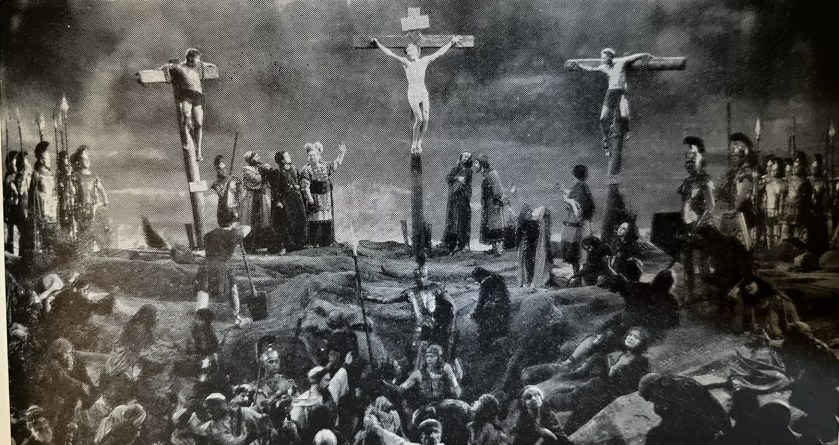
In the summer of 1927, De Mille’s The King of Kings was in theaters around the country. It was a two-and-a-half hour silent film, but for its day it was quite a spectacle.
A still from De Mille’s 1927 film, The King of Kings. From The Autobiography of Cecil B De Mille (Englewood Cliffs, NJ: Prentice-Hall, 1959).
Much of the dialogue was straight from the scriptures, and the chapter-and-verse citations were even included; but the scriptural context was often disregarded. Events and quotations were all jumbled up, like a weird black-and-white dream. After Jesus cleanses the temple, the crowd tries to make him king (confusing that scene with events in John 6), so he escapes to the top of the temple and then (again out of order) is tempted by the Devil. Early in the film, Simon Peter speaks to a young boy and says something straight out of one of the Epistles of Peter – written decades later.
The way Christ is introduced is interesting, but also a bit confusing. We see his disciples talking to him, but we don’t see him. Then a blind child is brought to him to be healed, and the screen goes black, showing us what the child sees. When the child’s eyes open, we see a bright light, which dissolves into the smiling face of the well-known silent-movie actor, H. B. Warner. It takes a moment to realize that he’s actually supposed to be Jesus. “Oh… okay then.”
It’s also rather distracting, at Christ’s crucifixion, to note that the thieves on either side of him aren’t nailed to their crosses; they’re just tied to them, and they don’t look like they’re going to die anytime soon.
But still, for its time it was quite a spectacle. Lloyd Douglas thought so, too. He wrote an article about it in The Christian Century (Lloyd C Douglas, “The Gospel According to De Mille,” Christian Century, 7/14/1927). The fact that Douglas was the pastor of the First Congregational Church of Los Angeles made the essay seem like on-location reportage, although it wasn’t.
Of DeMille himself, Douglas was highly complimentary: “Not only does this man know his New Testament, but he has ransacked the entire lore of that era. If the average preacher gave himself with as deep concern to the business of revitalizing the story of Jesus and his times, churchgoing would be vastly more rewarding.”
Of the film’s depiction of Jesus, however, Douglas was critical: “One is conscious, throughout the whole spectacle, that one is seeing the traditional Roman Catholic conception of a Christ who has come to earth primarily to die. Let all the people about him do or leave undone whatsoever they will; befriend or harass; condemn or crown; he is here to die—and everybody is waiting, nervously, for the tragedy. Jesus, in the picture, moves about slowly and sadly, with the air of one already unjustly convicted. Now and again, there is a gesture of futility more reminiscent of Omar Khayyam than Jesus of Nazareth…. The shadow does not lift….
“Persons who think of Jesus as the world’s master teacher, chiefly concerned with the spread of a new message of hope and joy, the promotion of victorious idealism, the development of a broader altruism, the building of a kingdom of heroes, are not quite content with so supine and languid a Christ as the abstracted, detached, time-marking, sighing Jesus who dominates the stage in ‘King of Kings.’”
Douglas liked the film’s depiction of the miracles. He felt it demonstrated just how ridiculous it was to picture Jesus as a worker of wonders. He hoped that “Persons who have been uncertain whether the magician-Jesus is quite adequate to deal with the baffling problems of these modern times, in which there is so little room for necromancy in the thought of intelligent people, will be encouraged by ‘The King of Kings’ to make a fresh examination of the essential character of Christ.”
Overall, Douglas gave the movie high marks, considering the fact that De Mille’s views were conservative and Douglas’s were liberal. Over the next several months, however, he became more critical of the film. I’ll talk about that in my next post.
(In recent posts, I’ve been telling you about the novel that would become known as Magnificent Obsession. When Lloyd Douglas was writing it in 1928, however, the working title was Salvage. In a future post, I’ll talk about the name change.)
The eighteenth chapter of Douglas’s book, Salvage, was remarkable for at least three reasons.
For one thing, he was poking fun at himself. The spotlight in this chapter is on the Reverend Doctor Bruce McLaren, a feisty minister of Scottish descent, who is modeled after fellow Scotsman Lloyd C. Douglas, D.D. This is remarkable because McLaren, although he is said to be “a good sport,” is also a somewhat comical figure. He is so well-educated, he preaches over the heads of his parishioners (as Douglas himself was doing at his church in Los Angeles, or so his critics claimed). McLaren is a modernist all the way.
“The whole business of institutionalized religion,” he says, “demands reappraisal! It appalls me to contemplate what must be the future of the Church when all the people who are now fifty and up are in their graves! This oncoming generation, now in its adolescence, is not in the least way concerned about organized religion. Religious enough, instinctively, I dare say; but out of sorts with the sects; weary of their bad-mannered yammering at one another over matters in which one man’s guess is as good as another’s, and no outcome promised either in faith or conduct, no matter whose guess is right!”
A little later, McLaren says, “A Christ who can help us to a clearer perception of God needs to be a personality confronted with problems similar to our ours, and solving them with knowledge and power to which we also have access – else he offers us no example at all. But here we have a majority of the churches trying to elicit interest in him because he was supernaturally born, which I wasn’t; because he turned water into wine, which I can’t; because he paid his taxes with money found in a fish’s mouth, which – for all my Scotch ingenuity – I can’t do; because he silenced the storm with a word and a gesture, whereas I must bail the boat; because he called back from the grave his friend who had been dead four days, while I must content myself with planting a rosebush and calling it a closed incident! What we want is a Christ whose service to us, in leading us toward God, is not predicated upon our dissimilarities, but upon our likenesses!”
Now… these are the very same things Douglas had been saying for a long time, almost word-for-word, in sermons, speeches, and articles. But when McLaren says them, we’re supposed to grin. For he’s right, up to a point; but he’s also missing the most important thing – the thesis of the whole book – and we know that Bobby Merrick is about to set him straight.
This reflects an important change in Douglas’s thinking, either just before or during his writing of the non-fiction book, Exploring Your Soul.
“I wonder if we modernists,” McLaren says later, “are not somewhat in the predicament of Moses, who had enough audacity to lead the slaves out of their bondage, but lacked the ingenuity to take them on into a country that would support them. We’ve emancipated them; but – they’re still wandering about in the jungle, dissatisfied, hungry, making occasional excursions into paganism and experimenting with all manner of eccentric cults, longing for the spiritual equivalent of their repudiated superstitions – sometimes wishing they were back in the old harness!”
“It’s worthwhile to have fetched them out of that,” says Bobby. “It ought to be equally interesting to lead them on. They mustn’t go back! But they will – if they’re not pointed to something more attractive than the jungle you say they’re in.”
How, exactly, can McLaren lead his people forward? By practicing what Bobby Merrick has just taught him: a message that goes beyond modernism.
In May of that same year (1928), Douglas published an article in the Christian Century entitled, “The Seeming Impotence of Christianity.” In it he asked:
May not the chief difficulty of the churches lie in the fact that we have all been interpreting Christianity in terms of metaphysics to a generation that does its thinking in terms of kinetic energies? Even modernism, for all its twentieth-centuryness, has made no more of a contribution at this point…. The modernist refutes the metaphysics of the fundamentalist by proposing another metaphysics. Both schools are equally absorbed in speculative thought, one hoping to show the public that the other is an infidel, the other hoping to show the public that the one is an ignoramus, but neither of them interested in showing the public that Christianity is a dynamic energy….
In the field of physical energies, it is common knowledge with our boys and girls that an ampere is the current produced by one volt acting through the resistance of one ohm; that a horsepower equals 746 volts-ampere; that a calorie is the heat required to raise a gram of water one degree centigrade. But what the soul can do, under given conditions, by reliance upon and utilization of divine power in fortifying against disappointments, encountering grief, and resisting the demands of appetite, is not only unknown but undiscussed. What manner of vital connection an aspiring soul may practically establish with its Source; under what circumstances spiritual power may be definitely guaranteed; whether prayer may be made a workable pursuit, and, if so, for whom, how, where, and when—these matters are spoken of with vagueness, albeit sung about with pious fervor. This generation has not been trained to think of power as something that should be set to music but set to work.
This is not to mean, however, that the present public is utterly without a spiritual aspiration. An increasing number of yearning people are possessed of the belief that there are certain spiritual energies in existence which, if practically utilized, could extend the reach of a man’s soul exactly as physical dynamics have multiplied the capacities of his eye, ear, and hand. That there is an unseen power, accessible to mankind, is not considered a mere chimera…
Lloyd C Douglas, “The Seeming Impotence of Christianity,” Christian Century, 5/24/1928, pp. 664-667.
This is the second thing that’s remarkable about the eighteenth chapter of Douglas’s novel: in it, Bobby Merrick claims that God can be approached in a manner that mimics applied science.
“Isn’t the modern school just substituting a new metaphysic for the old one?” Merrick asks McLaren. “Our generation is doing all its thinking in terms of power, energy, dynamics – the kind you read about, not in a book, but on a meter! Why not concede the reality of supernormal assistance, to be had under fixed conditions, and encourage people to go after it?”
Douglas’s emphasis here is on the “fixed conditions” – on doing what Jesus taught. To state the matter in religious terms, Merrick shares his testimony with the McLarens. But it’s not the typical tale of sorrowing over one’s sins and asking forgiveness; it’s a story about how he did what Jesus said… and received the promised results.
After the book’s publication, some conservative Christians would balk at the “pseudo-scientific” overtones of the story, but Douglas was really just putting his faith in Christ on the line. He was saying (although not in these exact words), “Do you believe in Jesus’ promises? If so, why be upset if someone follows his teachings and gets the promised results? Why be angry just because they didn’t come to him by following your four-step process? If they come to Jesus by doing what he himself said, how can that be wrong?”
The third thing that’s remarkable about the eighteenth chapter is that Douglas addresses an issue that every college freshman faces in Philosophy 101: the so-called “proofs for the existence of God.”
I’m a philosophy professor. I teach the “proofs.” And I see firsthand how irrelevant they are to people’s day-to-day lives. Students don’t resolve their doubts about the existence of God by having the matter “proven” or “disproven.” In fact, most people in this world never find intellectual resolution, one way or the other. They either believe, or they don’t. “We’ll find out when we die,” they say.
In the eighteenth chapter of the novel Salvage, however, Douglas claimed that resolution was possible.
When McLaren says that God is only “an hypothesis,” Merrick says, rather shyly, “I’m afraid I don’t accept that.”
“Oh – Doctor Merrick!” says Mrs. McLaren. “You don’t mean to say that you do not believe in God at all!”
“I mean that I do not think of God as an hypothesis.”
“But – my dear fellow,” says McLaren, “we really have no hard and fast proofs, you know!”
“Haven’t you?” asks Bobby. “I have.”
The text says: “The two forks in use by the McLaren family were simultaneously put down upon their plates. ‘Er – how do you mean – proofs?’ queried his guest.”
Of the three, this is perhaps the most remarkable feature of this chapter: that Lloyd Douglas claims we can go beyond just believing in God, then finding out if we were right only after we die. Douglas claims that, if we do what Jesus says, we’ll find out now. The things he promises will happen. We’ll come into daily contact with the Living God… and we’ll know.
I can’t speak for anybody else, but I can tell you about my own case: when I read this chapter just before starting my junior year of college, I was thunderstruck – not because I wanted to have that experience for myself, but because I already had; I just didn’t realize that it was intellectually permissible to say so. For me, the reading of this chapter was life-changing.
From the Lloyd C Douglas Papers, Box 4, “Miscellanea [1],” Bentley Historical Library, University of Michigan. (There is a typographical error. The series took place in 1928 and the announcement was made in December 1927. The typo must have occurred when this information was retyped in 1951 from a December 1927 church bulletin.)
During the first four Sundays of 1928, Lloyd Douglas preached a series of sermons based on the book he had been writing entitled, Exploring Your Soul. The series followed the topical outline indicated in the announcement imaged above. The first two sermons in the series can be found in The Living Faith: From His Selected Sermons. (Boston: Houghton Mifflin, 1955), pp. 230-257.
On Sunday, January 6, 1928, he spoke on the subject, “Your Soul: What It Is and How It Operates.” His treatment of the theme was neither systematic nor definitive. Although he avoided giving a definition of the soul, he said, “a man may arise in the morning and wash his face for the same reason that a cat washes hers; and eat his breakfast for the same reason that a dog eats his; and work all day to earn his victuals for the same reason that the horse works all day to earn his…. But when he sits down, quietly, to contemplate the everlastingness of himself, and comfort his mind with his firm belief that he is of eternal stuff; that he proposes to outlive all the material things he sees about him because his essential self was existent long before any of these material things came to be, he immediately puts himself in quite another category than that of the animals. It is his soul that he is dealing with now” (p. 233).
Douglas identified a few different types of souls and invited his listeners to think about what type of soul they might be. There are others, no doubt, and the ones he listed are not mutually exclusive – we might recognize ourselves in more than one category. He said:
One man had the soul of a mystic. As a mere child, the consciousness of God’s living presence in his life was at times quite overpowering. He could sit quietly, in rapt contemplation, and sense a kind of inner illumination, a warmth that was other than thermal, an awareness of the Divine affection. It was a very fine, high-grade potential soul – and needed expert handling. His parents were zealous about his physical welfare and saw to it that he knew his hygiene; were careful that he should have balanced rations and his full quota of sleep and the right amount of exercise and recreation. Equally mindful for the training of his intellect, which was quick and precocious, they were inquisitive about his school, his teachers, his outside reading. But it never occurred to them that his soul demanded direction. He learned about souls at the Sunday School.
There was no discipline in that Sunday School, for the reason that not only was the instruction voluntarily offered but as voluntarily accepted, and a good deal of the teacher’s efforts and ingenuity were spent in the sheer task of keeping her wriggling charges quiet enough to avoid disturbing the class adjacent.
To capture their attention and command interest, [the Sunday School teacher emphasized the fantastic stories of sensational events from the Old Testament]. Religion was something that used to be. It used to perform queer tricks. And certain men used to hear celestial voices; but apparently it had gone out of such business long since, for the teacher made no effort to connect this antique lore with present possibilities.
Obviously, what this lad needed, to develop the type of soul he owned, was the direction and influence of some mature person who, like himself, was of sensitive, mystical quality. As he grew up and went to the services of the church, he learned that the main business of the institution was to raise its annual budget (which is not often accomplished, probably for that reason) and around the family table he heard discussions of the main issues which commanded the attention of his parents’ church, and no one of them even remotely impinged upon the problem of his own soul hunger.
In later adolescence, he became absorbed in the affairs of his physical world – his vocational problems, college, love, the new home, his business – and forgot he had a soul. Now and again it throbbed and stretched and sighed, but he ignored it and it went to sleep again. He had the makings of an important spiritual leader but lost his chance to be that through mishandling – mishandling largely charged to the church, and the church’s misguidance (pp. 241-242).
“Another man,” Douglas said,
had a definitely aesthetic soul, but was so unfortunate as to be taught what passed for spiritual culture at the hands of people to whom the love of natural and moral beauty, for its own sake, had never been evoked. Religion was a sheer matter of conduct – their conduct. They had their own little table of mores, and the business of religion was to make everybody behave just like that. As for the loveliness of life, the livableness of life, the profoundly stirring majesty and wonder of the divinely coordinated beauty of life, they couldn’t teach it because they had never suspected it.
Religion was a gospel of don’t. It began and ended with Thou Shalt Not. It had no sunrises and sunsets; it knew nothing of great music, great literature, great drama. In short, it had nothing to offer to an aesthetic soul, and this particular aesthetic soul hungered awhile and dropped off, through sheer undernourishment and anemia, into a rather fitful slumber – occasionally haunted by longings and dreams, but colorless.
Then there are the inquisitive souls – eager to learn as much as they may of God’s will as apparently deducible from Nature, scientific discovery, and the ripest thinking of other inquisitive souls – people who, falling into the hands of confirmed Traditionalists, have been warned that inquiry is infidelity.
Highly socialized souls, who believe only in a gospel of work, should get themselves into some connection where there will be lots of committees to attend and speeches to make and hats to pass and cards to sign and resolutions to enact – a perpetual procession of things accomplished. For them to find themselves in a mystical atmosphere of quiet contemplation might not benefit their souls at all (pp. 242-243).
“One might suppose, from a survey of the churches of the day,” he said, “that there is abundant room for them to do some constructive work on this subject, in assisting men and women to a discovery of the paths to their own souls.
Too many of our churches are so busy regulating or – to speak more accurately – too busy attempting and failing to regulate the public conduct that they have about left off dealing with spiritual matters. All that Religion is about is souls, and their culture. Most of our modern religion concerns itself with practically everything else but souls and soul culture.
Spiritually hungry people come on Sundays to our churches, wishing they might learn something that would improve their celestial contacts and help them find out their peculiar soul-powers; and they go away pretty sure that they’ll have to muddle along without help…. Let organized religion begin talking about these things, and see what will happen to the churches. And to the people who compose the churches (pp. 243-244).
The following Sunday, January 13, 1928, Douglas addressed the topic, “Your Soul: What It Lives On.”
What does the soul live on? What manner of nourishment makes it conscious of its strength and eager to quest adventure with its powers?
First of all, it must be definitely assured of its own importance!
Out! on all these pale and sickly ballads that timidly chirp of ‘You in Your Little Corner and I in Mine’ and ‘Oh to Be Nothing’ and ‘For Such a Worm as I.’
Quite off pitch is the timbre of a feeble voice like that, when it tries to attune itself to the Galilean: ‘Ask What Ye Will, and It Shall Be Done! Seek, and Ye Shall Find! Knock, and It Shall Be Opened!’ (p. 252).
The first thing that nourishes the soul is its awareness that “I am a child of God.” The second thing is to realize that “all men everywhere are children of God. For if all other men are not the spiritual children of God, there is no sense or significance to my claim that I am” (p. 253). The third thing is “to help other men to… an awareness of their Divine Sonship” (p. 254). But the best way to do this, Douglas said, was not by talking about it; it was to demonstrate it (pp. 254-255). He was a little unclear on how to do this through actions rather than words, but in his next sermon he would take this one step further. And it was a very important step.



 The Lloyd C Douglas Page