From the Michigan Daily (the student paper of the University of Michigan) sometime in October 1919.
This is Part 2 in a short series of posts about some anonymous limericks Lloyd Douglas wrote for the Michigan Daily, the student paper at the University of Michigan, in the fall of 1919. These were meant as advice to incoming freshmen. “The Newcomer” tells about himself and an “Old Timer” (an upperclassman) offers advice. This one was printed sometime in October 1919 and it was titled, “Concerning Etiquette”:
The Newcomer Says:
I love this free Democracy Where all of us are brothers; But where I eat on Duroc Street They also board some others.
My Uncle! You should see this crew – Their arms up on the table – Our food supplies they vocalize As loudly as they’re able.
And when the feat is quite complete And they have mopped the platter, They find a stick and gouge and pick Where anything’s the matter.
Now I was taught that men of thought Are persons of good breeding; Please tell me why this rule’s awry When college men are feeding.
The Old Timer Replies:
My cultured friend, you need not mend The maxim you have quoted; Most men of thought, as you were taught, Are for good manners noted.
But don’t you know someday you’ll go From out these halls of knowledge? All sorts you’ll meet – and with them eat (For all you’re trained in college).
We could not bear to send you there Unused to sights revolting; So, for your good, you take your food Where some are skilled at bolting.
And afterwhile you’ll sometimes smile To see their feats courageous; Be careful, though; we’d have you know The habit is contagious.
[I will continue sharing these limericks over the next two posts.]
The phrase I’m talking about was: “If we may be permitted to lend our imagination wings…”
His biblical text was Matthew 13:45-46, which says, “The kingdom of heaven is like unto a merchant seeking goodly pearls; who, when he had found one pearl of great price, went and sold all that he had, and bought it.”
There doesn’t seem to be much meat in that short passage, but Douglas used his imagination to make more out of it. From a strictly exegetical point of view, one may argue that he should stick to the text; but from a biographical point of view, the fact that he indulged his imagination on this occasion is significant. And, unlike the average pastor, Douglas’s imagination always produced interesting results.
He says of the pearl trader: “If we may be permitted to lend our imagination wings, we may venture a guess that he… picked up one of his treasured pearls in Athens, the traditional seat of learning. Perhaps he called it his ‘Agnostic’ pearl. It had a special value for him. It stood for a neutral-tinted, convictionless attitude of mind, forever in quest of truth and never satisfied with its booty; forever asking for evidence, cross-examining witnesses and demanding testimony – and never reaching a verdict.
“Sometimes his heart proposed that he take a definite stand for something; espouse a cause and see it through; join hands with a movement and put it over; announce discipleship to some Master and follow him; but always he remembered the Agnostic pearl and remained non-committal. ‘Skeptic,’ his friends called him, and the word was not an epithet but a badge of merit, to his mind. He liked to be called ‘free-thinker.’ I suppose that of all the pearls he had, the merchant loved this one best.”
A lot of people in the church that day could probably empathize with this position – especially freshmen. Douglas continued:
“But not much less ardently did he rejoice in the possession of the flawless pearl he had bought in Rome, the headquarters of jurisprudence. Whatever qualms of conscience the Agnostic pearl aroused in him, this Roman stone, which he called the Justice pearl, stirred him to a self-righteous pride. For Justice was an undeniably fine attribute for any man to possess.
“Sometimes his heart suggested that he waive aside the claims of inexorable justice and invest something in behalf of human woe and wretchedness – even if that misery had but little to justify it. Sometimes he would have been glad to do something, out of the charity of his heart, for a weaker fellow; but always he remembered the Justice pearl. Every man should have exactly his due from him, and no more. Mercy was enervating. Mercy was always wearing its heart on its sleeve and getting itself taken in by imposters. No; Justice would do for him.”
Personnel from the administrative side of the University of Michigan were there that morning, and perhaps they felt the same way. Douglas continued:
“And then there was that most showy pearl of the lot, the one he had found in Alexandria, the home of riches and commercial prosperity. As he rubbed his sensitive thumb delicately over its satin surface, he glowed with satisfaction over its ownership. Just carrying it had brought him wealth. After all, honor and influence were not far away from the man who had amassed much property. It was ever so. Poverty, even voluntarily embraced in the interest of a great cause was nevertheless a serious handicap. Not for any consideration would he part from this jewel which he knew as his Prosperity pearl.”
Members of the Ann Arbor business community were members of the church, including prominent business leaders. Perhaps they could relate to this attitude. Douglas continued:
“But with all his goodly pearls he was not content, but still sought others. He appears to have had a haunting suspicion that somewhere there was a valuable pearl to which he had not yet gained access. I daresay he felt it would be a great pity to have gone through life, bent upon the exclusive business of finding the most valuable pearls, and then discover, perhaps when it was quite too late to achieve it, that the most wonderful pearl in the whole world was not his – could never be his – that he had not even seen it, much less owned it.
“It is this gnawing unrest that brings many of us toward the day of silvering hair and faltering footsteps, fearful that, after all, try as we might to live purposefully, we had somehow missed the very best things – maybe passed them, unnoticed, along the way; maybe tossed them aside, as of no account, in our ignorance of their value. Indeed, the man of fifty sometimes reflects that he remembers the day when he passed a great opportunity to possess something of inestimable worth; and if he might set his life back as easily as we set back our clocks last night [for the fall time-change], he would surely want to go back to that crucial hour and live it again.
“I do not know just how much this pearl-merchant worried lest he was rejoicing in the possession of some second-rate jewels when he was seeking the very best; but I do know that when the Master introduces him to us, he is still seeking pearls, goodly pearls. Still touring about from country to country, by ship and caravan, seeking better pearls than these he owned. It doesn’t look as if he was entirely contented.
“You will find them all along the way, many of them people you have envied for their conspicuous positions, their learning, their culture, their wealth – you will find them, like the pearl-merchant, still in quest of something better than they possess. Restless souls, whose very quest proclaims their dissatisfaction with their accretions.”
We know, of course, that the Pearl Merchant is going to find that one pearl that will outshine the others. But Douglas indulges his imagination in other ways, and what he does next is very interesting. I’ll tell about it in my next post.
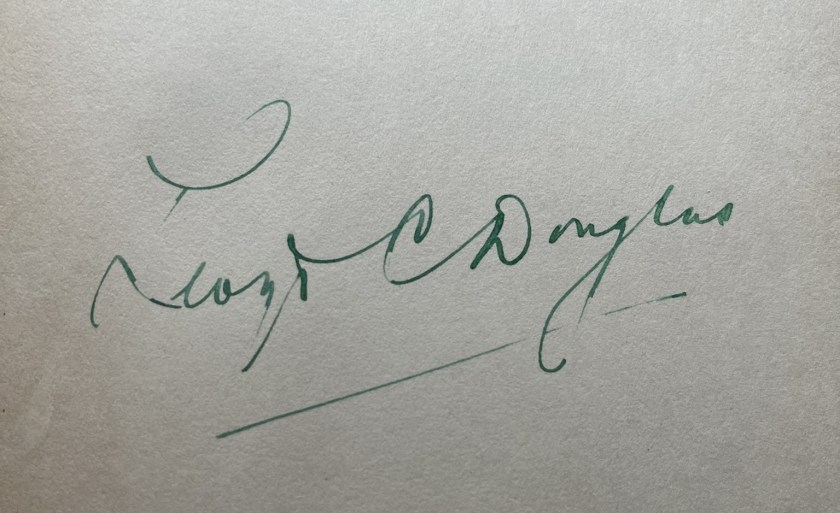
Autograph on first page of a customer copy of Forgive Us Our Trespasses.
Although it’s true that the phenomenal success of the 1929 novel Magnificent Obsession changed the life of its author, it was a delayed reaction. Not until he sat down to write Forgive Us Our Trespasses in the summer of 1932 did Lloyd Douglas realize how greatly his life would change. As I told you in previous posts, he had wanted his next novel to be a satire on the state of modern art, with emphasis (apparently) on the New Fiction of the 1920s; but instead, he wrote another novel like Magnificent Obsession, in which the story was based on a portion of the Sermon on the Mount. As he neared retirement from full-time ministry (which he planned to do in the summer of 1933), he had imagined himself as a mainstream novelist, not as a writer of Christian fiction.
His embarrassment comes through in an unpublished essay that he had intended for the Ladies’ Home Journal in early 1933. (All quotations in this post are from that essay, “Adventures in Parables,” which is filed under “Addresses and Articles,” Box 3, Lloyd C Douglas Papers, Bentley Historical Library, University of Michigan. The University of Michigan holds copyright to this document.)
“More or less by accident,” Douglas wrote, “I have become an author of goody-goody stories in which the characters are tiresomely decent and everything turns out happily in the end. This is an offense to modern art in letters, and if I knew to whom apologies should be offered, perhaps I might solicit such shriving as the transgression demands.”
He was joking, but he really did feel like he had been caught trespassing in literary territory. In that sense, the title Forgive Us Our Trespasses was more appropriate than people realized.
“My main trouble, in the opinion of the literary critics,” he continued, “is that I broke all the rules of novel-composition through ignorance. That’s what makes my position in the world of letters so embarrassing. The only woman at the dinner party who dares plant her elbows on the table and hold the squab in her fingers is the lady whose social experience is beyond the reach of query or cavil. If Maggie O’Flaherty did such a thing, the whole solar system would be set back two minutes due to time out for recovery.”
To understand the next example, you have to bear in mind that this was the Great Depression, and Roosevelt wasn’t president yet. At the very moment he wrote this piece, banks all over the country were closing. Douglas wrote, “The only man in town who can afford to wear a greasy old hat is the banker. (Pardon me. I was momentarily thinking of earlier times when bankers had money. If you can think of another word here for ‘banker,’ give him the old hat with our envious felicitations.)”
Then he got to the point:
“The only writer who can take the risk of breaking the laws in respect to the composition of fiction is the sanctioned, seasoned, spurred veteran; which I am not.
“Nobody in these frugal days should waste ink, stamps, and sarcasm in notifying me that Magnificent Obsession and Forgive Us Our Trespasses are, technically, about as bad as stories could be without exposing themselves to censorship in the cause of sound literary production. Perhaps I am too naive to know just how bad they are, but I have a general idea.”
He was being too hard on himself. Although a case can be made that this or that aspect of his first two novels could have been improved, critics with credentials – especially those based in New York – had good things to say about both novels. As I noted in a previous post, there were only a few writers in local newspapers (Kansas City, for example, and Birmingham, Alabama) who trashed Magnificent Obsession, and that trend continued with Forgive Us. But Douglas didn’t consider either of those books literary masterpieces, and that’s why he was embarrassed when some people did criticize them on literary grounds.
“I have only one defense to fall back upon,” he said, “when the really competent critics complain that my stories are shocking examples of How Not to Write a Novel. I am fully aware of it. I do not think of myself as a novelist at all. These things I have written are probably not novels. Perhaps they are modern parables.”
Again, he was conceding too much. They were novels; they just weren’t the kind that was in vogue after the literary revolution of the 1920s. They were “purpose novels”: novels in which the thesis was more important than the plot. And yet his first two books demonstrate that he understood plotting and did it with skill. His only real problem was this: that he was a writer of purpose novels in a day when that genre was considered a thing of the past.
There’s something he’s not telling us in this essay, however. The truth is, he had always aspired to be a novelist – not a writer of purpose novels but of real ones – ones in which the story was everything. Through all his years as a minister, he had waited patiently for that day, when he could shed the clerical collar and WRITE. But when his moment came, his incoming mail convinced him that God had other ideas. As much as he wanted to be “the sanctioned, seasoned, spurred veteran” writer of modern novels, he chose the path he felt his people needed.
This was the mission of Lloyd C. Douglas: to write “modern parables” for people who desperately needed the guidance such stories could provide. When he composed Forgive Us Our Trespasses, he had to make a choice. Would he follow his heart and be the novelist he had always dreamed of being, or would he do what he discerned the Spirit of God calling him to do? Knowing how much it meant to him, I believe it was a gut-wrenching decision. But he chose what he perceived to be his calling. And the rest is history.
This is as much as I can tell you, in these blog posts, about Douglas’s life story. The biography that I’ve written picks up here (1932) and covers the rest of his life, until his death in 1951. If you would like to know more about that book, I send a free monthly newsletter to Lloyd Douglas fans, updating them on the progress of my research and writing. I invite you to fill out the form below, and I will be glad to add you to my list.
In the meantime, future posts at this site will delve more deeply into the documents in the Lloyd Douglas archive: his sermons, speeches, published articles, and interviews. Stay tuned!
In my last post, I told you about the plans Lloyd Douglas had for his next novel, sometime around 1930-31. It was going to be a satire about modern art and was probably going to focus on the New Fiction of the 1920s. There is reason to believe that some of the book was going to take place in the bohemian artist’s colony at Greenwich Village, in New York.
In their biography of their father, Douglas’s daughters say that they lived in The Village for a short time. As I mentioned in earlier posts, Douglas had sent them to Paris for a year to study. After Lloyd and Besse moved to Montreal in 1929, the girls came “home” and joined them there. The following summer (1930), the girls moved to New York and rented an apartment in Greenwich Village, “hard by the Third Avenue elevated.” Betty, the oldest, “had a good position in the personnel department of a big Brooklyn store” (Shape of Sunday, 240); Virginia was “acting as secretary to an author” (p. 236). It’s not clear whether this “author” had ever had a book published, or why he needed a secretary, but it is clear that he didn’t have any money. He promised to pay Virginia “when his book comes out” (p. 237).
Concerned about the things his daughters wrote in their letters home, Douglas went down to New York to see for himself how they were doing. He was appalled at the poor conditions under which they were living. They were young and carefree and thought it was all rather fun, but he didn’t like it at all. He said nothing about it while he was there, however. He just listened and observed.
“He was very polite in his comments about our living quarters,” Virginia wrote later. “After all, we were in Greenwich Village, a place he had always read about longingly, and the artistic atmosphere was undoubtedly there. Betty and I took him to cellar eating-places where candles stuck into bottles glowed dimly in the gloom. We introduced him to our friends – most of whom were out of work and talked scathingly of the ones who had given up their art and gone home to help Father in the store.
“‘Oh, if I could only think of some novelty to catch the public fancy,’ they would groan. ‘Look at the chap who invented the Eskimo Pie: simply ice cream with chocolate around it. He’s made millions'” (p. 237).
Douglas wanted to meet Virginia’s “employer,” but she was equally determined to prevent such a meeting. The man was not only destitute but also deeply depressed, and he spoke rather casually about killing himself. On Douglas’s last day in New York, however, he and Virginia were in a restaurant at a table next to a window, and the starving artist suddenly appeared, watching them. Douglas insisted that he come in and join them, and the two men seemed to hit it off. But it only seemed that way. When Douglas was alone with Virginia afterwards, he called an end to her “employment” (pp. 237-239). And after he got home, he wrote her a letter (LCD to daughter Virginia, November 1930):
LCD to daughter Virginia, November 1930. In LCD Correspondence, Box 1, Lloyd C Douglas Papers, Bentley Historical Library, University of Michigan.
“There is a well-established theory that real art is produced in such kennels,” he wrote, referring to the apartment in which they were living. “I don’t know enough about Art to be in a position to pass on that.” This was typical of Douglas: he liked to make fun of his “country boy” upbringing and to pretend he was unsophisticated. “What little scribbling I have done has amounted to nothing; or next to nothing.” He was talking about Magnificent Obsession. In November of 1930 there was still no reason to consider the book a success. “I make no pretense of understanding how people ought to feel; how cold and miserable they ought to be; how empty of gut; how full of ideals; how frowsy of hair; how out at the seat of the pants one should be in order to make The Great Contribution to Reality.”
But as a parent, he had some strong opinions about the place. Betty was now engaged to be married, but Douglas wanted Virginia to come home to Montreal.
Still, the time she had spent in New York wasn’t a complete write-off. “It has probably been good for you to have had this experience,” he said. “You can make notes on it and come home and write a story. Ye gods – what a lot of firsthand information that ought to go into a novel!”
It’s unclear whether Virginia ever did write a story about Greenwich Village, but Douglas did. This is probably how he got the idea for his satire on modern art. At any rate, the novel he did end up writing was about an aspiring novelist living in The Village. “What a lot of firsthand information ought to go into a novel!” he said.
I’ve spent the past few weeks writing posts about how the novel Magnificent Obsession quietly worked its way from obscurity in November 1929 to the Top 25 Bestsellers in April 1931, and upwards from there. But meanwhile, the book’s author, Dr. Lloyd C. Douglas, was busy working as Senior Minister of St. James United Church of Montreal. Because his job kept him busy, and because he was living in Canada, Douglas felt somewhat remote from what was happening. Within the publishing world, his star was rising; but his day-to-day life went on almost as normal.
Almost.
He still had to prepare sermons and visit sick people. He still had to do all the things a pastor normally does. But his incoming mail increased dramatically, as people from all over North America wrote to him about his novel. The things they said, and the questions they asked, convinced him that the publication of Magnificent Obsession had started something he couldn’t walk away from. As he wrote later in his “Author’s Foreword” to Doctor Hudson’s Secret Journal, “the author became aware that he had not completed his task.” [All quotations that follow are from this “Foreword.”]
As strange as it may seem, he hadn’t realized that before. Magnificent Obsession was an experiment. He took what started out as a secular novel (Salvage) and added a religious thesis to it (Exploring Your Soul) in hopes of reaching a larger audience. But up until now (1930-31), he hadn’t given much thought to what would happen next. What if he did reach a larger audience? What if they needed help applying the thesis to their lives? What if they wanted to know more about the gospel?
As I said, he hadn’t anticipated those questions. He did enjoy writing Magnificent Obsession, and he wanted to do another novel, although his work at St. James kept him too busy to follow through on that wish. But he had no intention of writing another book like Magnificent Obsession. Douglas tried never to repeat himself. His next novel would be about the world of art, with emphasis on contemporary literature. He had some opinions about that, especially now that he himself had published a novel.
But his incoming mail kept nagging at him. “Do you honestly believe in this thing,” people asked him, “or were you just writing a story?” Well, he did believe in it, but he wanted his next novel to be just a story. He had some jokes he wanted to put into it… some rather droll remarks that his more sophisticated readers would enjoy… some critical comments about the state of literature today.
But his mail kept increasing. As he admitted later, “The task of dealing sympathetically with this strange correspondence became a grave responsibility. No stock letter, done on a mimeograph, would serve the purpose. It was necessary that individual replies be sent to all earnest inquirers. One dared not risk the accusation that, having advocated an expensive and venturesome technique for generating personal power, the author was thereafter too busy or lazy to care whether anybody benefitted by such investments.”
So he wrote to them, one-by-one. “Some of the questions were practically unanswerable,” he says, “but it wasn’t quite fair to limit one’s reply to a laconic ‘I don’t know.’ Frequently one’s counsel was pitiably inadequate, but not because it was coolly casual or thoughtlessly composed.”
Here, then, was a busy pastor, daydreaming about writing another novel in his spare time – just for fun – but instead spending all his available time corresponding with people who were prompted by his latest novel to ask for his help with their spiritual lives.
Whether he liked it or not, the shape of that next novel started to change. It would still be about the arts; the main character would be an aspiring young novelist living in “The Village” with other aspiring young artists. But instead of it being a satire as he had originally planned, it was slowly turning into a story about the young man’s soul. And as the story changed, Douglas’s future changed with it. He began to realize that the road ahead did not go in the direction he had envisioned.
I’ve been telling you about the various factors that made the novel Magnificent Obsession a bestseller. Unlike most successful books, however, it took a year and a half for this one to make it to the top. On April 18, 1931, eighteen months after its release, Publishers’ Weekly ran a notice about it: “A book which was published in November, 1929, has for some time been appearing on the best seller lists of mid-western stores, and this month its percentage brought it up among the leading twenty-five books of fiction. This is MAGNIFICENT OBSESSION, by Lloyd C. Douglas.” It wasn’t in the Top Ten yet, but the quiet path it had taken earned it respect, even from New York critics.
The prestigious Saturday Review of Books called Magnificent Obsession “a readable and refreshing story, with an unusual message.” “The idea of achieving a magnificent personality is not new,” the reviewer said, “but Dr. Douglas’s method is quite different from that of the personality racketeers, and no commercialism soils it.”
Surprisingly, The New York Times had already reviewed the book soon after its release (1/12/1930). On the whole, it was a good review, correctly summarizing the book and saying, “For those with curiosity concerning obsessions, flavored with love and adventure, Mr. Douglas’s book will prove pleasant reading.” There is only one negative remark, and it is difficult to interpret: “Even for those who have a large appetite and enjoy a varied menu, Magnificent Obsession should prove an ample though rather indigestible repast. Besides romance and mystery, it concerns itself with medicine, chemistry, psychology, ethics, religion, alcoholism and altruism, and above all, with the ‘Major Personality.’ Incidentally, a formula for success and happiness is propounded.” (That word “indigestible” would seem to be a negative assessment of the book, perhaps meaning that Douglas tries to do too much; but everything else the writer says is positive.)
The Times mentioned the book again a few years later (1/17/1933), at the start of a story about 1932’s bestsellers: “The year’s marvel, the wholesalers say, was The Magnificent Obsession, which placed sixth on the fiction list after lesser sales during three years on the market.” (It had moved up from the Top 25 in April 1931 to the Top Ten overall by the end of 1932.)
Nothing works like success. Now everybody reviewed the book. That meant, of course, that some would attack it, especially in cities where it had done well. In Kansas City, for example, a frustrated reviewer lamented, “Almost everything is wrong with The Magnificent Obsession. It is poorly constructed, the characters are unreal, the dialogue is not natural, the style is bad, and the plot is unconvincing. It does not even tell a good story.” The headline of the review was, “Why Publishers Go Mad.”
Kansas City Journal Post, Sunday, April 19 (no year).
In Birmingham, Alabama, an entire page was devoted to the subject. A local minister defended the book, but two critics from the paper trashed it on literary grounds. One of the critics called it “the most vulgar book I have ever been forced to read.”
But others were pleasantly surprised by the book.
Emily Newell Blair, the book review editor at Good Housekeeping, wrote in December 1932 that, although many people had urged her to read it, she had avoided doing so because she thought it would be a boring religious tract. “What was my amazement to find it, first of all, a corking good story with something happening in every chapter to hold your interest, characters which were actually alive, and a real plot. It was, in fact, a really good novel, entirely apart from the theme which has made its appeal so wide…” That theme, in the hands of a less gifted writer, would have ruined the story, she said. “That it does not spoil this one is almost proof that the author has practiced what he preaches; namely, that man may enlarge his personality and do anything he wishes if only he will adopt the philosophy of life discovered by the doctor in the book.”
With these words, Blair went farther than any of the book’s other reviewers, even among Christian periodicals. Not only did she claim that the book had technical merit but she also proposed that its author was illuminated by the very power that the book talked about. Then she took the next step that this implied: she wondered “why the thousands who have already read this book are not already practicing it.” Although she was surprised to find it “a really good novel,” she understood the challenge implicit within it. “Indeed, if its message were believed and practiced generally, it would change the world.” Although she was an editor at a secular magazine, she well understood what Douglas had accomplished and she challenged her readers, wondering why more people were not trying the experiment. “Perhaps they are,” she added hopefully.
Over the past dozen posts I’ve described the path Magnificent Obsession took from relative obscurity to the Top Ten bestsellers nationwide. What I find most interesting about its slow ascent is that it illustrates what is now a publishing truism: advertising alone doesn’t sell books; word of mouth is much more effective. There are many different reasons that people become motivated to buy a book, but as is so often the case, Magnificent Obsession got people’s attention by the “buzz” generated through a number of channels: religious, social, and professional. But first, of course, there has to be something in it worth talking about. Magnificent Obsession had that in spades.
And it changed Douglas’s life. I’ll talk about that in my next few posts.
In this series I have listed a number of factors that called the public’s attention to the novel Magnificent Obsession after its publication in 1929. Once people became aware of the book, then there were some distinctive features of it that kept them reading and talking about it. But the book did more than that: it also gave them something to do.
Nancy Ashford comes right out and says this in Chapter 11 when she tells Bobby Merrick that, if Doctor Hudson’s journal were to be published, “People would pronounce it utterly incredible, of course; but they would read it – and heartily wish it were true. And I have a notion they would be sneaking off to make experiments, no matter how they might have giggled when discussing the theory with their friends.”
Magnificent Obsession isn’t just a novel; it’s an invitation to try the thing yourself, and see what happens.
Nancy continues, “I wish I could tell you… you know why I cannot… about the quite startling experiences I myself have had lately…” She can’t tell him because it’s all about serving others and not bragging about it to anybody. But it’s implied that she has done a deed of kindness and has hidden up that secret for her and God alone, and her prayer-life has become more constructive as a result. This isn’t your typical novel. Most of them don’t give the reader something to try after they’re done reading.
But Douglas goes one step further: he hints that he would welcome a letter from them, telling him the results of their experiments.
In Chapter Thirteen, Merrick shares Doctor Hudson’s “secret” with Montgomery Brent, and Brent says he’s going to try it. “May I write to you, sometimes, and report?” Brent asks.
Merrick says, “Glad to have you. But you needn’t try to tell me what you’re doing for anybody else. That’s your affair. Write and tell me if it works – but not what you did to make it work. Do you get me?”
And that’s exactly what readers did. As Douglas tells us in his “Author’s Foreword” to Doctor Hudson’s Secret Journal, “After a while, letters began to arrive from persons who said they had tried it, and it worked; though they were careful not to be too specific in reporting their adventures, aware that if they told they would be sorry” (p. ix). Of course, not everyone had positive results. “A few lamented the cost of unrewarded experiments and denounced the whole idea as a lot of hooey.” He adds, “The task of dealing sympathetically with this strange correspondence became a grave responsibility” (p. x).
This, perhaps more than anything else, is what made Magnificent Obsession stand out from other novels: it created a community. People “tried” the book’s thesis and corresponded with Douglas about the results. And he wrote back. For the rest of his life, much of his time was spent answering letters like these. Douglas says, “A single post might contain inquiries from a high school boy, a college professor, a farmer’s wife, a physician, a pious old lady, an actress, a postman, a preacher, and a sailor…. I suppose that if all these letters were compiled and printed, they would fill several volumes as large as the novel which evoked them.”
There is evidence that Douglas considered doing something along that line. Around 1932-33, he wrote a To-Do List about these letters, then folded it up and stuck it in the back inside pocket of his Forgive Us Our Trespasses scrapbook. In the To-Do List he said he was going to “Take off mailing addresses from letters,” and then “Letters will be stored.” He seems to have had some long-range plans for them, but he doesn’t mention what he had in mind.
On a personal note, this “Strange Correspondence” is the first thing I looked for when I began studying Douglas’s private papers at the University of Michigan in 2005. Rather than a biography of Douglas, I initially wanted to write the story of this community-building that he did through letter writing. Unfortunately, other than fan letters from GIs during WWII (to which I do devote a chapter in my Douglas biography), Douglas’s daughters did not donate his fan mail to the university archives.
However, the main point I want to make today is that Magnificent Obsession prompted readers to go out and “try” the book’s thesis – and apparently many of them did. In that respect, it was more than a novel. For many people, reading it was a life-changing experience.
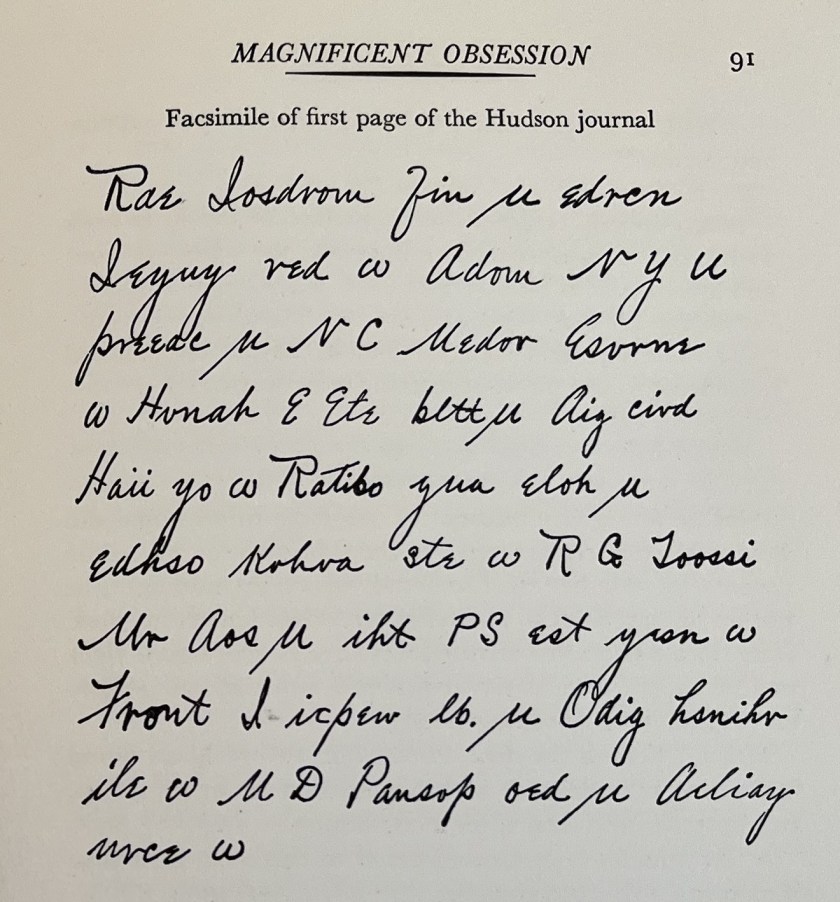
One interesting feature of the novel Magnificent Obsession is the fact that Doctor Hudson’s journal was written in code, to prevent people from discovering his secret too easily. When Nancy Ashford presents the diary to Bobby Merrick, he is determined to crack the code. Here is the first page of it:
In Douglas’s Magnificent Obsession scrapbook, there is at least one critic who complains that the code is easy and that it takes Merrick much longer than necessary to decipher it. Personally, I wouldn’t even know where to start.
Nancy and Bobby figure out one thing immediately: Dr. Hudson used the last letter of the Greek alphabet, omega, to indicate the end of a line, and he used the Greek letter mu to indicate the halfway point. This was a clue to divide each line into two, like so:
As an example of Douglas’s skill as a storyteller, he has Merrick work on the puzzle so late into the night that he falls asleep at his desk. The next morning when the butler comes to call him to breakfast, he finds him like this, then goes down to the kitchen and tells the cook, “You lost your bet!”
“Drunk again?”
“Quite!”
After the accident that saved his life at the expense of Dr. Hudson’s, Merrick has sworn off alcohol. This is a humorous scene that shows the household staff jumping to conclusions, just like we all do in real life.
Later on, having no better ideas, Merrick tries separating the letters and shifting the second half of the line slightly to the right…
Although I still wouldn’t have seen it, Merrick realizes that the key is to take the first letter from the top line, the second from the bottom line, the third from the top, and so on. He comes up with this:
“Reader, I consider you my friend…”
This is just the beginning, of course. He still has to decipher the whole journal in order to learn the secret that Dr. Hudson worked so hard to conceal. But this is just one example of the way Douglas keeps us in suspense.
When reviewers mentioned the code, they usually included it as one of the interesting features of the book. Some complained about it, however.
From The Congregationalist: “Dr. Douglas does, however, make a certain concession to the present age in surrounding rather simple and elemental Christian facts and experiences with an element of mystery and the occult. Our own judgment is that the diary of the famous surgeon which figures so prominently in the story would have been made both artistically and spiritually more effective if it had been plainly presented in simple English rather than in the unique code which, without the key that Dr. Douglas supplies, would have been difficult to decipher. However, Dr. Douglas probably knows his age and the unreadiness of the sophisticated to appreciate simple things simply stated.”
Lighten up! True, Douglas used the coded diary as a way of getting his audience interested, but there’s also a more basic truth here: a coded diary is fun. Douglas wanted us to enjoy reading Magnificent Obsession, and judging from the reviews in his scrapbook, many people did.
The message that Merrick deciphers is based on a page of scripture that is talked about but never entirely revealed. And that is another reason why Magnificent Obsession became “a publishing miracle.” I’ll tell you about that in my next post.
I am retracing the steps by which the novel Magnificent Obsession became a bestseller. I’ve already mentioned the support the book received from local newspapers and from people within the medical profession. Today we’ll see how those two factors intersected: a development in medical technology mirrored an important series of events in the novel, and this fact was reported in at least one newspaper.
In the novel, Dr. Merrick is trying to decrease mortality during brain surgery by inventing a tool that simultaneously cuts brain tissue and cauterizes the area around it, preventing bleeding. He has the general idea, but he can’t quite figure out how to place the vacuum tubes. This is all crucial to the plot because, as he meets the requirements of Dr. Hudson’s “theory” (or in other words, does what Jesus teaches in the opening verses of Matthew 6), he has a moment of clarity in which he sees the details that have been eluding him. Not only does he build the device and revolutionize brain surgery, but he also experiences the reality of God in the process.
Douglas didn’t make this up off the top of his head. In an interview with the Montreal Gazette (reported 11/25/1932), he said, “I started Magnificent Obsession while I was in California, before I came to Montreal. There I knew Dr. Carl Wheeler Rand, who is considered the most eminent brain surgeon on the west coast. I went to him and told him I had a strong desire to have a character in my book invent some surgical device and asked him if any work was being done along that line. He said that tentative experiments had been made with an electric cautery, but they had never been successful. He added that if I used the idea, it was possible there would be a few surgeons who would be interested in the fact.” Then he added, “Dr. Rand gave me nothing by way of detail, and when young Dr. Merrick thought in his dream of rearranging his vacuum tubes, it was my own idea.”
The Gazette interviewed Douglas because of a news item that had come to them over the wire from Des Moines, Iowa, where a man named Paul C. Rawls had demonstrated for local surgeons a device just like the one Merrick invents in Magnificent Obsession. The Gazette quoted the dispatch from Des Moines as saying, “Paul C. Rawls, the inventor who was granted a patent yesterday, explained how the use of vacuum tubes enabled him to obtain higher frequency electric current, thereby making possible the new knife.”
In their headline, the Gazette claimed that Douglas had “the Jules Verne touch.” They were referring to the science fiction writer whose novels anticipated many technological breakthroughs.
Below is a copy of the first page of Mr. Rawls’s patent. Click here for the link to Patent Number 1,945,867 on Google Patents. Below is an image of the diagram included with that patent.
What mystifies me about all this is that, in 1926, three years before the publication of Magnificent Obsession, Dr. Harvey Cushing invented a device which (if I am not mistaken) fits the same general description. As Elizabeth H. Thomson notes in her biography, Harvey Cushing: Surgeon, Author, Artist (New York: Henry Schuman, 1950), Cushing realized as a medical student at Harvard in 1894 that bleeding would have to be controlled before brain surgery could be done successfully (p. 62). By 1910 he had begun using silver clips (p. 171), which helped somewhat; but he kept working on the problem.
Thomson writes: “In the autumn of 1926, Cushing used for the first time an electric cautery apparatus in a brain operation. In general surgery and in genito-urinary surgery, high-frequency currents had been used for some time in dealing with both benign and malignant growths, but it was Cushing who established their value in neurological surgery. With the cooperation of Dr. W. T. Bovie, a physicist with the Harvard Cancer Commission who had previously developed apparatus for dealing with cancerous growths, he experimented with currents and equipment until they had one current that would cut tissue without attendant bleeding and another that would coagulate a vessel which might have to be cut during the course of an operative procedure” (pp. 247-248).
There is no mention of vacuum tubes, but the device itself sounds very much like the one Merrick invents in Douglas’s novel. This in no way diminishes Douglas’s reputation as a novelist, but if we’re going to talk about the real-world invention of this device, it seems to me that Dr. Cushing beat P. C. Rawls. However, based on Douglas’s conversation with Dr. Carl Wheeler Rand, which I presume took place in 1928 when Douglas was writing the novel, Dr. Rand and his West Coast associates had so far been unable to reproduce Dr. Cushing’s work with complete success.
What this means for Douglas is that he was aware of the problem that brain surgeons were trying to solve in the last years of the 1920s, and he built that problem and its likely solution into his novel. This made his novel current and fresh and based on facts – something you don’t normally get from a novel.
Below, also from Douglas’s Magnificent Obsession scrapbook, is a clipping about a doctor in Boston demonstrating a similar device. This clipping doesn’t say whether it’s the one invented by Harvey Cushing (in Boston) or the one invented by P. C. Rawls, or maybe a third invention. At any rate, it’s another instance that shows how current Douglas’s novel was, and why so many health professionals were interested in his book.
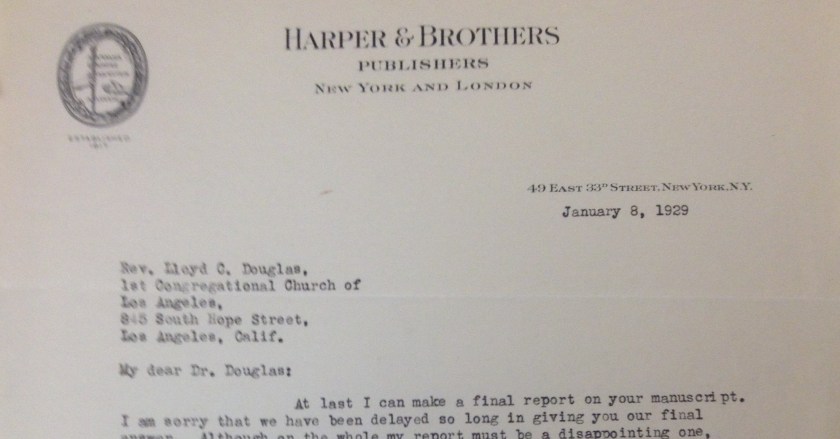
Eugene Exman to LCD, 1/8/1929. In LCD Correspondence 1926-1930, Lloyd C Douglas Papers, Box 1, Bentley Historical Library, University of Michigan. The University of Michigan holds copyright.
Over the last dozen posts I’ve been talking about Lloyd Douglas’s work on a novel called Salvage during the summer of 1928 (what would later become known as Magnificent Obsession) and of Harper & Brothers’ attempts to make sense out of it. Douglas had put two very different genres together: a novel (specifically, a hospital drama) and a non-fiction treatise about the first few verses of Matthew 6.
In January 1929, Eugene Exman, Harper’s religion editor, gave Douglas his company’s verdict. Four members of the Literary Department had read the updated version and recommended against publication as a novel. They categorized it “between the manuscripts that were almost good enough to publish and those which were obviously important enough to publish.” In his earlier correspondence, Exman had used words like “good enough” and “important enough” to assess the book’s marketability, not its literary quality. Years later, he would claim publicly that the head of the Literary Department considered the book “second-rate fiction and not deserving of the Harper imprint,” but nothing was said about that in his letters at the time. If it was true, however, then it added an extra layer of complexity to Douglas’s task: although he was using fiction techniques to communicate his message, he was under no illusion that he could be regarded as a serious – much less, first-rate – novelist. That wasn’t what he was trying to do at this stage in his career.
True to his word, Exman then tried to publish the book as religious non-fiction. As Harper’s Religion Editor, he had the authority to do that. In retrospect, it seems like a strange move, since Douglas had clearly written the book in novelistic form; but if it was a choice between treating it as a religious book or not publishing it at all, Exman chose the former. But first, he had to get the opinion of an expert.
He sent the manuscript to an anonymous but “prominent” churchman. I’m going to hazard a guess here: it very well might have been Harry Emerson Fosdick. I say that for two reasons. First, because Exman was then a member of Park Avenue Baptist Church, where Fosdick preached while Riverside Church was being built for him. Second, because Exman was patiently trying to win Fosdick over to Harper from Macmillan, and he eventually succeeded. They published 17 books together. (Stephen Prothero, God, the Bestseller: How One Editor Transformed American Religion a Book at a Time (San Francisco: HarperCollins, 2023), p. 41).
But whether I’m right or not, Exman showed the manuscript to some “prominent” churchman, who in turn shared it with three other “very discerning people.” The clergyman rejected the book’s thesis and advised against publication on theological grounds. And with good reason, one might argue. The book seemed to promise worldly success. A lot of explaining would be necessary to translate the story into anything resembling traditional Christian theology. That was Douglas’s intention, of course: to speak the language of the unchurched and get them interested in Jesus without sounding like a preacher. But the prominent churchman that Exman consulted was unwilling to go along with it.
“Whether his point is well taken is not of such great importance,” Exman told Douglas. “The thing which concerns me is that the publication of the manuscript would not get his backing as well as the backing of the group in the church he represents.” Once again, the main obstacle was economic. Exman had reason to believe that the book wouldn’t sell.
In brief, then: Harper had carefully considered publishing the book, but the editors were uncertain whether it could meet their sales goal. Would it do better as a novel or as a religious tract? Their answer was, Neither.
Douglas had hoped to present the Christian gospel in practical terms and to spread his message to an audience far beyond the confines of the church. His book was an experimental piece of writing that could possibly help him attain that goal, but “possibly” was the operative word. Eugene Exman realized that the book was unusual, but he lacked evidence that the general public would recognize its worth. Without that assurance, he could not take the financial risk. “I really believe that it should be published,” he told Douglas, “although this may seem a paradoxical statement; I am sorry the imprint of our House will not appear on your book when it does go out.”
The situation was paradoxical indeed, for Eugene Exman, perhaps more than any other religion editor, went on to publish the books that would both create and give direction to what we now call the SBNR movement (Spiritual But Not Religious). Late in his career, he considered Douglas’s book the one that got away (Prothero, p. 276).









 The Lloyd C Douglas Page