
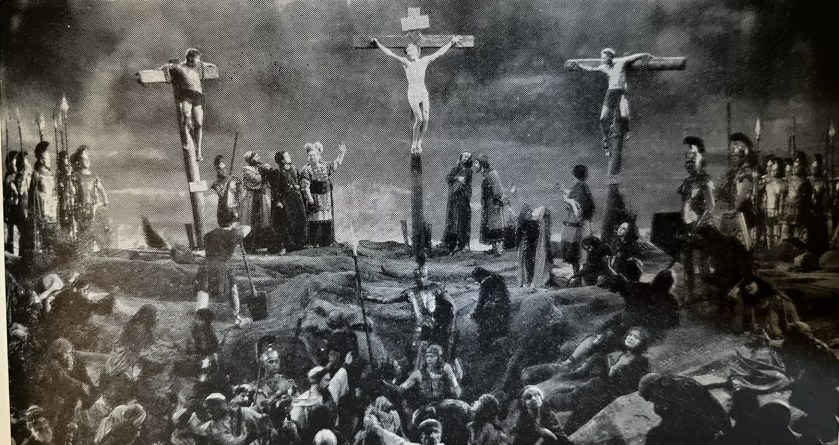
Although Lloyd Douglas initially spoke highly of Cecil B De Mille’s The King of Kings in 1927, a year later his remarks were a bit more negative. And what he disliked about the film tells us more about him than about the film itself. During a sermon he preached on 8/26/1928 at the First Congregational Church of Los Angeles, he said,
“It was a very beautiful and very impressive picture… But – when it was all done – the sum total of it was a confirmation of the quite general belief that Jesus was essentially a magician. A morose, anaemic, death-bound juggler, who performs amazing feats of magic – mostly to the advantage of other people, and done in the utmost kindness, to be sure – but, an oriental juggler, nevertheless, whose ministry was punctuated with inexplicable deeds which brought vast crowds about him to see him do tricks.
“Now, the sad part about this type of appraisal of the character of Jesus is that instead of bringing him closer to the average man, and encouraging discipleship to his theory of living, it has the effect of making Jesus more remote” (from “Sermons [1], Box 3, Lloyd C Douglas papers, Bentley Historical Library, University of Michigan).
Douglas then went on to illustrate this point:
He stills the storm with a word of command. Very good: I cannot do that, so we will check that item off as being impossible for me… He asks me to follow him; to be like him; to do as he does – but I cannot do that, so he and I have nothing in common at that point.
Water into wine? Not for me. I can’t do it!
Paying taxes by catching a fish with money in its mouth? Not for me – it isn’t that easy – for me.
‘Be thou healed,’ says Jesus to the blind man… But not for me, or you. It’s not that easy. We have to build big hospitals, and train surgeons, and raise huge budgets to attend to our altruism and works of human rehabilitation.
‘Lazarus – come forth!’ shouts Jesus when his friend is dead and four days in the tomb. But not for you, or me. It isn’t that simple. How passionately we wish we could make our voices heard by our dear departed! But no, we must console ourselves with our hope and faith, believing where we cannot see!
No – the Christ who is able to offer helpfulness to us in our perplexities must stake his claims to our discipleship on the likeness between his life and ours – his powers and ours – his difficulties and ours. Discipleship must be predicated upon our points of likeness, rather than upon our points of dissimilarity. If I follow Jesus, it is because we have much in common.
He must be portrayed as a norm of human character, so linked with God, spiritually, that he makes adequate use of divine power – exactly the same use that any man may make of divine power who confidently seeks it, and righteously employs it.
If these examples sound familiar, they should. This is very close to Dr. Bruce McLaren’s remarks in Chapter 18 of Salvage, as I mentioned in a previous post. Like his fictional character, Douglas believed that emphasis on Christ’s miracles was counterproductive, from the standpoint of daily discipleship. He stated again that he had nothing against De Mille himself: “However I might be inclined to disagree with Mr. DeMille in his appraisal of Jesus, I have the deepest respect for his motive. It is obvious that he would like to make a genuine contribution to the religious thought and Christian idealism of the public. If the average preacher were to go to a tiny fraction of the pains and research and consecration that Mr. DeMille invested in the making of that impressive picture of the Life of Christ, our churches would leap forward into a larger influence.”
But…
The trouble was: Jesus was not presented as an ideal type of spiritual energy in action, in the normal conduct of life, and common affairs of daily duty, where our human problems reside; but he was portrayed as one who possessed a power to which no one of us has access. Indeed, if the calm logic of the drama be considered, the picture was likely to send a man out of the theatre saying: Well, that settles it! If that was Jesus, then he and I can never possibly get together… He and I are not in the same category… And I cannot conceive why I should be invited or expected to follow him, or be like him, or indulge any hope that I might avail myself of the spiritual power he possessed.
Douglas’s disagreement, of course, was not with De Mille but with the traditional view of Jesus. Through his own life experience, Douglas had come to believe that Jesus’ teachings were much more important than any of the stories of his deeds. Christians, he felt, had for too long neglected Christ’s teachings because of their focus on his miracles. Douglas was trying to bring about a course correction in Christian life. Although he admired De Mille’s movie-making, he found it necessary to disagree with his approach.
In the summer of 1928, however, while Douglas was writing Salvage (the novel that would be retitled later as Magnificent Obsession), De Mille released a film aimed at young people, a group very dear to Douglas’s heart. It was called The Godless Girl, and it dramatized De Mille’s belief that the public schools were being taken over by atheists. Central to the film’s message was the claim that the theory of evolution was of Satanic origin. When Douglas saw this movie, he couldn’t keep quiet, and De Mille got involved. I’ll tell you about that in my next two posts.

 The Lloyd C Douglas Page