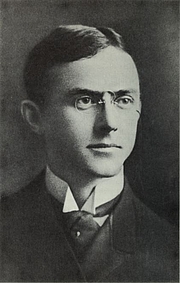
Lloyd C Douglas and the Akron Newspapers

by Ronald R Johnson (www.ronaldrjohnson.com)

As always, when Douglas arrived in Akron, he connected immediately with the editors of the local papers. It was like Washington, DC, all over again: he became the darling of the local press. But Akron was not Washington; it was a small town that had become a city overnight (due to the tire industry), and was now in the grips of an economic depression. Douglas was a fresh, prophetic voice for such a time. The papers hung on his every word, even when they disagreed with him.

There were three Akron newspapers (The Beacon Journal, The Times, and The Press), but other papers in the region also took notice of him. He appeared occasionally in the Toledo Times and was often in the Cleveland Plain Dealer. The local Rotary Club also had a newsletter called The Akrotarian, and since Douglas was a member of the club, he figured prominently in its pages, as well.

After his first year in town, Douglas introduced the idea of answering pre-submitted questions at the Sunday evening service, mostly so that he could concentrate all his energies on the morning sermon. But the Sunday evening Q-and-A’s were reported in the local papers and made Douglas the talk of the town.

He expressed his opinions on a number of hot topics:

The Ku Klux Klan: He not only criticized them but made fun of them. When a police officer pulled him over for speeding and realized who he was, the officer thanked him for all that he was doing to squash the Klan and sent him on his way without a ticket. But there were lots of other people who were angry at his remarks. His wife, Besse, worried that the parsonage would be bombed.

Chiropracters: As I’ve already mentioned, Douglas was an enthusiastic fan of modern medical practice, and he fought hard against people’s tendency to accept medical advice from the untrained. He was especially vocal about “the quackery of chiroprackery.”

Blue Laws: The other churches in town wanted to limit what people could do on Sundays. They were especially against moviegoing. Douglas took the unusual stance of opposing blue laws. (Unusual for a minister, that is.) He said that this was the kind of thing that turned people against Christianity. Newspapers all over the region reported his remarks.

Soldier’s Bonus: Decades before the GI Bill, Congress tried to pass a Soldier’s Bonus for veterans of WWI. Douglas mentioned, in an offhand way, that, given the current state of the economy (this was the depression before the Great Depression), he couldn’t support the idea of a Soldier’s Bonus. He felt it would be better to bolster the economy and give veterans jobs rather than make them dependent on the government. He received a lot of angry mail, besides all the talk in the Letters to the Editors. To clear things up, he gave a speech before an audience of veterans at the local American Legion post and explained his stance. There isn’t any indication that he changed people’s minds, but at least one letter from a veteran stated that they respected Douglas for all that he was doing to help the unemployed. (And he actually was doing something. He had accepted Mayor Carl Beck’s invitation to chair the city’s Unemployment Committee, which looked into ways to overcome unemployment. The letter to the editor claimed that he was also known to have contributed time and money into helping individuals find jobs. That’s a somewhat mysterious reference, but very much in line with his belief in investing in others.)

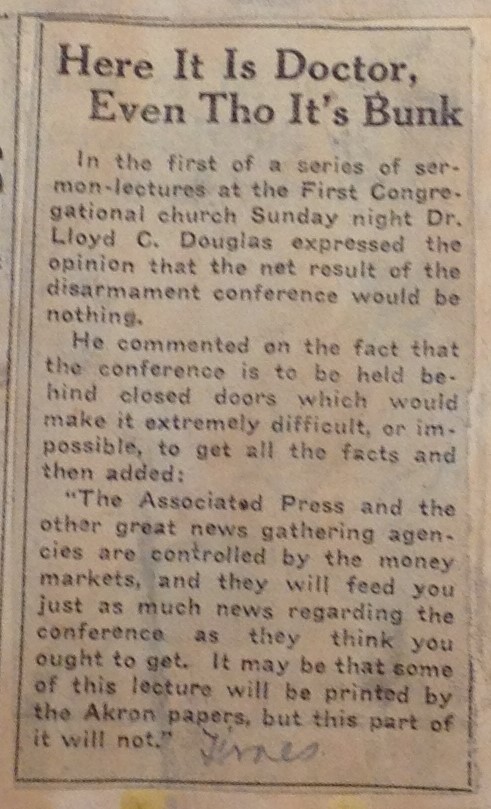
In all these cases (and others besides), it’s clear that local journalists respected Douglas even when they disagreed with them. Here’s my favorite example. In one of his Sunday-night speeches, Douglas claimed that the AP and other wire services were dominated by wealthy individuals who controlled what the newspapers would publish. “It may be that some of this lecture will be printed by the Akron papers,” Douglas said, “but this part of it will not.”

The Akron Times printed it, along with this headline: “Here It Is, Doctor, Even Tho It’s Bunk.”
I’ll tell you more about Douglas’s ministry in Akron in my next post.

For a free PDF copy of the booklet, The Secret Investment of Lloyd C. Douglas, fill out the form below:

← Back

Thank you for your response. ✨

Rubber City

by Ronald R Johnson (www.ronaldrjohnson.com)

When Lloyd Douglas began his ministry at the First Congregational Church of Akron in the fall of 1921, he viewed it as a chance to share all that he had learned during his time at the University of Illinois and the University of Michigan. As he explained later, “I came to you from an experience of about ten years, spent upon the campuses of two great universities, where I daily faced the new problem of a readjustment in religious thought, to make it consonant with the more recent disclosures of the philosophical and scientific world” (Lloyd C Douglas, “Five Years of Akron,” in The Living Faith (Boston: Houghton-Mifflin/Riverside Press, 1955), p. 80.)

During those years, he had been in university towns, but now he was in a city – “Rubber City,” they called it, due to the predominance of the big tire companies like Goodyear and Firestone – and he was putting his ideas into practice out in the world.

If this was ever used as an advertisement in the local paper or as a pamphlet, I’ve been unable to find a clipping of it. But this photograph is pasted into the last page of Douglas’s 1920-1923 scrapbook. The First Congregational Church of Akron is in the upper right corner of the picture. From Box 5, Lloyd C Douglas Papers, Bentley Historical Library, University of Michigan.

The first thing he focused on was worship. Not preaching, but worship.

In his inaugural sermon at the First Congregational Church of Akron on September 18, 1921, Douglas said, “The church is failing in America because it has failed to carry out its true mission…. The church may do philanthropic and social work, but its first duty is to be a house of worship, and when it fails in this it cannot expect the veneration to which it should be entitled” (“SCORES CHURCH/New Akron Pastor Flays Modern Worship,” Akron Press, n.d., 1920-1923 Scrapbook, Box 5, Lloyd C Douglas Papers, Bentley Historical Library, University of Michigan).

Over the past several years, Douglas had already established an order of worship that the people in Ann Arbor said was “probably unsurpassed elsewhere.” (This was from a resolution the congregation’s leaders drew up in 1921, accepting his resignation and thanking him for his ministry. Quoted on p. 63 of Calvin O. Davis, A History of the Congregational Church in Ann Arbor, 1847-1947, which was reprinted in A History of the First Congregational Church in Ann Arbor, 1847-1976 (Ann Arbor: First Congregational Church, n. d. [1976?]).

His services were heavily dependent on music. It was a source of great irritation to him that people would talk over the organ prelude. As he told his new congregation, “During the organ prelude in a church recently I learned the recipe for plum jelly, that a certain oil stock was a good buy, that there was to be a bargain sale at a local department store, and that the road to another city was in bad shape on account of the concrete cracking” (from “SCORES CHURCH” cited above).

He thought the church auditorium should be a true sanctuary where people would leave their worldly cares at the door and come into the presence of The Great Mystery. “The LORD is in His Holy Temple,” begins the Order of Worship from his first Sunday in Akron; “let all the earth keep silence before Him.” In Ann Arbor, Douglas had enforced that: ushers were to close the doors as soon as the organ prelude began and not open them again until later in the service. He was so adamant about this that it ruffled a few of his parishioners’ feathers, but he was striving to make the church a place where people could actually come with the expectation of meeting God.

The prelude should begin softly, Douglas felt, to counteract the rat-a-tat-tat of machinery that had assaulted worshipers’ ears for the past six days. It should calm the soul and prepare it for communion with the divine. Then, through subtle use of dynamics and ascending chords, it should end triumphantly in the exact key of the opening hymn and launch into that hymn immediately, so that worshipers would rise and sing without being prompted. Douglas hated how the typical Protestant minister could spoil the whole thing by announcing, “Beloved, shall we not rise and sing Hymn 321? That’s 321, and you’ll find it in the hymnal on the pew in front of you. Hymn 321.”

As Douglas said to an audience of fellow ministers and lay-workers:

Many a sensitive man would greatly prefer to take a book of essays with him to a shady bend in the river on Sunday morning than attend our church; whereas his whole soul cries out for a much closer contact with the divine than he can achieve by his communion with nature. But – it is a great deal better for that man’s spiritual welfare that he should go out Sunday morning and watch the river than to go to some church where the music is so ugly it positively frightens [him] and the preacher talks to the Great Unseen as if he were chaffing with his next-door neighbor over the back fence.

Lloyd C Douglas, “Making Worship Worshipful,” Christian Century, September 9, 1920, pp. 14-17.

What Douglas was trying to achieve can best be understood through his description of the exact opposite:

There wasn’t a single feature of that ‘service of worship’ calculated to quicken a man’s respiration, or grip his throat, or stir his pulse! What little of solemn ritual there was in it possessed no current, no rapids, no eddies, no sudden unexpected plunges over huge ledges into unfathomably deep pools, no sharp turns revealing startlingly beautiful vistas ahead – no! – but just ambled lazily along on a level like the sleepy Yanktse Kiang, for five hundred miles without a ripple. It reached no dramatic climaxes; pointed to no definite goal; never poured its flood into the deep sea. It spread out over the sands, and disappeared.

Lloyd C Douglas, Wanted: A Congregation (Chicago: Christian Century Press, 1920), p. 195.

At the movies, Douglas said – and he was talking about silent movies, remember, for this was 1921 – at the movies “there were certain tense moments when people stopped breathing and sat transfixed,” but at church…

…where the issue involved was the attempted establishment of actual, vital relationship with the Absolute – the invocation of His Presence at whose word light had dispelled the darkness, by whose divine fiat the worlds had appeared in space, by whose supernal genius His creatures had been endowed with a consciousness of their own immortality – this solemn and mysterious function was performed drowsily, calmly, with an air of tedium, boredom, and distaste.

Ibid., pp. 194-195.

Lloyd Douglas was the new minister in Rubber City. His first order of business was to stir people’s pulses… and invite them out into the deep sea.

To be continued…

For a free PDF copy of the booklet, The Secret Investment of Lloyd C. Douglas, fill out the form below:

← Back

Thank you for your response. ✨

Some Final Notes about Ann Arbor

by Ronald R Johnson (www.ronaldrjohnson.com)

Photo taken sometime during the Ann Arbor years (1915-1921.) Douglas’s daughter Betty is on the left, Virginia is on the right, and their mother, Besse, is in the center. From Virginia Douglas Dawson and Betty Douglas Wilson, The Shape of Sunday: An Intimate Biography of Lloyd C. Douglas (Boston: Houghton-Mifflin/Riverside Press, 1952).

In their book about their father, Douglas’s daughters Virginia and Betty say that the years their family spent in Ann Arbor (1915-1921) were happy ones. Douglas died before he could write his autobiography (he really didn’t want to do it anyway, and his book Time to Remember is only about his childhood), but in his proposed outline there was a chapter with the heading: “Ann Arbor – Happy Job!”

But Lloyd Douglas was never one to sit still, no matter how happy he was. There’s a scene in The Robe (chapter 22) that seems autobiographical to me. Marcellus, the hero of the story, has spent the summer in the Roman village of Arpino, telling the residents about Jesus; but now he’s leaving. “Aren’t you contented here?” they inquire. “Haven’t we done everything you wished?” “Yes,” he tells them. “That’s why I’m going.”

In the fall of 1921, Douglas accepted the call to be Senior Minister at the First Congregational Church of Akron, Ohio. And it’s fortunate that he did, because it was not until Akron that he began to formulate his ideas about the gospel and its place in modern life. He had learned a lot in the academic environments at the universities of Illinois and Michigan, but now he needed to get out among working people (both white- and blue-collar) and tell them what he had learned.

There are a few final notes I want to make about Ann Arbor, however.

His First Car

It was in Ann Arbor that he began his love affair with automobiles. The members of the church took up a collection in 1920 and surprised him with his own Model-T Ford. There was just one problem: could someone with his nervous disposition ever learn to drive it? Under her breath, his wife Besse whispered, “He’s never been able to mow the lawn in a straight line.” (We’re not talking about a power-mower. We’re talking about one of those old-fashioned manual push-mowers with the blades that extend between the two wheels.)

But Douglas learned quickly, and when he returned home from his “free lesson,” he declared his new car “a humdinger.” His daughters write, “He learned to be a very good driver and had no real accidents all the many years, although he became involved in hundreds of awkward situations” (Virginia Douglas Dawson and Betty Douglas Wilson, The Shape of Sunday: An Intimate Biography of Lloyd C. Douglas (Boston: Houghton-Mifflin/Riverside Press, 1952), p. 111).

There is at least one literary reference that comes readily to mind here: Douglas’s novel Green Light was inspired, in part, by his experiences behind the wheel.

His First Honorary Doctorate

Douglas used this image for promotional purposes throughout his Ann Arbor years.

In 1919, Douglas was awarded his first honorary doctorate (a Doctor of Divinity degree), from Fargo College. There is surprisingly little information about it in his scrapbooks. Several years later, he devoted 14 pages to the funeral of Marion LeRoy Burton, who was president of the University of Michigan at the time of his death. Douglas was involved in the ceremony, so he saved clippings of obituaries, photos of the funeral procession, and remembrances of the late president. But of his own honorary doctorate, Douglas left little record.

What we do have is in his 1918 Scrapbook. There’s a letter dated April 9, 1919, from Fargo’s president, E. Lee Howard, who was a classmate and fraternity brother of Douglas’s at Wittenberg, asking Douglas to give the commencement address and to accept the honorary degree. There is a clipping from the Fargo newspaper talking about the upcoming commencement and announcing that Douglas would be the speaker and one of the honorees. There’s another clipping that tells about the ceremony, including the speech, but doesn’t mention his doctorate. And then there’s the printed program. That’s all. No other record of the event. Seems like kind of an important thing to skim over.

A New Church Building

(Some of the information that follows comes from clippings in Douglas’s scrapbooks and from his daughters’ biography, but most of the details are from A History of the First Congregational Church in Ann Arbor, 1847-1976 (Ann Arbor: First Congregational Church, n.d., but probably 1976).)

Because of Douglas’s popularity as a preacher, especially among university students, the Ann Arbor church wasn’t big enough. It was typical for people to be turned away if they didn’t arrive early enough to find a seat. Almost immediately, there was talk of enlarging the building. At first there was enthusiasm for the idea, but the First World War put a halt to it. After the war, they began making plans, but those plans were dashed in 1921 when Douglas announced that he was leaving. It took a year for the congregation to find a replacement for him, but it was not someone who packed the house. The building was starting to deteriorate, though, so costly repairs had to be done – always an uninspiring prospect for a congregation that had hoped for so much more.

In the late 1920s, the idea was revived again, only for the stock market crash and the Great Depression to put the project on hold once more. It wasn’t until Dr. Leonard Parr’s pastorship (1937-1957) that the expansion finally happened. A lot of people contributed substantial sums of money, and as I glance down the list of contributors, I see the names of many people who were active in the church during Douglas’s pastorate.

But it’s also ironic to see the name of Lloyd Douglas, who was by then a world-famous novelist. It’s ironic, I say, because he ended up contributing to the project that initially was planned because the church couldn’t hold all the people who wanted to hear him preach.

And this leads to a related subject…

The Douglas Memorial Chapel

Although I’m getting ahead of the story, I’ll mention it here because it was part of the church’s expansion. After his beloved wife Besse died in the 1940s, Douglas wanted to build a chapel in her honor at the Ann Arbor site. It took a while for the project to happen, however, and when Douglas himself died in 1951, his daughters contributed further funds to make it a chapel in honor of both of their parents. The result was the Douglas Memorial Chapel, a wing of the First Congregational Church of Ann Arbor. Its windows evoke images of Douglas’s life as a minister and writer. To this day, the chapel is used for weddings and baptisms, and it is open daily for prayer and meditation. In Green Light and Invitation to Live, Dean Harcourt always began each day alone in the sanctuary, communicating with “Headquarters.” I think Douglas would have loved knowing that the Douglas chapel is a place where people can still do that in the 21st Century.

Click here for a description from the congregation’s website.

For a free PDF copy of the booklet, The Secret Investment of Lloyd C. Douglas, fill out the form below:

← Back

Thank you for your response. ✨

The Open Door at The Christian Century

by Ronald R Johnson (www.ronaldrjohnson.com)

Lloyd Douglas didn’t win the Christian Century’s essay contest in the summer of 1920; he took second place. But it didn’t matter…

From the July 22, 1920, issue of The Christian Century, p. 22. Available online at The Online Books Page.

…because his participation in the contest had excited the interest of the editor, Charles Clayton Morrison, and Morrison invited Douglas to submit another article to the Century – right away. “Our readers will be particularly interested in an article from you just now when their attention has been put on the qui vive [on the alert] by your taking one of the honors in the series,” Morrison said. “I hope you will feel not only free, but strongly prompted, to write for us at any time.”

Letter from Charles Clayton Morrison to Lloyd C Douglas, July 22, 1920. In 1918 Scrapbook, Lloyd C Douglas Papers, Box 5, Bentley Historical Library, University of Michigan.

Douglas accepted the invitation immediately. And he didn’t just send one article; he sent Part One of a three-part series. It was called, “Wanted: A Congregation,” and it was some of the finest writing he had ever done up to that time.

Letter from Charles Clayton Morrison to Lloyd C Douglas, August 3, 1920. In 1918 Scrapbook, Lloyd C Douglas Papers, Box 5, Bentley Historical Library, University of Michigan.

Upon receiving the first installment, Morrison gushed, “You write splendidly.” He wasted no time publishing it, even announcing it on the front cover (August 5, 1920), and he encouraged Douglas to send the other two installments as soon as possible.

Notice that Douglas now shares the front cover with John Spargo.

Douglas did better than that: he sent three more installments. But first he asked the editor’s permission. Morrison wrote back pretending to be “quite offended that you felt any inhibition at all in the matter of writing a fourth installment when you were prompted to do so.” He wasn’t really offended; he was delighted that Douglas had been “prompted,” either by his Muse or by the Spirit, to add another installment to the series. “The chances are 102 per cent that whatever you write will be available [he probably means ‘accepted’] for publication in The Christian Century.”

So… now Douglas not only had a series running in the Century, but he also had an open invitation from the editor to send him an article anytime, and to expect to see it published in that magazine.

Elesha J Coffman has written, “In 1920, the Century was not yet a magazine that other papers envied or a place where writers could make their names. By the end of the decade, through savvy and serendipity, it would be both.” (The Christian Century and the Rise of the Protestant Mainstream (NY: Oxford University Press, 2013), p. 63.)

That being the case, Douglas and the Century grew up together, for his frequent contributions beginning in 1920 made his non-fiction writing well-known among America’s Protestant clergy, and at the end of that decade, The Christian Century would play a major role in making him a world-famous novelist.

For a free PDF copy of the booklet, The Secret Investment of Lloyd C. Douglas, fill out the form below:

← Back

Thank you for your response. ✨

Lloyd C Douglas, Contestant

by Ronald R Johnson (www.ronaldrjohnson.com)

I’ve been telling you about the essay contest that Lloyd Douglas entered at The Christian Century during the Spring/Summer of 1920. The contest was prompted by John Spargo’s article, “The Futility of Preaching,” published May 20, 1920, in the Century.

Douglas’s response, “Preaching and the ‘Average Preacher'” was published anonymously, along with the essays of five other contestants, on July 1, 1920. The issue included a ballot for readers to choose the three best essays.

From the July 1st, 1920, issue of The Christian Century, p. 28. Available online at The Online Books Page.

Meanwhile, the Century’s editor, Charles Clayton Morrison, asked John Spargo to read the six anonymous essays and write a follow-up article in response. Spargo’s reply was published in the July 22nd issue. Notice how Morrison took a single submission (Spargo’s initial article published May 20th) and kept his readers interested in that one article all the way through July and beyond. He paired this with an advertising campaign that told potential readers what was happening. It was this kind of maneuvering that made the Century grow into a successful magazine.

For the most part, Spargo’s reply was general, telling his readers more about himself and his views. He only got angry at one of the contestants. Guess who!

Of course, in this discussion, as in every other, we have the quibbler who is less concerned to establish the essential truth than to score debating points. Shall I confess that I was amused by the sophomoric intensity of one of the writers in his attempt to demonstrate that my use of the term ‘average preacher’ was unscientific and an evidence of the fact that my views were not entitled to serious consideration?

John Spargo, “More about Preaching and the Ministry,” The Christian Century, July 22, 1920.

Amused? I don’t think so. His irritation is clearly displayed in his next remarks:

Of course, this is the characteristic spirit of the Medieval schoolmen that made theology such a terrible incubus upon religion. In the practical affairs of life, this good brother, not animated by sectarian dogmatism or pride, would not think of invoking such a rule. If his neighbor declared the day to be an ‘average’ one, he would not demand that the statement be accompanied by a statistical analysis of the meteorological records. Similarly, if a brother minister declared that he had a good ‘average’ congregation, the writer in question would not think of demanding verification of the statement in statistical terms. I emphasize my reference to this quite incidental and essentially irrelevant criticism because it illustrates the vicious narrowness of a mind fostered by ecclesiasticism. The plain, forthright speech and straight and direct thinking characteristic of honest men in their ordinary intercourse and business relations do not suit a certain familiar type of theologian or an equally familiar type of ecclesiastic.

Ibid

Ouch! He’s right, up to a point: his use of the term “average minister” wasn’t as important as Douglas made it out to be, and Douglas did use it to “score debating points.” But this wasn’t Douglas at his best. On any other occasion, Lloyd Douglas was nothing like the Medieval schoolmen, nor was he guilty of “the narrowness of mind fostered by ecclesiasticism.” It’s unfortunate that these two gifted men were pitted against each other so that it was practically impossible for them to appreciate each other’s talents.

Meanwhile, readers were now encouraged to await the results of the vote, in which they would discover exactly how many “debating points” each of the anonymous contestants had won.

To be continued…

For a free PDF copy of the booklet, The Secret Investment of Lloyd C. Douglas, fill out the form below:

← Back

Thank you for your response. ✨

Preaching and the ‘Average Preacher’

by Ronald R Johnson (www.ronaldrjohnson.com)

In his response to John Spargo for The Christian Century’s essay contest in the summer of 1920, Douglas began by trying to make Spargo look ridiculous. He claimed that Spargo wrote his article during “what was evidently an hour of utter exasperation” and that the piece “must have been composed while under stress of very strong emotion. So wrought up is he that he indicts the whole profession.” (I disagree. Spargo’s essay comes across calm and dispassionate; it is Douglas who seems fired up.)

Next, Douglas takes on the manner of an attorney in a courtroom. He harps on Spargo’s use of the term “the average minister,” and uses the following analogy:

Suppose that, instead of attacking the ministry, this author had pointed out the weaknesses of the medical profession. Suppose that he had said, ‘The average doctor is no more competent to diagnose a case or write a prescription than the average patient.’ …. [H]e would be obliged to show precisely how he had arrived at his ‘average.’ …. To the impartial prosecution of the case he should investigate all the various types represented among medical men, as, for example,—specialists (bona fide); specialists (bogus); specialists suspected of being quacks; specialists known to be quacks; doctors who would send a patient to an unscrupulous and unskilled surgeon on the latter’s promise of a ‘split fee’; doctors who work eighteen hours out of every twenty-four, and die poor; surgeons known to be extortionists; surgeons known to be generous; surgeons willing to venture with the untried; surgeons willing to delegate a critical case to a more experienced colleague; general practitioners of good intent but poor training; general practitioners with good training but no conscience; general practitioners who know little and care less; a host who have excellent training at school but very little experience, and as many more who have had wide experience but meager educational advantages.

Lloyd C Douglas, “Preaching and the ‘Average Preacher'”

Notice that Douglas’s analogy is from the medical profession. This is just one example of how science, and especially medical science, has come to dominate his thinking. But it’s also somewhat tedious. This isn’t Douglas at his best. He behaves like someone who’s trying to win a debate. Here’s where he’s going with the analogy:

Having secured all the accessible facts relative to these widely divergent types, a general ‘average’ might be computed. But before Mr. Spargo would dare to predicate any quality, attribute, state of mind, strength or weakness, of ‘the average doctor,’ he would have to be prepared to define and describe this typical medical man. By no means would it be an impertinence if the offended M. D., reading these contemptuous words hurled at ‘the average doctor,’ should inquire of the author, ‘What manner of home produced the average doctor? You ought to know: you struck the average. How old is he? What has been the nature of his experience? What about his training? Did he finish high school—this average doctor? Does he exhibit an interest in the general welfare of his community?’ And—if Mr. Spargo were to decline answering on the ground that no man could collect enough facts to warrant his attempt to answer such direct questions concerning ‘the average doctor’—the indignant medical man would then have a right to reply, ‘That being true, by what rule of audacity do you presume to speak of an “average doctor” at all?’

Ibid

A direct answer to Spargo’s objection would show why laypeople need well-trained ministers to help them understand the Bible and apply it to their lives. But Douglas doesn’t do that; instead, he tries to catch Spargo on a technicality: his use of the term “average minister.”

Douglas’s main point is that the type of minister Spargo describes is not average at all; he’s only talking about pastors of big-city churches, which Douglas says constitutes no more than 10 percent of the Protestant clergy in America. Even at that, Douglas says, Spargo contradicts himself, for he (Spargo) says at one point that these big-city ministers do preach from the scriptures and at another point that they do not. (I honestly don’t see where Spargo contradicted himself, but Douglas insists that he did.)

Believing that he has succeeded in making Spargo look ridiculous, Douglas changes tactics. (Remember, the editor of the Century gave Spargo’s article the provocative title, “The Futility of Preaching,” even though Spargo never actually used that word.)

Heigh-ho-hum! Let us talk about something else.

Let us talk about ‘futilities.’

When, in 1897, the first successful operation ever performed upon the heart was completed, one of the operators is said to have remarked: ‘The path to the human heart is only one inch long, but it has taken surgery twenty-four hundred years to travel it!’ One almost envies a man his proper pride who is able to say that he belongs to a profession possessed of enough faith and perseverance to continue its apparently futile efforts, for twenty-four centuries, undaunted by a consistent record of one hundred per cent failure, until, at length, it has registered a single success.

Ibid

Another medical analogy! His point this time is a bit more relevant, but we have to wait for it. Acknowledging that, throughout those centuries, physicians did succeed at other things (“setting broken bones, amputating crushed fingers, removing malignant growths, and straightening crippled feet”), he says that preachers, too, have had their successes: motivating cities to build hospitals (as Douglas himself had done in Lancaster, Ohio), as well as “the asylum, the orphanage, the home for the indigent and the aged, the reform of the prison, and philanthropies of all sorts.” It was preaching, he says, that finally won women the right to vote. (This was 1920, the very year in which that happened.) The popular conception of “the Brotherhood of Man” originated in the pulpit, and most of the nation’s colleges and universities were started by ministers.

Some day we will contrive to mend the very heart of society. Meanwhile, we will continue to perform such work as we have learned to accomplish. If the surgeons could sustain their faith in the possibility of mending hearts, for twenty-four hundred years, with an unbroken record of failure behind them, we ministers may indulge the hope that our efforts are contributing to the successes of them who take up our instruments after we have put them down, refashioning and readapting them to the needs of a rapidly changing world.

Ibid

Although it wasn’t Douglas’s best work, it caught the eye of the editor, Charles Clayton Morrison, who wrote this in reply, on May 29, 1920:

“My dear Doctor Douglas:

“I thank you very cordially for your communication concerning Mr. Spargo’s article. I have just read it through cursorily and am much impressed with the manner in which you handle him. This is to advise you that the article will appear in an early issue of The Christian Century and will be a candidate for the little premium we are offering.

“Very sincerely yours,”

Letter from Charles Clayton Morrison to Lloyd C Douglas, May 29, 1920. In 1918 Scrapbook, Lloyd C Douglas Papers, Box 5, Bentley Historical Library, University of Michigan

Morrison calls him “Doctor” Douglas. There were times when people assumed (in error) that Douglas had a doctorate, even earlier in his life, but in this case Morrison was right: Douglas received an honorary doctorate from Fargo College that same year (1920). Notice also the phrase “the manner in which you handle him,” meaning Spargo. Morrison has set this contest up as a prize fight, and he is choosing the submissions that he thinks will bloody Spargo’s nose.

The top six essays were published in the Century without by-lines on July 1st. Readers were asked to vote for the top three, without knowing the authors’ names. This was Morrison’s clever way of getting a lot of mileage out of Spargo’s essay, making it a topic of discussion throughout the summer and into the fall. But it also ended up being very good for Lloyd Douglas.

To be continued…

For a free PDF copy of the booklet, The Secret Investment of Lloyd C. Douglas, fill out the form below:

← Back

Thank you for your response. ✨

The Writing Contest

by Ronald R Johnson (www.ronaldrjohnson.com)

I’ve told you that Douglas began writing for The Christian Century in 1920. It started with a contest, centered around an intellectual named John Spargo.

Spargo, an Englishman, had begun preaching in the Methodist Church at the age of 14, and his sermons were printed in the newspapers. But he became aware of social inequities and eventually left the church to become a socialist lecturer and writer. He moved to America, and it was there that he developed “an evolutionary, spiritual understanding of the processes of social change” that put him at odds with other socialist thinkers. He never gave up his faith in God, and he insisted on combining socialism with Christianity, “a true synthesis” that “was his most unique contribution to socialist theory in America” (Markku Ruotsila, John Spargo and American Socialism (NY: Palgrave Macmillan, 2006), pp. 61, 68).

In the May 20, 1920, issue of the Christian Century, Spargo published an article that was meant to bolster the confidence of Christian leaders. The main point of his wide-ranging essay was his belief that the church would never be obsolete. He admitted that, in earlier years, he and his socialist friends had wondered what use they would make of the elaborate cathedrals “after the revolution,” when there would no longer be a need for churches. But now Spargo realized that the church would always be a vital and necessary part of social life, even if capitalism ceased to be.

That was the point he was trying to make.

Unfortunately, he digressed near the end of his essay to say that preaching, at least as it was being done in most mainstream churches in 1920, was relatively insignificant and would not endure. In predicting that the church would live on after the revolution, he did not mean that the typical Sunday morning church service would endure. He felt certain that preaching would no longer be necessary, because it was already proving itself worthless. Music and worship were vital to Christian life, but preaching wasn’t:

The pulpit is an anachronism in the modern world. Preaching comes down to us from a past age, when few possessed Bibles and fewer still could read them for themselves. It was necessary then when the believers assembled together to have someone read and explain the Word to them. Today when almost every person can read for himself, when Bibles can be purchased for a few cents, there is no need for such a service. The average man in the pew is quite as capable of reading the Bible and interpreting any passage which interests him as the average minister. That is probably the reason why the old-fashioned expository sermon and the sermon on doctrinal subjects are rarely heard in our cities nowadays…. The old hour-long interpretation with its illustrations arranged as ‘Firstly,’ ‘Secondly,’ ‘Thirdly,’ and ‘Finally Brethren’ has given place to the fifteen minute ‘snappy talk’ upon some topical subject or some abstract question. The old time ‘Lyceum’ lecture has supplanted the sermon.

John Spargo, “The Futility of Preaching”

Not only did he say that the “average man in the pew” could read the Bible as well as “the average minister,” but he went on to say, “The average minister is a poor guide in matters sociological,” meaning that sermons now tended to be on subjects that were best left to the sociologists. He was really just trying to say this: that the church’s role was not to meddle in politics and social reform, but to remake people into followers of Jesus; and if people became followers of Jesus, then they would behave in socially-responsible ways (Ruotsila, pp. 138-139).

I say this digression was unfortunate because the editor, Charles Clayton Morrison, seized upon it and made it the primary focus, ensuring that readers would misunderstand Spargo’s comments and even take offense. Morrison was good at his job. He was trying to increase the circulation of his magazine, and one of his methods was to identify potentially controversial statements in the articles he published, then provoke his readers into responding. He wanted the magazine’s articles discussed for weeks afterwards in the “Letters to the Editor” section, and you can see him stirring the pot again and again, throughout the 1920s.

I don’t know what title Spargo had originally given to his essay, but he did say later that Morrison changed it. The piece was published under the provocative heading, “The Futility of Preaching.” Morrison put it on the front page, and he included a quotation that would surely anger his readers (most of them ministers or lay leaders):

It is very doubtful, to my mind, whether all the preaching that will be done in America during the next twelve months, let us say, will add as much to the well-being of America as the work of one honest, efficient farmer, or as that of a humble schoolteacher in some ‘little red schoolhouse.’

Ibid.

And if that wasn’t enough to get his readers’ attention, the editor announced a competition:

Mr. John Spargo in his extraordinary article on “The Futility of Preaching,” in this issue of The Christian Century, has flung down the gauntlet to tradition and to those who hold that it is by ‘the foolishness of preaching’ that the Kingdom of God is to be brought in. Without doubt the article will arouse decided if not violent reactions from our readers. These reactions should be directed into rational formulations, and in order to encourage such a discussion of the radical question Mr. Spargo has raised, The Christian Century will give a prize for the strongest and most effective article it receives on the other side. The article should be not a detailed reply to Mr. Spargo but a constructive, non-controversial setting forth of the essential place of preaching in the life of the church and in social and ethical progress…. For the best article the prize will be $50. For the second best, $25. For the third best, $10…. It is hardly imaginable that this brilliant and original utterance of the distinguished socialist philosopher will fail to stir to their roots the convictions of the ablest writing men—and women—among our readers.

Charles Clayton Morrison, The Christian Century, May 20, 1920

Over sixty readers took the bait, out of which there were six finalists. One of them was Lloyd Douglas.

To be continued…

For a free PDF copy of the booklet, The Secret Investment of Lloyd C. Douglas, fill out the form below:

← Back

Thank you for your response. ✨

Lloyd Douglas and the Christian Century

by Ronald R Johnson (www.ronaldrjohnson.com)

Over the past few posts, I’ve been telling you about the periodicals in which Douglas’s writing appeared during his Ann Arbor years (1915-1921); but his big breakthrough came in 1920, when he began writing for The Christian Century. And that fact is ironic, because in 1920 the Century was still struggling to become an important magazine. To some extent, Douglas added distinction to the Century even as it helped him become more prominent on the national scene.

(For most of what follows, I am indebted to Elesha J Coffman, The Christian Century and the Rise of the Protestant Mainline (NY: Oxford University Press, 2013).)

The Christian Century began as an unimposing little Disciples of Christ paper. In fact, the Disciples of Christ itself began as a nineteenth-century religious movement that was so democratic, it lacked a hierarchy and therefore didn’t have an official “organ.” There were hundreds of papers published throughout the United States in the 1800s by people of that persuasion, most of them with a very small circulation. The Christian Century was just one of many, many such periodicals. And, like most of the others, it had to fight hard just to survive financially.

In 1914, the magazine’s young editor, Charles Clayton Morrison, made the decision to seek a wider audience outside of his denomination: specifically, Protestant ministers and laypeople who valued education and who were willing to think deeply about religious matters. The weekly magazine was published in Chicago, and the people who ran it, including Morrison, were well-connected with professors at the University of Chicago, in both the religion and the philosophy departments. It made sense for them to seek out the more intellectual members of the Protestant clergy and to publish articles on topics that would be of interest to such a group.

Charles Clayton Morrison, editor of The Christian Century from 1908 to 1947. Although he looks young in this picture, he was several years older than Douglas. (Image from LibraryThing)

I’m unable to say when Douglas began to read the Century. I do know that he was just the kind of reader Morrison was aiming at: one who was committed to higher education and to rethinking the gospel in terms of what was being taught in America’s state colleges. As I told you in an earlier post, Douglas was already following the work of Shailer Mathews as early as 1909, and Mathews led the Department of Religion at the University of Chicago. (He also wrote articles for the Century.) In fact, Mathews’ teachings had prompted Douglas to “go back to school” (first the University of Illinois and then the University of Michigan) and to revise his ideas about God; so Douglas’s career path made him a perfect fit for The Christian Century, not only as a reader but also as a contributor.

In 1919, a few wealthy members of the Disciples of Christ (including William H. Hoover of vacuum-cleaner fame), created an endowment for the magazine, and Morrison initially used these funds to begin advertising in a number of periodicals, including denominational organs like The Congregationalist and secular magazines like The Atlantic Monthly, both of which Douglas was writing for at the time. If the Century wasn’t on his radar prior to 1919, it probably was now.

At any rate, in the spring of 1920, Morrison announced an essay contest. This was just one of the ways in which he tried to increase his list of subscribers. He hoped to inspire ministers and thoughtful laypeople to write on the proposed subject. He would pick the best six entries, then readers would choose the first, second, and third-place winners from those six. (First prize was a whopping $50, second was $25, and third was $10. In fairness, Morrison himself apologized to the contestants for this pitiful remuneration.)

The event may or may not have increased the Century’s readership, but Morrison did snag a talented writer from Ann Arbor, Michigan, who was not yet known on the national stage. It was the beginning of a mutually-beneficial relationship.

To be continued…

For a free PDF copy of the booklet, The Secret Investment of Lloyd C. Douglas, fill out the form below:

← Back

Thank you for your response. ✨

Anonymous at the Atlantic

by Ronald R Johnson (www.ronaldrjohnson.com)

In 1857, just before the Civil War, an all-star cast of New England’s most respected writers worked together to launch a new publishing venture: a literary magazine called the Atlantic Monthly. All of these men were highly respected on both sides of the Atlantic Ocean (hence the title of the magazine), and all of them had three names. Ralph Waldo Emerson, Henry Wadsworth Longfellow, Oliver Wendell Holmes, and James Russell Lowell were the most famous members of this group. They wanted to provide intelligent, cultured reading material for the rising professional class. They got other well-known authors to write for them: for example, Samuel Clemens (known popularly as “Mark Twain”). To spice things up, they wrote anonymously, giving readers the fun of trying to guess the author (M. A. DeWolfe Howe, The Atlantic Monthly and Its Makers (Westport, CT: Greenwood Press, 1919).

Over time, the Atlantic began giving bylines to the regular articles but, just for fun, they kept one section of each issue anonymous. Authors could rant and clear the air and make controversial statements in this section without ruining their reputations. They called it the Contributors’ Club, and it soon became the most talked-about section of the magazine. Over the years, it was not only a forum for the already-famous (Mark Twain, Sarah Orne Jewett, Dorothy Canfield Fisher, D. H. Lawrence, Vladimir Nabokov) but was also a good place for aspiring writers to break into the business. As one reader noted years later, the Contributors’ Club was “the nearest thing to a Welcome mat ever thrown across the pathway of aspiring writers” (Irene Bertschy of Rhame, North Dakota, quoted in Philip B Eppard and George Monteiro, A Guide to the Atlantic Monthly Contributors’ Club (Boston: G. K. Hall & Co., 1983), p. xix).

This was especially true during the editorship of Ellery Sedgwick. By the early 20th century, the Atlantic had become the most respected American magazine that nobody subscribed to. Muckrakers’ journals like McClure’s and Collier’s were the big-name magazines now. The Atlantic still stood for quality, but it just wasn’t popular… until Sedgwick, a young hotshot editor, bought the magazine in 1908 and turned it around. He didn’t have a lot of money in the beginning, so he solicited aspiring writers, giving them a chance to get started in the Contributors’ Club. He had a good eye for talent, and he made helpful suggestions to his writers – those who were lucky enough to work with him.

Ellery Sedgwick from https://photogravure.com/collection/xxxi-ellery-sedgwick-editor-the-atlantic-monthly/

Of course, the Contributors’ Club was anonymous, but that was the beauty of it: it gave unknown writers a chance to show what they could do. Ever heard of Ralph Bergengren… or Elizabeth Woodbridge Morris… or F. Lyman Windolph? They were just a few of the anonymous members of the Club in 1917.

How about Lloyd C. Douglas? He joined the Club that same year.

Actually, he had aimed higher. A letter from “The Editor” dated a year earlier (October 26, 1916) seems to indicate that Douglas had sent a full article for publication. “This is racy and interesting,” Sedgwick told him, “and yet it really belongs in the Contributors’ Club.” Having Ellery Sedgwick speak so highly of the piece must have been encouraging, but having the essay demoted to anonymous status in the Contributors’ Club was probably not good news. And Sedgwick also wanted Douglas to do some heavy editing. “Is it too dampening a suggestion to say that, if there were some means of syncopating the piece so that it would be not more than 1600 words, we might use it there [in the Contributors’ Club]? You see, the first editor of the Atlantic has passed down to his successors the tradition that the first rule of the Club is to have no one take up too large a share of the talk, and even when the discourse is so interesting and sprightly as this, it ought not to be quite so long.” But he left it up to Douglas to figure out how to trim it. “Is there not a page or two which might come out of the paper toward its center? Of this, you are a better judge than we.”

There is no record of Douglas’s reaction to this letter. We don’t know what the piece was, so there’s no way of telling if he ever resubmitted it. But he didn’t give up; over the next eight years, he contributed five essays to the Club and was proud to call himself a Club member. I’ll talk about those contributions in my next post.

Douglas’s article “An Interrupted Homily” appeared in the Contributor’s Club of the November 1917 issue of the Atlantic.

For a free PDF copy of the booklet, The Secret Investment of Lloyd C. Douglas, fill out the form below:

← Back

Thank you for your response. ✨

Douglas’s Development as a Writer from 1915 to 1921

by Ronald R Johnson (www.ronaldrjohnson.com)

As busy as Douglas was during his years in Ann Arbor, both as a pastor and as a public speaker, he also spent a lot of time developing his craft as a writer. I’ve already mentioned his weekly column in the Ann Arbor Times-News and his occasional articles in The Congregationalist magazine. But he also had other avenues for his writing.

Just as he had done in his other pastorates, he continued to supply the local newspapers with printable summaries of his sermons. There’s an art to this. You don’t just hand them your sermon and expect them to print it verbatim. Douglas was a master at summarizing and pulling out the best parts of his sermons, so that the local editors didn’t have to trim them down. As a result, he was able to place before the public, week-after-week, the things he was telling his congregation.

He also continued to draw on his connections with the YMCA by being a frequent contributor to their monthly magazine, The Intercollegian (which briefly joined with similar organizations under the title, The North American Student). The earliest submission that I can find was in 1915, then there were a few in 1917 and 1918, but during the 1919-1920 school year, he was in every issue, and his articles were featured prominently on the last page – except for February 1920, in which it appeared on page one.

Also in 1919, the YMCA’s publishing house, Association Press, printed a booklet of his called The Fate of the Limited. “The Limited” was the name of a train, and the booklet was a parable about where society was headed, just after the war ended. The train had passengers from a variety of social groups, and the story was all about their different reactions when the train became stalled.

Douglas was still quite upset about the war, and still dead-serious about getting young people to do something important with their lives. The first page of The Fate of the Limited gives you the idea:

And here’s the last page:

But Douglas also had his more humorous side.

In the fall of 1919, he wrote a series of anonymous limericks in the University of Michigan’s campus newspaper, the Michigan Daily. These humorous poems gave advice to freshmen. In one, “Concerning Discipline,” a “newcomer” gushes about the guys from across the hall stopping by for a visit and how he chattered about his accomplishments in high school. “The Old-Timer replies”:

My friend, this means you’ve spilled the beans;

I shudder at your story.

No doubt these men will come again,

But when they do, be sorry.

[Why should he be sorry? Because of a little thing called “hazing”:]

Last year a lad – he was not bad,

Just talkative and flighty –

Addressed a loud and merry crowd

On State Street in his nighty.

But Douglas wasn’t aiming exclusively at students. During his years as pastor in Ann Arbor, he also began a new tradition. For three years in a row (1916-1918), and then again a few years later, he published small Christmas-themed gift books that approached the season in a way he couldn’t do from the pulpit. Here are summaries of each:

The Inn Keeper (1916): about an inn that’s always full on December 24th and even gives Santa one of the best rooms, but a mysterious visitor always has to be put up in the stable because there’s “no room in the inn.” To be honest, this booklet seems like a rough draft. I’m not sure what Douglas was trying to do, but (for me, at least) it doesn’t work. I think he was trying to say that we still shuffle Jesus off to the periphery because we’re too busy focusing on Santa Claus, but he tries to do it all through innuendo. The most interesting part of the booklet is the guest list for the 24th and 25th. See how many of them you can decipher. (I’ll give you the first one: Miss L. Toebough = mistletoe bough.)

After this whimsical treatment of the season, his booklet the next year was much more sober. For in December of 1917, the world was at war…

Christmas – One Thousand Nine Hundred and Seventeen Years After (1917): The following two-page spread establishes the mood. He’s speaking with a young woman at the card shop:

“Merely because I don’t happen to have a starred service-flag in my window doesn’t mean that I can face Christmas with a merry heart,” he wrote. “For, as long as my neighbor displays one in his window, it is almost equivalent to having one in mine – in its effect upon my holiday mood…. Maybe we had better not try to go to Bethlehem at all this Christmas. Perhaps a journey to Calvary would be more appropriate.”

The Dilemma of Santa Claus (1918): This booklet begins as a humorous and insightful description of the negotiation process children go through with Santa between Thanksgiving and Christmas; it transitions into a poignant and thought-provoking consideration of what happens in children’s minds when they learn the truth about Santa; there’s a short section about how, as parents, we appreciate him even more when we see the light of Christmas in our children’s eyes; and it concludes with the “dilemma” – the fact that Santa Claus is German, and everything German is hateful right now. (The war ended in November.) He admits that he and his readers will need to forgive the Germans someday. But he reminds us that children neither know nor care what nationality Santa is.

As far as I can tell, he didn’t publish another Christmas booklet until An Affair of the Heart (1922), which was during his years in Akron, Ohio. That one focused on the miraculous details of the Christmas story (the choir of angels, the wisemen following the star) and drew his readers’ attention to the most significant miracle of all: the fact that, two thousand years later, we were still talking about the child born in that manger.

Whether in the local paper, in magazines, or in holiday booklets, during the years 1915-1921, Douglas was doing the most important thing that anyone can do if they’re serious about being a writer: he was writing. Most importantly, he was writing for audiences. He didn’t just write things and hide them in his desk drawer; he wrote things for publication. Not that he earned much money from these pieces; he didn’t. But he developed the writing habit and began to build an audience that looked forward to his next article or booklet.

But there were two other publications that he wrote for during these years, and each one played a particularly important role in his development: The Atlantic Monthly and The Christian Century. Over the next few blog posts, I’ll tell you about each of those periodicals and the specific ways in which they helped his career as a writer.

For a free PDF copy of the booklet, The Secret Investment of Lloyd C. Douglas, fill out the form below:

← Back

Thank you for your response. ✨

Design a site like this with WordPress.com
Get started