Of course, we don’t have any other way of talking about God other than by using words; but Douglas was pointing out the error of confusing our verbal descriptions with The Thing Itself.
For example: “…the phrase ‘a personal God’ has been an unhappy combination of words in the mouths of people who couldn’t conceive of a person without instantly ascribing to that person such qualities as pertain to human personality. Thus the opinion found its origin that God is a tremendously great and powerful man-type.
“The authors of our most noted church confessions indulged themselves in the use of alarmingly big words which purported to magnify, but in reality only restricted and minimized, the Being they intended to laud. The more they defined Him, the more they sheared Him of power. Every time a new crop of dogmatists tried their hands at informing the world all about God, He lost ground in the opinion of people who didn’t want to trust to any superman, however super, to direct the affairs of the universe.”
But it was not so of Jesus, Douglas says. “There is a noticeable absence of ponderous phraseology in the Author of Christianity’s statements about God. To the mind of the Galilean, God was not to be encompassed by learned dissertations, but was only to be accepted as a fact, just as little children accept a fact which they do not comprehend. Of just one quality of God was Jesus sure. God was the Father of all men. He had not created the human race to serve a whim. And, as the Father of the race, He surely had not engendered it to hate it or neglect it, but to love and preserve it. This was a simple deduction, simply phrased. The dogmatists who have tried to improve upon it have failed.
“‘God is a Spirit,’ said Jesus. ‘They that worship Him, must worship Him in spirit’….
“Mankind is… a spiritual being, instinctively trying to relate his life to an intelligence beyond and without the province of temporal things. Christian philosophy simply falls back upon the childlike belief that God is the Father of us all…”
This view would lead Douglas throughout his life to minimize the importance of religious creeds. As he saw it, the task wasn’t to try to understand or explain God; it was to make contact with God. And for that reason, he also thought that Christians shouldn’t meddle in scientific explanations of the natural world and how it came to be. I’ll tell you more about that in my next post.
The title page of “The Conservation of Moral Leadership,” Sermons [4], Box 3, Lloyd C. Douglas Papers, Bentley Historical Library, University of Michigan. Copyright University of Michigan.
The date is October 19, 1919. Lloyd C. Douglas is preaching at the First Congregational Church of Ann Arbor, addressing the question, “what elements are really essential to the building of a faith, at once fearless in its appeal to the intellect and satisfying in its answer to the instinctive demands of the emotions”? He’s speaking to a congregation partly made up of university people (students, grad students, professors, and administrators), but also made up of people from the town, including some of the principal businessmen. They have chosen him as their pastor because they agree with what he’s trying to do: preach a gospel that appeals to the mind just as much to the emotions.
The rhetorical question he’s asking today is: What are the basic elements of such a gospel?
“In the first place,” he says, “the Christian religion grounds its life on the conviction that the universe is neither an accident nor the product of a blind necessity…. It rather considers all reality as the continuous activity of one who knows exactly what He is doing, and why.” (The first element is God as Father of us all, in other words.)
Second: ” …this establishes among us a common brotherhood. It declares that the strong and the weak, the civilized and the barbarian, the cultured and the ignorant, are bound together by ties which cannot be broken, and which it is decidedly perilous to ignore.” (So the second element is the brotherhood of man.)
“In the third place: Christian philosophy is considerably more than a system of ethics or metaphysics. It is an historical system of faith, of worship, and of practice which traces its origin to the life and teachings of a man whose character it regards as the highest embodiment of ideal living”: Jesus.
And finally: “The Christian philosophy, which begins with God’s Fatherhood, involving man’s brotherhood, and the Mastership of Jesus, who viewed this life as a training-school for future achievements of a higher order, finds it quite impossible to permit death to assume any other place than that of porter at the gates of another world.” (So the fourth element is belief in life after death.)
If you’re at all familiar with Lloyd C. Douglas the novelist, you may be surprised at how unoriginal this answer is. Douglas had a lot of interesting things to say throughout his career as a minister and especially in his writings, but it doesn’t take more than a glance at this sermon to see that, in the fall of 1919, he had not yet developed his ideas. It would take him most of the 1920s to accomplish that; at this point he was still saying many of the same things that other modernists of the period were saying. Christian religion for him was, in essence, a faith in God as Father, the Brotherhood of Man, the centrality of Jesus, and belief in life after death.
This is the core of Douglas’s sermon, but I have to be honest: on this occasion his remarks are not well organized. He talks about a variety of topics, but he doesn’t clearly tie them all together. In fact, I can’t see how the title, “The Conservation of Moral Leadership,” relates to the any of the things he says in the body of the sermon. On at least one other occasion (1/4/1920) he admitted that he was required to submit the titles of his sermons so far in advance (in order to be announced in the newspapers and printed in the bulletin) that his thoughts sometimes went in a different direction from the one he had in mind when he chose the title. Since his sermon the previous week was about the leadership responsibilities of young people in the years to come, he probably had this sermon in mind as a follow-up to that one, explaining how their leadership could be “conserved” by pursuing the kind of religion he was going to describe. Whatever his intentions were, he didn’t end up making them clear.
Despite all this, there are a few “quotable quotes” scattered throughout the sermon, and some of them are worth talking about. I’ll do that over the next few posts.
Lloyd Douglas is speaking to the young people who fill the balcony of his church on this occasion (students at the University of Michigan, October 12, 1919). He has been talking about their leadership responsibilities in the coming days, after graduation and beyond. It is, he says, “an age which faces problems of radical and rapid readjustment” after WWI that are “more serious and far-reaching than any generation has confronted for at least four centuries, if indeed ever before in the long history of mankind.”
Speaking of the rising generation in the third person, he says that, “if they are to deal with this situation wisely, it will require them to be diligent students of the past, especially as it relates to the development of the principle of religion in the life of the race.
“Moreover, if these potential leaders of the new days are to offer any useful contribution to this problem, it will be necessary that they seek to clarify, in their own minds, the elements of religion which need preservation and emphasis today.”
Now he speaks directly to them, addressing them in second person:
“Three courses are open to you in relation to this grave matter.
“First, you may decide that it is none of your business whether the religion of tomorrow survives or perishes; whether it helps or hinders human progress; whether it ministers to or menaces the aspirations of humanity. Now that you have determined to be an engineer, or a lawyer, or a banker, or a physician, it is no affair of yours that the religion of our people shall drift toward this tendency or that. Let the preachers fuss that all out among themselves….”
Douglas pauses to comment: “It is surprising how many people are going through this life minus any sense of responsibility to the broader needs of the human race.”
He continues: “The second course open to you is the advocacy of a stand-pat policy of religious thought, which refuses to admit of any change, either in historic beliefs or ecclesiastical observances and usages….
“The third course open to you is to insist upon the revitalizing of such religious systems as are now in active operation, striving for a return to elemental principles, and the discarding of all non-essential accretions, gathered up from the incidental excursions made along the way through the years.
“I do not mean that Christianity is to cast off its ancient sacramentalism and symbolism, much of which is of undoubted value to the culture of the soul. Neither do I mean that Christianity should become a mere manual training institution for the performance of social service, in which the mystical claims of the spirit are to be set at naught. But rather, that the real elements of Christianity, as taught and exemplified by the matchless Teacher of Nazareth in Galilee, shall be revivified and energized in modern life.”
(There is at least one other option that Douglas doesn’t mention: you can start a new religion. And it’s an important fact about Douglas that he doesn’t bring this up, for one of his most basic assumptions is that religion is a bequest: it is something we inherit from the strivings of people in past ages. Some years later, after a trip to England, he will shake his head at the lack of respect displayed by Mormon missionaries passing out pamphlets beside an old historic cathedral. To Douglas, religious innovations would only be meaningful if made within the context of all that has gone before.)
He has just said that this third option will build on “the real elements of Christianity.” And now he continues: “Just what these elements are may properly engage the attention of all thoughtful people who hope to contribute something to the conservation of religion in our day.
“For a few Sunday mornings, I expect to discuss with you the fundamental principles of religion as I see them, with the hope that we may clarify our thinking on this important subject. As highly privileged members of our generation, it is surely our duty to do some constructive thinking about the problems of life and character which confront the race.”
And so he invites his congregation of students, professors, administrators, and townspeople to join him in thinking this through more thoroughly in the weeks ahead.
“[Y]outh is by nature in a state of revolt. That is as it should be…. It is in the interest of progress that each new generation shall have its moments when father is fine, but a fogy, and mother is well-meaning, but obsolete.”
“An occasional pioneer may go out into a new and unknown country, led by the lure of strange adventures, gambling on finding a more enjoyable and prosperous life. But most pioneers go out because they have found their old conditions intolerable.
“Youth does not often announce that it proposes to pursue a new course of thought for the sheer love of adventure with the untried. He can offer a much better reason than this for his pilgrimage. He is dissatisfied with things and thoughts as they are. He is not an immigrant, but an emigrant. He is not searching for anything; he is discarding something. He wants to shake himself free of the restrictions which fetter his spirit. No sooner has he escaped his parental prison than he begins to rebel against the old authorities, and at a very tender age, sets up his will in defiance to the will of those who have custody of his childhood. In school, he considers it part of his life program to annoy his teachers and break their rules….
“Much of the scheming and plotting indulged in by college students, to deceive their instructors and slight their academic duties, does not indicate a desire on their own part to deny themselves the mental training which they have sacrificed many a pleasure to secure, so much as an inherent passion to escape the conventional restrictions imposed upon them by their elders.
“Frequently we deplore the overemphasis placed upon athletics and social diversions by students who, in the natural course of things, should be giving the best of their energy and ingenuity to their studies…. Perhaps it would be a pleasant experiment to devise a college course made up on athletics all forenoon, dances all afternoon, and compulsory movie-shows at night. It would be of great interest – would it not? – to see some people you know, possibly including yourself, begging an honest man to answer your name at roll-call at the hop, in order that you might steal to your room and snatch a few pages of economics.”
(Eyewitnesses say that the congregation often laughed out loud at some of the things Douglas said from the pulpit. Perhaps this was one of those times.)
“But we may as well be honest with each other,” he continues. “You have your duty to perform, and that duty demands that you shake yourselves free, so far as possible, from any restrictions which fetter the full development of your life. And we have our duty to perform as elders, also in obedience to an instinct over which we have little control, to see to it, with might and main, that you do not go too far or too fast in your revolt. Your generation constitutes the main-spring, and our generation constitutes the escapement-wheel. If it weren’t for you, there would be no more power promised; and if it weren’t for us, you would dissipate your energy to no purpose.”
To what purpose, then, should the students in this auditorium devote their lives? Yes, they must launch out in their own way, leaving the past behind, but to what specific purpose? That would be for each of them to decide for themselves, but whatever quest they choose, they must ask themselves what role religion will play in it.
“Not only is it laid upon the potential leader of the day that he shall approach this subject [of religion] with becoming seriousness, but that he shall be able to contribute certain constructive opinions as to what type of religious thought may best answer the needs proposed by the peculiar conditions at work in modern times.
“It is extremely doubtful if the professional clergy, enmeshed in their ecclesiastical traditions, and under the duress imposed upon them by the denominational authorities to whom they feel themselves obligated, can ever hope to do for religion what you may accomplish who, as influential laymen, will be in a position to contribute your thought, independent as you are of these restrictions and constraints.
“All this deepens the collegian’s responsibility to inform himself concerning the history of religion in the world, awake to its blunders and delinquencies as well as to its benefits and achievements, with the hope that it may repeat its triumphs and avoid the repetition of its failures.”
Douglas has been saying that the inherent rebelliousness of youth should be put to good use, studying the history of religion in order to help guide it in the immediate future. In the last part of his sermon, he will challenge the students in the balcony to take this responsibility seriously.
The title page of “The Religion of a Collegian,” Sermons [4], Box 3, Lloyd C. Douglas Papers, Bentley Historical Library, University of Michigan. Copyright University of Michigan.
Over the next few posts, I will be sharing a sermon preached by Lloyd C. Douglas at the First Congregational Church of Ann Arbor on October 12, 1919, entitled, “The Religion of a Collegian.”
It is the beginning of the 1919-1920 school year at the University of Michigan. After talking briefly about higher education and its goals, Douglas sets out to answer the question, “What manner of religion, then, may expect to find favor and acceptance with the average normal type of collegian mind?” His short answer is: a religion in which “the real elements of Christianity, as taught and exemplified by the matchless Teacher of Nazareth in Galilee shall be revivified and energized in modern life.” In other words, a religion based on the teachings of Jesus and applied to daily life in the twentieth century.
To summarize: He starts out, however, with the claim that religion in general is an important part of the cultural bequest that students should grapple with by the time they graduate. Next, he talks about how natural it is for young people to rebel. But today, with so many things to rebel against, where should thoughtful young rebels focus their efforts? If the church is to improve, he says, the laity rather than the clergy must take leadership – and he explains why. In the face of this great need, both on the part of the church and of the larger world, college students are called to respond, if they will accept the challenge.
Over the next few posts, I’ll go back over these points in more detail.
First, then: Why should college students pay attention to religion?
Because “the religious instinct is the oldest recorded interest and hope of mankind – coeval, so far as we can discover, with humanity’s earliest strivings…”
Because “this religious instinct is inseparably linked with human history, as far back as that history runs, and furnishing the chief clue to the achievements of those prehistoric folk whose aspirations may only be guessed at.”
Because “this religious instinct was directly responsible for most of the great migrations which have developed and civilized the world; and for most of the wars which, from time to time, have reset the stage and revised the plot and recast the players of the age-old terrestrial drama.”
Because “any education which fails to comprehend the importance of religion to the mental, spiritual, and physical evolution of the race is sadly deficient…”
He says “there are at least two mental types who fail to appreciate this fact…. Strangely enough, these types are utterly antagonistic to each other, at deadly enmity, holding each other in abhorrence; yet, by circuitous routes contriving to arrive at a common destination where their surprise at meeting is doubtless mutual.
“One is the blatant scoffer, who hoots at all religion as the shameful legacy bequeathed by a long line of superstitious forebears. And the other is the mole-eyed bigot whose sacred books and sacred creed and sacred symbols are the only authoritative manifestation of God to the human race.”
Douglas says that, of the two, it is probably the religious bigot who has “achieved the larger results in making shipwreck of their neighbors’ feeble faith.” People tend to be turned away from the faith most consistently by those who, “with rack and wheel and fagot-fire,” with “denunciation and the selfishness of bigotry, have maintained that their peculiar sects enjoyed a monopoly of religious truth, and that all who differed were without remedy or recourse in a sinful world.”
It is against such displays of narrow-mindedness that college students typically turn away in disgust, Douglas says. But more than that, it is perfectly natural for young people to rebel. It’s part of being young. It’s actually a good thing. It’s what keeps the human race moving forward. And it is that very rebelliousness that the church stands in desperate need of, he says. I’ll explain why in my next post.
Over the next several weeks, I will be using Frieda Diekhoff’s collection of Lloyd Douglas’s sermons to reconstruct his preaching during the 1919-1920 school year at the University of Michigan. If you want to imagine the scene, the first ingredient you’ll need to include is excitement. By all accounts, Douglas’s sermons attracted enthusiastic audiences – so much so, that latecomers were often turned away for lack of seating.
Lionel Crocker was a graduate student at the time. He remembered years later that Douglas “was the leading preacher in Ann Arbor when I was studying and teaching at the University of Michigan…. I, like hundreds of others, had to be in my pew at ten o’clock for a 10:30 service” (“Preaching Through the Novel,” Classmate, March 9, 1947, p. 3).
The congregation was composed of professors and administrators from the university, as well as businesspeople from Ann Arbor. Douglas appealed to both “town” and “gown.” But the balcony was reserved for students, and it was always filled to capacity. As I mentioned in previous posts, Douglas was in charge of the YMCA at the University of Illinois before coming to Ann Arbor, so he was popular with students. But he never talked down to them. His sermons were geared to the level of educated audiences – of all ages.
It’s the beginning of a new school year, and a new season of football at the University of Michigan. The Great War (which we, with a larger historical perspective, call the First World War) is in the recent past. It’s in the back of our minds, but quickly receding. Two years earlier, everyone was walking around in a grim mood, but not now. Life is good again. Although it’s too early for people to say so, the Roaring Twenties are about to begin.
The music at this church is excellent. Earl V. Moore is the organist and choir director. He will soon become the head of the Music Department at the university, but for now he is the university organist and Douglas’s prize catch. Although people come primarily to hear Douglas preach, they also come for the music.
Here is a description by Calvin O. Davis, Professor of Education, in A History of the Congregational Church in Ann Arbor, 1847-1947, published by the church circa 1947, pp. 60-61:
“Dr. Douglas was one of the most scintillating and brilliant ministers ever to occupy our pulpit. To many individuals he was a platform orator. Facile in speech, powerful in imagery, dramatic in delivery, and quick to utilize a pithy saying or a humorous anecdote in order to emphasize a point in his sermon, he made a tremendous appeal to young and old alike, particularly to many university students. Within a short time the auditorium of the church was filled to overflowing every Sunday morning – scores, if not hundreds, of persons often being turned away from the doors by ushers because there was not an available seat left in the building.
“Dr. Douglas was accustomed to use notes in the delivery of his sermons but rarely, if ever, did he read directly from his manuscript. His aesthetic nature was peculiarly sensitive and expressive, especially in his recital of poetry, his description of art pieces, and his appreciation of music. At times his audience would spontaneously laugh aloud at some unexpected descriptive phrase or witty saying.”
But Professor Davis didn’t gloss over the negatives: “To some he seemed not deeply spiritual – more of a lecturer and entertainer than a preacher and religious inspirer. Some withdrew from the church on that account; others stayed but criticized. Certainly the religious influence he exerted through the publication of his many books since leaving Ann Arbor is proof of the spiritual leadership he possessed. It is true his theological views were broad and liberal and he gave only slight emphasis to creeds, but to the thousands who came in contact with him either on Sunday mornings or at other times he was a genuine inspiration.”
But what did he say in those sermons? That’s the question I’ll be answering in detail over the next several weeks.
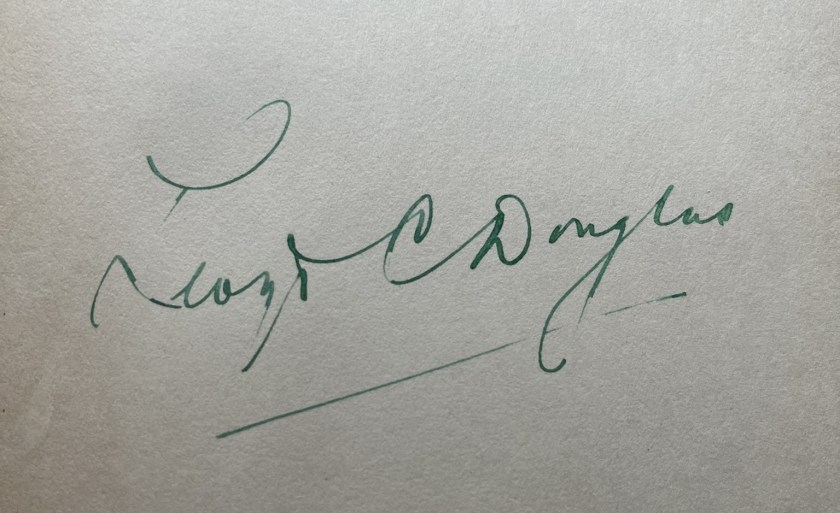
Autograph on first page of a customer copy of Forgive Us Our Trespasses.
Although it’s true that the phenomenal success of the 1929 novel Magnificent Obsession changed the life of its author, it was a delayed reaction. Not until he sat down to write Forgive Us Our Trespasses in the summer of 1932 did Lloyd Douglas realize how greatly his life would change. As I told you in previous posts, he had wanted his next novel to be a satire on the state of modern art, with emphasis (apparently) on the New Fiction of the 1920s; but instead, he wrote another novel like Magnificent Obsession, in which the story was based on a portion of the Sermon on the Mount. As he neared retirement from full-time ministry (which he planned to do in the summer of 1933), he had imagined himself as a mainstream novelist, not as a writer of Christian fiction.
His embarrassment comes through in an unpublished essay that he had intended for the Ladies’ Home Journal in early 1933. (All quotations in this post are from that essay, “Adventures in Parables,” which is filed under “Addresses and Articles,” Box 3, Lloyd C Douglas Papers, Bentley Historical Library, University of Michigan. The University of Michigan holds copyright to this document.)
“More or less by accident,” Douglas wrote, “I have become an author of goody-goody stories in which the characters are tiresomely decent and everything turns out happily in the end. This is an offense to modern art in letters, and if I knew to whom apologies should be offered, perhaps I might solicit such shriving as the transgression demands.”
He was joking, but he really did feel like he had been caught trespassing in literary territory. In that sense, the title Forgive Us Our Trespasses was more appropriate than people realized.
“My main trouble, in the opinion of the literary critics,” he continued, “is that I broke all the rules of novel-composition through ignorance. That’s what makes my position in the world of letters so embarrassing. The only woman at the dinner party who dares plant her elbows on the table and hold the squab in her fingers is the lady whose social experience is beyond the reach of query or cavil. If Maggie O’Flaherty did such a thing, the whole solar system would be set back two minutes due to time out for recovery.”
To understand the next example, you have to bear in mind that this was the Great Depression, and Roosevelt wasn’t president yet. At the very moment he wrote this piece, banks all over the country were closing. Douglas wrote, “The only man in town who can afford to wear a greasy old hat is the banker. (Pardon me. I was momentarily thinking of earlier times when bankers had money. If you can think of another word here for ‘banker,’ give him the old hat with our envious felicitations.)”
Then he got to the point:
“The only writer who can take the risk of breaking the laws in respect to the composition of fiction is the sanctioned, seasoned, spurred veteran; which I am not.
“Nobody in these frugal days should waste ink, stamps, and sarcasm in notifying me that Magnificent Obsession and Forgive Us Our Trespasses are, technically, about as bad as stories could be without exposing themselves to censorship in the cause of sound literary production. Perhaps I am too naive to know just how bad they are, but I have a general idea.”
He was being too hard on himself. Although a case can be made that this or that aspect of his first two novels could have been improved, critics with credentials – especially those based in New York – had good things to say about both novels. As I noted in a previous post, there were only a few writers in local newspapers (Kansas City, for example, and Birmingham, Alabama) who trashed Magnificent Obsession, and that trend continued with Forgive Us. But Douglas didn’t consider either of those books literary masterpieces, and that’s why he was embarrassed when some people did criticize them on literary grounds.
“I have only one defense to fall back upon,” he said, “when the really competent critics complain that my stories are shocking examples of How Not to Write a Novel. I am fully aware of it. I do not think of myself as a novelist at all. These things I have written are probably not novels. Perhaps they are modern parables.”
Again, he was conceding too much. They were novels; they just weren’t the kind that was in vogue after the literary revolution of the 1920s. They were “purpose novels”: novels in which the thesis was more important than the plot. And yet his first two books demonstrate that he understood plotting and did it with skill. His only real problem was this: that he was a writer of purpose novels in a day when that genre was considered a thing of the past.
There’s something he’s not telling us in this essay, however. The truth is, he had always aspired to be a novelist – not a writer of purpose novels but of real ones – ones in which the story was everything. Through all his years as a minister, he had waited patiently for that day, when he could shed the clerical collar and WRITE. But when his moment came, his incoming mail convinced him that God had other ideas. As much as he wanted to be “the sanctioned, seasoned, spurred veteran” writer of modern novels, he chose the path he felt his people needed.
This was the mission of Lloyd C. Douglas: to write “modern parables” for people who desperately needed the guidance such stories could provide. When he composed Forgive Us Our Trespasses, he had to make a choice. Would he follow his heart and be the novelist he had always dreamed of being, or would he do what he discerned the Spirit of God calling him to do? Knowing how much it meant to him, I believe it was a gut-wrenching decision. But he chose what he perceived to be his calling. And the rest is history.
This is as much as I can tell you, in these blog posts, about Douglas’s life story. The biography that I’ve written picks up here (1932) and covers the rest of his life, until his death in 1951. If you would like to know more about that book, I send a free monthly newsletter to Lloyd Douglas fans, updating them on the progress of my research and writing. I invite you to fill out the form below, and I will be glad to add you to my list.
In the meantime, future posts at this site will delve more deeply into the documents in the Lloyd Douglas archive: his sermons, speeches, published articles, and interviews. Stay tuned!
Although he never flaunted it, Lloyd Douglas knew his New Testament Greek. And that was probably why he chose the working title, Release, for his next novel,in the summer of 1932.
Luke 6:37 is usually translated into English as, “Forgive, and you will be forgiven,” but a literal translation would be “Release, and you will be released.” The Greek verb is apoluō, which means “to release.” It also means “to forgive,” because that is one example of how you can “release” someone. The point Douglas wanted to emphasize in this new novel was that, in releasing others, we ourselves are released.
Here is how he explained his thesis to Ira Rich Kent, the Managing Editor at Houghton Mifflin Publishing Company on 7/26/1932 (from Box 1, Lloyd C. Douglas Papers, Bentley Historical Library, University of Michigan):
“This book is not in any sense a sequel to Magnificent Obsession…. The thesis of M.O. was, briefly: How to get what you want, and be what you would like to be, through a practice of a Galilean principle of secret philanthropy.
“The thesis of the present work is: how to get free of the encumbrances which block the way to the expansion of personality.
“The most common of these encumbrances is hatred – prejudice, toxic frustrations, cancerous might-have-beens, bottled-up injustices.”
Notice that his examples go beyond just hatred to include disappointment and frustration that has been “bottled-up.” The title Release has even more meaning in this regard. He continues:
“The solution – to be cryptically disclosed through a process not at all homiletic, but by a device capable of sustaining reader interest – is based on the only comment the Lord offered on ‘the Lord’s Prayer’: If ye forgive men their trespasses, your Heavenly Father will forgive yours.
“Trespasses, in this book, are considered as ‘invasions of rights.’ My ‘Major Personality’ has a right to energies which He has invested in me. I cannot hope to succeed in a large way unless I concede and honor His right to the control of such power.
“My freedom to enjoy; to savor life; to get out of it all that is in it for me by putting into it all that I possess, depends upon my willingness to put myself into complete harmony with His design for me.
“I cannot hope to do this unless I free myself of the encumbrances that weight me down.
“At this point, there arises a quite definite proposal of NEGOTIATION. If I sincerely forgive all who have made life difficult for me, I have offered the credentials necessary for this FREEDOM.
“All this sounds didactic and brittle, as I attempt to explain it; but it will not appear so in the book.”
That part about “negotiation” will almost certainly appear foreign to Christians. We place our trust in Jesus, not in any sort of “negotiations” or “credentials” we may bring. The thing to remember here is that Douglas isn’t talking about salvation, and he’s not using orthodox vocabulary. He’s talking about unleashing one’s potential in one’s daily pursuits, and he’s using the vocabulary of the ordinary person out in the world. His congregations were filled with people who professed to be Christians but who had never done the things Jesus talked about. He’s trying to get them beyond talking about it and actually doing it. And he’s starting at Square One.
In the book (Chapter 15), he has the character Julia explain it this way (and she seems to be referring to Matthew 18 here):
This little piece [of scripture]… doesn’t whine at all. It doesn’t ask you to whimper for mercy.
It’s just a business proposition same as if you owed a thousand dollars to Mr. Smith, and ten other people owed you a hundred dollars apiece, and Mr. Smith said, ‘Pay me that thousand dollars,’ and you said, ‘I can’t – with all these people owing me.’
And Mr. Smith said, ‘I don’t need the money so much, but I like you and want to be friends with you, and as long as you are owing me you’ll be keeping away from me for fear I’ll ask you for it and make you ashamed. And it won’t do any good for me to tell you just to keep the money and forget it, because that would make you ashamed, too, and you would always feel in debt. So – I’ll make you a proposition. If you will cancel all the debts of these people who owe you, and are afraid to face you, so that they can afford to cancel the debts of the people who owe them, I’ll call it square with you. Then we can all be good neighbors again, and nobody will be afraid of anyone else, or shy, or ashamed.’
This all sounds so much more sensible to me, dear, than the way they talk about it at the meetings. It’s just as if God wanted us to do business with Him about these things that have kept us strangers.
Houghton Mifflin published the book in November 1932 under the title, Forgive Us Our Trespasses. Douglas had thought it would be a clever satire of modern art, but it ended up being much more. And, in writing it, he found his mission in life. I’ll tell you about that in my next post.
I’ve been listing specific reasons why the novel Magnificent Obsession became a bestseller after its publication in 1929. In today’s post I’ll cover one of the most talked-about reasons: in Doctor Hudson’s secret journal, he says he learned “the secret to power” from a sculptor who clipped a passage out of the Bible and carried it around in his wallet. The author, Lloyd Douglas, wrote the story in a way that builds suspense around the question: “What was on that page?” He gives the essence of the answer, but he never tells his audience what page of the Bible it was.
Here is the passage in which he comes the closest to giving the answer:
From page 138 of the original printing of Magnificent Obsession. This scene is in Chapter 8.
As Laurine Wanamaker Schwan wrote in the Akron Journal shortly after the book’s release (11/1/1929): “This idea is hidden, indeed, in as much mystery and pomp as you will find anywhere. But it is disclosed in bits with much vivid action in between – in bits just big enough to whet your curiosity and interest. And – here is the master stroke of all – is never entirely revealed!”
There is simply this reference to the biblical admonition not to let your left hand know what your right hand is doing. For anyone who knows the Bible (or has access to a good concordance), that’s enough of a clue to find the passage Douglas has in mind. But why didn’t Douglas give the answer?
Here’s what he said later, in his “Author’s Preface” to Doctor Hudson’s Secret Journal in 1939 (p. ix):
“The theme of the novel had derived from a little handful of verses midway of the Sermon on the Mount, but all references to the enchanted passage were purposely vague, the author feeling that a treasure hunt in Holy Writ would probably do his customers no harm. Within the first twelve months after publication, more than two thousand people had written to inquire, ‘What page of the Bible did the sculptor carry in his wallet?’ We left off counting these queries, but they have continued to come, all through these intervening years.”
Notice that even now he didn’t give chapter and verse. If you don’t know where the Sermon on the Mount can be found, you’re out of luck. If you do, then you’ll find it exactly where he says: at the midway point of it.
Why all the secrecy? First of all, because this was his ingenious way of attracting the attention of people who didn’t go to church and wouldn’t be interested in hearing about the Bible under normal circumstances. Second, because citing chapter and verse would have broken the spell. This is a mainstream novel, not Christian fiction. Third, as he says in the paragraph I just quoted, he was hoping his readers would get their hands on a Bible and go for “a treasure hunt,” just like Bobby Merrick ends up doing in the novel.
Laurine Wanamaker Schwan, whose review in the Akron Journal I mentioned a moment ago, thought there might be a fourth reason: “Those who want to see this philosophy in black and white are given a hint as to where they may find it for themselves. And this again is a master stroke. For those who might say, ‘Ho hum! Now what is important about that?’ will never be able to find it. Only those few who will click with its meaning… will ever actually see that idea in cold print!” This is an intriguing suggestion, for it echoes what some scholars believe to be the reason for the so-called “Messianic Secret” in the gospels: to communicate with those who are receptive while keeping critics in the dark. But Douglas himself never said this was his intention.
At any rate, Douglas’s technique of keeping the Bible verses a secret was effective, as the two thousand inquiries he received shows. But it’s interesting to see how reviewers handled this feature of the book.
One reviewer gave it away, without so much as a Spoiler Alert. This was in an article entitled, “Unknown, Read by 150,000,” in the Chicago Herald Examiner (2/20/1932). After admitting that the book’s popularity was due, in large part, to the “mystery of the message in a secret code to be solved,” the review ends with these words: “The ‘magic page’ is apparently Matthew vi:1-6.” (Yeah, thanks a lot. What a killjoy!)
One columnist teased his readers, pretending he was about to reveal the secret… then didn’t. He wrote in his final paragraph: “The scriptural passage in which Dr. Hudson found the secret of his power and which is transmitted to Dr. Merrick is not revealed. The reader is privileged to guess. My own is – but this is Lloyd Douglas’s book.” (W. F. Hardy, “As I View the Thing,” Decatur (IL) Herald, n.d.)
Ozora Davis, writing to an audience of ministers and biblical scholars in the Chicago Theological Seminary Register must have felt that information was more important than letting his colleagues discover it for themselves: “The Sermon on the Mount is in [this book],” he said, “and it is such a comment on the sixth chapter of Matthew as I have not read in many a day.” In this case, Douglas didn’t mind the spoiler. A recommendation from Ozora Davis was a big deal in those days.
One religious periodical scolded Douglas for keeping the passage a secret. The reviewer in Personal Power (October, 1931) wrote, “For the benefit of those who cannot find the scripture passage upon which Randolph’s secret was based, look up Matt. 6:2-7. As a preacher, Dr. Douglas should not have kept people guessing like that.”
A severe critic from Birmingham, Alabama, however, went in the opposite direction: he believed that Douglas had kept the passage a secret because the actual biblical text did not support Douglas’s interpretation. Dean Gilbert W. Mead of Birmingham-Southern College, wrote in the Birmingham News-Age-Herald (3/26/1933), “From the first I felt, as probably many another reader did, that the author was playing a cheap trick on us by never telling us just what was the exact scriptural reference out of which the whole obsession grew…. [T]here isn’t a single thing I can see hindering Mr. Douglas from telling us right out what the discovery was – citing chapter and verse – except, perhaps, that he didn’t dare chance the flimsiness of his absurd structure by exhibiting the weakness of the foundation.”
Whatever one’s opinion may be of the technique Douglas used, it was effective. It got people talking. It prompted thousands of them to write to him, asking questions about the Bible. It motivated columnists and reviewers to write about the book in newspapers all across the country. It accomplished, in other words, what every novelist tries to do, and most fall short of: it made an impression on the larger culture.
But, for many readers, it did something more – something that novels rarely do: it offered a call to action. I’ll tell you about that in my next post.
Lists of bestsellers, such as those printed in the New York Times or USA Today, are compiled from periodic reports submitted by certain designated bookstores around the country. These reports may not always be accurate, but they give at least a general idea of the top books that are selling at each of those stores.
After the publication of Magnificent Obsession in 1929, its publisher, Willett, Clark & Colby, had access to sales information for that book and shared it with the novel’s author, Lloyd Douglas. It’s not clear how much time Douglas spent looking at these stats for his earlier non-fiction books, but he became an expert on the subject from Magnificent Obsession onward, keeping track of where his books sold and correlating it with other facts, such as advertising campaigns or his own personal appearances. For this reason, some remarks he made in 1935 are especially helpful in tracing sales of Magnificent Obsession.
This is jumping ahead in the story, but in January 1935 he wrote a letter to his agent/editor Rich Kent, advising him on where to spend advertising dollars for his newest novel, Green Light. “I believe a little ad in a Kansas City paper – The Star, maybe – would do some good. That’s the plexus which drove Magnificent Obsession. Kansas City. They took it up first. They put me on the map…. Kansas City is really the center of the largest sales we had of that book” (LCD to Ira Rich Kent, 1/28/1935).
It would be fascinating to probe deeper and find out why that city was the one where his book sold best. Viewed superficially, it was a mob town, ruled by Tom Pendergast; but as David McCullough notes in Truman (New York: Touchstone/Simon & Schuster, 1992/93), pp. 196-198), despite the Great Depression, life in Kansas City “had never been better” than in the early 1930s (the very time in which Kansas City’s residents were buying Magnificent Obsession). “Compared to other cities,” writes McCullough, “the Kansas City outlook was confident and expansive. There were jobs, and local government – the organization – was providing most of them” (196). It was, in other words, a complex social situation that defies easy analysis, but there were people in that place who actually governed well (including a young judge named Harry Truman), and the overall mood seems to have been upbeat.
It is surely significant, also, that Kansas City was the headquarters of Unity, Inc. Douglas was surprised by the enthusiastic response his novel received from that spiritual organization. He joked to a friend, “Oddly enough, several metaphysical cults have reviewed the book at considerable length and have adopted me into their respective households of faith. Whether, at the present writing, I am in better standing as a Christian Scientist, a member of ‘Unity, Incorporated,’ or as a preacher in the rather conventional ‘United Church of Canada,’ is not quite clear” (LCD to Jewell Stevens, 10/6/1930).
In Douglas’s scrapbook is the July 1930 issue of a Unity publication called Scientific Christian Training. The first 18 pages of that issue are devoted to a retelling of key parts of Douglas’s story. Richard Lynch, the editor, writes, “Here, in brief, is an interpretation of a section of the Sermon on the Mount and of its instructions as to how to draw on the universal Supply that I have never come across before. It is but a reinforcement of all the teachings of Unity” (p. 17).
Douglas shouldn’t have been surprised. In its vocabulary and teachings, Magnificent Obsession seems to agree with the basic principles of Unity as laid out in James Dillet Freeman’s book, The Story of Unity (Lee’s Summit, MO: Unity School of Christianity, 1965). What Douglas offered as a metaphor (God as a form of energy, for example, or Christianity as a kind of science), the Unity organization had been saying very seriously since the late 1800s. To the extent that Kansas City “put [Douglas] on the map,” it may have been because his book was embraced by leaders within the Unity organization.
But Kansas City wasn’t the only metropolitan area that bought the book in large numbers. In his letter to his agent/editor, Douglas also mentions “Buffalo, Chicago…. Nashville. Dallas. Atlanta. Magnificent Obsession and Forgive Us [his second novel] have been rated as bestsellers in Atlanta, GA, for years and years!”
Atlanta was another interesting case. I assume he meant “white” Atlanta, because the city and the state were heavily segregated, and there was little in Magnificent Obsession that would have appealed to the day-to-day lives of people of color. But, as in Kansas City, the white people of Atlanta were optimistic in the years leading up to Magnificent Obsession’s publication and were working to bring their city up to date. They considered themselves part of the New South, and they did what they could to attract business and encourage the arts. (See Darlene R. Roth and Andy Ambrose, Metropolitan Frontiers: A Short History of Atlanta (Marietta, GA: Longstreet Press, 1996), chapter three.) Where Atlanta differed from Kansas City was in its response to the Stock Market Crash in 1929: Kansas City was still doing well in the early 1930s, but Atlanta was hurting.
In many respects, Atlanta seems to have been like Akron during the years that Douglas was there: growing fast, trying to become urbane, but also dealing with significant economic decline. Under those conditions, Akron had drawn inspiration from Douglas’s ideas. Perhaps Atlanta liked him for many of the same reasons.
I haven’t even begun to probe this subject (why particular cities responded more enthusiastically than others to Douglas’s novel), and I’m not sure that I can. Douglas didn’t have enough information himself to draw inferences about that. All he knew was that Magnificent Obsession sold well in certain metropolitan areas. He didn’t know why.
Here’s a commonsense suggestion. It’s probably safe to say that word-of-mouth advertising, in 1929, 1930, and 1931, was most effective at the local level. If a person bought the book because they heard about it from a friend, that friend was probably someone they interacted with face-to-face. Long-distance telephone service wasn’t a part of people’s daily life yet. Letter writing was, and that may have played a role, but, of course, none of the technologies that are so much a part of our lives today (telephone, internet, social media) were available then. So it may be safe to say that good sales in one city and poor sales in another may have had a lot to do with word-of-mouth advertising (or the lack thereof) in each of those cities.
And while we’re on the subject of conversation, the novel itself had certain features that lent itself to discussion around the watercooler and elsewhere. I’ll talk about that in my next post.




 The Lloyd C Douglas Page