Are You Too Busy?

by Ronald R Johnson

The front cover of Christopher Morley, Two Classic Novels in One Volume: Parnassus on Wheels and The Haunted Bookshop (Dover Publications, 2018). (From amazon.com)

In a sermon on January 4, 1920, at the First Congregational Church of Ann Arbor, Lloyd Douglas shared with his congregation a passage from Christopher Morley’s 1919 book, The Haunted Bookshop. (In Sermons [5], Box 3, Lloyd C. Douglas Papers, Bentley Historical Library, University of Michigan. © University of Michigan.)

As I mentioned in a previous post, Douglas had trouble coming up with a title for this sermon because the passage he quoted was about washing dishes. In the book, Morley’s character Mifflin talks about how he used to hate washing dishes until he realized that it slowed him down and gave him a chance to relax from his daily labors. As Mifflin says,

“Do not laugh when I tell you that I have evolved a whole kitchen philosophy of my own. I find the kitchen the shrine of our civilization, the focus of all that is comely in life. The ruddy shine of the stove is as beautiful as any sunset. A well-polished jug or spoon is as fair, as complete and beautiful, as any sonnet. The dishmop, properly rinsed and wrung and hung outside the back door to dry, is a whole sermon in itself. The stars never look so bright as they do from the kitchen door after the icebox pan is emptied, and the whole place is ‘redd up,’ as the Scotch say.”

Douglas comments on this passage:

“Now, all of this has set me thinking on the subject of our drudgeries, and to wondering if the search for contentment in life is not, after all, mostly a transfiguration of these petty drudgeries into desirable employments. I am fully aware that my original premise is not extremely popular. That one should seek contentment nowadays is almost equivalent to a confession of selfishness and moral lassitude. The way to behave, modernly, is to strive.

“Be busy. Be doing things. Be perpetually going through a multitude of motions. Don’t sit down. People might think you lazy. Don’t slow down. People might think you were losing your punch. It is best to lope about, watch in hand, with an expression of fatigue and anxiety on your face; then people will recognize you as a person of consequence. You really can’t be a man of affairs unless you are out of breath.

“It is also wise to talk a great deal about the pressure that is put on you from every direction. This is the easiest part of the performance, of course; and once you get going, it will come quite natural to you to speak of your congested program — almost to the exclusion of any other topic.

“This is the way we have been living in recent years, until the quest of contentment has come to be considered a very unworthy ambition.

“Now, I cannot believe that this sort of panicky living makes for permanent gains in the development of modern civilization. I don’t see how work that is done under such obvious pressure, and necessarily in such a great hurry, can contribute much to the lasting values of our time. There’s too much DO and not nearly enough BE in it.

“We have been chattering volubly about dynamics (one of the words that ought to collect double wages of this generation, for overtime). This, we say, is a dynamic age; and we are living in a dynamic country; and we are a dynamic people. If you want to say something pleasant about some active man, don’t forget to mention that he is dynamic.

“Now, strictly speaking, a dynamic is like the lights on a popular, democratic motorcar. So long as the car is in motion, the lights are on. When the car stops, the lights go out. A dynamic is under obligation to some other agency for its energy; and when that other agency takes a day off, so does the dynamic.

“I think it were about time we began speaking of the desirability of a static power — owing its energy to sources external to itself, to be sure; but not quite so slavishly dependent upon them. They can shut down for repairs if they wish, but the reservoir in which the static power has been stored is good for such period as it has provided for in the hours of its receipt of energy.

“To the storing of this static power in our lives, we need to give considerably more attention than we have been giving it, to a fine, well-balanced spiritual content.

“Whenever I get to the point, in high dynamics, that I must confess I have hardly time to eat my meals; am a stranger to my own household; haven’t read a book, other than that appertaining to my craft, for weeks, months, maybe; I may also seriously ask myself whether, in my abnormal life, lived under conditions artificial, unhealthy, and distinctly antisocial, my contribution to my age is likely to have very much in it of permanent value to mankind.

“I confidently expect to see, long before I die, a decided swing of sentiment away from this popular stampede toward a program of life embracing a little of dignified leisure for thought and a renewal of the well-nigh lost art of contentment.”

The rest of his sermon was about practical ways to find contentment. I’ll tell more about that in my next post.

Christmas in Ann Arbor, 1919

by Ronald R Johnson

Title page of the sermon, “What Do You Want for Christmas?” which Lloyd C. Douglas preached at the First Congregational Church of Ann Arbor on 12/14/1919. In Sermons [4], Box 3, Lloyd C. Douglas Papers, Bentley Historical Library, University of Michigan. © University of Michigan.

“What do you want for Christmas?” Lloyd Douglas asked his congregation at the First Congregational Church of Ann Arbor on December 14, 1919:

How would a wish like this strike you? To wish for some added grace of character that would make people love you, not for anything you had on, or for the house you happened to live in, or the material possessions you were known to command, but just because you are you.

So that, if the clothes go out of style, or the moth eats them up, or the house burns down, or panic upsets business, and rust corrodes your machinery – you will still be possessed of a grace of character that will make people respect you, and have confidence in you, and be glad when you come into the room where they are, and sorry when you leave.

The ability to wake up every morning with a smile and go to sleep every night with peace of mind and satisfaction of heart.

How would you like a gift that would ensure your happiness, in all kinds of weather; that would hold you independent of the inroads of little disappointments – a sort of perpetual guarantee against despair and dissatisfaction?

Somehow, I believe that if we might today choose, for a Christmas gift, absolutely anything we really wanted, to last us for life, this gift that I have been talking about would meet the demand.

Well, you may have it! Take it, and welcome.

Lloyd C Douglas, “What Do You Want for Christmas?” in Lloyd C. Douglas Papers, Sermons [4], Box 3, Bentley Historical Library, University of Michigan.

What do you want for Christmas?

In the Aftermath of the Great War

by Ronald R Johnson

Front cover of a promotional brochure for sermon entitled, “Walled Towns.” In LCD 1918 Scrapbook, Box 5, Lloyd C Douglas Papers, Bentley Historical Library, University of Michigan. © University of Michigan.

As the 1919 Christmas season was about to begin, Lloyd C. Douglas announced an unusual sermon offering “The Way Out” of the intricate problems left over from the Great War (which we now call World War I). There was nothing Christmasy about this sermon. It was a review of the book, Walled Towns, by Ralph Adams Cram, a professor of architecture at MIT.

In a brochure announcing the upcoming sermon, Douglas wrote that Walled Towns “urges and predicts a return, in all things, to ‘the unit of human scale,’ believing ‘the Free City’ — ‘the Walled Town’ — to be the only solution of our problem which, [Cram] declares, involves the destruction of Imperialism, Materialism, and ‘the quantitative standard’ — the ‘three errors of modernism.’

“‘The life of society,’ writes Cram, ‘is conditioned by a rhythmical wave motion; curves rising and descending… the falling curve meeting at some point the rising curve of a future coming into being, the crossing points forming the nodes of history, and spacing themselves at five-century intervals either side of the birth of Christ, or the year 1, A.D.

“By the use of the drawing which appears below (special permission having been secured from Professor Cram to reproduce it here), the author calls attention to ‘the correspondence, in time, between certain periodic manifestations of spiritual force, identical in nature, though somewhat varied in fashion, and these nodal points: that is to say, the monastic idea as this showed itself in the first, sixth, eleventh and sixteenth centuries. This synchronism may be graphically explained thus, the thin line indicating the approximate curve of social development, the shaded line the monastic manifestation…

From promotional brochure for sermon entitled, “Walled Towns.” In LCD 1918 Scrapbook, Box 5, Lloyd C Douglas Papers, Bentley Historical Library, University of Michigan. © University of Michigan.

“‘It would appear from this,’ continues Professor Cram, ‘that now while the next nodal point is possibly seventy-five years in the future [1994], the next manifestation of monasticism should already be showing itself. The curve of modernism is now descending as precipitously as did that of the Roman Imperialism; but already, to those who are willing to see, there are indisputable evidences of the rising of the following curve.

“‘Whether this is to emulate in lift and continuance the curves of Medievalism and of modernism, or whether it is to be but a poor copy of the sag and the low, heavy lift of the Dark Ages, is the question that man is to determine for himself during the next two generations [the 1920s and 30s].'”

In the remaining paragraphs of his announcement, Douglas calls Cram’s views “prophetic” and says, “This new conception of a ‘way out,’ surely cannot fail to be of interest to the ‘tried and tired mind’ of the present generation. For many of us it will have such an allurement that we may be tempted seriously to give ourselves to the promotion of this expedient to rescue our social order from its own blunders.

“Owing to the limited seating capacity of the church and the probable interest on the part of many people in the matter indicated above, Mr. Douglas will deliver this address on ‘Walled Towns’ at both the 10:30 AM and 7:30 PM services…”

It was unlike Douglas to create so much hype around a controversial idea of this kind. He was a modernist, and Cram was not. Cram was advocating a return to monasticism. For Douglas to jump on this bandwagon, especially at the beginning of the Christmas season, is rather alarming. But we have to remember that this was just a year after the end of the Great War, and it seemed clear that the nations were still in turmoil (a fact that would eventually lead to another World War). Douglas was obviously concerned about the future.

In my next post, I’ll tell you about “Walled Towns,” a sermon that wasn’t very important in its own right, but that laid the foundation for one of his most memorable novels.

The Grounds of Our Gratitude: Gratitude Itself

by Ronald R Johnson

Asylum Lake, Kalamazoo, Michigan. Taken by the author.

This is from a sermon entitled “The Grounds of Our Gratitude,” that Lloyd C. Douglas preached at the First Congregational Church of Ann Arbor on the Sunday before Thanksgiving, November 23, 1919. (It can be found in Sermons [4], Box 3, Lloyd C. Douglas Papers, Bentley Historical Library, University of Michigan. © University of Michigan.)

He gives four reasons for being grateful. I talked about the first three in my last three posts: that he and his people were alive during such an interesting era, that they lived in the comparative freedom and safety of America, and that they (especially the students present) were able to get a college education.

His concluding reason is short but interesting:

“In the last place, but by no means last in importance, one good ground of gratitude today — if I am grateful — is just the plain, simple fact that I am grateful. All the joy that is to be had, of this one life which we have to live, is ours for the mere price of recognizing it when it comes. It is entirely up to me whether I face the morning with a scowl or a smile. Whether my books are a drudgery or a delight. Whether my business downtown is a bore and a burden, or a source of happiness. Whether my home duties are irksome or pleasant. Whether my thoughts bring me satisfaction or pain.

“My mind, to me, a kingdom is. And as a man thinketh in his heart, so he is.

“And the kingdom of God is within us. All happiness and contentment is generated inside ourselves. Therefore, it is a great thing just to be thankful — just to be conscious of the largeness and richness of our lives. And, if we are thankful, it goes without saying that we shall want to help our fellow-pilgrims to the same happy and contented state of mind. For this habit of thankful, grateful contentment with life makes for steadiness of character, strength of purpose, inner peace, and the poise which all men covet.

“Thus endowed, we master many a grief and overcome many a disappointment that would crush us, but for this spiritual power.”

The Grounds of Our Gratitude: Having a Chance to Go to College

by Ronald R Johnson

The University of Michigan from https://static7.depositphotos.com/1141099/788/i/450/depositphotos_7888786-stock-photo-university-of-michigan.jpg

This is from a sermon entitled “The Grounds of Our Gratitude,” that Lloyd C. Douglas preached at the First Congregational Church of Ann Arbor on the Sunday before Thanksgiving, November 23, 1919. (It can be found in Sermons [4], Box 3, Lloyd C. Douglas Papers, Bentley Historical Library, University of Michigan. © University of Michigan.)

He gives four reasons for being grateful. I talked about the first two in my last two posts: that he and his people were alive during such an interesting era, and that they lived in the comparative freedom and safety of America.

His third reason is directed at his audience, which is made up of students, professors, and administrators from the University of Michigan. But he is especially talking to the students. He says “it is surely a ground for gratitude that so many of us are able to train our minds to think clearly and to gather up the accumulated wisdom of the ages and make it ours, at this seat of learning.

“When I think of the thousands who envy us and wish they had our chance at life’s larger privileges, and then am forced to reflect that, every day, I pass so many of these advantages by, thoughtlessly — it gives me cause for shame.

“For how many cramped lives are yearning for just a modicum of the chance we have at life — men and women who would be entirely satisfied with the crumbs that fall from the table where we sit, sometimes half-bored, jaded, and dyspeptic!

“We have even been known to rebel against the ardent endeavors of our counselors to put us into contact with the mental and spiritual energies that drive the world, and have plotted and schemed to avoid the privilege of developing the only life we have.

“Millions exist in a weary treadmill, standing all day at the mouths of white-hot furnaces, groping in the depths of dangerous mines, tending nerve-racking machinery in the shops, or eking out a wretched living in some monotonous work which they hate.

“For you and me (and just why is it for you and me, and not for them?) the ways of life have been made smooth; achievement easy; honor and high attainment not only possible but the natural order of events. Surely we have cause for thankfulness in this — a thankfulness that ought to beautify our characters and shine in our eyes, and lend us courage for whatever little labors and perplexities are incident to the rich and free and full life handed to us as a gift which we have done nothing to merit — but for whose uses we shall be held strictly accountable by the Spirit who issues and controls our destinies.”

To be continued…

The Grounds of Our Gratitude: Living in This Country

by Ronald R Johnson

From Britannica Online: https://www.britannica.com/story/thanksgiving-day-in-the-united-states

This is from a sermon entitled “The Grounds of Our Gratitude,” that Lloyd C. Douglas preached at the First Congregational Church of Ann Arbor on the Sunday before Thanksgiving, November 23, 1919. (It can be found in Sermons [4], Box 3, Lloyd C. Douglas Papers, Bentley Historical Library, University of Michigan. © University of Michigan.)

He gives four reasons for being grateful. The first (which I talked about in the previous post) was the fact that he and his people were alive during such an interesting era.

The second: “I am glad that I am permitted to live in this country. How would you like to be spending the only life you have to live in Russia these days? [The revolution in Russia had begun two years earlier and was still going on.] Or would you have preferred Armenia? [Their fate was uncertain in 1919.] How about Germany? [Having lost the war, they were expected to pay everyone else’s bills.] Can you think of any other country on the face of the earth that could offer you as much of advantage — security — liberty — and general satisfaction as this land in which we live?

“To be sure, we, too, are in a maze of serious problems; but they are not problems of how to deal with hardships so much as how to deal with excessive prosperity. It is not our poverty that has bothered us but our marvelous national riches.

“We are not now worried over the problem of trying to secure a larger liberty, but how to regulate those who would abuse the liberties that have been tendered them with such prodigality. Our industrial problem, for example, does not consist of a situation in which labor has more work than it really ought to be asked to do, but how to give the laboring man a contented mind, now that he has so much time on his hands to fret about the limitations of his job.

“Our problems are serious; but they are all problems arising out of progress, and not of repression or slavery. Any child in this country who wants an education can get it, and when he completes what the state has to offer him, absolutely free of cost, he has the equivalent of the education offered by the average college only twenty-five years ago.

“Any child who is lacking in mentality can find a safe refuge where his small capacities are trained to the utmost. A little while ago, the village idiot roamed the streets, either as an object of ridicule or crude and bungling sympathy of curious neighbors. In almost all the other nations of the world, such condition obtains at this hour. Here, the little child with the lame foot is invited by the state to come and be made whole, at the expense of the people.

“There is very little actual misfortune in America for which no remedy has been devised. There never was a more tenderhearted, more philanthropic nation known to human history. With all our obvious blunders, our mad rush, our almost insane desire to take shortcuts to prosperity (in the course of which we miss much, if not most, of the real satisfaction of life); with all our hard driving, and fierce competition, we are obliged to admit that our America, today, is, by all counts, the most livable country in the world.

“We can be thankful that it has been given to us to spend what little time is allotted to us on earth, right here in the United States.”

To be continued…

The Grounds of Our Gratitude: Living in These Times

by Ronald R Johnson

From the title page of “The Grounds of Our Gratitude.” In Sermons [4], Box 3, Lloyd C. Douglas Papers, Bentley Historical Library, University of Michigan. © University of Michigan.

This is from a sermon entitled “The Grounds of Our Gratitude,” that Lloyd C. Douglas preached at the First Congregational Church of Ann Arbor on the Sunday before Thanksgiving, November 23, 1919. (It can be found in Sermons [4], Box 3, Lloyd C. Douglas Papers, Bentley Historical Library, University of Michigan. © University of Michigan.)

He gives four reasons for being grateful.

The first, he says, “is that we are alive in this remarkably interesting period of the world’s life…. [W]e seem to have but one brief visit to this world in which we now live. And it is not for any of us to choose the time for that single visit. This is of considerably more importance than would appear on first thought. Even the distant friend, visiting our own little Ann Arbor for just once in his life, would deem himself fortunate to have arrived yesterday at the annual homecoming — everything a riot of color and a wealth of welcome. He would have formed quite another impression, had he visited us about the first of September, when the place had all the marks of a deserted city.

“The same thing is true of our visit to this old planet — earth. It is of great consequence that one’s single, brief stay here should occur when there is something really doing, something important afoot….

“Of certain generations in the Christian era, very little is preserved. Indeed, there are certain cloudy strips of time, about midway of civilization’s journey from Golgotha to Verdun, so innocent of any real achievement that we really know nothing about men’s thoughts, deeds, or aspirations for periods of three or four generations laid end to end.

“Now, if I am to have only one life in this world, I am glad that I didn’t have to take my turn then.

“Until very recently, a considerable portion of the earth-dweller’s time and energy was occupied with the business of keeping alive and dealing with bodily discomforts. I am not an extremely old gentleman; yet, in the course of my life I have seen common life made more enjoyable. I remember very distinctly when the streets of Ft. Wayne, Indiana (which was the nearest large town) were lighted for the first time by electricity, and what an object of curiosity it was! In the town in which I lived then — a place of 2,000 population — a man drove around in a cart every evening and lighted a few oil-burning lamps. Most of the sidewalks were wooden, and the long planks had a trick of warping and becoming disconnected at one end, to the occasional undoing of pedestrians groping their way along the dimly lighted streets — streets that would mire a wagon almost any time in spring, and from which blinding clouds of dust arose all summer.

“I was ten when I saw a telephone for the first time, and several years older before I had occasion to use one. Such surgery as we had was very crude, and employed only as a last resort — and, if my memory serves me correctly, it generally proved to be, indeed, the last resort of the patient.

“I shall not forget the tremendous excitement that was caused when the first automobile appeared in town. It had only one cylinder and was in appearance like an old-fashioned buggy. The more discerning businessmen of the place agreed that it was an interesting toy, but assured one another that it would never be made practical. My own pet ambition as a little boy was to own some day one of those bicycles with a front wheel about five feet in diameter, trailed by a very small wheel less than a foot high. Altogether, it was a deadly weapon, but quite the thing with all the young men of the period. Practically the whole business of automatic machinery has come into being in the course of my own lifetime. I am thankful, today, that I have lived to see so many drudgeries of life rendered unnecessary.

“It is good to be living in a time when one does not have to spend quite so much of one’s nervous energy in the business of just keeping alive, and trying to cope with discomforts….

“Moreover, there are certain great issues before men’s minds today which serve to make this age of peculiar interest. The whole social order — the world ’round — is in a state of change. We know not what the next little group of years will bring forth, but we know that they will produce some radical revisions of our recent processes of living.

“There have been whole centuries when men grew up from boyhood to take over their father’s farm or shop or office and live precisely the manner of life that had been lived by their predecessors. Until very recently, the average American, speaking of his foreign-born neighbor, said, ‘He came from the Old Country.’ Which old country didn’t matter. All old countries looked alike — somewhere across the sea, they were.

“Now we have achieved an international consciousness — not an international conscience, as yet, but a recognition of the existence of other peoples and a growing desire to see them rid themselves of their old-world burdens of ignorance, disease, drudgery, and despair.

“True: the new knowledge has but added to our responsibilities and increased our obligations, but it is a great thing just to be alive in this period that shall be known in history as an era of radical changes more significant than any changes which have befallen human experience since the dawn of Christendom, nearly twenty centuries ago.

“I am thankful that, having but one life to live, I am permitted to be in the world now.”

To be continued…

On the Need for Prophetic Voices Today

by Ronald R Johnson

“Today we are bewildered by racket and confusion of such variety and extent that we need — more than commonly — to seek counsel of those whose ears are trained to hear significant messages spoken by the small voice of the Spirit of God.”

This is from a sermon entitled “Understudies,” that Lloyd C. Douglas preached at the First Congregational Church of Ann Arbor on November 16, 1919. (It can be found in Sermons [4], Box 3, Lloyd C. Douglas Papers, Bentley Historical Library, University of Michigan. © University of Michigan.)

“A year ago [at the end of the First World War], we adorned our rhetoric of gratitude with the quotation of that quieting couplet of Kipling’s: ‘The tumult and the shouting dies: the captains and the kings depart.’

“At the present hour, while we feel assured of the departure of the captains and the kings, it is not so apparent that the tumult and the shouting have died. Indeed, it seems again to rise… from a low rumble… breaking into the shrill crescendo of a turbulent, angry world bent on doing it-knows-not-what, by some drastic process, it knows not how.

“Again, as we look about for adequate leadership in the solution of this vast problem of disorder, we grow depressed. They who spoke of sacrifice in golden words a little while ago, when the cold steel of the invader was held menacingly at the throat of a peaceful and prosperous civilization, have little to say to us now.

“Party politics warp the vision of our statesmen, and ballots upon measures affecting the future destinies of the race are determined by the outworn political denomination of these supposedly great men. In an epoch like ours, the world stands at the crossroads of history. A few years will probably fix the course of the next few centuries. Great crises will come again, inevitably, but they will spring from, and may be determined by, the crisis of our day. It is extremely doubtful if any generation ever faced such possibilities of future weal or woe as does our own, as it witnesses nations being born, ancient civilizations scrapped, time-hallowed customs discarded for the new and untried, civilizations begging for guidance and counsel of other civilizations which stand awed in the presence of the strange demand — with so little of genuine confidence in their own plans and purposes.

“It may well be proved true that the present generation, now groping about for a solvent of our problems — our intricate mesh of troubles — shall be quite unable to find a medicine for the world’s ills. Perhaps the best contribution we can make today will be the discovery of a new type of leadership which will give promise of better things to come tomorrow.”

After telling his congregation the story of Elijah putting his mantle on the shoulders of young Elisha, he drew this lesson:

“I see very little hope of any constructive leadership arising out of the ranks of our people who have been trained to think in terms of parochial and partisan interests. Our hope is in the future, and the clear-minded men and women that the future will produce. Our hope is in the youth who, with shining eyes, front an open door into the new age, with the old prejudices and presuppositions banished.

“If only we, who must admit ourselves baffled, can have the spiritual discernment to cast the mantle of our generation upon the shoulders of dynamic leaders, calling them out of their little labors into larger action, we shall have done our part. It may be that this is all that is now possible for us to do toward the solution of our present problems.

“Four years have ended the work of four centuries — and there is no going back. ‘Finis’ has been written at the end of a long episode, and there is no way by which we can knit together again the strands that are severed forever.

Raising his eyes toward the balcony, where the students liked to sit, he said, “Our hope is in you upon whom the mantle falls; and our obligation is to make you understand the nature of your trust.

“We do well who, in these turbulent days, listen for the small voice that stills our hearts — and leads us, once more, into the paths of righteousness.”

On Hearing the Voice of God

by Ronald R Johnson

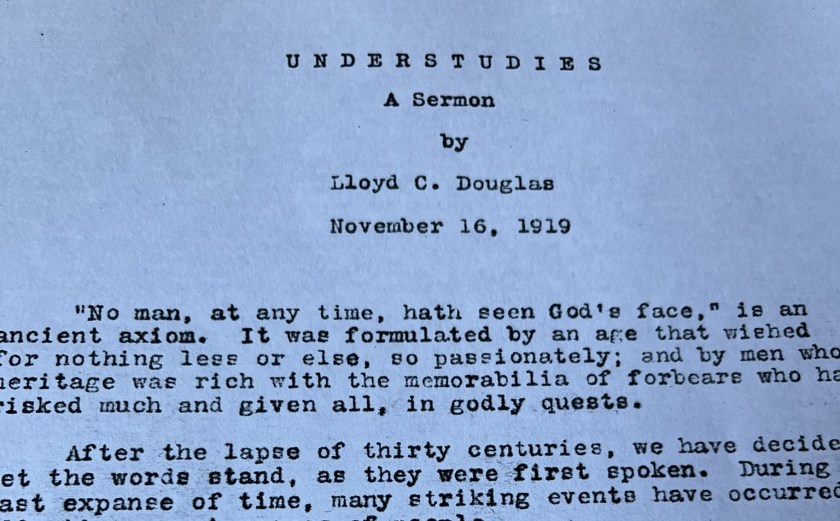
From the title page of “Understudies.” In Sermons [4], Box 3, Lloyd C. Douglas Papers, Bentley Historical Library, University of Michigan. © University of Michigan.

“Doubtless God has often spoken to men who, though they had the capacity for understanding the message, balked at the heavy cost of obedience. It is a matter of record that many men who, having announced their receipt of such a message and their purpose to execute its demands, have lacked the necessary spiritual energy or physical courage to see it through.”

This is from a sermon about Elijah hearing the still small voice of God after expecting to hear it in the earthquake, wind, and fire. The sermon is entitled “Understudies,” and it was preached by Lloyd C. Douglas at the First Congregational Church of Ann Arbor on November 16, 1919. (It can be found in Sermons [4], Box 3, Lloyd C. Douglas Papers, Bentley Historical Library, University of Michigan. © University of Michigan.) You’ll have to overlook the exclusive use of the word “men” instead of “people” throughout this sermon. It was 1919, folks.

Douglas continues:

“Many men, like Terah of Ur-Casdim, have left all to seek a promised land and, again like Terah, have stopped at Haran to rest awhile — where the vision paled, and conviction weakened, and the adventure closed.

“Much more often, however, men of sterling worth, who might have become agencies for the transmission of Divine messages — men brilliantly endowed by Nature with rare gifts of acumen and courage — have never trained their hearing to receive supernal direction. Like the casual layman waiting in the telegraph office, hearing nothing but a bewildering sputter of clicking magnets, while the trained ear of the operator is learning, from this same confused blur of metallic sounds, astounding facts about the lives of men and movements of nations — thus do many worthy and capable men actually hear messages which they are totally unable to comprehend. Their minds have been habitually set upon other things. Their training has been experienced at the hands of other forces.

“Again, there are resourceful men who become aware of supernal messages when certain… spectacular events are going forward in the world. Let the nations go to war and almost inextricably tangle themselves into one squirming mass of hatred and cruelty, and almost any man who thinks at all begins to wonder what eternal significance resides in the event — and questions God for light on the problem.

“Through the earthquake, wind, and fire, the average man who permits himself to think at all, fancies he hears — or reflects that he really ought to hear — some tidings from the Central Energy. But it is only the few who, after the storm has cleared — the earthquake over, the fire quenched, the wind exhausted — have the spiritual capacity to hear the small voice that stills them into a serene and confident faith that God is speaking.

“Those few constitute the prophetic college of the era. Whatever light shines upon the path of men, shines through them. Whatever means are resolved upon to find a new and better way to walk in, are of their devising.”

Douglas is speaking to an audience of professors and administrators from the University of Michigan, with students filling the balcony. There are also prominent business leaders in the pews: a mix of town and gown. But the crux of his message is for the students — “the understudies.” I’ll tell you about that in my next post.

Greatness Isn’t Cheap

by Ronald R Johnson

From the title page of “Buried Treasure.” In Sermons [4], Box 3, Lloyd C. Douglas Papers, Bentley Historical Library, University of Michigan. © University of Michigan.

“The Kingdom of Heaven is like unto treasure hid in a field which, when a man found, he concealeth; and for joy thereof goeth and selleth all that he hath and buyeth that field” (Matthew 13:44).”

This is the text of a sermon entitled “Buried Treasure,” which Lloyd C. Douglas preached at the First Congregational Church of Ann Arbor on November 9, 1919. (It can be found in Sermons [4], Box 3, Lloyd C. Douglas Papers, Bentley Historical Library, University of Michigan. © University of Michigan.)

In this sermon, Douglas emphasized the following point: in order to get the treasure, the buyer must also purchase the field. Douglas says:

“Have you not sometimes coveted an extraordinary gift in the character of a friend and wished it were yours — his poise, for example [there’s that word again], his absolutely perfect balance that keeps him strong and sound and fine and fair, regardless of his circumstances? You often think it would be, indeed, a great blessing to your turbulent and restless life to possess an anchorage like that; if you could have such perfect equilibrium, it would be like discovering a rich treasure.

“Well, doubtless you can have it; but there are a few conditions attached to the possession of such a grace of character — long, patient, unfailing diligence in dealing dispassionately and calmly with difficulties; practicing your science consistently through the petty irritations of daily routine, as earnestly as under the heavy strains that all but crush. One does not take this treasure without accepting also the field in which it lies.

“Sometimes young people have been known to envy an influential man his gift of leadership. Just to possess his exceptional ability to direct the thought and action of large numbers of people — that [ability], they think, would constitute the most desirable acquisition in life. Yet, one does not take that gift of leadership without accepting also the somewhat drastic conditions which invariably accompany it — the almost complete abrogation of most of the simple yet exceedingly precious joys of private life; the sheer loneliness of it; the criticisms that bark and snap at it; the ridicule, the reviling, the invective. He who takes this treasure must also contract to take the field in which he found it; and a jolly rough piece of land it is, too, if they are to be believed who hold deeds to such property.

“Says another of his friend whose happiness seems to overflow continually, and [who] appears to be going through life on the crest of a wave that never dips or breaks, ‘Oh, if I could have that man’s radiant personality! I should give anything to be like that!’ But it just happens that people who have extraordinary capacities for happiness and good humor, who never seem to take anything very seriously: ah, but how they can suffer with a suffering that nobody is able to understand but other people of the same temperament.

“Says one, ‘I would give ten years of my life to have been able to write that song.’ Ten years of your life! That would be getting off rather easily. Before he was able to write that song, this man had to have his heart broken, and everything humanly desirable swept out of his life.”

Regarding the scripture text, Douglas says, “There are many bridges to be burned as one makes toward the Kingdom. Jesus states the case very simply, but very clearly, in this parable. Here is the discoverer, in the very ‘ecstasy of eagerness’ over his find. Here is the treasure, a chest of potential happiness, which may possibly be his if the right processes are pursued. And here is the field, which he does not want at all, but must take if he is to claim the treasure. And if he does take the field, it will cost him everything.

“All that he has gathered up in his life until now must be sacrificed. His little home, doubtless fraught with many associations very dear — it must go.

“It is just at this point that many a finding man who has stumbled upon the Kingdom hidden in a field fails to meet the conditions governing its possession.

“Certain old friendships hold him back, friendships with men who by their cynicism and unfaiths make it impossible for the discoverer of the treasure to claim his find. And he knows that if he is to own this treasure, he must cut loose from the old ties, the old influence, the old environment.

“It means a very great deal for him to dispose of everything, just to be able to negotiate for this field that he doesn’t want.

“It is at this point, I say, that most people miss their chance of achieving the Kingdom of Heaven in their hearts.

“The Master recognized the difficulty in the way. Indeed, he sometimes called special attention to it when he feared some zealous convert was about to take a step too long for him. Jesus never tried to induce anybody to accept the Kingdom of Heaven on easy terms. He never proposed an excursion rate, or a short cut, or a remnant sale.

“Intuitive psychologist that he was, the Lord knew that anybody who achieved the Kingdom of Heaven in his heart without giving anything for it would never realize any happiness in its possession. And following the logic of this bargain to its finest conclusion, he argues that if the Kingdom is to produce the highest degree of happiness, the discoverer must be willing to surrender all that he has, and take not only the treasure but the field as well.”

Design a site like this with WordPress.com
Get started