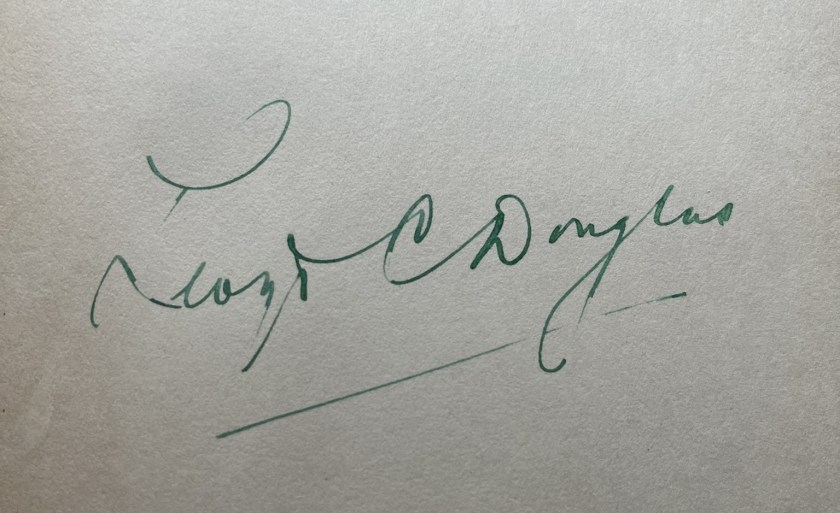
Although it’s true that the phenomenal success of the 1929 novel Magnificent Obsession changed the life of its author, it was a delayed reaction. Not until he sat down to write Forgive Us Our Trespasses in the summer of 1932 did Lloyd Douglas realize how greatly his life would change. As I told you in previous posts, he had wanted his next novel to be a satire on the state of modern art, with emphasis (apparently) on the New Fiction of the 1920s; but instead, he wrote another novel like Magnificent Obsession, in which the story was based on a portion of the Sermon on the Mount. As he neared retirement from full-time ministry (which he planned to do in the summer of 1933), he had imagined himself as a mainstream novelist, not as a writer of Christian fiction.
His embarrassment comes through in an unpublished essay that he had intended for the Ladies’ Home Journal in early 1933. (All quotations in this post are from that essay, “Adventures in Parables,” which is filed under “Addresses and Articles,” Box 3, Lloyd C Douglas Papers, Bentley Historical Library, University of Michigan. The University of Michigan holds copyright to this document.)
“More or less by accident,” Douglas wrote, “I have become an author of goody-goody stories in which the characters are tiresomely decent and everything turns out happily in the end. This is an offense to modern art in letters, and if I knew to whom apologies should be offered, perhaps I might solicit such shriving as the transgression demands.”
He was joking, but he really did feel like he had been caught trespassing in literary territory. In that sense, the title Forgive Us Our Trespasses was more appropriate than people realized.
“My main trouble, in the opinion of the literary critics,” he continued, “is that I broke all the rules of novel-composition through ignorance. That’s what makes my position in the world of letters so embarrassing. The only woman at the dinner party who dares plant her elbows on the table and hold the squab in her fingers is the lady whose social experience is beyond the reach of query or cavil. If Maggie O’Flaherty did such a thing, the whole solar system would be set back two minutes due to time out for recovery.”
To understand the next example, you have to bear in mind that this was the Great Depression, and Roosevelt wasn’t president yet. At the very moment he wrote this piece, banks all over the country were closing. Douglas wrote, “The only man in town who can afford to wear a greasy old hat is the banker. (Pardon me. I was momentarily thinking of earlier times when bankers had money. If you can think of another word here for ‘banker,’ give him the old hat with our envious felicitations.)”
Then he got to the point:
“The only writer who can take the risk of breaking the laws in respect to the composition of fiction is the sanctioned, seasoned, spurred veteran; which I am not.
“Nobody in these frugal days should waste ink, stamps, and sarcasm in notifying me that Magnificent Obsession and Forgive Us Our Trespasses are, technically, about as bad as stories could be without exposing themselves to censorship in the cause of sound literary production. Perhaps I am too naive to know just how bad they are, but I have a general idea.”
He was being too hard on himself. Although a case can be made that this or that aspect of his first two novels could have been improved, critics with credentials – especially those based in New York – had good things to say about both novels. As I noted in a previous post, there were only a few writers in local newspapers (Kansas City, for example, and Birmingham, Alabama) who trashed Magnificent Obsession, and that trend continued with Forgive Us. But Douglas didn’t consider either of those books literary masterpieces, and that’s why he was embarrassed when some people did criticize them on literary grounds.
“I have only one defense to fall back upon,” he said, “when the really competent critics complain that my stories are shocking examples of How Not to Write a Novel. I am fully aware of it. I do not think of myself as a novelist at all. These things I have written are probably not novels. Perhaps they are modern parables.”
Again, he was conceding too much. They were novels; they just weren’t the kind that was in vogue after the literary revolution of the 1920s. They were “purpose novels”: novels in which the thesis was more important than the plot. And yet his first two books demonstrate that he understood plotting and did it with skill. His only real problem was this: that he was a writer of purpose novels in a day when that genre was considered a thing of the past.
There’s something he’s not telling us in this essay, however. The truth is, he had always aspired to be a novelist – not a writer of purpose novels but of real ones – ones in which the story was everything. Through all his years as a minister, he had waited patiently for that day, when he could shed the clerical collar and WRITE. But when his moment came, his incoming mail convinced him that God had other ideas. As much as he wanted to be “the sanctioned, seasoned, spurred veteran” writer of modern novels, he chose the path he felt his people needed.
This was the mission of Lloyd C. Douglas: to write “modern parables” for people who desperately needed the guidance such stories could provide. When he composed Forgive Us Our Trespasses, he had to make a choice. Would he follow his heart and be the novelist he had always dreamed of being, or would he do what he discerned the Spirit of God calling him to do? Knowing how much it meant to him, I believe it was a gut-wrenching decision. But he chose what he perceived to be his calling. And the rest is history.
This is as much as I can tell you, in these blog posts, about Douglas’s life story. The biography that I’ve written picks up here (1932) and covers the rest of his life, until his death in 1951. If you would like to know more about that book, I send a free monthly newsletter to Lloyd Douglas fans, updating them on the progress of my research and writing. I invite you to fill out the form below, and I will be glad to add you to my list.
In the meantime, future posts at this site will delve more deeply into the documents in the Lloyd Douglas archive: his sermons, speeches, published articles, and interviews. Stay tuned!




 The Lloyd C Douglas Page