On the Need for Prophetic Voices Today

by Ronald R Johnson

“Today we are bewildered by racket and confusion of such variety and extent that we need — more than commonly — to seek counsel of those whose ears are trained to hear significant messages spoken by the small voice of the Spirit of God.”

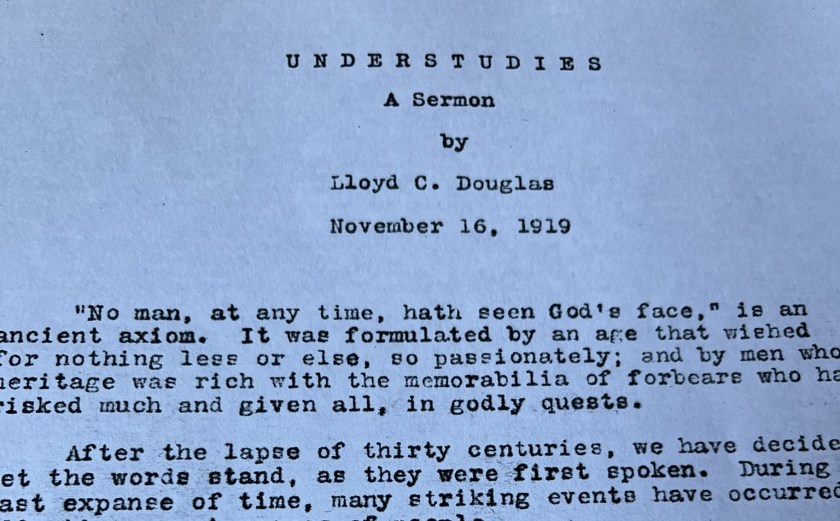
This is from a sermon entitled “Understudies,” that Lloyd C. Douglas preached at the First Congregational Church of Ann Arbor on November 16, 1919. (It can be found in Sermons [4], Box 3, Lloyd C. Douglas Papers, Bentley Historical Library, University of Michigan. © University of Michigan.)

“A year ago [at the end of the First World War], we adorned our rhetoric of gratitude with the quotation of that quieting couplet of Kipling’s: ‘The tumult and the shouting dies: the captains and the kings depart.’

“At the present hour, while we feel assured of the departure of the captains and the kings, it is not so apparent that the tumult and the shouting have died. Indeed, it seems again to rise… from a low rumble… breaking into the shrill crescendo of a turbulent, angry world bent on doing it-knows-not-what, by some drastic process, it knows not how.

“Again, as we look about for adequate leadership in the solution of this vast problem of disorder, we grow depressed. They who spoke of sacrifice in golden words a little while ago, when the cold steel of the invader was held menacingly at the throat of a peaceful and prosperous civilization, have little to say to us now.

“Party politics warp the vision of our statesmen, and ballots upon measures affecting the future destinies of the race are determined by the outworn political denomination of these supposedly great men. In an epoch like ours, the world stands at the crossroads of history. A few years will probably fix the course of the next few centuries. Great crises will come again, inevitably, but they will spring from, and may be determined by, the crisis of our day. It is extremely doubtful if any generation ever faced such possibilities of future weal or woe as does our own, as it witnesses nations being born, ancient civilizations scrapped, time-hallowed customs discarded for the new and untried, civilizations begging for guidance and counsel of other civilizations which stand awed in the presence of the strange demand — with so little of genuine confidence in their own plans and purposes.

“It may well be proved true that the present generation, now groping about for a solvent of our problems — our intricate mesh of troubles — shall be quite unable to find a medicine for the world’s ills. Perhaps the best contribution we can make today will be the discovery of a new type of leadership which will give promise of better things to come tomorrow.”

After telling his congregation the story of Elijah putting his mantle on the shoulders of young Elisha, he drew this lesson:

“I see very little hope of any constructive leadership arising out of the ranks of our people who have been trained to think in terms of parochial and partisan interests. Our hope is in the future, and the clear-minded men and women that the future will produce. Our hope is in the youth who, with shining eyes, front an open door into the new age, with the old prejudices and presuppositions banished.

“If only we, who must admit ourselves baffled, can have the spiritual discernment to cast the mantle of our generation upon the shoulders of dynamic leaders, calling them out of their little labors into larger action, we shall have done our part. It may be that this is all that is now possible for us to do toward the solution of our present problems.

“Four years have ended the work of four centuries — and there is no going back. ‘Finis’ has been written at the end of a long episode, and there is no way by which we can knit together again the strands that are severed forever.

Raising his eyes toward the balcony, where the students liked to sit, he said, “Our hope is in you upon whom the mantle falls; and our obligation is to make you understand the nature of your trust.

“We do well who, in these turbulent days, listen for the small voice that stills our hearts — and leads us, once more, into the paths of righteousness.”

On Hearing the Voice of God

by Ronald R Johnson

From the title page of “Understudies.” In Sermons [4], Box 3, Lloyd C. Douglas Papers, Bentley Historical Library, University of Michigan. © University of Michigan.

“Doubtless God has often spoken to men who, though they had the capacity for understanding the message, balked at the heavy cost of obedience. It is a matter of record that many men who, having announced their receipt of such a message and their purpose to execute its demands, have lacked the necessary spiritual energy or physical courage to see it through.”

This is from a sermon about Elijah hearing the still small voice of God after expecting to hear it in the earthquake, wind, and fire. The sermon is entitled “Understudies,” and it was preached by Lloyd C. Douglas at the First Congregational Church of Ann Arbor on November 16, 1919. (It can be found in Sermons [4], Box 3, Lloyd C. Douglas Papers, Bentley Historical Library, University of Michigan. © University of Michigan.) You’ll have to overlook the exclusive use of the word “men” instead of “people” throughout this sermon. It was 1919, folks.

Douglas continues:

“Many men, like Terah of Ur-Casdim, have left all to seek a promised land and, again like Terah, have stopped at Haran to rest awhile — where the vision paled, and conviction weakened, and the adventure closed.

“Much more often, however, men of sterling worth, who might have become agencies for the transmission of Divine messages — men brilliantly endowed by Nature with rare gifts of acumen and courage — have never trained their hearing to receive supernal direction. Like the casual layman waiting in the telegraph office, hearing nothing but a bewildering sputter of clicking magnets, while the trained ear of the operator is learning, from this same confused blur of metallic sounds, astounding facts about the lives of men and movements of nations — thus do many worthy and capable men actually hear messages which they are totally unable to comprehend. Their minds have been habitually set upon other things. Their training has been experienced at the hands of other forces.

“Again, there are resourceful men who become aware of supernal messages when certain… spectacular events are going forward in the world. Let the nations go to war and almost inextricably tangle themselves into one squirming mass of hatred and cruelty, and almost any man who thinks at all begins to wonder what eternal significance resides in the event — and questions God for light on the problem.

“Through the earthquake, wind, and fire, the average man who permits himself to think at all, fancies he hears — or reflects that he really ought to hear — some tidings from the Central Energy. But it is only the few who, after the storm has cleared — the earthquake over, the fire quenched, the wind exhausted — have the spiritual capacity to hear the small voice that stills them into a serene and confident faith that God is speaking.

“Those few constitute the prophetic college of the era. Whatever light shines upon the path of men, shines through them. Whatever means are resolved upon to find a new and better way to walk in, are of their devising.”

Douglas is speaking to an audience of professors and administrators from the University of Michigan, with students filling the balcony. There are also prominent business leaders in the pews: a mix of town and gown. But the crux of his message is for the students — “the understudies.” I’ll tell you about that in my next post.

Greatness Isn’t Cheap

by Ronald R Johnson

From the title page of “Buried Treasure.” In Sermons [4], Box 3, Lloyd C. Douglas Papers, Bentley Historical Library, University of Michigan. © University of Michigan.

“The Kingdom of Heaven is like unto treasure hid in a field which, when a man found, he concealeth; and for joy thereof goeth and selleth all that he hath and buyeth that field” (Matthew 13:44).”

This is the text of a sermon entitled “Buried Treasure,” which Lloyd C. Douglas preached at the First Congregational Church of Ann Arbor on November 9, 1919. (It can be found in Sermons [4], Box 3, Lloyd C. Douglas Papers, Bentley Historical Library, University of Michigan. © University of Michigan.)

In this sermon, Douglas emphasized the following point: in order to get the treasure, the buyer must also purchase the field. Douglas says:

“Have you not sometimes coveted an extraordinary gift in the character of a friend and wished it were yours — his poise, for example [there’s that word again], his absolutely perfect balance that keeps him strong and sound and fine and fair, regardless of his circumstances? You often think it would be, indeed, a great blessing to your turbulent and restless life to possess an anchorage like that; if you could have such perfect equilibrium, it would be like discovering a rich treasure.

“Well, doubtless you can have it; but there are a few conditions attached to the possession of such a grace of character — long, patient, unfailing diligence in dealing dispassionately and calmly with difficulties; practicing your science consistently through the petty irritations of daily routine, as earnestly as under the heavy strains that all but crush. One does not take this treasure without accepting also the field in which it lies.

“Sometimes young people have been known to envy an influential man his gift of leadership. Just to possess his exceptional ability to direct the thought and action of large numbers of people — that [ability], they think, would constitute the most desirable acquisition in life. Yet, one does not take that gift of leadership without accepting also the somewhat drastic conditions which invariably accompany it — the almost complete abrogation of most of the simple yet exceedingly precious joys of private life; the sheer loneliness of it; the criticisms that bark and snap at it; the ridicule, the reviling, the invective. He who takes this treasure must also contract to take the field in which he found it; and a jolly rough piece of land it is, too, if they are to be believed who hold deeds to such property.

“Says another of his friend whose happiness seems to overflow continually, and [who] appears to be going through life on the crest of a wave that never dips or breaks, ‘Oh, if I could have that man’s radiant personality! I should give anything to be like that!’ But it just happens that people who have extraordinary capacities for happiness and good humor, who never seem to take anything very seriously: ah, but how they can suffer with a suffering that nobody is able to understand but other people of the same temperament.

“Says one, ‘I would give ten years of my life to have been able to write that song.’ Ten years of your life! That would be getting off rather easily. Before he was able to write that song, this man had to have his heart broken, and everything humanly desirable swept out of his life.”

Regarding the scripture text, Douglas says, “There are many bridges to be burned as one makes toward the Kingdom. Jesus states the case very simply, but very clearly, in this parable. Here is the discoverer, in the very ‘ecstasy of eagerness’ over his find. Here is the treasure, a chest of potential happiness, which may possibly be his if the right processes are pursued. And here is the field, which he does not want at all, but must take if he is to claim the treasure. And if he does take the field, it will cost him everything.

“All that he has gathered up in his life until now must be sacrificed. His little home, doubtless fraught with many associations very dear — it must go.

“It is just at this point that many a finding man who has stumbled upon the Kingdom hidden in a field fails to meet the conditions governing its possession.

“Certain old friendships hold him back, friendships with men who by their cynicism and unfaiths make it impossible for the discoverer of the treasure to claim his find. And he knows that if he is to own this treasure, he must cut loose from the old ties, the old influence, the old environment.

“It means a very great deal for him to dispose of everything, just to be able to negotiate for this field that he doesn’t want.

“It is at this point, I say, that most people miss their chance of achieving the Kingdom of Heaven in their hearts.

“The Master recognized the difficulty in the way. Indeed, he sometimes called special attention to it when he feared some zealous convert was about to take a step too long for him. Jesus never tried to induce anybody to accept the Kingdom of Heaven on easy terms. He never proposed an excursion rate, or a short cut, or a remnant sale.

“Intuitive psychologist that he was, the Lord knew that anybody who achieved the Kingdom of Heaven in his heart without giving anything for it would never realize any happiness in its possession. And following the logic of this bargain to its finest conclusion, he argues that if the Kingdom is to produce the highest degree of happiness, the discoverer must be willing to surrender all that he has, and take not only the treasure but the field as well.”

Design a site like this with WordPress.com
Get started