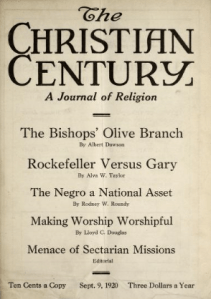
In my last post, I talked about how The Christian Century advertised the novel Magnificent Obsession heavily and consistently from October 1929 (just before its release) onward. Because The Christian Century was read primarily by mainstream ministers and lay leaders, this was a good strategy. The Century’s readership was an audience of influencers – people who would not only read the book but also, if properly motivated, share their opinion of it with their own audiences. And in this case, many of them were motivated, not only by the fact that they were already Lloyd Douglas fans (due to his frequent articles in the Century) but also by the provocative way he wrote this book. As one prominent minister said, Douglas presented his material “in such a fascinating way, we do not know that he is talking about religion” (quotation from Rev. John Warren Day in article, “DAY REVIEWS BOOK,” name of newspaper not given, n.d. In Douglas’s Magnificent Obsession Scrapbook, Box 6, Lloyd C. Douglas Papers, Bentley Historical Library, University of Michigan).
In that era, it was common for mainstream ministers to review noteworthy books in their sermons. Douglas himself did it quite often. In the case of Magnificent Obsession, however, ministers not only reviewed it from their own pulpits but also published articles in denominational magazines and gave presentations about it at diocesan conferences.
In Douglas’s private papers, I found a typewritten list of influencers who were especially helpful in spreading the word about Magnificent Obsession. (The list is in “Miscellanea [3],” Box 4.) Out of those several pages of names, I found 21 ministers:
*Rev. Preston Bradley, The Peoples Church, Chicago, IL
*Rev. W. H. Upton, Davenport, IA
*Rev. Dr. Ralph Welles Keeler, Goodsell Memorial Methodist Episcopal, Brooklyn, NY
*Dr. Frank G. Smith, First Central Congregational Church, Omaha, NE
*Rev. E. D. Hood, Terre Haute, IN
*Rev. John Warren Day, Dean of Grace Cathedral, Topeka, KS
*Dr. H. P. Dewey, Plymouth Congregational Church, Minneapolis, WI
*Rev. F. G. Forrester, Nome Federated Church, Nome, AK
*Rev. F. W. Kerr, St. Andrews Church, Westmount, Quebec, Canada
*Rev. Rolla S. Kenaston, Fourth Street Methodist Church, Moberly, MO
*Dr. Victor W. Thrall, First Methodist Church, Battle Creek, MI
*Rev. Elbert Paul, First Baptist Church, Vancouver, British Columbia, Canada
*Rev. J. Whitcomb Brougher, Jr., Tremont Temple Baptist Church, Glendale, CA
*Rev. Arthur E. Fish, Congregational Church, Keokuk, IA
*Rev. Dr. A. P. Record, First Unitarian Church, Detroit, MI
*Dr. Torrance Phelps, First Congregational Church, Kalamazoo, MI
*Dr. L. Wendell Fifield, Plymouth Church, Seattle, WA
*Rev. George O. Fallis, Canadian Memorial Church, Vancouver, British Columbia, Canada
*Rev. L. M. Rymph, Fairmount Community Church, Wichita, KS
*Rev. Paul H. Krauss, D.D., Trinity English Lutheran Church, Fort Wayne, IN
*Dr. Newton Powell, United Church of Canada, Toronto, Ontario, Canada
And there were others about whom Douglas didn’t learn until later. A friend told him that Dr. James Wise, Bishop of the Diocese of Kansas in the Episcopal Church, was preaching a series of Lenten Noonday Meetings in Chicago that spring (1931), and that he devoted one entire meeting to an enthusiastic review of Magnificent Obsession. The friend added that Bishop Wise told him after the talk “that he kept four or five copies [of Magnificent Obsession] in circulation through his Diocese in Kansas” (Jewell Stevens to LCD, 4/30/1931. In Jewell Stevens File, Morris Library Special Collections, Southern Illinois University at Carbondale).
Douglas would also later give credit to Bishop Robert Nelson Spencer of the West Missouri Diocese of the Episcopal Church and Dr. William Stidger of the Boston University School of Theology, both of whom remained enthusiastic supporters of his novels all through subsequent years.
As I’ve explained in previous posts, local newspapers gave much more coverage to churchmen in the early twentieth century than they do now. What a minister said in the pulpit made headlines, provided he was skilled at presenting the editor with usable soundbites. Because of that, when these pastors preached about Magnificent Obsession, they were influencing not only their own congregations but also the larger community. Here are just a couple of examples of newspaper clippings in Douglas’s Magnificent Obsession Scrapbook:


We can easily see how word spread about Douglas’s book. Many of the parishioners of these churches bought it and read it… and told others. And that leads me to another group of influencers that was, arguably, even more important than the clergy. On Douglas’s list of important influencers that I mentioned earlier, there are many more of these names than there are of ministers. I’m referring to women’s book groups, and I’ll tell you about them in my next post.


 The Lloyd C Douglas Page
