Meanwhile, Back in Montreal…

by Ronald R Johnson

I’ve spent the past few weeks writing posts about how the novel Magnificent Obsession quietly worked its way from obscurity in November 1929 to the Top 25 Bestsellers in April 1931, and upwards from there. But meanwhile, the book’s author, Dr. Lloyd C. Douglas, was busy working as Senior Minister of St. James United Church of Montreal. Because his job kept him busy, and because he was living in Canada, Douglas felt somewhat remote from what was happening. Within the publishing world, his star was rising; but his day-to-day life went on almost as normal.

Almost.

He still had to prepare sermons and visit sick people. He still had to do all the things a pastor normally does. But his incoming mail increased dramatically, as people from all over North America wrote to him about his novel. The things they said, and the questions they asked, convinced him that the publication of Magnificent Obsession had started something he couldn’t walk away from. As he wrote later in his “Author’s Foreword” to Doctor Hudson’s Secret Journal, “the author became aware that he had not completed his task.” [All quotations that follow are from this “Foreword.”]

As strange as it may seem, he hadn’t realized that before. Magnificent Obsession was an experiment. He took what started out as a secular novel (Salvage) and added a religious thesis to it (Exploring Your Soul) in hopes of reaching a larger audience. But up until now (1930-31), he hadn’t given much thought to what would happen next. What if he did reach a larger audience? What if they needed help applying the thesis to their lives? What if they wanted to know more about the gospel?

As I said, he hadn’t anticipated those questions. He did enjoy writing Magnificent Obsession, and he wanted to do another novel, although his work at St. James kept him too busy to follow through on that wish. But he had no intention of writing another book like Magnificent Obsession. Douglas tried never to repeat himself. His next novel would be about the world of art, with emphasis on contemporary literature. He had some opinions about that, especially now that he himself had published a novel.

But his incoming mail kept nagging at him. “Do you honestly believe in this thing,” people asked him, “or were you just writing a story?” Well, he did believe in it, but he wanted his next novel to be just a story. He had some jokes he wanted to put into it… some rather droll remarks that his more sophisticated readers would enjoy… some critical comments about the state of literature today.

But his mail kept increasing. As he admitted later, “The task of dealing sympathetically with this strange correspondence became a grave responsibility. No stock letter, done on a mimeograph, would serve the purpose. It was necessary that individual replies be sent to all earnest inquirers. One dared not risk the accusation that, having advocated an expensive and venturesome technique for generating personal power, the author was thereafter too busy or lazy to care whether anybody benefitted by such investments.”

So he wrote to them, one-by-one. “Some of the questions were practically unanswerable,” he says, “but it wasn’t quite fair to limit one’s reply to a laconic ‘I don’t know.’ Frequently one’s counsel was pitiably inadequate, but not because it was coolly casual or thoughtlessly composed.”

Here, then, was a busy pastor, daydreaming about writing another novel in his spare time – just for fun – but instead spending all his available time corresponding with people who were prompted by his latest novel to ask for his help with their spiritual lives.

Whether he liked it or not, the shape of that next novel started to change. It would still be about the arts; the main character would be an aspiring young novelist living in “The Village” with other aspiring young artists. But instead of it being a satire as he had originally planned, it was slowly turning into a story about the young man’s soul. And as the story changed, Douglas’s future changed with it. He began to realize that the road ahead did not go in the direction he had envisioned.

Publishing Miracle 13: The Call to Action

by Ronald R Johnson

In this series I have listed a number of factors that called the public’s attention to the novel Magnificent Obsession after its publication in 1929. Once people became aware of the book, then there were some distinctive features of it that kept them reading and talking about it. But the book did more than that: it also gave them something to do.

Nancy Ashford comes right out and says this in Chapter 11 when she tells Bobby Merrick that, if Doctor Hudson’s journal were to be published, “People would pronounce it utterly incredible, of course; but they would read it – and heartily wish it were true. And I have a notion they would be sneaking off to make experiments, no matter how they might have giggled when discussing the theory with their friends.”

Magnificent Obsession isn’t just a novel; it’s an invitation to try the thing yourself, and see what happens.

Nancy continues, “I wish I could tell you… you know why I cannot… about the quite startling experiences I myself have had lately…” She can’t tell him because it’s all about serving others and not bragging about it to anybody. But it’s implied that she has done a deed of kindness and has hidden up that secret for her and God alone, and her prayer-life has become more constructive as a result. This isn’t your typical novel. Most of them don’t give the reader something to try after they’re done reading.

But Douglas goes one step further: he hints that he would welcome a letter from them, telling him the results of their experiments.

In Chapter Thirteen, Merrick shares Doctor Hudson’s “secret” with Montgomery Brent, and Brent says he’s going to try it. “May I write to you, sometimes, and report?” Brent asks.

Merrick says, “Glad to have you. But you needn’t try to tell me what you’re doing for anybody else. That’s your affair. Write and tell me if it works – but not what you did to make it work. Do you get me?”

And that’s exactly what readers did. As Douglas tells us in his “Author’s Foreword” to Doctor Hudson’s Secret Journal, “After a while, letters began to arrive from persons who said they had tried it, and it worked; though they were careful not to be too specific in reporting their adventures, aware that if they told they would be sorry” (p. ix). Of course, not everyone had positive results. “A few lamented the cost of unrewarded experiments and denounced the whole idea as a lot of hooey.” He adds, “The task of dealing sympathetically with this strange correspondence became a grave responsibility” (p. x).

This, perhaps more than anything else, is what made Magnificent Obsession stand out from other novels: it created a community. People “tried” the book’s thesis and corresponded with Douglas about the results. And he wrote back. For the rest of his life, much of his time was spent answering letters like these. Douglas says, “A single post might contain inquiries from a high school boy, a college professor, a farmer’s wife, a physician, a pious old lady, an actress, a postman, a preacher, and a sailor…. I suppose that if all these letters were compiled and printed, they would fill several volumes as large as the novel which evoked them.”

There is evidence that Douglas considered doing something along that line. Around 1932-33, he wrote a To-Do List about these letters, then folded it up and stuck it in the back inside pocket of his Forgive Us Our Trespasses scrapbook. In the To-Do List he said he was going to “Take off mailing addresses from letters,” and then “Letters will be stored.” He seems to have had some long-range plans for them, but he doesn’t mention what he had in mind.

On a personal note, this “Strange Correspondence” is the first thing I looked for when I began studying Douglas’s private papers at the University of Michigan in 2005. Rather than a biography of Douglas, I initially wanted to write the story of this community-building that he did through letter writing. Unfortunately, other than fan letters from GIs during WWII (to which I do devote a chapter in my Douglas biography), Douglas’s daughters did not donate his fan mail to the university archives.

However, the main point I want to make today is that Magnificent Obsession prompted readers to go out and “try” the book’s thesis – and apparently many of them did. In that respect, it was more than a novel. For many people, reading it was a life-changing experience.

Publishing Miracle 11: The Coded Message

by Ronald R Johnson

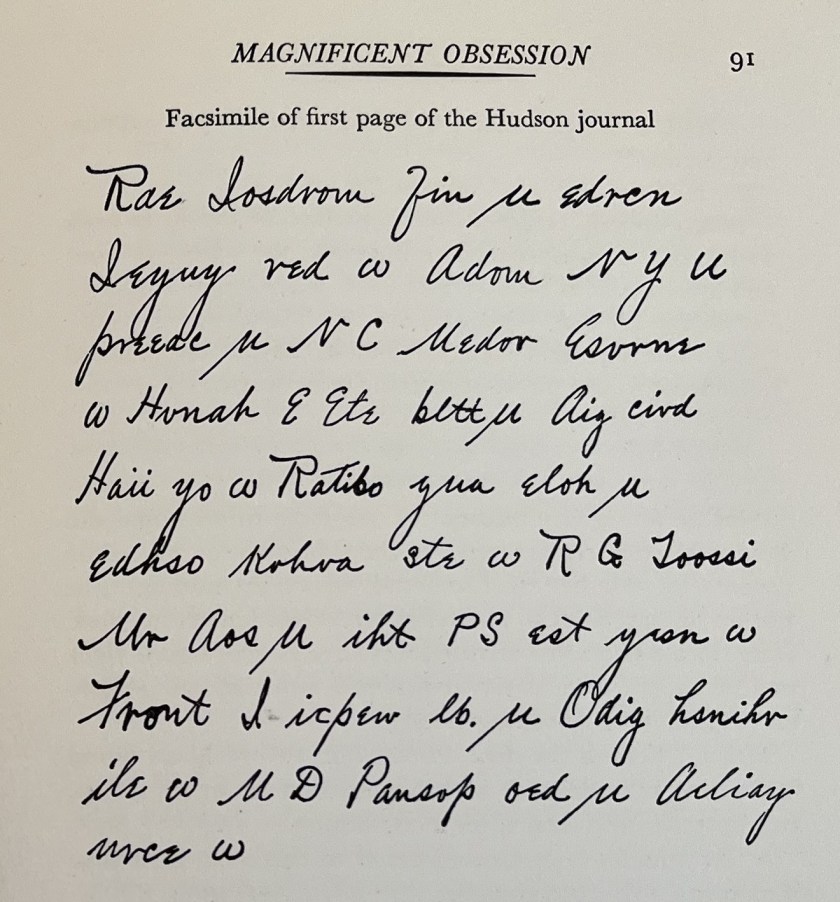
One interesting feature of the novel Magnificent Obsession is the fact that Doctor Hudson’s journal was written in code, to prevent people from discovering his secret too easily. When Nancy Ashford presents the diary to Bobby Merrick, he is determined to crack the code. Here is the first page of it:

In Douglas’s Magnificent Obsession scrapbook, there is at least one critic who complains that the code is easy and that it takes Merrick much longer than necessary to decipher it. Personally, I wouldn’t even know where to start.

Nancy and Bobby figure out one thing immediately: Dr. Hudson used the last letter of the Greek alphabet, omega, to indicate the end of a line, and he used the Greek letter mu to indicate the halfway point. This was a clue to divide each line into two, like so:

As an example of Douglas’s skill as a storyteller, he has Merrick work on the puzzle so late into the night that he falls asleep at his desk. The next morning when the butler comes to call him to breakfast, he finds him like this, then goes down to the kitchen and tells the cook, “You lost your bet!”

“Drunk again?”

“Quite!”

After the accident that saved his life at the expense of Dr. Hudson’s, Merrick has sworn off alcohol. This is a humorous scene that shows the household staff jumping to conclusions, just like we all do in real life.

Later on, having no better ideas, Merrick tries separating the letters and shifting the second half of the line slightly to the right…

Although I still wouldn’t have seen it, Merrick realizes that the key is to take the first letter from the top line, the second from the bottom line, the third from the top, and so on. He comes up with this:

“Reader, I consider you my friend…”

This is just the beginning, of course. He still has to decipher the whole journal in order to learn the secret that Dr. Hudson worked so hard to conceal. But this is just one example of the way Douglas keeps us in suspense.

When reviewers mentioned the code, they usually included it as one of the interesting features of the book. Some complained about it, however.

From The Congregationalist: “Dr. Douglas does, however, make a certain concession to the present age in surrounding rather simple and elemental Christian facts and experiences with an element of mystery and the occult. Our own judgment is that the diary of the famous surgeon which figures so prominently in the story would have been made both artistically and spiritually more effective if it had been plainly presented in simple English rather than in the unique code which, without the key that Dr. Douglas supplies, would have been difficult to decipher. However, Dr. Douglas probably knows his age and the unreadiness of the sophisticated to appreciate simple things simply stated.”

Lighten up! True, Douglas used the coded diary as a way of getting his audience interested, but there’s also a more basic truth here: a coded diary is fun. Douglas wanted us to enjoy reading Magnificent Obsession, and judging from the reviews in his scrapbook, many people did.

The message that Merrick deciphers is based on a page of scripture that is talked about but never entirely revealed. And that is another reason why Magnificent Obsession became “a publishing miracle.” I’ll tell you about that in my next post.

Publishing Miracle 6: Canada

by Ronald R Johnson

I’ve been explaining how the novel Magnificent Obsession became so successful after its publication in 1929. One factor that was especially serendipitous was the support Douglas received from Canadians.

As I noted in earlier posts, in the spring of 1929 Douglas and his wife Besse moved to Montreal, where he served as pastor of the St. James Church. This congregation was part of the United Church of Canada, a denomination that had been formed four years earlier from a merger of Methodist, Congregational, Presbyterian, and other churches in the Canadian provinces. As in earlier seasons of his life, Douglas’s influence spread well beyond the city in which he served. He was often invited to speak in Toronto and other cities in Ontario. He was well-received and was already well-known throughout that region of Canada by the time his novel was published in the fall of 1929.

Within the publishing realm, Canada was a separate entity from the United States. US publishers didn’t just distribute their books throughout the provinces as though they were extensions of the fifty states. Publishers had to form relationships with Canadian publishers and sign agreements with them to distribute their books within Canada.

As a small publishing house, Willett, Clark & Colby, the company that published Magnificent Obsession, had a very informal agreement with Douglas. There was no contract, per se. And they lacked any official relationship with Canadian publishers. So Douglas made his own agreement with the Thomas Allen Company in Toronto. Instead of just distributing the American version of the book, the Thomas Allen Company actually printed their own Canadian version. Although the text wasn’t different from the American version, the fact that the Canadian books contained the Thomas Allen imprint and said they were printed in Canada gave them the appearance of having originated within Canada rather than being an American import. And the misimpression this created turned out to be helpful to Douglas, for Canadians took special pride in what they perceived as Canadian books.

For example, in her column in The Sherbrooke Telegram, Anne Merrill was surprised that a local YWCA library in Sherbrooke, Quebec, didn’t have a copy of Magnificent Obsession on its shelves. She said, “Had this really great book been written by a man in the USA, high-powered salesmen would have been set to work on it, till it was pushed into the million class!” In other words, she thought it was a Canadian book written by a Canadian author, and she lamented that it wasn’t being hyped to the extent that it would have been if it had been published in America. In his scrapbook, Douglas drew a smiley face beside her comment.

A similar remark was made in the Calgary Daily Herald: “Seldom, if ever, has the fiction product of a Canadian author met with such sales success in the Canadian field in so short a time.”

As I said, this was a misimpression. Douglas was not a Canadian author. (Anyone who heard him speak would know instantly that he was an American. Having grown up in Indiana and northern Kentucky, he had that uniquely nasal Indiana twang.) But some Canadians thought he was one of them, and even those who knew better took pride in his connection with them as pastor of the church in Montreal. This boosted sales throughout the Canadian provinces in a way that did not ordinarily happen with American books.

In appreciation of this fact, Douglas would remain loyal to the Thomas Allen Company for the rest of his life, insisting on signing separate Canadian contracts with that publisher for all of his novels, instead of letting his American publisher work out arrangements in Canada.

Sales of Magnificent Obsession also benefitted from Douglas’s special connection to another influential interest group: the medical profession. I’ll tell you more about that in my next post.

Design a site like this with WordPress.com
Get started


