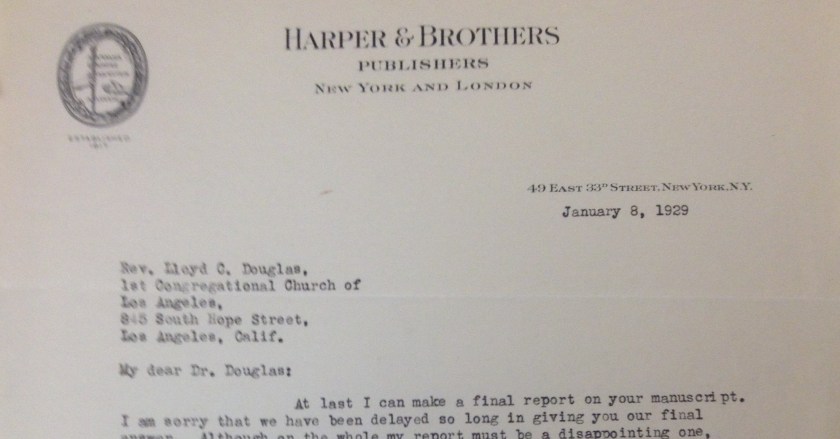
Harper’s Verdict

by Ronald R Johnson

Eugene Exman to LCD, 1/8/1929. In LCD Correspondence 1926-1930, Lloyd C Douglas Papers, Box 1, Bentley Historical Library, University of Michigan. The University of Michigan holds copyright.

Over the last dozen posts I’ve been talking about Lloyd Douglas’s work on a novel called Salvage during the summer of 1928 (what would later become known as Magnificent Obsession) and of Harper & Brothers’ attempts to make sense out of it. Douglas had put two very different genres together: a novel (specifically, a hospital drama) and a non-fiction treatise about the first few verses of Matthew 6.

In January 1929, Eugene Exman, Harper’s religion editor, gave Douglas his company’s verdict. Four members of the Literary Department had read the updated version and recommended against publication as a novel. They categorized it “between the manuscripts that were almost good enough to publish and those which were obviously important enough to publish.” In his earlier correspondence, Exman had used words like “good enough” and “important enough” to assess the book’s marketability, not its literary quality. Years later, he would claim publicly that the head of the Literary Department considered the book “second-rate fiction and not deserving of the Harper imprint,” but nothing was said about that in his letters at the time. If it was true, however, then it added an extra layer of complexity to Douglas’s task: although he was using fiction techniques to communicate his message, he was under no illusion that he could be regarded as a serious – much less, first-rate – novelist. That wasn’t what he was trying to do at this stage in his career.

True to his word, Exman then tried to publish the book as religious non-fiction. As Harper’s Religion Editor, he had the authority to do that. In retrospect, it seems like a strange move, since Douglas had clearly written the book in novelistic form; but if it was a choice between treating it as a religious book or not publishing it at all, Exman chose the former. But first, he had to get the opinion of an expert.

He sent the manuscript to an anonymous but “prominent” churchman. I’m going to hazard a guess here: it very well might have been Harry Emerson Fosdick. I say that for two reasons. First, because Exman was then a member of Park Avenue Baptist Church, where Fosdick preached while Riverside Church was being built for him. Second, because Exman was patiently trying to win Fosdick over to Harper from Macmillan, and he eventually succeeded. They published 17 books together. (Stephen Prothero, God, the Bestseller: How One Editor Transformed American Religion a Book at a Time (San Francisco: HarperCollins, 2023), p. 41).

But whether I’m right or not, Exman showed the manuscript to some “prominent” churchman, who in turn shared it with three other “very discerning people.” The clergyman rejected the book’s thesis and advised against publication on theological grounds. And with good reason, one might argue. The book seemed to promise worldly success. A lot of explaining would be necessary to translate the story into anything resembling traditional Christian theology. That was Douglas’s intention, of course: to speak the language of the unchurched and get them interested in Jesus without sounding like a preacher. But the prominent churchman that Exman consulted was unwilling to go along with it.

“Whether his point is well taken is not of such great importance,” Exman told Douglas. “The thing which concerns me is that the publication of the manuscript would not get his backing as well as the backing of the group in the church he represents.” Once again, the main obstacle was economic. Exman had reason to believe that the book wouldn’t sell.

In brief, then: Harper had carefully considered publishing the book, but the editors were uncertain whether it could meet their sales goal. Would it do better as a novel or as a religious tract? Their answer was, Neither.

Douglas had hoped to present the Christian gospel in practical terms and to spread his message to an audience far beyond the confines of the church. His book was an experimental piece of writing that could possibly help him attain that goal, but “possibly” was the operative word. Eugene Exman realized that the book was unusual, but he lacked evidence that the general public would recognize its worth. Without that assurance, he could not take the financial risk. “I really believe that it should be published,” he told Douglas, “although this may seem a paradoxical statement; I am sorry the imprint of our House will not appear on your book when it does go out.”

The situation was paradoxical indeed, for Eugene Exman, perhaps more than any other religion editor, went on to publish the books that would both create and give direction to what we now call the SBNR movement (Spiritual But Not Religious). Late in his career, he considered Douglas’s book the one that got away (Prothero, p. 276).

Thirsty Fish

by Ronald R Johnson

I told you in my last post that Eugene Exman, Religion Editor at Harper and Brothers, was working with the Literary Department in the fall of 1928 to get Douglas’s novel Salvage accepted for publication. In November, Douglas told Exman he had come up with a much better title for the book.

LCD to Eugene Exman, 11/15/1928. In LCD Correspondence 1926-1930, Box 1, Lloyd C Douglas Papers, Bentley Historical Library, University of Michigan. The University of Michigan holds copyright to this item.

“Not at any time have I been entirely satisfied with the name Salvage,” he told Exman. “By the time I had reached the third chapter, the book had outgrown the ‘salvage’ concept.” (And there was a reason for that: because the novel Salvage had now been combined with the thesis of his non-fiction book, Exploring Your Soul, making it an entirely different story than he had originally planned.) “I have hit upon a title now that will be sufficiently cryptic to be intriguing to the reader’s curiosity and yet significant enough to be entirely comprehensible to him in due time. I am calling the book…”

(Drum roll, please…)

“…Thirsty Fish.”

Exman must have blinked a few times before responding. “I must confess frankly that it doesn’t register at all with me.”

Nor with me. There is nothing in his private papers that tells us what the proposed title meant to him. Obviously, a thirsty fish is an oxymoron, for a fish lives in water. In reference to Bobby Merrick, the hero of the novel, was Douglas implying that he was surrounded by material wealth but was poor in spiritual things? Or that the spiritual help he needed most was all around him and he didn’t know it? We simply don’t have enough evidence to guess what Douglas had in mind.

The nearest thing to a clue comes from Douglas’s novel Forgive Us Our Trespasses, although that’s getting way ahead of the story. Near the end of that book, Dinny Brumm gets the idea for a novel called Thirst. It’s based on Ecclesiastes 12:6, in which the Hebrew writer advises remembering God before the time of adversity, “Or ever the silver cord be loosed, or the golden bowl be broken, or the pitcher be broken at the fountain, or the wheel broken at the cistern.” (Douglas was quoting from the King James Version.) The idea here is that the person becomes thirsty even unto death, because he no longer has a way to draw water from the well. But that seems like a very different idea from the image of a thirsty fish.

At any rate, Exman never forgot it. Years later, when he wrote an official company history, he included Douglas and his book as a comical sidenote and livened up the story by claiming that, from the very start, Douglas had sent him the manuscript with it already titled as Thirsty Fish (Eugene Exman, The House of Harper: One Hundred and Fifty Years of Publishing (New York: Harper & Row, 1967), 223.)

Meanwhile, Exman and his associates got down to work reading the updated manuscript. As I mentioned in a previous post, Douglas was in trouble. To avert disruption from a core group of conservatives in his congregation in Los Angeles, he had resigned, effective January 1929. He didn’t have any other positions lined up, and both of his daughters were now studying in Europe. He needed an income – immediately. The new book became more important than ever…

X-Man

by Ronald R Johnson

In the summer of 1928, after Lloyd Douglas had combined his novel Salvage with the non-fiction material he had been working up in Exploring Your Soul, he reached out to his most recent publisher to tell them what he was doing.

Douglas’s non-fiction book, Those Disturbing Miracles, had been published by Harper and Brothers the previous year. Since its release, Harper’s Religion Editor had died and was replaced by Eugene Exman, a young man who had recently earned a Masters degree in Religion from the University of Chicago; his mentor had been Shailer Mathews. Because of the influence Mathews had on Douglas early in his career, it seemed like a good fit. (For more information on Exman, see Stephen Prothero, God, the Bestseller: How One Editor Transformed American Religion a Book at a Time (San Francisco: HarperCollins, 2023).)

Exman was very interested in what Douglas was doing. But there was a problem. Because the book was technically a novel and he was the Religion Editor, he had to refer the manuscript to the Literary Department. And that’s where the problem came into sharper focus: what genre was this book?

It comes down to this: publishing is a business, and it costs money to print books and distribute them to bookstores. Publishers have to believe that they will recoup their losses before they agree to publish a book. In the case of Douglas’s earlier books, they fit neatly under the heading, “Non-fiction, Religious,” and his publishers knew exactly who would buy them: ministers. All they had to do was add up the number of ministers in North America who could reasonably be expected to buy the book, and that would tell them (roughly) how much revenue the book would earn. It wouldn’t be much, but that was to be expected for religious non-fiction.

In the case of this new book, however, it wasn’t clear who would buy it… or whether anyone would. In September 1928, Exman reported to Douglas that there was “a divergence of opinion” among the members of the Literary Department, “and this divergence of opinion [about the book] largely centers on the sale possibility it has…. We all agree that your manuscript does have literary merit,” he said, but they worried that it would not sell enough copies: “in its present form we cannot be sure that it is good enough to get out of the class of ‘just another novel.’” Despite that evaluative term “good enough,” the focus was on sales. “If… you could indicate in a conservative way what demand there would be for the book [in cities] where you have friends, that would also be of distinct help to us in making a final decision as to its publication.”

On an internal memo, William H. Briggs from the Literary Department confirmed that this was the main consideration. After typing a list of suggestions for improvement from a literary standpoint, he then wrote in pen, beside his initials, an estimate of potential sales: 500 to the religious trade and 1000 to members of Douglas’s past congregations. If it was going to be presented to the public as a novel, then their goal was to sell at least ten thousand copies. Beneath this he wrote “general trade” (the general public, in other words) but was unable to make an estimate. That was the point at issue. In order for the book to reach the sales goal, it would have to appeal to the public. Douglas had written the book with a wider audience in mind, but the editors at Harper were uncertain whether the general public would be interested in such a book.

This was the main issue. If Harper did agree to publish the book, would it be most successful if packaged as a non-fiction religious book just like his others, or as a novel? Exman told Douglas that he was strongly in favor of publishing it one way or the other, and that he would push to have it released as a religious work of non-fiction if it came down to that, but he advised Douglas to make the narrative changes that Briggs and others had suggested.

Over the next two months, Douglas made some of the requested improvements. He also changed the name of the story…

Design a site like this with WordPress.com
Get started