The People in the Pews at Ann Arbor

by Ronald R Johnson (www.ronaldrjohnson.com)

In the series of lectures Lloyd Douglas delivered at various universities as a representative of the YMCA, and in his “Sermonettes” in the Daily Illini (the student paper at the University of Illinois), we can glimpse Douglas’s emerging theology. There wasn’t a lot of meat to it yet, but one principle came through quite clearly: he believed that the new state universities were engaged in a day-to-day discovery of the truth.

Therefore, when he went back into active ministry in April/May 1915, it’s no coincidence that he accepted a call to be the Senior Minister at the First Congregational Church of Ann Arbor, adjacent to the University of Michigan. And what an opportunity this was! Many of his parishioners were members of either the faculty or the administration of the university. The list below is from a booklet Douglas published for university students in the fall of 1916. It’s available online; you can view it by clicking the following link: L.C. Douglas, Congregationalism at the University of Michigan (Ann Arbor: Michigan Congregational Conference/First Congregational Church, 1916).

Here are the members who were in some way connected to the university:

The booklet then went on to list the students who were members of the congregation, from sophomores through seniors, as well as graduate students. There were several hundred names.

I look at it this way: Lloyd Douglas did his best thinking at the typewriter. He always typed out his sermons, even though (by all reports) he delivered them extemporaneously rather than just reading them. As he typed, he was keenly aware of his audience. When he rehearsed his sermons, usually on Saturday afternoons, he must have crafted them with these people in mind: the faculty and administrators I’ve listed above, as well as the hundreds of students in the balcony. From his daughters’ testimony we know that, after the service on Sunday mornings, he and his wife and daughters would walk home without speaking, but as soon as they got home, he debriefed, telling his wife Besse the specific reactions he saw on his parishioners’ faces to this or that part of the sermon. (His daughters give us a vivid description of this in the opening chapter of their book, The Shape of Sunday: An Intimate Biography of Lloyd C Douglas (Boston: Houghton Mifflin, 1952).)

We also know that he was willing to change his mind, sometimes on very important matters, and that he usually did it by reflecting on something he himself had preached or published earlier. The progression followed this pattern: he would make a strong statement in a sermon or magazine article and then, on a later date, would disagree with that statement, sometimes even quoting what he had said on the earlier occasion, although he never told his audience that the person he was refuting was himself. He did this at a few key moments in his life, and (in my estimation) his later views were an improvement.

During his years at Ann Arbor, however, I believe we see this happening on a smaller, subtler scale. The years 1915-1921 were the core of Douglas’s education. He did some important thinking during this period, and he did it in full view of the faculty and administration of one of the Midwest’s most influential state universities. As he typed out his beliefs, he did so with this audience in mind, and when he delivered the message to them on Sunday morning, he was very tuned-in to their reactions, self-correcting as needed. The reactions of this audience were especially pertinent because he wasn’t just preaching the old, old gospel in the old, old way. He was trying to communicate the message of Jesus Christ to people on the cutting edge of twentieth century scholarship (both the sciences and the humanities) and bring it to bear on the lives they were actually living on weekdays. Although he was always trying to reach students, he now began to focus his energies especially on the faculty. They were the ones most on his mind as he prepared his sermons. (He told us this in his “Third Commandment” in an article called, “Ten Commandments for the College Church.” Click the link to see the article in full.) And by preaching to the faculty, he became more mature as a thinker and a representative of Jesus Christ to the modern world.

But he also knew he had a responsibility to reach the townspeople not involved with the university, and he did that, as well. I’ll tell you more in the next post.

For a free PDF copy of the booklet, The Secret Investment of Lloyd C Douglas, fill out the form below:

← Back

Thank you for your response. ✨

Douglas: A.M. Degree Means ‘Amused Myself’

by Ronald R Johnson (www.ronaldrjohnson.com)

By the Fall of 1914, Douglas had already stayed longer at the University of Illinois than his original contract had stipulated. He had agreed to give them three years (from Fall 1911 to Spring 1914). He ended up staying through the 1914 calendar year but left to be a pastor again in the early months of 1915.

In the months leading up to that move, he spoke to students at the University of Michigan a couple of times: first at a YWCA gathering (Y events were still segregated by gender) and then at a meeting sponsored by the university’s Student Christian Association (the SCA). The SCA event took place at the Majestic Theater in Ann Arbor. Although he was invited to speak to students, the First Congregational Church of Ann Arbor had a pastoral vacancy and was interested in him – and he was interested in them. The bio he sent to the event organizers is fascinating in light of that situation. He wasn’t just aiming at students; he knew this bio would be his self-introduction to the search committee at the Congregational Church and, to some extent, also to the larger community.

His bio began as follows:

“Lloyd C. Douglas, age 37, able-bodied but not husky. Ran 100 yards in college but never went to Olympic games in consequence. Member Phi Gamma Delta – worked harder on that than on calculus. Also manager of Glee Club, which took much time which might otherwise have been squandered on logic. Also managing editor of college paper, during which administration it was thought to be a humorous sheet – typographically, at all events. Managed to corral a degree of A.M., meaning, in this case, ‘Amused Myself.'”

This first paragraph shows how much Douglas changed while at the University of Illinois. When he introduced himself to the Washington, DC press corps, he wisely portrayed himself as a fellow journalist in order to win their acceptance and get them to stop focusing on the scandal he had inherited at the church. But now he was much more relaxed. His bio was written for students, of course, but it’s also consistent with the new style of writing he had developed, first as the anonymous author of the “Zom” ads in the Daily Illini, then as the creator of the “Weekly Sermonettes” in the Illini, and then as the writer (again anonymously) of the “Pen Portraits of Prominent People” in the Siren. He wasn’t just amusing himself; lots of others found him amusing as well.

But the bio continues. After disarming his audience with humor, then he gets more serious:

“Was minister eight years, after two years’ experience as police reporter on two Ohio dailies. Also lectured sometimes at Chautaquas (does yet when hard up). Also wrote some magazine stuff of an ethico-homileticallian character.” Sermons, in other words.

He’s still tongue-in-cheek, but he’s also touting his resume. He’s vying for the job and being nonchalant at the same time. There’s more:

“Last church held was in Washington, D.C., within three blocks of White House, attended by several people identified by other characteristics than such attendance. Has personal acquaintance with two or three men whose names have appeared in newspapers from time to time. Was member of the National Press Club.”

He’s got an impressive record for one so young, and he’s not afraid to show it. But he’s still got that “no big deal” tone of voice. When he mentions the “two or three men whose names have appeared in newspapers from time to time,” he’s talking about Champ Clark, the Speaker of the House, and Charles Hillis, who was President William Howard Taft’s Special Assistant. He may also be throwing in Gifford Pinchot, the conservationist, who sent Douglas a letter of thanks after he said kind words about Pinchot in a sermon. At any rate, Douglas was letting the people of Ann Arbor know that he was well-connected, but that it was “no big deal.”

He continues:

“Came to Illinois as religious work director in 1911 at the instance of John R. Mott.” In other words, the top man in the YMCA personally invited him.

“At the expiration of three years for which he had contracted, the local board asked him to stay as general secretary plus R. W. D. [Religious Work Director] This association is thought to have the largest paid membership of any student YMCA in the world.

“Has participated in evangelistic campaigns at universities of Wisconsin, Minnesota, Iowa, Iowa Ag., Penn State, and Michigan, besides many colleges.”

This bio appeared in the Michigan Daily, the student newspaper of the University of Michigan. Yes, he wrote it for students; but he also made sure he laid out his substantial credentials for anyone else who might be listening. The headline says it all: “SCA SPEAKER HIS OWN PRESS AGENT/L. C. Douglas Who Addresses Sunday’s Meeting Writes Own Publicity.”

He got the job. During his six years as pastor of the First Congregational Church of Ann Arbor (1915 to 1921), students packed the balcony, but professors and administrators were attracted to him, too. In fact, the church wasn’t big enough. They had to enlarge it.

I’ll tell you more about this very interesting congregation in my next post.

To receive a free PDF of the booklet, The Secret Investment of Lloyd C. Douglas, fill out the form below:

← Back

Thank you for your response. ✨

Briefly Presbyterian

by Ronald R Johnson (www.ronaldrjohnson.com)

When Lloyd Douglas resigned as pastor of Luther Place Memorial Church in Washington, DC, he had already made up his mind to change denominations. A year later, he did so. In a handwritten note on one of the pages of his 1909-1915 scrapbook, he wrote:

“On September 18, 1912, in a telegram to… the president of the Maryland Synod [of the Lutheran Church in America], I formally severed my connection with that Body and was unanimously elected on that same day to membership in the Presbytery of Bloomington [Illinois]…”

There is also a printed report of meeting minutes, stating that Douglas was received into the fold.

But other than teaching a Sunday School class for university students at a Presbyterian congregation in Champaign, he never actually served in the Presbyterian Church.

As I survey his career, I believe it was his plan all along to be a Congregationalist. As early as 1909, when he was a Lutheran pastor in Lancaster, Ohio, he was invited to lunch with Dr. Washington Gladden, the esteemed pastor of the First Congregational Church of Columbus.

Dr. Washington Gladden

Rev. Gladden was one of the leading social gospel preachers of his day. We catch a glimpse of just how highly he was respected when we read the letter of invitation from E. Lee Howard (dated July 14, 1909). It says, in part:

“It is the custom of the little coterie of Congregational ministers to gather informally in Dr. Gladden’s study every Monday at 11:30 o’clock, for an hour of good fellowship, after which we go to luncheon together. The Doctor is home this month, although several of the fellows are away. The Doctor is exceedingly cordial in his greeting to young ministers, and he was interested in the account which I gave of you the Monday after your address at Kenton. You will enjoy an hour with him very much, and if you will meet me at the Neil House at 11:30, we will go from there to the study in the church.”

How formal! “The Doctor”! “You will enjoy it very much”! And yet this must have cheered young Douglas a great deal, to be invited into this highly-cultured group of men (“the fellows”) and accepted as one of them. The visit itself was undocumented. We don’t know what happened. But the event must have made an impression on him, for in his final months as a Lutheran pastor (late 1910-early 1911), when he was already planning his next career move, he sent two article submissions to The Congregationalist and Christian World, a bi-weekly magazine. Both were immediately published. In the second one, the editor inaccurately referred to Douglas as “a Washington (DC) Congregational minister.”

Years later, he said that his work at the University of Illinois put him in touch with Congregationalists, although it’s not clear what he meant by that, since the YMCA introduced him to leaders from a wide variety of denominations and he had already made connections with Congregationalists. While in Champaign-Urbana, he continued to send article submissions to The Congregationalist and Christian World, and at some point (I’ve been unable to determine exactly when) he became good friends with Dr. Carl Patton, who was pastor of the First Congregational Church of Ann Arbor (adjacent to the University of Michigan) from 1900 to 1911.

Given all this, I’m not sure why he joined the Bloomington Presbytery. It did allow him to “sever” his relationship with the Lutheran Church while remaining a licensed minister, and perhaps he knew that Congregational search committees would accept a Presbyterian candidate. Especially since this happened at the same time that he taught Sunday School at the new McKinley Memorial Presbyterian Church – the erection of which was a pet project of Thomas Arkle Clark, who was one of the faculty representatives on the YMCA Governing Board – it was probably just a good opportunity to change his affiliation. At any rate, Lloyd Douglas was briefly (and inconsequentially) a Presbyterian. Just a little trivia for you.

Early in 1915, the First Congregational Church of Ann Arbor (where Carl Patton had been pastor for 11 years) extended a call to Douglas, and he accepted it. He remained a Congregational minister for the rest of his life.

His self-introduction at Ann Arbor was interesting, though. At Washington, DC, he had introduced himself to the press corps as a former reporter. The way he introduced himself to the people of Ann Arbor was quite different. It shows how much his experience in Champaign-Urbana had loosened him up and made him more humorous and nonchalant. I’ll tell you about that in the next post.

To receive a free PDF of the booklet, The Secret Investment of Lloyd C. Douglas, fill out the form below:

← Back

Thank you for your response. ✨

Douglas’s “Pen Portraits of Prominent People”

by Ronald R Johnson (www.ronaldrjohnson.com)

Besides contributing a weekly column in the University of Illinois’ student newspaper, the Daily Illini, Lloyd Douglas also wrote anonymous articles in The Siren, a student-run magazine. During the 1914-1915 school year, he wrote a series of tributes to the university’s top administrators, describing their distinctive characteristics (hence the name “Pen Portraits”). It was just like Douglas to give the series a memorable title through the use of alliteration: “Pen Portraits of Prominent People.”

Dr. Edmund James, President of the University of Illinois from 1904 to 1920.

Dr. Edmund James is remembered as one of the university’s successful presidents, helping to bring about the school’s growth, not only in its physical plant but also in its reputation. (See, for example, Robert P. Howard, Illinois: A History of the Prairie State (Grand Rapids: Eerdmans, 1972), p. 404, and Allan Nevins, Illinois (NY: Oxford, 1917), pp. 210-218.)

In his Pen Portrait of the “Prexy” (the nickname for “President”), Douglas called James “a cosmic person whose resourcefulness will not be fully understood” until decades later. “For the Prexy is living in the future…. [He] turns out early these fine mornings on his saddle-horse and as he rides about the campus he sees great buildings that aren’t there at all. But they’re real enough to him! He guides his horse carefully around them and peoples them with thousands of students who have yet to be born.

“However, living away out yonder as he does – a dozen decades beyond tomorrow – the Prexy is mightily interested in today. He has his fingers on the pulses of all the colleges that make up the University – very steady fingers, too, when one remembers that the Prexy is venerable in years. He knows what grade of steel and concrete is going into the new Chemistry laboratories; knows how much Pat O’Brien earns per hour, shoveling dirt out of the hole where the Administration Building will stand; knows the name of the last new book that came into the library yesterday.

“He has just one obsession…. the future greatness of the University of Illinois!”

Thomas Arkle Clark, the Dean of Men.

Thomas Arkle Clark, the Dean of Men, was and is a legend. When I spent a few days at the University of Illinois archive in 2015 and asked the librarian to get me his private papers, she was thrilled. “Are you going to write a book about him?” “No,” I told her. “I’m writing about the bestselling novelist Lloyd C. Douglas.” “Oh,” she said, looking very disappointed.

Somebody needs to write a book about Thomas Arkle Clark; it’s well overdue. They say that, during Prohibition, he broke up a party at a frat house by coming down the chimney like Santa Claus. Of course, it didn’t happen – it couldn’t have happened – but stories like that were told and retold even while he was still alive because they caught the essence of the man. In his Pen Portrait of the Dean (whom he refers to as “Tommy”), Douglas says:

“It is confidently asserted of Tommy that he can flay his victim and nail his quivering pelt to the mast with greater ease and dispatch than any other skinster between the Aurora Borealis and Palm Beach. Moreover, the flaying is achieved so deftly and with such a wealth of good humor that the hideless one rejoices over his… condition, regretting that he has only one skin to give to his executioner….

“Perhaps there is no place in all this world where a man is so courteously invited to build his own scaffold, make his own funeral arrangements, adjust his own black cap and kick himself through the trap, as in the pleasant room of vast distances where Tommy sits day by day, calmly and dispassionately dealing with a docket full of the delinquent and deficient.

“It is mostly a court of reprieves. Tommy only hates one type – the liar. If one has business with the Dean o’ Men, it is better to tell him the truth at once, thereby saving time and self-respect. It is privately believed in certain quarters that Tommy has an X-Ray attachment in the top rim of his glasses and that when he lowers his head to gaze over them, he can see what the culprit had for dinner…”

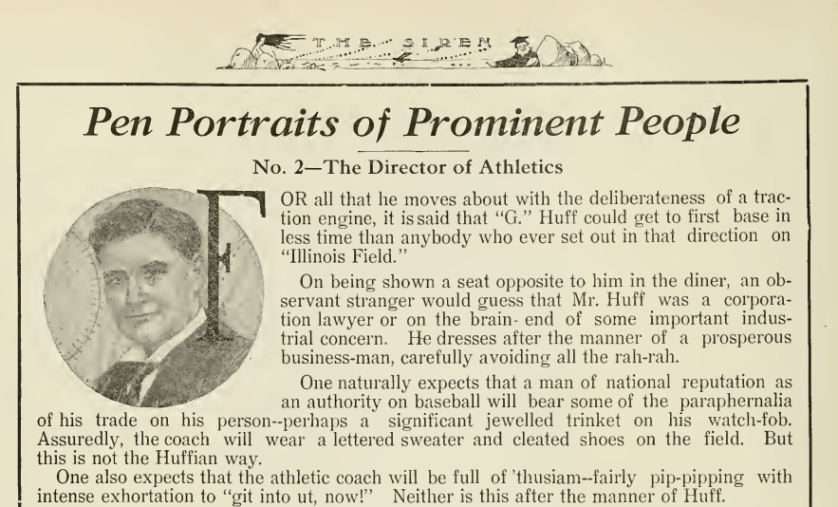
Douglas wrote about “G. Huff,” the Athletic Director…

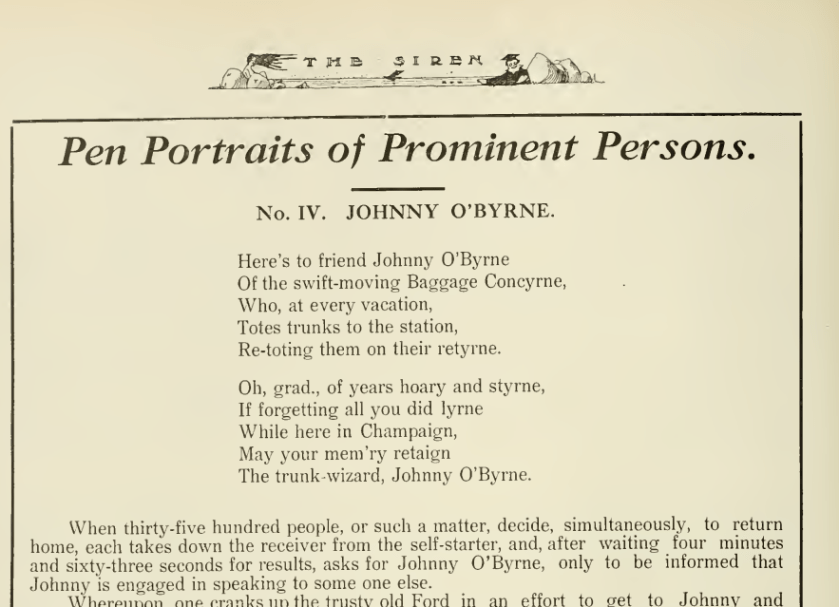
…Johnny O’Byrne, the baggage guy at the local train station…

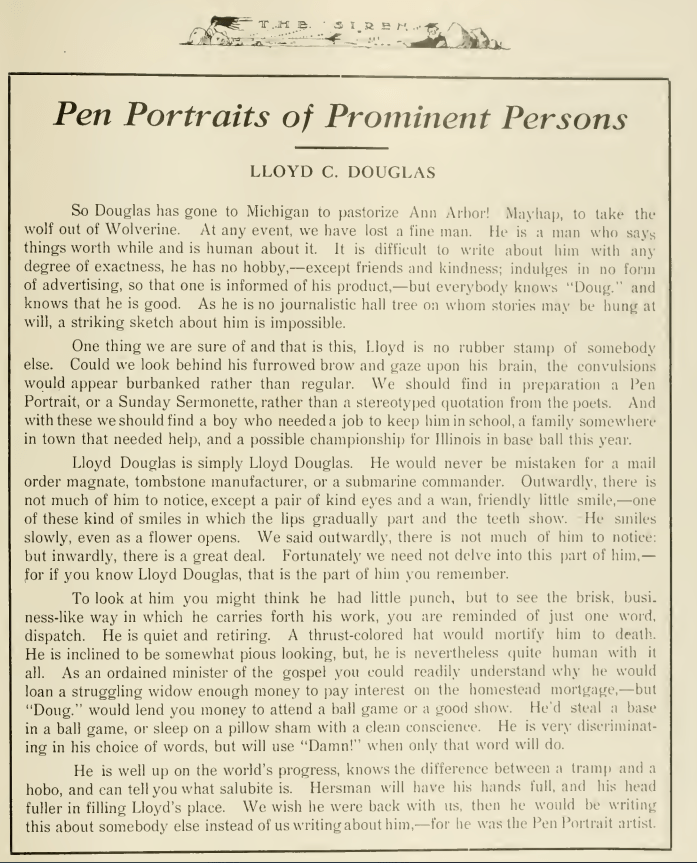
…Eugene Davenport, the Dean of the School of Agriculture, and other people well-known to students and faculty. Each essay was fun, imaginative, and full of life. Not religion, but life. As I mentioned earlier, they were also published anonymously. Month after month, everyone on campus must have speculated about who wrote them. This was during the 1914-1915 school year, and in the early months of 1915 Douglas left to become pastor of the First Congregational Church of Ann Arbor (in Michigan). The student editor of The Siren, Ralph Barlow, wrote the final “Pen Portrait” himself, and it was a tribute to Douglas.

I’ve included an image of the complete essay below, because it’s full of first-hand observations of Douglas. It also must have been the talk of the school, because of the concluding sentence: “We wish he were back with us, then he would be writing this about somebody else instead of us writing about him – for he was the Pen Portrait artist.”

But even though he was becoming better at writing for secular audiences, Douglas still felt the call to be a pastor. While he was at the University of Illinois, he was working on that, too, behind the scenes. I’ll tell you about that in the next post.

To receive a free PDF of the booklet, The Secret Investment of Lloyd C. Douglas, fill out the form below:

← Back

Thank you for your response. ✨

A New Start

by Ronald R Johnson (www.ronaldrjohnson.com)

Lloyd C Douglas, circa 1911-1912. From a promotional brochure in his 1909-1915 scrapbook.

Something happened to Lloyd Douglas between 1912 and 1913. In the previous post I told you that, in 1912, he invested secretly in Roger Zombro by writing anonymous ads for him in the Daily Illini. Neither of the two men ever mentioned it, but I have a lot of evidence to back up that hypothesis. (I have included it in the booklet The Secret Investment of Lloyd C Douglas, available upon request.) Of all the evidence I have gathered, the most important is this: Douglas’s writing style changed between 1912 and 1913, the exact period during which the anonymous “Zom” ads began running in the student newspaper.

Douglas had always been a powerful writer, but his earlier essays were intense. His sense of humor shined through, too, but overall he came across as a very serious young man. In the fall of 1913, though, he began displaying a more relaxed, whimsical style that would characterize his writing for the rest of his life. He was still a powerful writer, but he exercised that power in a new way: through a nonchalant, humorous presentation somewhat like that of Mark Twain. Prior to this, he reached out and grabbed you by the lapels with his writing, but now he disarmed you with humor and casually persuaded you. I believe it was his anonymous work on the “Zom” ads that gave him this breezy new way of expressing himself; but even if I’m wrong about the cause, the effect is obvious. In 1913, Douglas found his voice as a writer.

And there was something else: prior to this, Douglas’s writing was religious. It was church-oriented. In 1913, he put that behind him. He spoke as one who was deeply acquainted with the day-to-day lives of real people, both students and faculty. He focused on the things that mattered to his readers.

We see his new style exhibited in a weekly column he wrote in the Daily Illini called “The Sunday Sermonette” (later changed to “The Weekly Sermonette”). He doesn’t sound like a young man anymore; he sounds like a wise older man with a sense of humor and a very light touch. There were flaws in these “sermonettes” – they were often paternalistic and somewhat patronizing – but they were popular and down-to-earth, and they set a course for all of his future writing. For example, when he moved to Ann Arbor, Michigan, in 1915, he started writing a weekly column in one of the local newspapers called, “The Saturday Sunset Sermonette,” aimed more at the townspeople than the students. The “sermonettes” in the Daily Illini set the pattern.

Here are some examples from the Daily Illini column:

On writing home to Mother: “If you wish to make a distinct hit with her, tell her how you are faring as to creature comforts. Since you came upon this planet, her chief concern has been your physical well-being. She was always glad, of course, when you exhibited any interest whatever in the development of your mind or the culture of your soul; but her first thought for you has always been cast in terms of food, clothes, shelter. Tell her where you are living. Draw a map of the house, showing the position of your room. Draw a diagram of the room, indicating doors, windows, closet, registers, book-cases – where you sit when you study, etc.” (“The Letter Home,” Daily Illini, Sunday, September 28, 1913, p. 4).

On rags-to-riches stories: “Reacting against an ancient notion that a man must be hereditarily rich and influential to achieve greatness, book markets of our country are glutted with biographies of eminent men who came up into positions of trust and honor from homes of poverty…. In view of the highly prosperous state of our civilization, perhaps it might be just as well to ease up a bit now on advice for the poverty-stricken and make some effort to provide an inspirational pabulum upon which the rich man’s son may feed” (“Washington,” Daily Illini, Sunday, February 22, 1914, p. 4).

On hanging out with the crowd: “The student who fails to provide for an occasional hour by himself becomes about as original and inventive in his thought and speech as the funnel of a phonograph” (“The Man Himself,” Daily Illini, Sunday, October 5, 1913, p. 4).

On rushing around campus, taking oneself too seriously: “Many people here, students and others, are afflicted with a ‘busy’ bee. They maintain the breathless attitude of one who leaps from an engagement brimful of crisis to another even more fraught with fearful consequences…. Cold-blooded as it sounds to say it, the world was hobbling along – handicapped, to be sure, but managing to struggle painfully along – before any of us arrived and it is… possible that the world may continue to do business when the grass is a foot high over the place where our tired bodies rest from their frenzied scramble to attend to so many important things at once” (“How Doth the Little Busy Bee?” Daily Illini, Sunday, April 26, 1914, p. 4).

These are just a few examples. A little later (the 1914-1915 school year), he also began writing “Pen Portraits” of the university’s top administrators. As with the “Zom” ads, he published them anonymously – only this time his identity was revealed. I’ll tell you about it in my next post.

To receive a free PDF of the booklet, The Secret Investment of Lloyd C. Douglas, fill out the form below:

← Back

Thank you for your response. ✨

Behind the Scenes

by Ronald R Johnson (www.ronaldrjohnson.com)

At the University of Illinois, Lloyd Douglas worked at the new YMCA Building on the northwest corner of Wright and John streets, at the western edge of campus. He taught classes, wrote anonymous articles about the Y for the Daily Illini (the student-run newspaper), tried to get students to join the Y, and organized events featuring visiting speakers (most notably the organization’s leader, John Mott). Although he was busy, he was surprisingly low-key. He wasn’t in the news nearly as much as he had been as a pastor in North Manchester, in Lancaster, and in Washington, DC.

And there was a reason for that: Douglas had taken this job to get out of “active ministry” for a while and think things over. But he wasn’t the kind of man who needed to get completely away from it all in order to ruminate; rather, he did his best thinking when he knew he had to answer to the public, especially on a deadline. He no longer had to compose two sermons each week (for a.m. and p.m. services on Sundays), but he still wrote articles for religious periodicals (The Congregationalist now, instead of the Lutheran Observer), and he still taught classes at the YMCA and spoke at “smokers” designed to increase YMCA membership. (The university Y shamelessly imitated the fraternities, inviting young men to come and see a “lantern show” of Ben-Hur, for example, and hear an inspiring talk by Lloyd Douglas while enjoying a dessert and cigar.)

The newly-erected YMCA Building at the University of Illinois. Note the horse hooked up to the hitching post. From The Promise of Association: A History of the Mission and Work of the YMCA at the University of Illinois, 1873-1997 (Champaign, IL: University YMCA, 1997)
The same structure today. It’s no longer the YMCA Building, though; it’s Illini Hall. I took this picture in February 2015. There were no horses parked out in front.

But he wasn’t nearly as much in the public eye as he had been from 1903 to 1911. He spent time at the library across the street (that’s not a church steeple in the image below; it’s the campus library)…

…and he soaked up the campus culture. He spent most of his time with students, of course, but he was especially impressed with the faculty. Years later he wrote, “I had some exceptional opportunities to develop along the line of a liberal interpretation of religion during my work at the University of Illinois, where I came constantly in contact with a forward-looking group of very intelligent people who comprised the first sizable party of persons I had ever known who were both mentally solvent and religiously inclined. Up until that time only an occasional man of my acquaintance had qualified as [a] high grade intellectual and disposed toward a devout interpretation of religion. I discovered that it was possible for a man to be both religious and preserve his intellectual morality” (Douglas to Dr. Frank C. Ransdell, December 15, 1927. In Douglas Papers, Correspondence 1926-1930, Box 1, Bentley Historical Library, University of Michigan).

The most important work Douglas did at the University of Illinois was behind the scenes. He talked to people, and listened, and studied, and thought. Our best glimpse of the shifts in his theology comes from newspaper articles about the series of lectures he delivered at other universities during the second semester of the 1911-1912 school year. I’ll tell about that in the next post.

To receive a free PDF of the booklet, The Secret Investment of Lloyd C. Douglas, fill out the form below:

← Back

Thank you for your response. ✨

What Douglas Wanted Most

by Ronald R Johnson (www.ronaldrjohnson.com)

Sometime while he was pastor at Luther Place Memorial Church in Washington, DC (between Fall 1909 and Summer 1911), Lloyd Douglas preached a sermon that must have puzzled his parishioners (Lloyd C Douglas, The Living Faith (Boston: Houghton Mifflin, 1955), pp. 14-21).

He claimed that the local congregation was like the Bethesda Pool in the fifth chapter of the Gospel of John. Paralyzed people gathered on porches around the pool because it was rumored that an angel sometimes stirred up the waters, giving them momentary healing powers; the first to wade in would be made whole. Of course, those most in need were never able to reach the water first. “Some of our churches are like that Pool of Bethesda,” he argued. “They are handsomely equipped…. But there seems to be such a noticeable lack of provision for bringing in just the people who are in such obvious need of its curative agencies.”

It was not enough for the churches to welcome visitors, he said. There had to be a way to get the gospel out to people rather than just trying to bring them in. The members of Luther Place Memorial Church must have wondered what Douglas was talking about, because Douglas’s predecessor, Dr. J.G. Butler, had been very effective at reaching out to the larger community, not only by being chaplain of both the House and the Senate, but also by mentoring young black men who were called to ministry. The church even had a health clinic run by one of Butler’s sons, who was a doctor. So why was Douglas saying that the church needed to find a way to get its “curative agencies” out to the people who needed it most?

Because Douglas wasn’t talking about social programs. He was talking about accessing the power of God and putting it to work in our lives, and he was saying that the church had not yet found a way to get this access out to the people who would never come to church. For him, the gospel was not so much about church attendance as about harnessing divine energies to make the world a better place. The mission of the church was to get that power into people’s hands – even people who did not attend church. In his sermon on the Bethesda Pool, he said that, if he knew how to accomplish this, then “by next week I would be figuring in headlines an inch high in a thousand metropolitan papers.” Although this was an expression of youthful hyperbole, it shows just how important this issue was to Douglas. He wanted to articulate a gospel that would have practical effects in everyday life, and he insisted on taking that message to the larger public.

Although no one who heard that sermon probably realized it, he was telling them the thing he wanted to accomplish above all else. And the missing puzzle piece was this: he wanted to reach people outside the church through his writing.

Although his parents groomed him for the ministry from a young age, he seems to have sensed an even deeper calling to be a writer. Nor did he just want to publish sermons and religious essays. For as far back as his scrapbooks take us, he was kicking around the idea of writing something for the mass reading public, and what he had in mind was fiction. In his letters to friends and family, he made light of this aspiration, calling himself “a scribbler” and speaking as though his passion for writing were an addiction.

In a letter to his cousin Edith Kirkwood in 1910 (while he was pastor at Luther Place), he said, “Lately I have revived an old slumbering passion for writing yarns. Not long ago I sold a small ornament off my desk to Eddie Bok [an editor] and the sight of that check, with its beautiful corrugated edges – albeit it was not for more than two figures – started up my old trouble; and the gnawing at my vitals… has compelled me to scribble some more. God help the preacher who isn’t content to stick to his parish duties!… I have a lot of old mummies in my ecclesiastical museum who would feel that Hell had opened up its maw (and its paw, for that matter) to embrace me, were the news to out that I had disgraced the profesh and besmirched the cloth by writing fiction. I shall spare them the discomfort by seeing to it that nobody finds out. I am now on the hunt for a satisfactory nom-de-plume…” (Quoted in Virginia Douglas Dawson and Betty Douglas Wilson, The Shape of Sunday: An Intimate Biography of Lloyd C Douglas (Boston: Houghton Mifflin, 1952), p. 66.)

In 1910 he was willing to keep his fiction writing a secret by using a pen name, but a year later, when the YMCA offered him a job and a chance to say “Good riddance” to the “old mummies,” that seemed like a better plan. As it turned out, he didn’t tell his employers at the Y that he was writing fiction, either, but that was all right; his fiction wasn’t good enough to display yet. At this phase in his life, he had a lot to learn about the craft of writing fiction. The point is this: his devotion to “scribbling” went so deep, he couldn’t beat the addiction, even though he felt guilty about indulging in it while being a man of the cloth. But deep down, he always believed he was going to make it as a writer. It may seem like a small thing, but take a look at the opening page of his very first scrapbook in 1903.

That’s more than a signature; if I’m not mistaken, he was practicing his autograph – the same one he used years later to sign copies of his bestselling novels. Here’s a signed copy of the inside page of Forgive Us Our Trespasses, published almost thirty years later, in 1932. It is practically identical:

Lloyd Douglas the Author was always there in germinal form, even while he was working so hard to establish himself as a minister. And he obviously felt those two things were incompatible, at least in the minds of some of his parishioners.

Over the past several blog posts, I’ve addressed the question, “Why did Douglas resign his important post at Luther Place Memorial Church to work for the YMCA?” So far I’ve answered this question in bits and pieces, but now I’m ready to pull it all together into a coherent explanation.

Douglas resigned for many reasons, most of which he kept concealed. He wanted to go back to school and get the kind of education he could only get from a state university. At that institution, he wanted to rethink his theology and align it with the latest, most up-to-date information available. Pursuant to this goal, he wanted to leave the Lutheran Church and start fresh with some other denomination. And he wanted to do all this not only so that he could preach again, but – more importantly – because he wanted to write something… probably fiction. He couldn’t quite put his finger on it. If anyone had asked him in 1911, he would have been incapable of telling them what he had in mind. But he did have something in mind, and he sensed that he would never bring it to full expression unless he could shed his current social limitations and start over.

And that’s why Lloyd C Douglas moved his family west to Champaign, Illinois in the Fall of 1911. He had great hopes. But he was taking a tremendous risk.

For a free PDF of the booklet, The Secret Investment of Lloyd C Douglas, fill out the form below:

← Back

Thank you for your response. ✨

Brave New World

by Ronald R Johnson (www.ronaldrjohnson.com)

The University of Illinois

When Shailer Mathews traveled the United States to tell the general public about the new biblical scholarship being done at the University of Chicago and elsewhere, his message included a description of the new state-college system that was transforming the social landscape in America.

It had been happening all around us, he argued, and yet we were strangely unaware of it. During the Civil War, Congress had passed legislation mandating that each state set aside lands and funds for colleges, and the state-sponsored schools that resulted were quite different from the colleges and universities that had been in existence prior to that. The old colleges and universities were sponsored by religious organizations and taught a fixed body of knowledge that was assumed to be true for all time. These new schools were research institutions. The professors were engaged in state-of-the-art research, and teaching was secondary. This had a number of ramifications, but perhaps the most important, according to Mathews, was the fact that the teachers and the students in these schools looked at the world through new eyes. Part of the new worldview was a belief in the tentative nature of knowledge: since the members of the faculty were constantly making new discoveries, they taught their students to expect updates, at least once in a while if not constantly. Graduates of these institutions went out into the world with the tools to keep learning throughout their lives. And as they did so, and they participated in the workplace, especially in management and professional positions, they were transforming their society.

This brave new world they were creating was one in which facts were of supreme importance – not opinion, not feelings, not beliefs, but facts. Those facts were gathered systematically, according to procedures that, as much as possible, were developed to mimic scientific investigations. The old institutions of learning had stressed literature, history, and philosophy; the new institutions were – or at least strived to be – scientific. And the young people who graduated from these new schools were quietly changing the world.

Of all the things Mathews said, this touched Douglas most deeply. Douglas had been home-schooled. His mother and father were both educators, and they gave him a rigorous classical education: in other words, an education that emphasized literature, history, and philosophy (or in his case, theology). On more than one occasion, he hinted that he was not very happy with the education he received at Wittenberg College (a Lutheran institution), and he was especially critical of the seminary, saying it did not give him any of the hands-on training that was necessary for being a pastor. When Mathews talked about the new state universities and the influence they were having on American society, Douglas’s imagination soared. He not only wanted to understand what was happening in the state colleges; he wanted the kind of education they offered. Although he was in his late thirties, he wanted to go back to school.

When the YMCA told him they had created a position for him at the University of Illinois, it was an offer he couldn’t refuse. Sometime later, when he was a pastor in Akron, he looked back on the years 1911 to 1921 and said, “I came to you from an experience of about ten years spent upon the campuses of two great universities [Illinois and Michigan], where I daily faced the new problem of a readjustment in religious thought, to make it consonant with the more recent disclosures of the philosophical and scientific world” (Lloyd C Douglas, The Living Faith (Boston: Houghton Mifflin, 1955), p. 80).

Although Douglas was going to Illinois to evangelize students, his personal desire was to go back to school. It was a win-win situation for him.

But I still haven’t given you the whole picture on why Douglas left Luther Place Church to work for the YMCA. There was another factor involved, and it was more important than any of the others I’ve told you about so far. I’ll explain in my next blog post.

For a free PDF of the booklet, The Secret Investment of Lloyd C Douglas, fill out the form below:

← Back

Thank you for your response. ✨

Shailer Mathews

by Ronald R Johnson (www.ronaldrjohnson.com)

Shailer Mathews

Sometime while the Douglases were living in Washington, DC, they attended a series of lectures by Shailer Mathews, Dean of the Divinity School at the University of Chicago.

I have been unable to pinpoint where or when they heard him speak. It could have been anywhere in the vicinity, including New York City, and it could have been anytime between Fall 1909 and Summer 1911. Besides his duties at the university, Mathews traveled around the country explaining the new principles of biblical scholarship to the general public. In his autobiography, he says he gave more than 150 speeches all over the US in the years immediately after 1896 (Shailer Mathews, New Faith for Old: An Autobiography (NY: Macmillan, 1936), p. 83.) In these lectures, he pulled no punches. He told the public about the scholarly work being done on the Bible, much of which was difficult for laypeople to hear because it cast into doubt many of the old beliefs about how the biblical books were compiled. (For example: the assertion that the gospels of Matthew, Mark, and John were not actually written by the biblical characters Matthew, Mark, and John, nor were the first five books of the Old Testament written by Moses.)

We don’t know when Lloyd and Besse heard Mathews speak. This much we know: his lectures changed Douglas’s life. The point at issue, however, is precisely how Douglas’s life changed.

In their book about their father, Douglas’s daughters tell us this about Lloyd and Besse’s experience while living in Washington, DC:

From every direction new and revolutionary ideas rushed at them, rocking the solid beliefs they had never dreamed of questioning. They began to read books and articles of churchmen who were openly criticizing the old theories of religion. They found themselves in sympathy with the new protest against tradition. Not only was religion being held up and examined for mothholes, but in Washington they discovered that all the traditions of American life were undergoing a great change in which only a few scandalizing rumors had ever penetrated the old walls behind which they had been raised.

Together they attended a series of lectures given by Shailer Mathews, an exponent of religious modernism, which left them in a most distressed state of mind. They recognized the reasonableness and were forced to agree with the attack upon the old conceptions, but they heard nothing satisfying which they could grasp to fill the void.

“Daddy became very unsettled in his thinking while we were in Washington,” Mother told us.

She found comfort on one subject at least. Dr. Holt’s book The Care and Feeding of Children, had been a treasure of information to replace her shockingly old-fashioned ideas on child care. “Sometimes I used to wish we could find a book so sane and satisfying on the Care and Feeding of Faith.”

Virginia Douglas Dawson and Betty Douglas Wilson, The Shape of Sunday: An Intimate Biography of Lloyd C Douglas (Boston: Houghton Mifflin, 1952), p. 68.

I read this book years before I first arrived at the University of Michigan’s Bentley Historical Library, where Douglas’s private papers are kept. When I began researching his papers, this was my working thesis: that Douglas had undergone a crisis of faith after attending the Mathews lectures, and that was why he left the Lutheran ministry. To my surprise, however, I could find nothing to corroborate Besse’s description of his mental state after hearing Mathews’ lectures. Eventually I found it necessary to modify that thesis, based on my own research.

I realize that no one was closer to Douglas than his wife, but I have come to believe that her testimony reflects her own reaction much more than it does her husband’s. For a number of reasons, I do not believe that Douglas suffered a profound crisis of faith after hearing Mathews speak. The lecture series did change his life, but not exactly in the way that his daughters claim it did.

There are a couple of very basic facts I need to tell you about Lloyd Douglas before I continue. First, he kept no diaries. Everything we know about his inner state (his thoughts and feelings), we have from his writings. I don’t just mean his published writings; his letters to friends and family are so extremely candid that I’m sure he’d be embarrassed if he knew that they are now available for anyone to read. The unfortunate thing is that, in his letters, Douglas is usually humorous. Whatever his spiritual experiences may have been from day to day, he didn’t express them to other people. And since he didn’t keep diaries, that means we know almost nothing about his inner life.

I can find only one time he ever tried to start a diary, and he only did it for a day or two before he gave up. It was during his first trip (with Besse) to Europe in the 1920s. Why did he give up? Because at the end of each day of exploring, he was so busy writing letters home to his daughters that he didn’t have time to write in his diary. However, in those few pages we get a glimpse of him that we get nowhere else. He tried to describe how he felt pushing off to sea. This was a voyage he had dreamed about for most of his life, and when the moment came, it was mystical. In his letters to his daughters, he never mentioned this. His letters are filled with humor; they contain no hints of any mystical experience. And since those few pages comprise the only diary he ever wrote (as far as I can tell), I can only surmise that we will never know what his spiritual life was really like.

The second basic fact we need to realize about him is that he did most of his thinking at the typewriter. When he was perplexed, he worked it out by hammering away at the keyboard. Then he pulled what he had written out of his typewriter and either presented it from the pulpit (if it was a sermon) or sent it off to an editor (if it was a magazine article), or put it in an envelope and sent it as a letter to a friend. Although his spiritual life is mostly hidden from us, his intellectual life was extremely well-documented. We can trace his thinking by reading his sermons and speeches, his magazine articles, and his correspondence. And when I do that, I find a direct line of thought, uninterrupted by any crisis of faith. He did lose faith in his denomination, but not in God.

The Shailer Mathews lectures seem to have stimulated his thinking rather than troubling him. Douglas already knew the biblical problems that Mathews raised (for example, discrepancies in the accounts of Jesus’ resurrection among the four gospels). Douglas himself had mentioned those same biblical problems in some of his earliest magazine articles during his first couple of years in the ministry, and even in those early articles, he was already pointing in the direction that his thought would go later on. Nowhere do I see him faltering, either during his pastorate in Washington or during his years with the YMCA. Douglas didn’t have a faith crisis, but Shailer Mathews did challenge him to do some serious rethinking. And in order to do so, he knew he needed to get out of his role as a pastor, especially within the Lutheran Church.

He wrote these words in his last article for the Lutheran Observer, just after leaving Washington:

“I used to think that if I could just get out of the active pastorate for a week or two and hie myself away where I wouldn’t need care very much whether my constituency understood my motives or not, and take careful aim and bang away at two or three things that everybody knows need to be ventilated, what a glorious, albeit smellful, event it would be.

“From this safe angle then I modestly pull the trigger, fondly hoping that all who are in the vicinity of the target will promptly squeal in order that we may be able to check up on the efficiency of our marksmanship.”

These were not the words of a man who was “very unsettled in his thinking,” and certainly not one who was “in a most distressed state of mind.” These words evinced a deep confidence in his own ability to formulate a better theology if he could cut loose from the social obligations that were tying him down. That’s why he accepted the position with the YMCA: because he wanted to start over, rethinking his entire theology without having any denominational restrictions placed on him, and without having to answer to his parishioners.

But Douglas had another huge takeaway from Shailer Mathews’ lectures that no one has ever mentioned. I’ll tell you about that in my next blog post.

For a free PDF of the booklet, The Secret Investment of Lloyd C Douglas, fill out the form below:

← Back

Thank you for your response. ✨

Leaving the Lutheran Church

by Ronald R Johnson (www.ronaldrjohnson.com)

The Augsburg Confession

Lloyd Douglas resigned as pastor of Luther Place Memorial Church in July 1911, effective September 1. He told his congregation he was leaving to serve the YMCA at the University of Illinois. And that was true, but it was only part of the truth. Another part of it was that he felt an immediate need to leave the denomination.

Douglas had been a Lutheran all his life. When he was very young, his father A.J. Douglas was a Lutheran pastor. Prior to that, A.J. had been an attorney and then a school superintendent, and he had met and married the wife of his old age – Lloyd Douglas’s mother – when she was teaching at his school. Lloyd Douglas had siblings who were a generation older than he was; they were A.J.’s children from a previous marriage, and their mother had died, leaving A.J. a widower until he met Lloyd’s mother. A.J. had promised the Lord that he would be a minister, but he didn’t make good on that promise until he was old. As compensation, he groomed his youngest son for the ministry. A.J. took the boy with him as he made his rounds to see his parishioners and to preach at the multiple small-town churches under his charge. From as far back as Douglas could remember, he had sat beside his father in their horse-and-carriage as A.J. went on his rounds, and together they parsed Greek words and talked in depth about the ministry. The Lutheran ministry.

So it was no small matter sometime in 1911 when Lloyd Douglas turned to his wife on the way home from Luther Place one day and said, “Besse, I’m going to get out of the church.” Besse told their daughters the story years later: “I was terribly shocked,” she said. “He had talked that way before, but this time I felt he really meant it. The first thing I thought was, ‘What will his mother say?'” (Virginia Douglas Dawson and Betty Douglas Wilson, The Shape of Sunday: An Intimate Biography of Lloyd C Douglas (Boston: Houghton Mifflin, 1952), p. 72.) (His father had already died.)

Predictably, his mother wasn’t too keen on the idea. Nor were Besse’s parents, the Reverend and Mrs. Porch, also of the Lutheran Church.

But Douglas had to break free, especially now. For in the summer of 1911, the General Synod of the Lutheran Church in America had its annual convention, and they passed constitutional amendments that Douglas could not tolerate.

The conference was held at – of all places – Luther Place Memorial Church in Washington, DC. The meetings began Wednesday, June 7 and ended Sunday, June 11. Tickets were needed in order to attend the opening session on Wednesday, which featured speeches by President William Howard Taft, House Speaker Champ Clark, and Rev. Lloyd C Douglas. The legislation that bothered Douglas so much was passed on Friday, June 9.

It had to do with the Augsburg Confession, a detailed statement of faith that was written by Philip Melanchton in 1530. For our purposes, the content of that document doesn’t matter. What matters is that the members of the conference affirmed that “the unaltered Augsburg Confession” is “a ‘correct exhibition of the faith and doctrine’ of the church as founded upon the Scriptures” (Evening Star, Friday, June 9, 1911, p. 3). In the years prior to this, the Lutheran Church in America had treated the Augsburg Confession as “substantially correct,” leaving its ministers free to interpret the scriptures for themselves, without regard to whether their interpretations matched those of the Confession. But this subtle change in verbiage (that the Confession was a “correct exhibition of the faith and doctrine”) now meant that the Augsburg Confession was just as authoritative as the Bible.

Milton Valentine, the editor of the Lutheran Observer who had done so much to help Douglas in his ministerial career, had now, in the past two years, had a chance to meet him in person, since Douglas had moved to the East Coast. During the time that Douglas served as pastor of Luther Place, he and Valentine met on more than one occasion and deepened their friendship. It was Valentine, more than anyone else, who understood why Douglas resigned from Luther Place. He didn’t know all of the factors involved, but he rightly guessed this much of it.

Just after Douglas resigned, Valentine wrote to him. He began by congratulating him, then stated his true feelings: “My regret is that this work will take you out of active connection with the General Synod, where we are so badly in need of men who have knowledge of the times in which they live and are in sympathy with its movements – not theological pedants, obscurantists, but men with their faces forward.” Then he suggested that the constitutional changes made at the church conference were the real reason Douglas was leaving: “From what I know of your mental makeup and habits of thought, I feel that the recent meeting of the General Synod has not been without its influence in your decision to take up this new work. I do not know when the outlook was more discouraging in the General Synod.” He stopped short of asking Douglas to confirm his guess, but he was right.

From Douglas’s very first sermons and published articles, we see in him a note of confidence that was only possible because he felt totally at liberty to think for himself and to share his thoughts with others. Freedom of thought and of expression were things he had always taken for granted. The constitutional changes made at the church conference threatened those freedoms. And Douglas needed intellectual freedom now more than ever. I’ll explain why in my next blog post.

For a free PDF of the booklet, The Secret Investment of Lloyd C Douglas, fill out the form below:
← Back

Thank you for your response. ✨

Design a site like this with WordPress.com
Get started