Lloyd C. Douglas and “The Great War”

by Ronald R Johnson (www.ronaldrjohnson.com)

Prior to 1917, Lloyd Douglas was against war. Especially as the Europeans geared up for the Great War (what we now call World War I), Douglas made it clear that war in itself was immoral and that the United States should stay out of it.

In a booklet entitled, The Reappraisement of Heroism, he said it was unfortunate that our heroes tended to be military leaders. He felt it was time to find new kinds of heroes. He described war as “the passion that bids a man stuff his pockets with cartridges at the bidding of his ruler and start out to orphan the children of some man with whom he has no quarrel, when both he and his pretended foe would greatly prefer to be at home digging potatoes and raking hay.”

But his attitude changed in April 1917, when the United States declared war on Germany.

On April 4, the day the Senate voted in support of joining the war, Douglas was the featured speaker at the annual banquet of the Ann Arbor YMCA. “I wanted to be a pacifist,” he told his listeners. “I am bewildered by the trend of events. I am shocked. I have not recovered.” But his recovery was actually very quick.

Douglas was well-aware of his gifts as an orator. He worried that the nation was unprepared, both materially and spiritually, for what was ahead. He believed that it was now his responsibility to rally public opinion around the war effort.
And that’s what he did. He told his congregation that some members of the faculty at the university needed “patriotic encouragement.” He criticized students who would neither enlist nor help raise funds for the troops. He asked sophomores at the university to stop bullying freshmen and turn their attention to “some of our Ann Arbor philistines,” who refused to contribute to the Red Cross. “If you want to take these gentlemen out and pour catsup in their hair, and encourage them to make patriotic speeches, I should be the last in town to offer a word of protest.” I’ve already told you about his weekly column in the Ann Arbor Times-News. He changed its title to “Home Patriotism,” saying things like this: “give until it hurts, and then keep giving until it doesn’t hurt anymore.”

Nor did he confine his energies to Ann Arbor. He told the graduating class of Morenci High School that prostitutes were a kind of “Female Fritz” – aiding and abetting the enemy by spreading disease and immorality, and (worse yet) not helping out with the war effort. He kept a watchful eye on the German-Americans in eastern Michigan, warning them not to keep anybody guessing about their true loyalties. He toured the state speaking on the subject, “Buy Bonds or Wear Them,” and he was on a committee of men who visited German farmers, insisting that they buy war bonds.

To his congregation, he said, “Queer doctrines for the church, I admit. I wish it were not so. I wish we were still free to live our lives in love and tenderness and peace. But our day of ease and happiness has passed and the best we can now do is to attempt to recover our lost happiness for our children. Let us not delay.”

As the war continued, he stepped up his efforts. In the local papers he published poetry condemning “Kaiser Bill.” A humorous article ostensibly written by a child (“Kids Ready to Peddle Stamps for Uncle Sam”) bore his unmistakable style. He spoke to bankers, women’s groups, anyone who would listen.
The headlines became more and more shrill. “GERMANS NOT CHRISTIANS DECLARES LLOYD C. DOUGLAS.” “PUBLIC SCHOOL PLACE TO TEACH NATION’S YOUTH; Rev. Lloyd C. Douglas Expects Lutheran Parochial Schools to Be Abolished by Law.” This last pronouncement was especially noteworthy, since Douglas himself had once been a Lutheran minister. But the Lutheran Church had strong German roots, and he was no longer tolerant of anything German.

His efforts did not go unnoticed by his old employer, the YMCA. During the last six months of the war, he spent most of his time in New York City chairing publicity for the Y’s 35-million-dollar War Fund campaign.

It was an unexpected transformation. In fairness to Douglas, he wasn’t the only minister who changed his attitudes so drastically during WWI. Years later, Douglas was ashamed of how he had behaved. He felt that he had been hoodwinked by the Wilson Administration’s propaganda machine. He vowed that he would never fall for it again.

But it took him years to get to that point. For the immediate future (1917-1918), he had a lot of work to do to find his way back to a gospel of peace and love. As I’ve said before, Douglas did most of his thinking at the typewriter. To a large extent, his thought process is documented. Next time I’ll tell you more about how he moved past his hatred of the German race.

For a free PDF copy of the booklet, The Secret Investment of Lloyd C. Douglas, fill out the form below:

← Back

Thank you for your response. ✨

Poise

by Ronald R Johnson (www.ronaldrjohnson.com)

First Congregational Church of Ann Arbor, from a 1915 postcard announcing an upcoming preaching series. In Douglas’s 1917 Scrapbook, Douglas Papers, Box 1, Bentley Historical Library, University of Michigan

From 1915 to 1921, the First Congregational Church of Ann Arbor was the place to be on Sunday mornings. Professors and students from the University of Michigan, and people from the larger community, arrived for worship in such numbers that the leaders of the congregation started a fund drive to enlarge the building. The ushers kept having to turn people away. And, of course, there was a reason for this: the preaching of Lloyd C. Douglas.

The thing that people found most compelling about him was his relevance. He understood their daily lives. He knew what was on their minds. He didn’t drone on about age-0ld doctrines that they couldn’t relate to; he told them why the gospel mattered to them here and now.

He was still learning. His distinctive message didn’t come into focus until 1921, but there is one subject in particular that he preached on as early as 1915, and he spent the rest of his life talking about it: “Poise.”

“We are racing through our lives at top speed,” he said. “As in no preceding epoch of the world’s life, the sense of the necessity of hurry has become an obsession. We are going too fast for our own good; but we dare not slow up…. May one live a life of poise, then, in our day? If so, one must arrange to achieve that poise while on the run, in the ruck, in the racket, in the thick of the scramble.”

He offered prescriptions. For example: Control the things you can control. He told about a man “whose office chair was so near the edge of his rug that whenever he moved to his desk the leg of the chair ploughed up the rug, compelling him to arise and extricate the thing with a scowl and a smothered imprecation. The hinges on his door squeaked abominably. His office windows were so nearly immovable that they had to be jimmied up in the morning and struggled down again at night by brute force. He was forever looking for a blotter, or a pin, or a rubber band, and nothing ever seemed to be where he was searching. If he had a life program, it was to see how much nerve force he could waste.” Douglas listed these annoyances as things that could be brought under control.

“Then there are things… over which we have no control. The weather, for example. It’s amazing what a deal of talking and worrying we do about the weather. If it’s cold, we go about telling everybody that it is cold, as if other people did not know it. If it’s hot, we make it still hotter by commenting upon it. If it rains every other day for two months, we just open the windows of our spirits and let it rain in all over us. It saturates us. It deluges us without and within.”

We also deprive ourselves of poise by the way we review our life histories. “If you will take the time to leaf through your ‘memory book,’ you will observe that it is not arranged in chronological order, but classified under topics. Some of these chapters show signs of having been much thumbed; printed in black face 12-point, underscored with heavy line-rule. Other chapters seem hardly to have been touched; set up in such tiny type as to be almost illegible.

“Last night, when you couldn’t sleep, you took out the book and turned to the chapter on ‘My Stupid Blunders.’ You read for the ten-thousandth time the history of all the things you have said and done which brought you regret and humiliation. Then you turned to the chapter headed, ‘What Might Have Been’ – and read of all the big chances you have let slip through your fingers, chances which might have made you rich, which might have brought you fame (and which might have put you in your grave by now, though no hint of that occurs anywhere in the chapter)….

“You must rewrite this book. Begin by classifying your blunders into ‘Blunders Irremediable’ and ‘Blunders I May Repair.’ Reset the former in small type and put it in an obscure corner of the new volume. Then set yourself to the task of writing those long-deferred letters of apology and paying those visits which will clear up so many of these blunders.

“After having done that, you may begin to take an interest in the ‘Joy’ chapters which you so seldom read. Even the memories of childish delights will become interesting again – the first visit, alone, to your uncle’s farm; your first sight of the sea; the ecstasies of those crisp, snowy Christmases; the exultant glee of meeting returning brothers and sisters, coming home for the holidays with their arms laden with mysterious packages. Do you know why you do not often read these ‘Joy’ chapters now? Surely you know! Too much serious business needing attention, needing repair!”

The article continues: “Mr. Douglas also suggested a revision of ‘Convictions,’ holding that many people are unable to secure ‘personal peace’ because they pretended to advocate principles in which they had no personal interest. ‘Be sincere. Be what you are. Not by lowering your reputation to fit your character, but by bringing your character up to meet your reputation.’ Examples were cited of the man who is zealous to see foreign missionary operations going forward but refuses to speak to representatives of these great nations who reside here. ‘The very flower and pick of these greater nations you want saved pass your door every day!’ declared the speaker. ‘And are you, who are interested in China, Korea, Japan, and India offering them your personal friendship and hospitality?’

“Then there is the man who makes fervent petitions in the church prayer meeting that God will clean up the city’s politics on the night the primaries are held [so presumably he’s at church instead of the voting booth], and the man who volubly discusses international peace but refuses to keep his chickens out of his neighbor’s flower-beds.”

Douglas’s sermons were filled with these kinds of practical applications. That, along with his sense of humor, made him a popular preacher and speaker. But speaking of international peace, there was already a war going on in Europe, and it would soon be impossible for Americans to ignore it.

For a free PDF copy of the booklet, The Secret Investment of Lloyd C. Douglas, fill out the form below:

← Back

Thank you for your response. ✨

The Man Who Lost His Arms

by Ronald R Johnson (www.ronaldrjohnson.com)

I mentioned last time that Lloyd Douglas published a weekly column in the Ann Arbor Times-News starting in the Fall of 1915. In his December 18th article, he told his readers about Bill McKinnon (or MacKinnon – both spellings appeared in the column and in related articles in the days ahead). “Big Bill” worked at a farm in Manchester, Michigan, and was sent to Ann Arbor for medical attention when he lost both of his arms in a corn husking machine. Douglas met him in the hospital while doing visitations, and he wrote about Bill’s plight in his weekly column.

Douglas asked him what he thought about the prospect of living without arms. “And he replied, smilingly, without a quaver in his voice, ‘I really don’t know. It’s an awkward situation. I never heard of anybody being in just this fix and I don’t know what I could do. But,’ he reflected, ‘this is a mighty good world and the people wouldn’t let me starve to death, would they?’ I felt sure they would not. ‘And perhaps,’ he continued, ‘perhaps somebody will suggest something for me to do.'”

A few days later, Douglas wrote that he had commended Bill for his positive attitude. “He just grinned and replied, ‘I don’t see how it would help things any for me to complain.  I’m here; and they’re off [his arms, in other words]; and the people [in the hospital] are being very kind to me.  I guess I might as well make the best of it.’”

In his December 18th article, Douglas proposed that the members of the community raise some funds to help Bill with expenses. With only seven days left before Christmas! Even at such short notice, though, the effort was successful. Over the next week, the paper ran a number of articles about the fund drive, listing the names of people who contributed and the amount they gave. There was even a story about an 80-year-0ld woman who shoveled snow to earn money for Bill. The community responded in a big way, and by the time it was over they had collected $968.32. That doesn’t sound like much, but according to one website, it’s equivalent to $27,200.00 in US dollars today (2022). It must’ve seemed like a lot to them, because Douglas made it the headline of his next column.

But raising money was only a small part of Douglas’s plan. What he really wanted the people of Ann Arbor to do – and what he kept writing about in subsequent articles – was to help Bill think of some way he could contribute to society, even with his disability.

“It’s a clear case that Bill doesn’t propose to be a public charge if he can help it.  He has always been independent and he rebels at the idea of having the state look after him.  I think this is the only real worry he has.  His pain and discomfort seem not to count much.”

This was a new idea in 1915. Typically, someone in Bill’s situation would be institutionalized. He’d have to be. An article in the Tmes-News (probably written anonymously by Douglas) explained why. “Did it ever occur to you just how helpless Big Bill is? Here are a lot of good people with big hearts preparing to establish for him a bank account, but having no arms it will not be possible for him to sign a check when he wants to draw on that fund. If instead of a bank account the checks and currency which have been sent to the Times-News office were turned into nice crisp $10 notes and handed to Big Bill, he couldn’t even put them in his pockets, and if somebody were to place them in his pockets he couldn’t take them out. Though he has the frame of a giant and the strength of an ox, he is as helpless as a baby in arms. But money can do a lot of things. It can secure him somebody to wait upon him until such a time as he can learn to wait upon himself. Because in time Big Bill will learn to use his toes and his teeth to supply the need of arms. A human being is ingenious, and when one is deprived of a limb he learns to get along without it. Doubtless there are mechanical arms which may be secured, and which will help Big Bill to help himself. Anyhow, Big Bill does not propose to become a charge upon the community if he can help it, and the contributions of the good people of Ann Arbor will go a long way toward helping him to independence.”

In another article Douglas wrote, “When [Bill] saw me coming to his bedside he greeted me with a cheery ‘Hello!’ and asked, ‘Well, have you thought of anything yet?’  Bill always asks me that when I see him now.  He means, ‘Have you thought of anything a man without arms can do to provide for his living?’”

As I said earlier, this was a new idea in 1915. Normally, he’d have been put in an institution so that nurses or local volunteers could feed him, bathe him, dress him, and so on, but Bill wanted to remain in the world as a productive member of society. Douglas used his weekly column to excite the imaginations of his highly-educated community. If they put their heads together, could they think of a way for Bill to live a somewhat normal life, even with his disability? For us in 2022, this seems like a possibility; but for “Big Bill” in 1915, it wasn’t.

There is only one more mention of Bill in Douglas’s scrapbooks. It’s an undated newspaper article about Bill McKinnon suing Frank Turner (his former employer) for damages. It’s on p. 10 of Douglas’s 1918 Scrapbook, along with other articles dated Spring 1918. The article just tells us that the trial is going before Judge George W. Sample and a jury “today” in the circuit court in Ann Arbor. We aren’t told the outcome.

This is one of the topics I have on my “Wish List” at this website. I have an open-ended request for readers to tell me if anyone knows what became of Bill. Back in 2007, I put the question in an online bulletin board for Washtenaw County history buffs, but didn’t get an answer. I had hoped to search the county court records, available in Lansing, but court records for that period of time were destroyed in a flood.

Unless I eventually hear from someone, we’ll never know what happened to “Big Bill.” From what I know about Lloyd Douglas, he was probably disappointed that Bill sued his employer, although only litigation and legislation could ever have made our society more open to people like Bill. I think about him sometimes and wonder if he was ever able to do anything with his life. If anyone out there knows the answer, I’d appreciate hearing from you.

At any rate, this shows you the kinds of projects Douglas devoted himself to, over and above being a minister and writer. He was quite idealistic but also somewhat unrealistic. I think he honestly believed that someone in the community would buddy-up with Bill and help him carve out his niche. Maybe they did. If so, I hope we find out someday.

For a free PDF copy of the booklet, The Secret Investment of Lloyd C. Douglas, fill out the form below:

← Back

Thank you for your response. ✨

Local Columnist

by Ronald R Johnson (www.ronaldrjohnson.com)

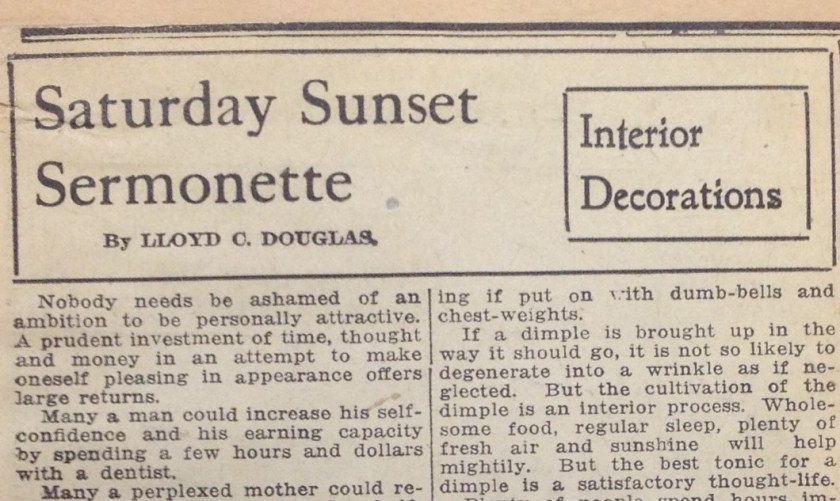
During the last two school years Lloyd Douglas was at the University of Illinois, he wrote a weekly column in the Daily Illini, the student newspaper. In 1915, when he accepted a call as Senior Minister at the First Congregational Church of Ann Arbor, he widened the circle. Since he was no longer strictly involved in campus ministry, he knew he also had a responsibility to reach out to the larger community. One way he did that was to write a weekly column in the Ann Arbor Times-News. The column was called “The Saturday Sunset Sermonette,” and it began in September of 1915. Despite the word “sermonette,” the topics were quite down-to-earth. Here are some examples:

On your kid’s first few weeks in elementary school: “Be very patient with him. He is learning a new craft. His little world is being melted and stirred and shaken… all the fences are being torn down and rebuilt after a different pattern and for a different purpose, around his small domain…. No wonder if… he seems distracted; forgets the errand he promised to run; omits doing his customary chores. Be patient. If you were going through any such radical revision of your life-processes, just now, likely they’d have you in a straitjacket with an ice-pack on your head.”

From an extremely tongue-in-cheek essay on why women should not be allowed to vote: “In the first place, Providence never intended woman to be man’s equal, as is clearly proved by the fact that the first woman was made of the first man’s rib. Anybody can see that this disqualifies her for citizenship. The first man, it will be remembered, was made of dirt. This gave him such a fine start that woman has never been able to overtake him in ability to manage politics, which is pretty dirty business in many localities.”

On sending Christmas cards: “Among the people we should plan to remember with a card or a note of good wishes are the old friends whom we seldom see and from whom we rarely hear: our teachers, back in the old days, who wonder if we have forgotten that they exist; the schoolmates of long ago; the men and women, now aged and infirm, who used to take a kindly interest in us as children; the nurse who pulled us through scarlet fever; the man who fished us out of the river that day we were unsuccessfully attempting the ambitious aquatic performance. To be sure, we have lost track of many of these good angels of our youth. We are not sure they are alive. But, by beginning, early, to make inquiries, we may be able to locate some of them.”

From an essay entitled, “The Hated Job”: “To touch humanity with the power of an uplifting personality; to make it think, make it act, make it want to live four-square and above the fog because you do – because your character is contagious – this is the secret that transforms many a humdrum house of merchandise into a temple and many a common workbench into a shrine.”

By just such humorous and practical essays, Douglas reached out to people in the community who might not step inside a church. It was through this column that Douglas also rallied the people of the city around a charity case during the 1915 Christmas season. I’ll tell you about that in the next blog post.

For a free PDF copy of the booklet, The Secret Investment of Lloyd C. Douglas, fill out the form below:
← Back

Thank you for your response. ✨

The People in the Pews at Ann Arbor

by Ronald R Johnson (www.ronaldrjohnson.com)

In the series of lectures Lloyd Douglas delivered at various universities as a representative of the YMCA, and in his “Sermonettes” in the Daily Illini (the student paper at the University of Illinois), we can glimpse Douglas’s emerging theology. There wasn’t a lot of meat to it yet, but one principle came through quite clearly: he believed that the new state universities were engaged in a day-to-day discovery of the truth.

Therefore, when he went back into active ministry in April/May 1915, it’s no coincidence that he accepted a call to be the Senior Minister at the First Congregational Church of Ann Arbor, adjacent to the University of Michigan. And what an opportunity this was! Many of his parishioners were members of either the faculty or the administration of the university. The list below is from a booklet Douglas published for university students in the fall of 1916. It’s available online; you can view it by clicking the following link: L.C. Douglas, Congregationalism at the University of Michigan (Ann Arbor: Michigan Congregational Conference/First Congregational Church, 1916).

Here are the members who were in some way connected to the university:

The booklet then went on to list the students who were members of the congregation, from sophomores through seniors, as well as graduate students. There were several hundred names.

I look at it this way: Lloyd Douglas did his best thinking at the typewriter. He always typed out his sermons, even though (by all reports) he delivered them extemporaneously rather than just reading them. As he typed, he was keenly aware of his audience. When he rehearsed his sermons, usually on Saturday afternoons, he must have crafted them with these people in mind: the faculty and administrators I’ve listed above, as well as the hundreds of students in the balcony. From his daughters’ testimony we know that, after the service on Sunday mornings, he and his wife and daughters would walk home without speaking, but as soon as they got home, he debriefed, telling his wife Besse the specific reactions he saw on his parishioners’ faces to this or that part of the sermon. (His daughters give us a vivid description of this in the opening chapter of their book, The Shape of Sunday: An Intimate Biography of Lloyd C Douglas (Boston: Houghton Mifflin, 1952).)

We also know that he was willing to change his mind, sometimes on very important matters, and that he usually did it by reflecting on something he himself had preached or published earlier. The progression followed this pattern: he would make a strong statement in a sermon or magazine article and then, on a later date, would disagree with that statement, sometimes even quoting what he had said on the earlier occasion, although he never told his audience that the person he was refuting was himself. He did this at a few key moments in his life, and (in my estimation) his later views were an improvement.

During his years at Ann Arbor, however, I believe we see this happening on a smaller, subtler scale. The years 1915-1921 were the core of Douglas’s education. He did some important thinking during this period, and he did it in full view of the faculty and administration of one of the Midwest’s most influential state universities. As he typed out his beliefs, he did so with this audience in mind, and when he delivered the message to them on Sunday morning, he was very tuned-in to their reactions, self-correcting as needed. The reactions of this audience were especially pertinent because he wasn’t just preaching the old, old gospel in the old, old way. He was trying to communicate the message of Jesus Christ to people on the cutting edge of twentieth century scholarship (both the sciences and the humanities) and bring it to bear on the lives they were actually living on weekdays. Although he was always trying to reach students, he now began to focus his energies especially on the faculty. They were the ones most on his mind as he prepared his sermons. (He told us this in his “Third Commandment” in an article called, “Ten Commandments for the College Church.” Click the link to see the article in full.) And by preaching to the faculty, he became more mature as a thinker and a representative of Jesus Christ to the modern world.

But he also knew he had a responsibility to reach the townspeople not involved with the university, and he did that, as well. I’ll tell you more in the next post.

For a free PDF copy of the booklet, The Secret Investment of Lloyd C Douglas, fill out the form below:

← Back

Thank you for your response. ✨

Douglas: A.M. Degree Means ‘Amused Myself’

by Ronald R Johnson (www.ronaldrjohnson.com)

By the Fall of 1914, Douglas had already stayed longer at the University of Illinois than his original contract had stipulated. He had agreed to give them three years (from Fall 1911 to Spring 1914). He ended up staying through the 1914 calendar year but left to be a pastor again in the early months of 1915.

In the months leading up to that move, he spoke to students at the University of Michigan a couple of times: first at a YWCA gathering (Y events were still segregated by gender) and then at a meeting sponsored by the university’s Student Christian Association (the SCA). The SCA event took place at the Majestic Theater in Ann Arbor. Although he was invited to speak to students, the First Congregational Church of Ann Arbor had a pastoral vacancy and was interested in him – and he was interested in them. The bio he sent to the event organizers is fascinating in light of that situation. He wasn’t just aiming at students; he knew this bio would be his self-introduction to the search committee at the Congregational Church and, to some extent, also to the larger community.

His bio began as follows:

“Lloyd C. Douglas, age 37, able-bodied but not husky. Ran 100 yards in college but never went to Olympic games in consequence. Member Phi Gamma Delta – worked harder on that than on calculus. Also manager of Glee Club, which took much time which might otherwise have been squandered on logic. Also managing editor of college paper, during which administration it was thought to be a humorous sheet – typographically, at all events. Managed to corral a degree of A.M., meaning, in this case, ‘Amused Myself.'”

This first paragraph shows how much Douglas changed while at the University of Illinois. When he introduced himself to the Washington, DC press corps, he wisely portrayed himself as a fellow journalist in order to win their acceptance and get them to stop focusing on the scandal he had inherited at the church. But now he was much more relaxed. His bio was written for students, of course, but it’s also consistent with the new style of writing he had developed, first as the anonymous author of the “Zom” ads in the Daily Illini, then as the creator of the “Weekly Sermonettes” in the Illini, and then as the writer (again anonymously) of the “Pen Portraits of Prominent People” in the Siren. He wasn’t just amusing himself; lots of others found him amusing as well.

But the bio continues. After disarming his audience with humor, then he gets more serious:

“Was minister eight years, after two years’ experience as police reporter on two Ohio dailies. Also lectured sometimes at Chautaquas (does yet when hard up). Also wrote some magazine stuff of an ethico-homileticallian character.” Sermons, in other words.

He’s still tongue-in-cheek, but he’s also touting his resume. He’s vying for the job and being nonchalant at the same time. There’s more:

“Last church held was in Washington, D.C., within three blocks of White House, attended by several people identified by other characteristics than such attendance. Has personal acquaintance with two or three men whose names have appeared in newspapers from time to time. Was member of the National Press Club.”

He’s got an impressive record for one so young, and he’s not afraid to show it. But he’s still got that “no big deal” tone of voice. When he mentions the “two or three men whose names have appeared in newspapers from time to time,” he’s talking about Champ Clark, the Speaker of the House, and Charles Hillis, who was President William Howard Taft’s Special Assistant. He may also be throwing in Gifford Pinchot, the conservationist, who sent Douglas a letter of thanks after he said kind words about Pinchot in a sermon. At any rate, Douglas was letting the people of Ann Arbor know that he was well-connected, but that it was “no big deal.”

He continues:

“Came to Illinois as religious work director in 1911 at the instance of John R. Mott.” In other words, the top man in the YMCA personally invited him.

“At the expiration of three years for which he had contracted, the local board asked him to stay as general secretary plus R. W. D. [Religious Work Director] This association is thought to have the largest paid membership of any student YMCA in the world.

“Has participated in evangelistic campaigns at universities of Wisconsin, Minnesota, Iowa, Iowa Ag., Penn State, and Michigan, besides many colleges.”

This bio appeared in the Michigan Daily, the student newspaper of the University of Michigan. Yes, he wrote it for students; but he also made sure he laid out his substantial credentials for anyone else who might be listening. The headline says it all: “SCA SPEAKER HIS OWN PRESS AGENT/L. C. Douglas Who Addresses Sunday’s Meeting Writes Own Publicity.”

He got the job. During his six years as pastor of the First Congregational Church of Ann Arbor (1915 to 1921), students packed the balcony, but professors and administrators were attracted to him, too. In fact, the church wasn’t big enough. They had to enlarge it.

I’ll tell you more about this very interesting congregation in my next post.

To receive a free PDF of the booklet, The Secret Investment of Lloyd C. Douglas, fill out the form below:

← Back

Thank you for your response. ✨

Briefly Presbyterian

by Ronald R Johnson (www.ronaldrjohnson.com)

When Lloyd Douglas resigned as pastor of Luther Place Memorial Church in Washington, DC, he had already made up his mind to change denominations. A year later, he did so. In a handwritten note on one of the pages of his 1909-1915 scrapbook, he wrote:

“On September 18, 1912, in a telegram to… the president of the Maryland Synod [of the Lutheran Church in America], I formally severed my connection with that Body and was unanimously elected on that same day to membership in the Presbytery of Bloomington [Illinois]…”

There is also a printed report of meeting minutes, stating that Douglas was received into the fold.

But other than teaching a Sunday School class for university students at a Presbyterian congregation in Champaign, he never actually served in the Presbyterian Church.

As I survey his career, I believe it was his plan all along to be a Congregationalist. As early as 1909, when he was a Lutheran pastor in Lancaster, Ohio, he was invited to lunch with Dr. Washington Gladden, the esteemed pastor of the First Congregational Church of Columbus.

Dr. Washington Gladden

Rev. Gladden was one of the leading social gospel preachers of his day. We catch a glimpse of just how highly he was respected when we read the letter of invitation from E. Lee Howard (dated July 14, 1909). It says, in part:

“It is the custom of the little coterie of Congregational ministers to gather informally in Dr. Gladden’s study every Monday at 11:30 o’clock, for an hour of good fellowship, after which we go to luncheon together. The Doctor is home this month, although several of the fellows are away. The Doctor is exceedingly cordial in his greeting to young ministers, and he was interested in the account which I gave of you the Monday after your address at Kenton. You will enjoy an hour with him very much, and if you will meet me at the Neil House at 11:30, we will go from there to the study in the church.”

How formal! “The Doctor”! “You will enjoy it very much”! And yet this must have cheered young Douglas a great deal, to be invited into this highly-cultured group of men (“the fellows”) and accepted as one of them. The visit itself was undocumented. We don’t know what happened. But the event must have made an impression on him, for in his final months as a Lutheran pastor (late 1910-early 1911), when he was already planning his next career move, he sent two article submissions to The Congregationalist and Christian World, a bi-weekly magazine. Both were immediately published. In the second one, the editor inaccurately referred to Douglas as “a Washington (DC) Congregational minister.”

Years later, he said that his work at the University of Illinois put him in touch with Congregationalists, although it’s not clear what he meant by that, since the YMCA introduced him to leaders from a wide variety of denominations and he had already made connections with Congregationalists. While in Champaign-Urbana, he continued to send article submissions to The Congregationalist and Christian World, and at some point (I’ve been unable to determine exactly when) he became good friends with Dr. Carl Patton, who was pastor of the First Congregational Church of Ann Arbor (adjacent to the University of Michigan) from 1900 to 1911.

Given all this, I’m not sure why he joined the Bloomington Presbytery. It did allow him to “sever” his relationship with the Lutheran Church while remaining a licensed minister, and perhaps he knew that Congregational search committees would accept a Presbyterian candidate. Especially since this happened at the same time that he taught Sunday School at the new McKinley Memorial Presbyterian Church – the erection of which was a pet project of Thomas Arkle Clark, who was one of the faculty representatives on the YMCA Governing Board – it was probably just a good opportunity to change his affiliation. At any rate, Lloyd Douglas was briefly (and inconsequentially) a Presbyterian. Just a little trivia for you.

Early in 1915, the First Congregational Church of Ann Arbor (where Carl Patton had been pastor for 11 years) extended a call to Douglas, and he accepted it. He remained a Congregational minister for the rest of his life.

His self-introduction at Ann Arbor was interesting, though. At Washington, DC, he had introduced himself to the press corps as a former reporter. The way he introduced himself to the people of Ann Arbor was quite different. It shows how much his experience in Champaign-Urbana had loosened him up and made him more humorous and nonchalant. I’ll tell you about that in the next post.

To receive a free PDF of the booklet, The Secret Investment of Lloyd C. Douglas, fill out the form below:

← Back

Thank you for your response. ✨

Douglas’s “Pen Portraits of Prominent People”

by Ronald R Johnson (www.ronaldrjohnson.com)

Besides contributing a weekly column in the University of Illinois’ student newspaper, the Daily Illini, Lloyd Douglas also wrote anonymous articles in The Siren, a student-run magazine. During the 1914-1915 school year, he wrote a series of tributes to the university’s top administrators, describing their distinctive characteristics (hence the name “Pen Portraits”). It was just like Douglas to give the series a memorable title through the use of alliteration: “Pen Portraits of Prominent People.”

Dr. Edmund James, President of the University of Illinois from 1904 to 1920.

Dr. Edmund James is remembered as one of the university’s successful presidents, helping to bring about the school’s growth, not only in its physical plant but also in its reputation. (See, for example, Robert P. Howard, Illinois: A History of the Prairie State (Grand Rapids: Eerdmans, 1972), p. 404, and Allan Nevins, Illinois (NY: Oxford, 1917), pp. 210-218.)

In his Pen Portrait of the “Prexy” (the nickname for “President”), Douglas called James “a cosmic person whose resourcefulness will not be fully understood” until decades later. “For the Prexy is living in the future…. [He] turns out early these fine mornings on his saddle-horse and as he rides about the campus he sees great buildings that aren’t there at all. But they’re real enough to him! He guides his horse carefully around them and peoples them with thousands of students who have yet to be born.

“However, living away out yonder as he does – a dozen decades beyond tomorrow – the Prexy is mightily interested in today. He has his fingers on the pulses of all the colleges that make up the University – very steady fingers, too, when one remembers that the Prexy is venerable in years. He knows what grade of steel and concrete is going into the new Chemistry laboratories; knows how much Pat O’Brien earns per hour, shoveling dirt out of the hole where the Administration Building will stand; knows the name of the last new book that came into the library yesterday.

“He has just one obsession…. the future greatness of the University of Illinois!”

Thomas Arkle Clark, the Dean of Men.

Thomas Arkle Clark, the Dean of Men, was and is a legend. When I spent a few days at the University of Illinois archive in 2015 and asked the librarian to get me his private papers, she was thrilled. “Are you going to write a book about him?” “No,” I told her. “I’m writing about the bestselling novelist Lloyd C. Douglas.” “Oh,” she said, looking very disappointed.

Somebody needs to write a book about Thomas Arkle Clark; it’s well overdue. They say that, during Prohibition, he broke up a party at a frat house by coming down the chimney like Santa Claus. Of course, it didn’t happen – it couldn’t have happened – but stories like that were told and retold even while he was still alive because they caught the essence of the man. In his Pen Portrait of the Dean (whom he refers to as “Tommy”), Douglas says:

“It is confidently asserted of Tommy that he can flay his victim and nail his quivering pelt to the mast with greater ease and dispatch than any other skinster between the Aurora Borealis and Palm Beach. Moreover, the flaying is achieved so deftly and with such a wealth of good humor that the hideless one rejoices over his… condition, regretting that he has only one skin to give to his executioner….

“Perhaps there is no place in all this world where a man is so courteously invited to build his own scaffold, make his own funeral arrangements, adjust his own black cap and kick himself through the trap, as in the pleasant room of vast distances where Tommy sits day by day, calmly and dispassionately dealing with a docket full of the delinquent and deficient.

“It is mostly a court of reprieves. Tommy only hates one type – the liar. If one has business with the Dean o’ Men, it is better to tell him the truth at once, thereby saving time and self-respect. It is privately believed in certain quarters that Tommy has an X-Ray attachment in the top rim of his glasses and that when he lowers his head to gaze over them, he can see what the culprit had for dinner…”

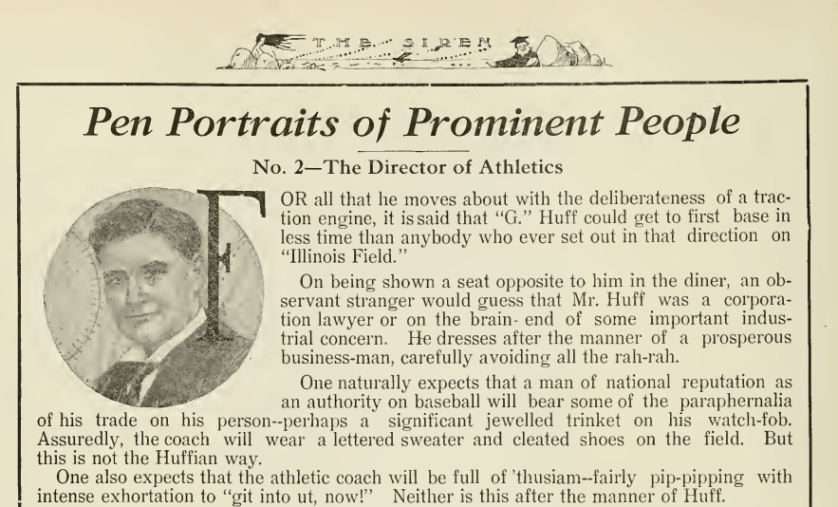
Douglas wrote about “G. Huff,” the Athletic Director…

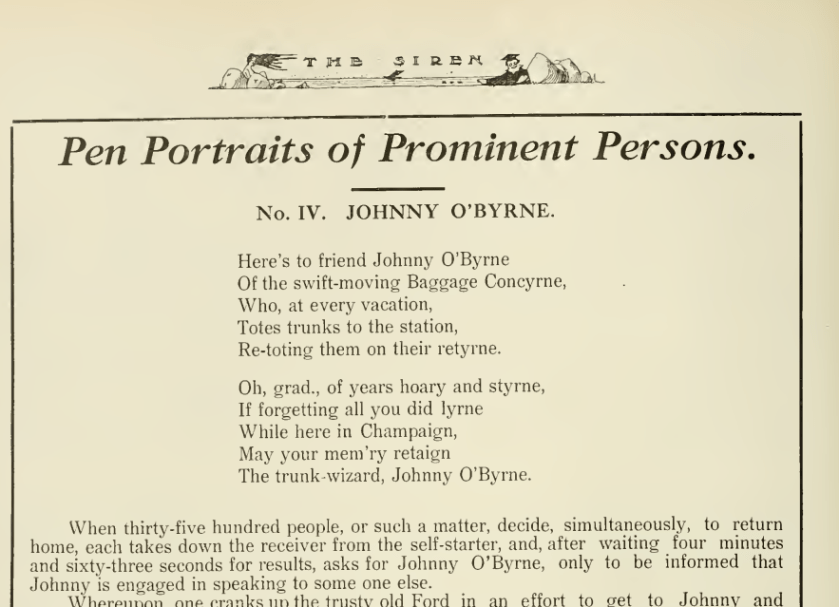
…Johnny O’Byrne, the baggage guy at the local train station…

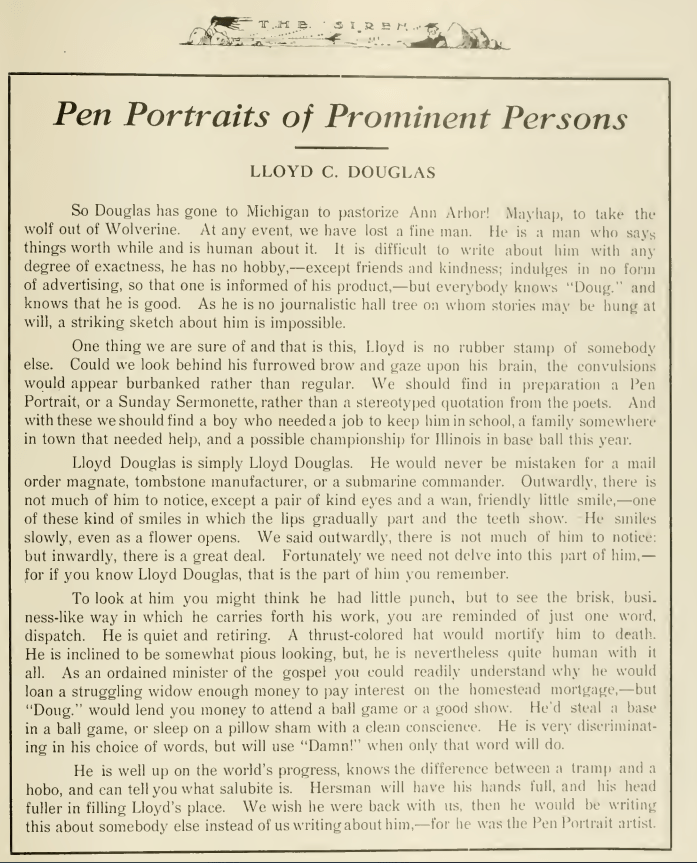
…Eugene Davenport, the Dean of the School of Agriculture, and other people well-known to students and faculty. Each essay was fun, imaginative, and full of life. Not religion, but life. As I mentioned earlier, they were also published anonymously. Month after month, everyone on campus must have speculated about who wrote them. This was during the 1914-1915 school year, and in the early months of 1915 Douglas left to become pastor of the First Congregational Church of Ann Arbor (in Michigan). The student editor of The Siren, Ralph Barlow, wrote the final “Pen Portrait” himself, and it was a tribute to Douglas.

I’ve included an image of the complete essay below, because it’s full of first-hand observations of Douglas. It also must have been the talk of the school, because of the concluding sentence: “We wish he were back with us, then he would be writing this about somebody else instead of us writing about him – for he was the Pen Portrait artist.”

But even though he was becoming better at writing for secular audiences, Douglas still felt the call to be a pastor. While he was at the University of Illinois, he was working on that, too, behind the scenes. I’ll tell you about that in the next post.

To receive a free PDF of the booklet, The Secret Investment of Lloyd C. Douglas, fill out the form below:

← Back

Thank you for your response. ✨

A New Start

by Ronald R Johnson (www.ronaldrjohnson.com)

Lloyd C Douglas, circa 1911-1912. From a promotional brochure in his 1909-1915 scrapbook.

Something happened to Lloyd Douglas between 1912 and 1913. In the previous post I told you that, in 1912, he invested secretly in Roger Zombro by writing anonymous ads for him in the Daily Illini. Neither of the two men ever mentioned it, but I have a lot of evidence to back up that hypothesis. (I have included it in the booklet The Secret Investment of Lloyd C Douglas, available upon request.) Of all the evidence I have gathered, the most important is this: Douglas’s writing style changed between 1912 and 1913, the exact period during which the anonymous “Zom” ads began running in the student newspaper.

Douglas had always been a powerful writer, but his earlier essays were intense. His sense of humor shined through, too, but overall he came across as a very serious young man. In the fall of 1913, though, he began displaying a more relaxed, whimsical style that would characterize his writing for the rest of his life. He was still a powerful writer, but he exercised that power in a new way: through a nonchalant, humorous presentation somewhat like that of Mark Twain. Prior to this, he reached out and grabbed you by the lapels with his writing, but now he disarmed you with humor and casually persuaded you. I believe it was his anonymous work on the “Zom” ads that gave him this breezy new way of expressing himself; but even if I’m wrong about the cause, the effect is obvious. In 1913, Douglas found his voice as a writer.

And there was something else: prior to this, Douglas’s writing was religious. It was church-oriented. In 1913, he put that behind him. He spoke as one who was deeply acquainted with the day-to-day lives of real people, both students and faculty. He focused on the things that mattered to his readers.

We see his new style exhibited in a weekly column he wrote in the Daily Illini called “The Sunday Sermonette” (later changed to “The Weekly Sermonette”). He doesn’t sound like a young man anymore; he sounds like a wise older man with a sense of humor and a very light touch. There were flaws in these “sermonettes” – they were often paternalistic and somewhat patronizing – but they were popular and down-to-earth, and they set a course for all of his future writing. For example, when he moved to Ann Arbor, Michigan, in 1915, he started writing a weekly column in one of the local newspapers called, “The Saturday Sunset Sermonette,” aimed more at the townspeople than the students. The “sermonettes” in the Daily Illini set the pattern.

Here are some examples from the Daily Illini column:

On writing home to Mother: “If you wish to make a distinct hit with her, tell her how you are faring as to creature comforts. Since you came upon this planet, her chief concern has been your physical well-being. She was always glad, of course, when you exhibited any interest whatever in the development of your mind or the culture of your soul; but her first thought for you has always been cast in terms of food, clothes, shelter. Tell her where you are living. Draw a map of the house, showing the position of your room. Draw a diagram of the room, indicating doors, windows, closet, registers, book-cases – where you sit when you study, etc.” (“The Letter Home,” Daily Illini, Sunday, September 28, 1913, p. 4).

On rags-to-riches stories: “Reacting against an ancient notion that a man must be hereditarily rich and influential to achieve greatness, book markets of our country are glutted with biographies of eminent men who came up into positions of trust and honor from homes of poverty…. In view of the highly prosperous state of our civilization, perhaps it might be just as well to ease up a bit now on advice for the poverty-stricken and make some effort to provide an inspirational pabulum upon which the rich man’s son may feed” (“Washington,” Daily Illini, Sunday, February 22, 1914, p. 4).

On hanging out with the crowd: “The student who fails to provide for an occasional hour by himself becomes about as original and inventive in his thought and speech as the funnel of a phonograph” (“The Man Himself,” Daily Illini, Sunday, October 5, 1913, p. 4).

On rushing around campus, taking oneself too seriously: “Many people here, students and others, are afflicted with a ‘busy’ bee. They maintain the breathless attitude of one who leaps from an engagement brimful of crisis to another even more fraught with fearful consequences…. Cold-blooded as it sounds to say it, the world was hobbling along – handicapped, to be sure, but managing to struggle painfully along – before any of us arrived and it is… possible that the world may continue to do business when the grass is a foot high over the place where our tired bodies rest from their frenzied scramble to attend to so many important things at once” (“How Doth the Little Busy Bee?” Daily Illini, Sunday, April 26, 1914, p. 4).

These are just a few examples. A little later (the 1914-1915 school year), he also began writing “Pen Portraits” of the university’s top administrators. As with the “Zom” ads, he published them anonymously – only this time his identity was revealed. I’ll tell you about it in my next post.

To receive a free PDF of the booklet, The Secret Investment of Lloyd C. Douglas, fill out the form below:

← Back

Thank you for your response. ✨

Behind the Scenes

by Ronald R Johnson (www.ronaldrjohnson.com)

At the University of Illinois, Lloyd Douglas worked at the new YMCA Building on the northwest corner of Wright and John streets, at the western edge of campus. He taught classes, wrote anonymous articles about the Y for the Daily Illini (the student-run newspaper), tried to get students to join the Y, and organized events featuring visiting speakers (most notably the organization’s leader, John Mott). Although he was busy, he was surprisingly low-key. He wasn’t in the news nearly as much as he had been as a pastor in North Manchester, in Lancaster, and in Washington, DC.

And there was a reason for that: Douglas had taken this job to get out of “active ministry” for a while and think things over. But he wasn’t the kind of man who needed to get completely away from it all in order to ruminate; rather, he did his best thinking when he knew he had to answer to the public, especially on a deadline. He no longer had to compose two sermons each week (for a.m. and p.m. services on Sundays), but he still wrote articles for religious periodicals (The Congregationalist now, instead of the Lutheran Observer), and he still taught classes at the YMCA and spoke at “smokers” designed to increase YMCA membership. (The university Y shamelessly imitated the fraternities, inviting young men to come and see a “lantern show” of Ben-Hur, for example, and hear an inspiring talk by Lloyd Douglas while enjoying a dessert and cigar.)

The newly-erected YMCA Building at the University of Illinois. Note the horse hooked up to the hitching post. From The Promise of Association: A History of the Mission and Work of the YMCA at the University of Illinois, 1873-1997 (Champaign, IL: University YMCA, 1997)
The same structure today. It’s no longer the YMCA Building, though; it’s Illini Hall. I took this picture in February 2015. There were no horses parked out in front.

But he wasn’t nearly as much in the public eye as he had been from 1903 to 1911. He spent time at the library across the street (that’s not a church steeple in the image below; it’s the campus library)…

…and he soaked up the campus culture. He spent most of his time with students, of course, but he was especially impressed with the faculty. Years later he wrote, “I had some exceptional opportunities to develop along the line of a liberal interpretation of religion during my work at the University of Illinois, where I came constantly in contact with a forward-looking group of very intelligent people who comprised the first sizable party of persons I had ever known who were both mentally solvent and religiously inclined. Up until that time only an occasional man of my acquaintance had qualified as [a] high grade intellectual and disposed toward a devout interpretation of religion. I discovered that it was possible for a man to be both religious and preserve his intellectual morality” (Douglas to Dr. Frank C. Ransdell, December 15, 1927. In Douglas Papers, Correspondence 1926-1930, Box 1, Bentley Historical Library, University of Michigan).

The most important work Douglas did at the University of Illinois was behind the scenes. He talked to people, and listened, and studied, and thought. Our best glimpse of the shifts in his theology comes from newspaper articles about the series of lectures he delivered at other universities during the second semester of the 1911-1912 school year. I’ll tell about that in the next post.

To receive a free PDF of the booklet, The Secret Investment of Lloyd C. Douglas, fill out the form below:

← Back

Thank you for your response. ✨

Design a site like this with WordPress.com
Get started