A Twentieth-Century Gospel for “a Hick Town”

by Ronald R Johnson (www.ronaldrjohnson.com)

This is the publicity photo that Douglas used during his years in Akron. See Burton Funeral Scrapbook, Box 5, Lloyd C Douglas Papers, Bentley Historical Library, University of Michigan.

I mentioned last time that Lloyd Douglas made headlines frequently while he was pastor of the First Congregational Church of Akron, mostly for controversial statements he made during his Sunday evening Q-and-A sessions at the church. Some of those remarks (such as his lack of support for the Soldier’s Bonus or his disgust with the KKK) prompted long and angry discussions in the Letters to the Editors (besides earning Douglas a lot of angry mail himself).

Here’s another one: speaking at a luncheon club, he told the astonished listeners that Akron was “a hick town.” Culturally and religiously, it was behind the times, he claimed. These words were reported in the papers, and another round of angry letters began.

But it was just this kind of thing that the journalists respected about Douglas: he spoke his mind fearlessly, especially on religious matters. Here’s a sample of the kinds of things he said on Sunday morning from the pulpit:

I have not encouraged you to worry over all the implications involved in the ancient doctrine of the atonement. I couldn’t see how as great a God as God would inevitably have to be, to create and operate the universe, would get himself entangled in a situation demanding that His son be killed in order that His own integrity might be conserved. I felt that a God so short-sighted as to get Himself into a fix like that would be hardly stable enough to see us through to the end of the trip.

I have told you that this conventional view of the atonement – in which the death of Christ became necessary to justify the parole of Adam – was unwarranted because there was no adequate basis for the Adam story. My grandfather believed in that Adam story. He also believed that the horse-chestnut which he carried in his pocket would keep off rheumatism. He was a good man, too. But he included in his creed a lot of things I cannot possibly believe…

Lloyd C Douglas, “Five Years of Akron,” p. 90. In The Living Faith (Boston: Houghton-Mifflin/Riverside Press, 1955).

Even now, 100 years later, a pastor must be careful about saying such things out loud, even if he believes them privately. But Douglas didn’t come to Akron to play it safe; he came to bring them a gospel fit for the twentieth century. Over the next several posts, I’ll tell you what his message consisted of. For it was in Akron that Douglas began to articulate the ideas for which he is now remembered.

For a free PDF copy of the booklet, The Secret Investment of Lloyd C. Douglas, fill out the form below:

Go back

Your message has been sent

Warning
Warning
Warning
Warning.

Lloyd C Douglas and the Akron Newspapers

by Ronald R Johnson (www.ronaldrjohnson.com)

As always, when Douglas arrived in Akron, he connected immediately with the editors of the local papers. It was like Washington, DC, all over again: he became the darling of the local press. But Akron was not Washington; it was a small town that had become a city overnight (due to the tire industry), and was now in the grips of an economic depression. Douglas was a fresh, prophetic voice for such a time. The papers hung on his every word, even when they disagreed with him.

There were three Akron newspapers (The Beacon Journal, The Times, and The Press), but other papers in the region also took notice of him. He appeared occasionally in the Toledo Times and was often in the Cleveland Plain Dealer. The local Rotary Club also had a newsletter called The Akrotarian, and since Douglas was a member of the club, he figured prominently in its pages, as well.

After his first year in town, Douglas introduced the idea of answering pre-submitted questions at the Sunday evening service, mostly so that he could concentrate all his energies on the morning sermon. But the Sunday evening Q-and-A’s were reported in the local papers and made Douglas the talk of the town.

He expressed his opinions on a number of hot topics:

The Ku Klux Klan: He not only criticized them but made fun of them. When a police officer pulled him over for speeding and realized who he was, the officer thanked him for all that he was doing to squash the Klan and sent him on his way without a ticket. But there were lots of other people who were angry at his remarks. His wife, Besse, worried that the parsonage would be bombed.

Chiropracters: As I’ve already mentioned, Douglas was an enthusiastic fan of modern medical practice, and he fought hard against people’s tendency to accept medical advice from the untrained. He was especially vocal about “the quackery of chiroprackery.”

Blue Laws: The other churches in town wanted to limit what people could do on Sundays. They were especially against moviegoing. Douglas took the unusual stance of opposing blue laws. (Unusual for a minister, that is.) He said that this was the kind of thing that turned people against Christianity. Newspapers all over the region reported his remarks.

Soldier’s Bonus: Decades before the GI Bill, Congress tried to pass a Soldier’s Bonus for veterans of WWI. Douglas mentioned, in an offhand way, that, given the current state of the economy (this was the depression before the Great Depression), he couldn’t support the idea of a Soldier’s Bonus. He felt it would be better to bolster the economy and give veterans jobs rather than make them dependent on the government. He received a lot of angry mail, besides all the talk in the Letters to the Editors. To clear things up, he gave a speech before an audience of veterans at the local American Legion post and explained his stance. There isn’t any indication that he changed people’s minds, but at least one letter from a veteran stated that they respected Douglas for all that he was doing to help the unemployed. (And he actually was doing something. He had accepted Mayor Carl Beck’s invitation to chair the city’s Unemployment Committee, which looked into ways to overcome unemployment. The letter to the editor claimed that he was also known to have contributed time and money into helping individuals find jobs. That’s a somewhat mysterious reference, but very much in line with his belief in investing in others.)

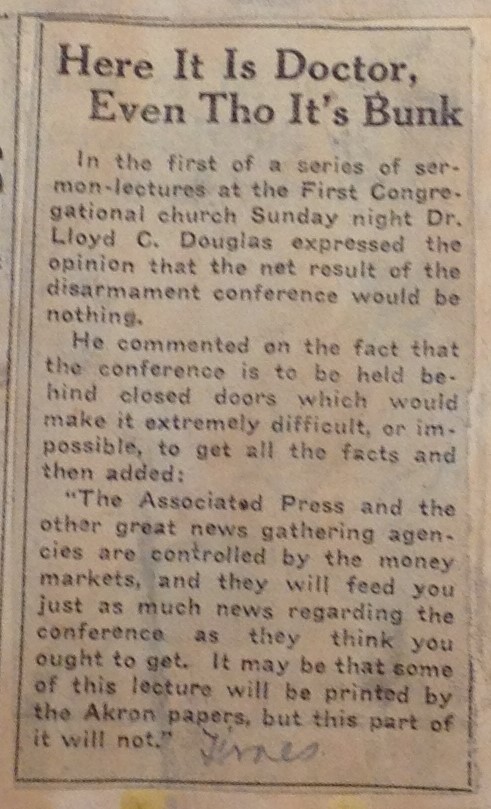
In all these cases (and others besides), it’s clear that local journalists respected Douglas even when they disagreed with them. Here’s my favorite example. In one of his Sunday-night speeches, Douglas claimed that the AP and other wire services were dominated by wealthy individuals who controlled what the newspapers would publish. “It may be that some of this lecture will be printed by the Akron papers,” Douglas said, “but this part of it will not.”

The Akron Times printed it, along with this headline: “Here It Is, Doctor, Even Tho It’s Bunk.”

I’ll tell you more about Douglas’s ministry in Akron in my next post.

For a free PDF copy of the booklet, The Secret Investment of Lloyd C. Douglas, fill out the form below:
Go back

Your message has been sent

Warning
Warning
Warning
Warning.

Design a site like this with WordPress.com
Get started