An Unfortunate End to a Distinguished Career

by Ronald R Johnson (www.ronaldrjohnson.com)

From January through March 1909, two Washington, DC, newspapers (the Washington Herald and the Washington Times) gave an unusual amount of coverage to a dispute occurring among the membership of Luther Place Memorial Church. The church council wanted to make changes in the way the congregation was governed, and particularly in the way that finances were handled, but the pastor, Rev. Dr. J. G. Butler, was offended.

In January, the council asked Dr. Butler to announce an upcoming congregational meeting to discuss the issues, but he did not share the announcement with the congregation. A few of the council’s leaders resigned in protest, but since their resignations had to be brought before a congregational meeting, Butler surprised the council the following Sunday by announcing the resignations immediately after his sermon and asking all in favor to say “Aye.” This took everyone by surprise, since the leaders of the council, rather than the pastor, were supposed to preside over congregational meetings. But parliamentary procedures were ignored.

The next day, the story appeared in the local papers. This may not seem like the kind of thing that would make headlines, but (1) churches were considered much more newsworthy in the early 1900s than they are now; (2) Luther Place was considered one of the more significant churches in Washington, DC, and Dr. Butler was arguably the most highly-esteemed churchman; (3) the inauguration of William Howard Taft was just weeks away, but it was a boring story since Theodore Roosevelt, the current president, had hand-picked Taft as his successor (in other words, it was a slow season for news); and (4) perhaps most importantly, it was scandalous. And people on both sides of the conflict made it increasingly scandalous by hurling accusations against each other in the newspapers.

The congregational meeting finally did happen, but Dr. Butler presided over it and, again, parliamentary procedures were not followed. Butler accused the council of trying to oust him as pastor, and he asked for a vote of confidence for his leadership. Some tried to speak but were not given the floor. A lot of people walked out, saying they’d never come back. Of those who remained, the majority voted in favor of Dr. Butler. “The insurgents have been repulsed and are in full retreat,” he told the Washington Times a few days after the meeting (Times, Friday, February 5, 1909, p. 11).

The following Sunday he preached on the Parable of the Wheat and the Tares. “While we slept,” he said, “the enemy has been sowing tares. There are children of the devil in the church. We have the sheep and the goats among us. Examine yourselves this morning, and see where you stand – among the sheep or among the goats. Those who stand aloof and out of the church at this time of fractional disruption will stand a small chance before the judgment seat. There were factions and schisms in the old church at Corinth, and the Apostle Paul rebuked those responsible for rebelling against God… This church is not to be disrupted by factions and strife.” (Washington Times, Sunday Evening, February 7, 1909, p. 1).

The following Sunday he preached on Matthew 12:30: “He that is not with me is against me.”

This kind of talk did nothing to win people back to the church. The group that the press called “insurgents” or “dissenters” began meeting on Sunday mornings at Confederacy Hall, Vermont Avenue, between N and O streets northwest, which was less than two blocks north of Luther Place. A Congregationalist minister served as interim pastor until they could obtain a Lutheran pastor. When approached for a comment, Dr. Butler told the Herald, “The whole thing is a closed incident to me. These persons have left the church, and the church is getting along without them.” (Washington Herald, Monday, February 15, 1909, p. 1).

Dr. Butler was a fighter. When the War Between the States had begun in 1861, the permanent residents of Washington, DC, were by no means unanimous in their reaction. They lived south of the Mason-Dixon Line, south of two slave-holding states (Maryland and Delaware); the Confederate state of Virginia was just across the Potomac River; and Washington itself had a significant slave population. More than half of the capital city’s families came from either Virginia or Maryland. Geographically and culturally, they had more in common with the genteel South than with the abolitionist North. At the commencement of the war, it was not at all clear whether the village residents would be loyal to the Federal Government. (See Constance McLaughlin Green, Washington: A History of the Capital, 1800-1950 (Princeton: Princeton University Press, 1962), volume 1, chapters 9-11).

At that time, Butler was pastor of St. Paul’s Lutheran Church, and he did not mince words. Despite the general uncertainty, he did what he could to tip the scale in favor of the Union. In his sermons he opposed secession, and although some of his parishioners left the church in anger, many more joined. Vice President Schuyler Colfax frequently attended, as did a number of congressmen and high-ranking military men. Glad of Butler’s support, President Lincoln appointed him chaplain of both a military hospital and of the 5th Regiment of the Pennsylvania Volunteers.

Butler kept up that same fighting spirit long after the war was over, preaching and acting in support of the newly-freed slaves, establishing a health clinic at the church, and helping the poor and disadvantaged within the District of Columbia. And when there was a fire in the church, he rallied his congregation and got them to rebuild it. He was 80 years old at the time. It seems appropriate that, at the rededication of Luther Place following that rebuilding, President Theodore Roosevelt used fighting imagery to describe the state of American politics:

“The forces of evil are strong and mighty in this century and in this country,” he said, and he added that “the people who sincerely wish to do the Lord’s work will find ample opportunity for all their labor in fighting the common enemy” (President Theodore Roosevelt, “At the Rededication of the Luther Place Memorial Church, Washington, DC, January 29, 1905.” In A Compilation of the Messages and Speeches of Theodore Roosevelt, 1901-1905, Alfred Henry Lewis, ed. (Washington, DC: Bureau of National Literature and Art, 1906), pp. 548-550).

This fighting imagery was very much to Butler’s taste. He was a fighter to the end.

Unfortunately, in the final months of his life, when the members of his own congregation were trying to get organized to continue the work he started, he misinterpreted their intentions and fought back, even using the local newspapers to help him win. It was a sad end to a long and distinguished career – and it truly was the end, for on the morning of August 2, 1909, he collapsed on his bedroom floor and died of a heart attack.

The church council moved quickly. They wanted a new pastor charismatic enough to reunite the warring factions. So intent were they on this course of action that they took a huge risk. They passed over Dr. Butler’s son, the Rev. Charles Butler, his heir-apparent. They by-passed a close friend of Dr. Butler, the Rev. Dr. D. Frank Garland of Dayton, Ohio. They declined the opportunity to hear and evaluate distinguished ministers from the length and breadth of the land, many of whom would have been thrilled at the opportunity.

Only one candidate was invited: a young man who had been a minister for no more than six years and who had spent that time serving small-town parishes in the Midwest. He was thirty-two years old, but the Washington papers said he looked much younger. Within only a few short years, he had made a name for himself as a writer for the Lutheran Observer, and he was considered an up-and-coming progressive.

His name was Lloyd C. Douglas.

[To be continued…]

For a free PDF of the booklet, The Secret Investment of Lloyd C Douglas, fill out the form below:

← Back

Thank you for your response. ✨

Going Places

by Ronald R Johnson (www.ronaldrjohnson.com)

By the summer of 1909, Lloyd C Douglas was going places. He was a frequent contributor to the Lutheran Observer, was often mentioned in the local newspapers, and could easily attract a crowd to hear his sermons and speeches. He was invited to speak at churches and events throughout the region and was a favorite with young people, especially at the Young Men’s Christian Association (YMCA) and a group called Christian Endeavor. In fact, both of these latter groups were trying to get him to work for them. And he was giving it serious consideration.

But no one – not even Douglas himself – could have predicted where he would end up next. For in the summer of 1909, the Reverend Doctor J. G. Butler died, leaving a vacancy at the Memorial Evangelical Lutheran Church in Washington, DC.

The church was five blocks northeast of the White House on a crossroads called Thomas Circle. At the center of this circle was a garden and statue of Major General George H. Thomas. Bisecting it east and west was M Street, north and south was 14th, with Vermont and Massachusetts, in opposite diagonals, forming an X through its center. The Memorial Church sat atop a pie-slice wedge on the circle’s northern side.

Riding around Thomas Circle in a horse-drawn carriage and viewing the church straight-on, one could simultaneously peer down both Vermont and 14th streets, which ran along either side of the church. The building itself, conforming to those boundaries, was triangular. Its front was narrow, with a central entryway and high steeple, then it became increasingly wider, with smaller towers on either side at the structure’s back. Its outer surface was red sandstone, and the Gothic towers were green. And in front of the entrance, facing Thomas Circle, was a replica statue of Luther-at-Worms, holding a massive Bible, his face heavenward as if saying, “Here I stand.” When that statue was added in 1884, people began to call it Luther Place Memorial Church.


It was the Reverend Dr. John George Butler who first dreamed of this place and made it a reality. The War Between the States was still raging—indeed, Confederate cannons were within hearing distance of the nation’s capital—when Butler laid plans to build a unique Lutheran church in Washington, D.C. It was to be a living memorial, expressing gratitude to God for preserving the nation and freeing the slaves. In the front would be two “reconciliation pews” representing Union General Ulysses S. Grant and Confederate General Robert E. Lee. On either side of the sanctuary, the theme of reconciliation would continue with windows memorializing heroes from outside Lutheranism: Luther, Melanchthon, and John Huss would share space with Wesley and Calvin. And looking down upon all this, with outstretched arms of approval, would be an art-glass reproduction of the Thorwaldsen Christ.

Butler was already well-known as pastor of St. Paul’s Lutheran Church in Washington, DC. During the war, President Lincoln appointed him chaplain of both a military hospital and a regiment. After the war, Butler got people all over the country excited about his idea for the new church, and donations poured in, making it financially possible. The church was built and began operating in 1873. Butler resigned his post at St. Paul’s to become the pastor of Luther Place Memorial, and from that place his name went out even farther than before. He served as chaplain of the House of Representatives for six years (1867-73), then of the Senate for seven years a decade later (1886-93). He did what he could to help advance black men in the ministry. For twenty years he taught homiletics and church history at the Howard University Divinity School, and he helped establish the Church of Our Redeemer in Washington, DC, a segregated congregation for African Americans.

He was a towering figure in the nation’s capital, and Douglas had no way of knowing that he would be the man’s successor. But through a series of coincidences, that’s what happened. (To be continued.)

For a free PDF copy of the booklet, The Secret Investment of Lloyd C Douglas, fill out the form below:

← Back

Thank you for your response. ✨

Are You a Man? Then Read This

by Ronald R Johnson (www.ronaldrjohnson.com)

In January 1908, Lloyd Douglas began a series of Sunday afternoon lectures designed specifically for men. The Lancaster Eagle reported him saying that “there are many men in the city who have nowhere to go on Sunday afternoon, and who would be glad to avail themselves of the opportunity to spend an hour hearing good music and a sermon-lecture of a popular nature.” If this seems unlikely, bear in mind that most public places were closed on Sundays, and this was the dead of winter. The Gazette added Douglas’s suggestion that there were some men “who may find it more convenient to attend a church service on Sunday afternoon than at the regular hours of service, and who might be more inclined to attend a men’s meeting than one designed for a mixed audience.” The day before the first meeting, the Eagle said that there would be a large male chorus led by “Prof. E. R. Barrington, the noted baritone of Columbus.”

To help spread the word about these meetings, Douglas had the following cards printed, which were handed out to men on the street. The first page was really a half-page, and the man to whom it was handed was invited to flip open the page:

Although it’s hard to believe that anyone would take the time to do this, apparently some men did, perhaps because they were intrigued. They stopped “within” (probably the church) and were given a flyer describing the upcoming meetings:

Then they went outside and handed the “Are You a Man?” card to the next male who passed by.

(This was just the kind of thing Douglas loved, by the way: one person not affiliated with the church handing an invitation to someone equally a stranger to the church. He used something similar years later in his novel, Green Light, when Dean Harcourt of Trinity Cathedral would have a counseling session with a woman who was not a churchgoer, then, on her way out, ask her to introduce the next person who had come for counseling.)

This passing-of-the-cards technique, although interesting, was not the primary way that Douglas got the word out; he also prepared a number of press releases in the days leading up to the meetings, and the local papers ran them. He doesn’t seem to have run any paid advertisements; he didn’t need to. The articles raised enough interest on their own.

When the first meeting was held on Sunday, January 5, 1908, at 3:15 pm at the First English Lutheran Church in Lancaster, Ohio, the Eagle reported it as “the largest assemblage of men ever seen in a Lancaster church edifice… beyond all expectations, the seating capacity of the church auditorium being overtaxed, even the gallery of the church which has not been occupied for many months had to be thrown open and was well filled… It was an inspiring sight to see such a large audience of intellectual men and thrilling to hear the songs as they were rendered by that multitude of male voices.” Another paper (presumably the Gazette) declared the event “a great success” and counted “about four hundred men in attendance.”

Douglas told the story of Esau and his brother Jacob from a man’s perspective. He called Jacob “a mama’s boy.”

“To me,” he said, “one of the most unfortunate mistakes parents can make in their attitude toward their children is to single out one or two and to treat them as favorites.

“I have heard it said many a time, and so have you:

“‘Yes, Jimmy is mama’s boy. Johnny and Billy and Annie and Susie all run after their father but Jimmy is mama’s boy, ain’t you Jimmy?’

“And Jimmy replies truthfully and awkwardly that the allegation is correct.”

“I see a future for Jimmy that is neither bright nor dim – just a sweet twilight. People will say of Jimmy to their own sons:

“‘See here, Thomas, why don’t you keep clean, and play in the house, and say “Yes, ma’am,” and “If you please” like Jimmy does?’

“And so all the boys will come to hate Jimmy…”

Jacob’s brother Esau, on the other hand, “was a born sportsman. As a boy he wandered the fields with his bow and knife. No tent for him. He belonged to the sunshine, and he meant to live in it.”

And with this down-to-earth introduction, Douglas told the story of Jacob cheating his brother out of his birthright. I can’t say I’ve ever heard the story told the way Douglas told it, but it must’ve held the attention of the four hundred men sitting shoulder-to-shoulder that day, for the following week one of the papers said that the church “lacked seating capacity for the large audience that attended,” and another paper reported “one hundred more” in attendance than the previous week.

His messages continued to defy prediction. From the story of Judas Iscariot, for example, he extracted the unusual question, “What do you think about when you’re alone?… What are you thinking about when you take that long walk by yourself out into the country and sit down on some hilltop to survey the landscape?” In reply to his own question, he said, “Show me a stenographic report of five minutes’ meditation up there, and I believe I can tell you what kind of a man you are.”

From the New Testament story of Ananias and Sapphira, he ended up talking about what happens when you let your insurance policy lapse, and then he used that as a metaphor to explain why he thought deathbed confessions were useless.

The fourth and final Sunday he preached on “The Failure of a Loan and Trust Company,” which turned out to be about the Parable of the Talents.

As one of the local papers remarked, “Men of every church in the city have united heartily in these meetings and there have been many men in attendance who have no regular church homes. Perhaps it has been the stirring music, perhaps the peculiar nature of the addresses, perhaps the mere novelty of a service distinctly for men – that has brought forth all this enthusiasm, but whatever it is, the audiences are so large that it has become quite a problem to accommodate them in the church…”

Another unusual feature of the series was the fact that each sermon was printed in full, a day or two later, by one of the local papers.

After the fourth week, as the newspapers noted, Douglas stopped the afternoon meetings but promised to continue the series “at the regular Sunday evening services to which everybody is invited. During the month of February he will deliver sermon-lectures on the theme, ‘Mistakes of Great Men,’ and it is safe to predict that the church will be filled at each service.”

The newspapers reported that he was, indeed, “greeted with a full house” the next Sunday evening, and later in the month “the church was crowded to its utmost capacity” for the evening service – this despite the fact that the United Churchmen’s League of Lancaster, using the momentum caused by Douglas’s afternoon meetings, held a series of its own afternoon lectures for men in the city hall auditorium throughout the month of February. Speakers from around the region (Columbus, Dayton) were invited, and attendance was good at those events, too.

What’s significant about this is that Douglas’s afternoon lectures raised enough interest to sustain not only his own evening services but also a continuation of the men’s meetings, even in his absence. But no one forgot the role he played in getting the men’s meetings started, and when he was invited back to give another lecture at the United Churchmen’s League a few weeks later, the minister who introduced him called him “the godfather” of the afternoon men’s meetings. (This means something very different in our day, thanks to Francis Ford Coppola. They weren’t comparing Douglas to a mafia boss; they were recognizing his important role in getting the meetings started.)

The United Churchman’s League meetings quickly became focused on civic and moral (rather than religious) issues, and when Douglas addressed them a few weeks later, he used the opportunity to push for a more systematic board of charities for the city. The newspaper accounts say that he was interrupted numerous times by applause, and when he asked, at the conclusion, how many would support the board of charities, they gave him a standing ovation.

All of this shows how highly Douglas was regarded in Lancaster by Spring 1908, but there is one more subtle display of admiration that he did not fail to miss. While the “Are You a Man?” card is pasted into the inside front cover of his 1908-1909 scrapbook, he gave the scrapbook a wonderful symmetry by pasting this advertisement to the inside back cover. It was from a local shoe store:

For a free PDF copy of the booklet, The Secret Investment of Lloyd C Douglas, fill out the form below:

← Back

Thank you for your response. ✨

A Sermon That Made a Difference

by Ronald R Johnson (www.ronaldrjohnson.com)

Douglas had only been in Lancaster, Ohio, for a year when he was honored with an unusual preaching opportunity. The city had a Ministerial Association through which the local Protestant ministers kept in touch with each other and cooperated in certain ways. Each year on Thanksgiving, they held special Union services in a few designated churches around town. Attendance was usually good, considering the fact that the members of the city’s many churches all gathered at only two or three places, chosen in advance by the Association. Because the occasion was Thanksgiving, a special collection was taken, and the monies received were split among the participating congregations.

In 1906, Douglas was selected to preach at the largest of the three host churches, and newspaper accounts say that the place was crowded. The message Douglas delivered that morning made a difference: it altered (at least slightly) the history of Lancaster.

Preaching on the text “Greater love hath no man than this, that he lay down his life for his friends,” Douglas asked the congregation whether they were Jesus’ “friends.” He dwelt on that question a while, making sure heads were nodding all around the room, then drove home the point that friendship with Christ, who gave his life for us, must manifest itself in “a keen desire to help others.”

There must have been gasps of disbelief as he gave the following description of their annual Thanksgiving Union service:

“We have come together in times past to eulogize ourselves for our prosperity, and readjust our homemade haloes… and brag and boast about what all we have to be thankful for, after the order of the Pharisee’s Thanksgiving prayer, ‘Lord, I thank thee that I am not as other men are!’ We have even been so stupidly indifferent to the great tasks that belong to us, that we have divided our pitiful little Thanksgiving offering of nickels and dimes among the various church treasurers for them to use for their respective poor; and the church treasurers, for the most part deeming their own treasuries to be the most poverty-stricken creatures in town, have emptied this treasure into the coffers of their own churches, where it gently and silently evaporated into a calm, sweet nothingness…

“It wasn’t fair. It wasn’t right. Christ wants and has a right to expect something better of his friends.

“If you have a thankful heart this day, reveal it by your sacrifice. Then let this handsome gift, amassed, initiate some fund that will put us on record for having this day, as friends of Christ, remembered in gratitude the boundlessness of his love…”

All of this was prelude. Now came the pitch: it was time to build a hospital in Lancaster.

“Every few days we are confronted with a problem, gigantic and soul-searching. A man is severely wounded. Maybe his home is not appointed to meet the exigencies that have arisen. He must be subjected to an operation. He must receive the most careful subsequent attention. One of two courses lies open. Either he must run the gauntlet with the pitiable circumstances in his humble home… or else the other alternative will be chosen and he is taken on a cot in the baggage car to Columbus for hospital treatment. And if he has not all the odds in his favor, in either case he hasn’t had a fighting chance.”

Douglas went on to argue that it made as much sense from a civic as from a religious perspective to build a hospital in town rather than shipping people off to Columbus for medical attention. He added:

“I believe that the highest adoration to God is rendered by the man who accompanies his ‘Praise God from whom all blessings flow’ with a check on his bank account. I believe that a man can express more real, conscientious Christianity with his pocketbook than with his prayer book.”

As one of the local papers remarked, “So effective were his words that at the conclusion of his address Mr. James T Pickering [Lancaster’s Postmaster General] arose and moved that the day’s collection be used as the nucleus of a hospital fund. The motion met with practically unanimous approval and the offertory which followed aggregated over $100.” These were 1906 dollars, bear in mind. One online calculator estimates that it would be $3018.84 in 2021 dollars. By comparison, the collection at the other two Union services totaled $4 ($12 by today’s values).

In 1907, the “Park Street Hospital” opened in a private home in the 200 block of Park Street. It was not unusual for cities of that size to set up their first hospitals in houses. The city where I live (Kalamazoo, Michigan) did the same thing : Borgess Hospital in Kalamazoo began in 1889 in a private residence, and what is now Bronson Hospital did the same thing in 1900. (See Jacqueline L Wylie and Anna M Stryd, Bronson Women and the School of Nursing: Journeys Through One Hundred Years (Kalamazoo: Alumni Association of Bronson Methodist Hospital School of Nursing, 2005), pp 4, 9-10.)

Others had pushed for a hospital in Lancaster prior to November 1906, but Douglas’s sermon helped move the project along. Most of us never get a chance to make history, even on the local level, but Douglas did. And it started as nothing more than an opportunity to preach. It tells us something about Douglas that he saw larger possibilities in that invitation.

For a free PDF copy of the booklet, The Secret Investment of Lloyd C Douglas, fill out the form below:

← Back

Thank you for your response. ✨

Dear Valentine: Douglas and the Lutheran Observer

by Ronald R Johnson (www.ronaldrjohnson.com)

One of the biggest boosts to Douglas’s career as both a minister and an author was the invitation to contribute, on a regular basis, to The Lutheran Observer, a weekly newspaper published in Baltimore from 1840 to 1915. The invitation came from the Rev. Dr. Milton Valentine, who was editor of the Observer from 1899 to 1915.

In a letter to Douglas dated June 25, 1906, Valentine described himself as “intently scanning the horizon” for new writers. Douglas had sent him something before, apparently, and he wrote to Douglas on June 2oth asking him to contribute again. Douglas responded quickly. The essay he sent pleased Valentine so much that he wrote to Douglas on the 25th asking him to be a regular contributor:

“The very first communication you sent me showed promise of great aptness for this kind of work, and I think I have not observed a more marked development in gifts for it than in your case. Your style is clean, clear and direct. You not only think clearly but you have the power of finely and forcibly expressing your thoughts. The Church is in great need of just such talents as yours…”

That was all Douglas needed to hear. For the next five years, Douglas’s articles spiced up the Observer, tackling controversial issues with boldness, imagination, and a powerful command of the English language. “There is not another man in our Church who could have written that article of yours,” Valentine said on another occasion (October 11, 1911).

Milton Valentine was a godsend for Douglas: full of praise and encouragement while giving Douglas a free hand. Although the Observer seems to have had a wide circulation within the denomination, Valentine didn’t micromanage, even when Douglas spoke frankly on hot topics (which he did regularly). Douglas’s articles in the Observer made him a rising star within the Lutheran Church in America. These publications, and his many speaking engagements around the country, put his name on many people’s lips within the denomination.

For a free PDF copy of the booklet, The Secret Investment of Lloyd C Douglas, fill out the form below:

← Back

Thank you for your response. ✨

Douglas’s Regret

by Ronald R Johnson (www.ronaldrjohnson.com)

While still in North Manchester, Indiana, Lloyd Douglas wrote a book called More Than a Prophet. It’s a hard book to categorize. Although he considered it fiction, it wasn’t a novel, and it certainly wasn’t anything like the novels he would write later in life. It seems more like a prose poem.

It’s about John the Baptist… before he was born. That’s right. Although there is no other hint anywhere in Douglas’s writings or sermons that he believed that we humans pre-existed before our earthly lives, he does seem to have believed that John the Baptist did. Or at least he believed it when he wrote this book. In this story, the pre-existent John is actually an angel, and he volunteers to become a human in order to prepare the way for Christ. It’s a highly imaginative work, and in places the language is quite lovely. It’s also surprising that some of the more seasoned ministers, to whom he sent a copy, didn’t chafe at its theological implications; for this story says that the pre-existent John was an angel who almost joined forces with Satan, and came to earth to atone for his sin.

Here’s the review I posted about it on Amazon a number of years ago:

Potential readers should be aware that this book is unlike any of the novels for which Lloyd Douglas is famous. It was published more than twenty years before his bestsellers, when he was newly graduated from Wittenberg College’s divinity school. It is of historic interest because it was written just before he committed his life to an updating of the faith, to meet the demands of the modern age. There is nothing modern in this book, and there is very little in it that is even of earthly interest. The hero of the story is an angel, and much of the action occurs in the heavens. All the dialogue is in Elizabethan English.

Nevertheless, there is something wondrous about Douglas’s narrative voice in this book. It has a strange cadence, like poetry. The landscape of the story is also more grand and sweeping than in any of his later novels, since it takes us beyond the material world. And it is fascinating to read his account of what happens to the devil and his army of mutinous angels – this from an author who, later on, was quite passionate about denying the existence of a devil. If you think you know Lloyd Douglas, this slender book is full of surprises.

It is a difficult book to read, however, and most readers would be best advised to avoid it. But for those who respect the mind of Lloyd Douglas and want to trace his evolution as a religious thinker and as a popular writer, it may be well worth the effort.

Reviewed November 3, 2008 on Amazon

When Douglas was unsuccessful at finding a publisher for the book, he borrowed some money and printed 1000 copies, optimistic that he could sell them himself. He was a good salesman in other respects, but he never sold more than 500 copies of the book, and he ended up lugging them around from one parsonage to another over the course of his ministry. It became one of the great regrets of his life, most of all because he was unable to repay the debt. It wasn’t until he got his first royalty check from Magnificent Obsession (in 1929) that he was finally able to pay back the person who had loaned him the money.

Years after its publication, he gave his daughter Betty a copy and wrote this inscription: “More Than a Prophet was less than a profit.” In their book, The Shape of Sunday, Betty and her sister Virginia admit, with a great sense of guilt, that they were unable to read the book all the way through.

Having said all this, however, I found the book fascinating. I gave it 3 out of 5 stars on Amazon because I wanted to warn potential buyers that it’s not a typical Lloyd Douglas novel. But it does provide a snapshot of his spiritual state at that time in his life, and of his theology. Combined with his sermons and the magazine articles that he would soon begin to publish in abundance, this book presents us with a super-serious young man who thought deeply, and with great originality, about things that most Christians take for granted. He especially felt the need to understand – and then to explain to others – some of the Bible’s more enigmatic passages. In fact, this tendency (to focus on problematic scripture verses) was the driving force behind his writing, his speaking, and his career decisions in the years to come.

For a free PDF copy of the booklet, The Secret Investment of Lloyd C Douglas, fill out the form below:

← Back

Thank you for your response. ✨

Moving Up In the World

by Ronald R Johnson (www.ronaldrjohnson.com)

When the young Lloyd Douglas and his wife Besse moved from North Manchester, Indiana to Lancaster, Ohio in the summer of 1905, it seemed like they had stepped into a larger world. The towns were a little over 200 miles apart, but the life that Lancaster offered them had many more opportunities.

For one thing, the people in North Manchester had known Douglas as a boy; despite his drive and energy, it was hard for him to recreate himself. Lancaster gave him a fresh start, and he took advantage of it.

North Manchester was a town of 2,500 people; Lancaster had 10,000 residents, and it was a little less than 40 miles southeast of Columbus, the state capital. Although the map below shows how the area looks today, with highways that didn’t exist at the time, we can still see that it was a more populous area with many more social opportunities than Douglas had had in Indiana.

Speaking of social opportunities, when Douglas was installed as pastor at the First English Lutheran Church in Lancaster, the guest speaker was Frank Garland, Synod President and pastor of a large Lutheran Church in Dayton. Douglas did a fine job of networking while in Lancaster, but Garland himself ended up being an extremely helpful contact, as we will see later.

One family in particular formed lifelong bonds with Douglas: the Vorys Family. Arthur, the father, had an important position in state government, and his four sons learned a lot from Douglas in their catechism classes with him. Arthur went on to form a law firm with three other partners, and his son Webb Vorys took leadership of the firm a generation later. The firm is still active today.

During his time at Lancaster, Douglas was approached by Milton Valentine, the editor of the Lutheran Observer, to write articles for that paper. Douglas didn’t just honor the editor’s request; he wrote articles that stood out.

While in Lancaster, Besse gave birth to their two daughters, Betty and Virginia.

Douglas ramped up his public speaking, crisscrossing the region to give graduation addresses and other speeches. At his own church, he started an innovative Men’s Group that brought in a younger crowd. He spoke at the nearby YMCA (when it was still largely a religious institution) and became a favorite among the young men there. He was even instrumental in getting the city of Lancaster to create its first hospital.

It was just the kind of place that gave Douglas a chance to show what he could do. Over the next several posts, I’ll go into more detail about his accomplishments there.

For a free PDF of the booklet, The Secret Investment of Lloyd C Douglas, fill out the form below:

← Back

Thank you for your response. ✨

Greatness Trying to Break Out

by Ronald R Johnson (www.ronaldrjohnson.com)

“Can any good thing come out of Nazareth?”

That was the text of Lloyd Douglas’s sermon at Grace Lutheran Church in Muscatine, Iowa (USA), sometime in the spring or summer of 1905. They were considering calling him as pastor, and they ended up doing so; but he turned them down. He was on his way to bigger and better things than they could offer him in small-town Iowa.

His sermon topic, taken from John 1:46, says it all. He had spent the last two years as the pastor of another small-town church in North Manchester, Indiana, and he was ready for a break-out.

“Nazareth,” he said, “is for us whatever fetters and binds. It may be a town; it may be poverty; may be disease; may be the one black stain on the escutcheon of a family. Nazareth may be a long vista of years when education was denied; may be an occupation, hated and scorned.”

It was an odd choice of topic, for he was speaking to people in a little town in Iowa, and for Douglas, who had always hoped to make his mark on the larger society, this place was a backwater. It’s strange that he even accepted the invitation, knowing that it was for the purpose of calling him to be their pastor. But it’s even stranger that he stood before them and hinted that they were living in a modern-day Nazareth. He was always trying to reach young people, and it almost seems like he was saying to some imaginary boy or girl in the pews, “Don’t lose hope. I grew up like you, but I’m moving on… and so can you!” His sermon was not aimed at those who were complacent; it was meant for the restless ones in his audience – people just like himself.

For even though he did (for whatever reason) make the trip back to Iowa (he had served as a student pastor at a church in Des Moines in 1902), he was even at that moment being wooed by another congregation in Lancaster, Ohio. This, too, was a small-town church, but it was close to Columbus (a larger metropolitan area that was also the state capital), and it was growing. Douglas wanted to contribute to that growth. But until he got a solid offer from Lancaster, he felt he needed to keep the poor souls of Muscatine, Iowa, on the hook. And that is the only reason I can give for the fact that he was now, on this Friday evening, preaching to them about how boring it was to “come from Nazareth.”

But whatever his listeners thought the sermon meant, or however they might have applied his message to their own lives, it is clear how Douglas applied it to himself. He had been born and raised in Nazareth, but he was determined to get out of it, one way or another. And so this rather odd sermon was a sort of Declaration of Independence, even if nobody who heard it on that occasion knew what he really meant.

He concluded with a note of warning – whether to himself or to his hearers is not clear. He said, “There are responsibilities attached to any departure from Nazareth. The reconstruction of environment brings added capabilities and commensurate burdens. The road leading from Nazareth may pass the cross.”

Be that as it may, he was ready to go; and a short time later, he did, for he was offered the job in Lancaster and moved there in the summer of 1905. But the two years he had just spent in North Manchester were not wasted, for even though he was restless to leave such humble surroundings, his work in that little town had already shown signs of his future greatness.

[The sermon discussed above is described in an undated newspaper clipping on p. 31 of Scrapbook 1 in Box 5 of Douglas’s private papers at the Bentley Historical Library, University of Michigan. The sermon was entitled, “Environment: Its Limitations and Possibilities.”]

For a free PDF copy of the booklet, The Secret Investment of Lloyd C Douglas, fill out the form below:

← Back

Thank you for your response. ✨

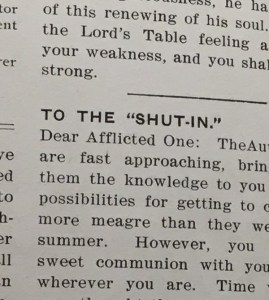
Douglas’s Open Letters to the Shut-Ins

by Ronald R Johnson (www.ronaldrjohnson.com)

During his first pastorate at Zion Lutheran Church in North Manchester, Indiana (USA), Lloyd Douglas published a weekly newsletter. One of the notable features of the paper was a weekly editorial addressed specifically to the homebound members of his congregation. These open letters are fascinating because they are so tender, thoughtful, wise, and compassionate, while at the same time being pretentious, pompous, condescending, and preachy (coming as they do from a young man just out of seminary talking to people two or three times his age).

The article I am about to share with you is from The Church and Sunday-School, Published by Zion Lutheran Congregation, North Manchester, Indiana, Vol. 1, No. 2, September 11, 1903, p. 3. It’s in Douglas’s earliest scrapbook, p. 15, Box 5 of the Lloyd C Douglas Papers at the Bentley Historical Library.)

FOR THE ‘SHUT-IN’
Do not think, dear brother or sister, that because you are afflicted, we have forgotten you. Our prayers ascend for you very often, and our hearts yearn for the time when you can be with us again. If some of us are so busy with toils and cares that we do not come to see you, do not take that to mean that we are not inquiring about you often and wishing best possible things for you. The church is doing splendidly; all the departments are taking on new life. Really, you would not recognize some of our auxiliaries, they have changed so. The prayer-meeting is becoming in favor with a great many people. The Sunday-school is witnessing an ingathering of some who had outgrown it years ago and are just now getting back. We are anxious to have you with us, but until you can come, will you do us the service of praying for the church and her work? On Wednesday evening, for instance, ask God to speak to those who are not housed up as you are, and tell them to go to His House and receive strength for better service.

The next week (Vol. 1, No. 3, September 18, 1903), he wrote this on pp. 3-4:

Dear afflicted one—we are still missing you. You wish that you might come to our services, and we wish, too, that you might. You will be happy when we tell you that we are on the high road to prosperity. Do you remember the little handful of people who used to come to Prayer-meeting? Well, we have doubled, and trebled our number. Just at present we are having Bible Readings. Look up the topic for Wednesday Evening in the Calendar, and find all the Scripture references you can on that subject—just so you will feel that you are having a part in our work. Know how to do that? Here is an example: Next Wednesday evening the topic is ‘Baptism.’ Find some verse relating to Baptism—John 3:5. In the verse you will find a letter that refers you to a marginal reference. Find this letter in the margin and it will refer you to Mark 16:16. Read that verse and discover a clue to other verses on the subject. This is systematic Bible study. You will be greatly helped by it. Do not forget to pray for others in affliction. No matter how distressed you are, you will always find someone who is worse off than yourself. Let your prayer for your own happiness be made in humble submission. Ask God to remove your affliction, if it is His Will, and if not His Will, to give you Divine Grace for your trials, that you may bear them.

In Vol. 1, No. 6, October 9, 1903, p. 3, he said,

Dear Friend: We are confident that you were thinking very seriously last Sunday morning while your brothers and sisters in the church were gathering about the altar to receive the ‘Broken Body’ and ‘Shed Blood’ of the Savior. We wished you, too, might have been with us, and we prayed for you, that the Savior would manifest Himself to you in the Spirit of the Comforter while this sacrament was being ministered. There are few burdens so heavy that might not be still heavier. Be thankful for the blessings you have, and pray for grace to sustain you in your trials.

Sometimes he just filled them in on what was happening at the church. But these words excerpted from a longer communication in Vol. 1, No. 5, October 2, 1903, pp. 2-3, are especially touching:

Dear Afflicted One: The Autumn days are fast approaching, bringing with them the knowledge to you that your possibilities for getting to church are more meagre than they were in the summer. However, you can hold sweet communion with your Saviour wherever you are. Time was when men thought the only way to worship God was in His Temple; that adoration and praise were only to be rendered in the House of Prayer. Those were the days of burnt offerings, and as such offerings were made through the media of the priests, the Temple was the only place where such worship might be rendered. But now conditions are changed. ‘The Sacrifices of God are a broken spirit; a broken and a contrite heart, O God, Thou wilt not despise.’ Since Christ is our Great High Priest, we may worship God through Him, and since He is a Spirit, it is not necessary that we should defer our prayers until the time we may go into a church set apart for sacred homage to the King.

After some newsy items, he concluded with this (and it could serve as a benediction for us all):

May the compassionate Christ be very dear to you in your afflictions. ‘No pathway so thorn-strewn that He cannot guide securely; no night so long and dark that He, the Bright and Morning Star, does not bring the dawn; no burden so heavy that He, the burden-bearer, does not beg to share it; no trial so sore, no temptation so threatening, no sorrow so sad, that He, the compassionate, does not say in tenderness: ‘Come unto Me, all ye that labor and are heavy laden, and I will give you rest.’

For a free PDF copy of the booklet, The Secret Investment of Lloyd C Douglas, fill out the form below:

← Back

Thank you for your response. ✨

A New Dispensation

by Ronald R Johnson (www.ronaldrjohnson.com)

When Lloyd Douglas took over as pastor at Zion Lutheran Church in North Manchester, Indiana (USA) in the spring of 1903, he did not consider it business-as-usual. He may have been in a little town, but he intended to shake things up. Just months after he arrived, he began publishing a four-page weekly newsletter. It is typical (now, at least) for congregations to have newsletters, but this was on high-quality paper and had a photograph – not just a drawing – on the front cover. In 1903, it was unusual even for local newspapers to include photographs. (The image below is from Douglas’s earliest scrapbook, p. 15, in Box 5 of the Lloyd C Douglas Papers at the Bentley Historical Library.)

“This paper is to herald the arrival of the ‘new dispensation,'” he wrote. “It has been advisable to issue it [the newsletter] at this time because many of us feel that we have begun a new epoch in the life of the church. We have decided to work harder, to pray more.” [Underlined in the original, and “pray more” is double underlined.]

Later in this same issue, he shamelessly borrowed Admiral Horatio Nelson’s message to the British fleet before the Battle of Trafalgar in 1805: “Remember that we are starting in on a ‘New Dispensation,’ and we must say as was said to Britain’s sons: ‘England (The Church) expects every man to do his duty.’”

No doubt his enthusiasm was contagious, but he could also get carried away, issuing orders to “the troops,” forgetting that most of them were older – indeed, far older – than he was.

The following week, he wrote: “Those of our readers who attended last Sunday’s services need not be told that there is a ‘great awakening’ in our work. It was manifest in many ways. There were visitors attending who have not been in our church for months; there were members with eyes open to the comfort of the stranger; there was soulful singing and a spirit of deep devotion to be noticed. These are elements of success, and as they continue to be practiced we will observe an increasing attendance at church services. The work is now but fairly started…” Nor did he intend to see it slack off.

“Where, indeed, shall we begin to tell of the transformation at work in the Sunday-school?” he asked later in that issue. “The Bible Class has suddenly grown to a size which warrants a division…. There were people in Sunday-school last Sunday who had thought long ago that they had outgrown it completely, but they say they are coming again.”

Douglas’s arrival in the sleepy little town of North Manchester was about as abrupt as that of a tsunami. He had lots of energy and an endless supply of ideas. But there was only so much he could do in such a small town, especially in a place where everybody knew him as a youngster; so his ministry didn’t really take off until he left for his next pastorate in 1905. But we can see signs of his later genius even here. The newsletter is an example. He wrote each article of each issue himself, and he did it in an intimate voice as if he were speaking to you, the reader. When his parishioners died, he himself wrote the obituaries for the newspaper, and he did it with all the passion and eloquence of a novelist. On at least two occasions he preached a sermon series on weeknights, as if he were a big-name evangelist. He seemed surprised when the young people of his congregation did not flock to his new Sunday afternoon catechism class.

But he wasn’t “all work and no play.” While he was in North Manchester, he pulled some strings to help get Dr. F. M. Porch of Louisville, Kentucky, the position of pastor at Grace Lutheran Church in nearby Columbia City, then wooed and won his daughter – Bessie Io Porch – and made her his wife. He also wrote a book. It was a busy two years!

For a free PDF copy of the booklet, The Secret Investment of Lloyd C Douglas, fill out the form below:

← Back

Thank you for your response. ✨

Design a site like this with WordPress.com
Get started