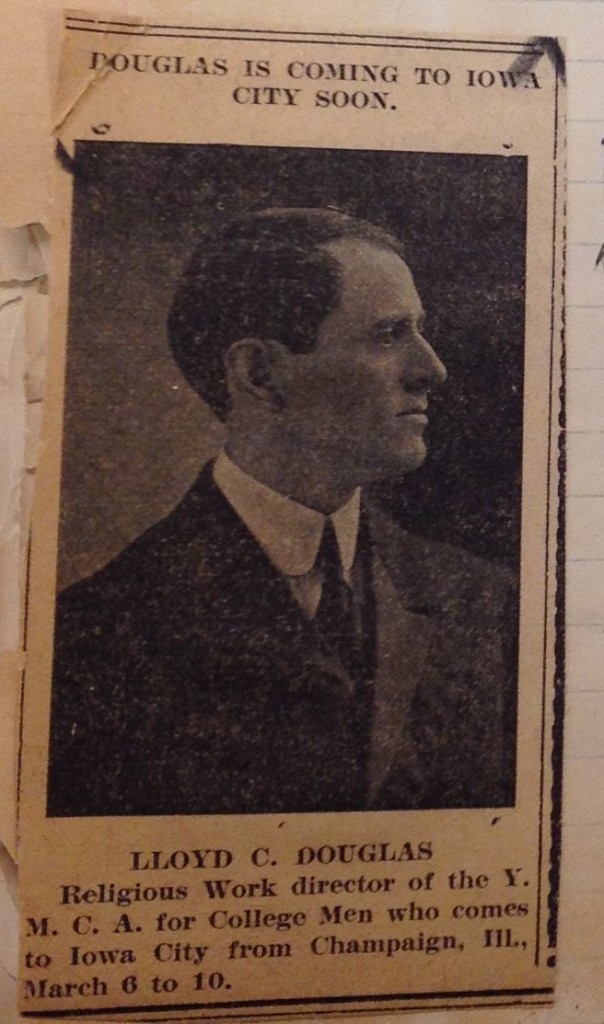
Douglas’s “Pen Portraits of Prominent People”

by Ronald R Johnson (www.ronaldrjohnson.com)

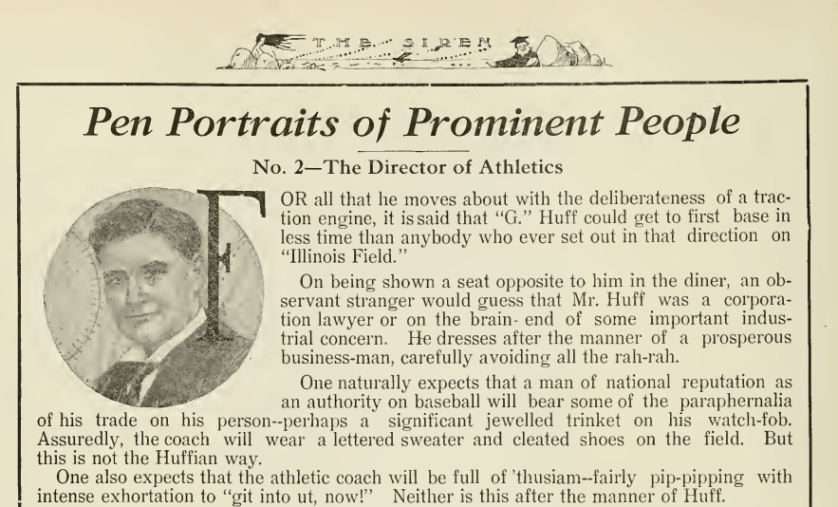
Besides contributing a weekly column in the University of Illinois’ student newspaper, the Daily Illini, Lloyd Douglas also wrote anonymous articles in The Siren, a student-run magazine. During the 1914-1915 school year, he wrote a series of tributes to the university’s top administrators, describing their distinctive characteristics (hence the name “Pen Portraits”). It was just like Douglas to give the series a memorable title through the use of alliteration: “Pen Portraits of Prominent People.”
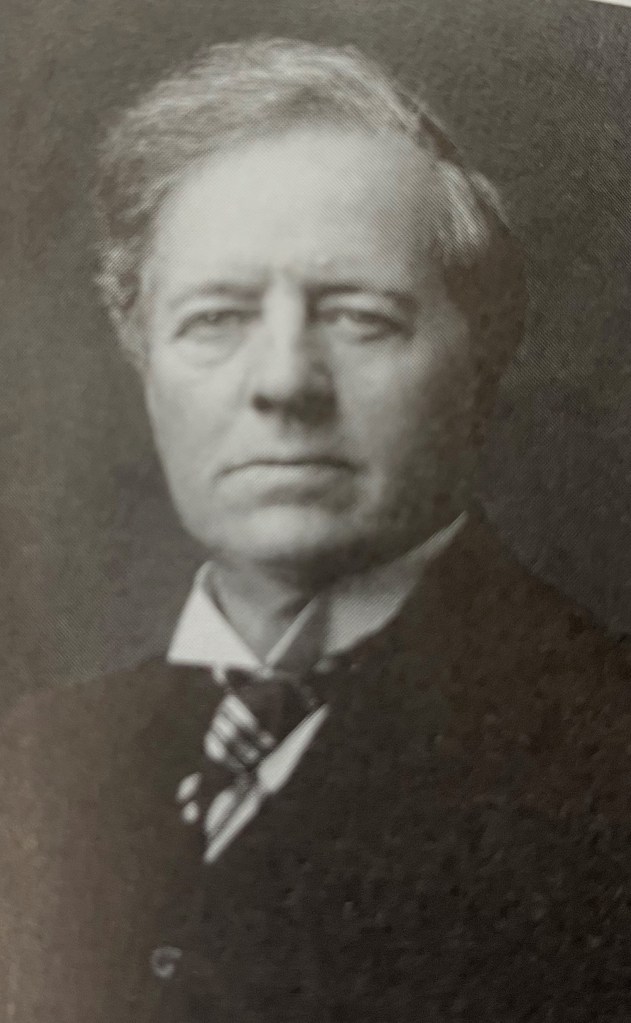
Dr. Edmund James, President of the University of Illinois from 1904 to 1920.

Dr. Edmund James is remembered as one of the university’s successful presidents, helping to bring about the school’s growth, not only in its physical plant but also in its reputation. (See, for example, Robert P. Howard, Illinois: A History of the Prairie State (Grand Rapids: Eerdmans, 1972), p. 404, and Allan Nevins, Illinois (NY: Oxford, 1917), pp. 210-218.)

In his Pen Portrait of the “Prexy” (the nickname for “President”), Douglas called James “a cosmic person whose resourcefulness will not be fully understood” until decades later. “For the Prexy is living in the future…. [He] turns out early these fine mornings on his saddle-horse and as he rides about the campus he sees great buildings that aren’t there at all. But they’re real enough to him! He guides his horse carefully around them and peoples them with thousands of students who have yet to be born.

“However, living away out yonder as he does – a dozen decades beyond tomorrow – the Prexy is mightily interested in today. He has his fingers on the pulses of all the colleges that make up the University – very steady fingers, too, when one remembers that the Prexy is venerable in years. He knows what grade of steel and concrete is going into the new Chemistry laboratories; knows how much Pat O’Brien earns per hour, shoveling dirt out of the hole where the Administration Building will stand; knows the name of the last new book that came into the library yesterday.

“He has just one obsession…. the future greatness of the University of Illinois!”
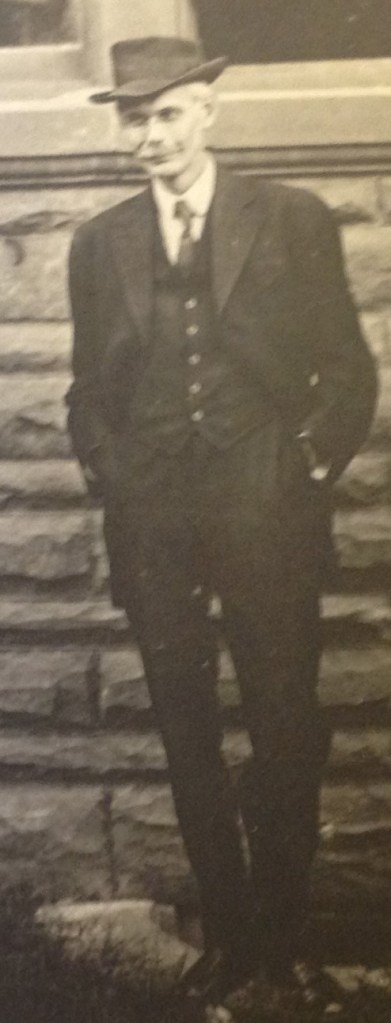
Thomas Arkle Clark, the Dean of Men.

Thomas Arkle Clark, the Dean of Men, was and is a legend. When I spent a few days at the University of Illinois archive in 2015 and asked the librarian to get me his private papers, she was thrilled. “Are you going to write a book about him?” “No,” I told her. “I’m writing about the bestselling novelist Lloyd C. Douglas.” “Oh,” she said, looking very disappointed.

Somebody needs to write a book about Thomas Arkle Clark; it’s well overdue. They say that, during Prohibition, he broke up a party at a frat house by coming down the chimney like Santa Claus. Of course, it didn’t happen – it couldn’t have happened – but stories like that were told and retold even while he was still alive because they caught the essence of the man. In his Pen Portrait of the Dean (whom he refers to as “Tommy”), Douglas says:

“It is confidently asserted of Tommy that he can flay his victim and nail his quivering pelt to the mast with greater ease and dispatch than any other skinster between the Aurora Borealis and Palm Beach. Moreover, the flaying is achieved so deftly and with such a wealth of good humor that the hideless one rejoices over his… condition, regretting that he has only one skin to give to his executioner….

“Perhaps there is no place in all this world where a man is so courteously invited to build his own scaffold, make his own funeral arrangements, adjust his own black cap and kick himself through the trap, as in the pleasant room of vast distances where Tommy sits day by day, calmly and dispassionately dealing with a docket full of the delinquent and deficient.

“It is mostly a court of reprieves. Tommy only hates one type – the liar. If one has business with the Dean o’ Men, it is better to tell him the truth at once, thereby saving time and self-respect. It is privately believed in certain quarters that Tommy has an X-Ray attachment in the top rim of his glasses and that when he lowers his head to gaze over them, he can see what the culprit had for dinner…”

Douglas wrote about “G. Huff,” the Athletic Director…
…Johnny O’Byrne, the baggage guy at the local train station…
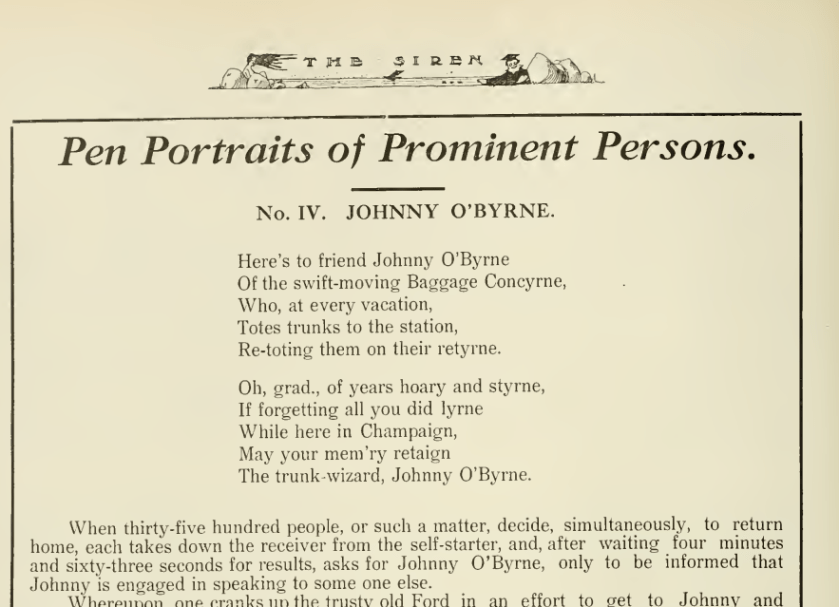
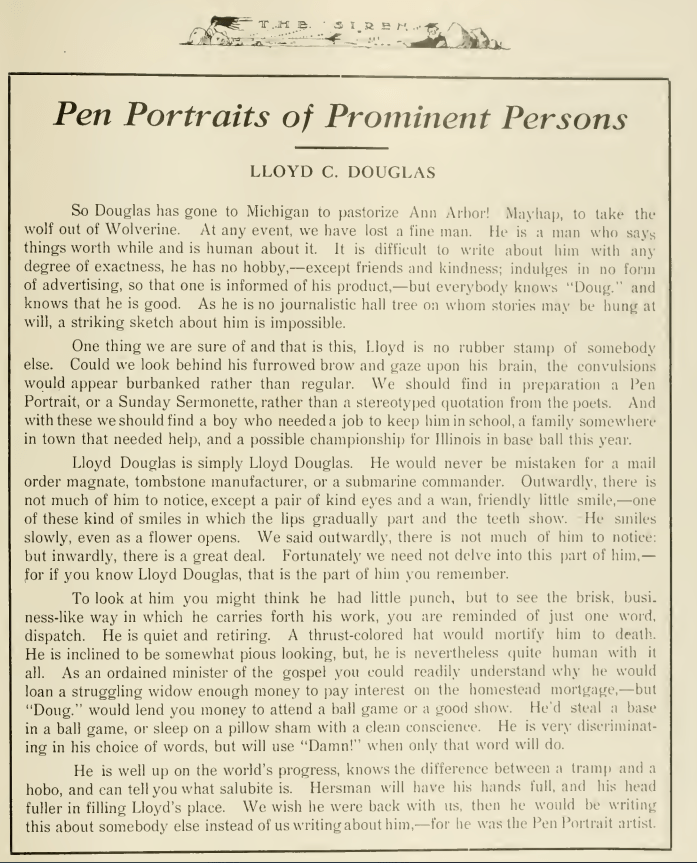
…Eugene Davenport, the Dean of the School of Agriculture, and other people well-known to students and faculty. Each essay was fun, imaginative, and full of life. Not religion, but life. As I mentioned earlier, they were also published anonymously. Month after month, everyone on campus must have speculated about who wrote them. This was during the 1914-1915 school year, and in the early months of 1915 Douglas left to become pastor of the First Congregational Church of Ann Arbor (in Michigan). The student editor of The Siren, Ralph Barlow, wrote the final “Pen Portrait” himself, and it was a tribute to Douglas.

I’ve included an image of the complete essay below, because it’s full of first-hand observations of Douglas. It also must have been the talk of the school, because of the concluding sentence: “We wish he were back with us, then he would be writing this about somebody else instead of us writing about him – for he was the Pen Portrait artist.”
But even though he was becoming better at writing for secular audiences, Douglas still felt the call to be a pastor. While he was at the University of Illinois, he was working on that, too, behind the scenes. I’ll tell you about that in the next post.

To receive a free PDF of the booklet, The Secret Investment of Lloyd C. Douglas, fill out the form below:

← Back

Thank you for your response. ✨

A New Start

by Ronald R Johnson (www.ronaldrjohnson.com)

Lloyd C Douglas, circa 1911-1912. From a promotional brochure in his 1909-1915 scrapbook.

Something happened to Lloyd Douglas between 1912 and 1913. In the previous post I told you that, in 1912, he invested secretly in Roger Zombro by writing anonymous ads for him in the Daily Illini. Neither of the two men ever mentioned it, but I have a lot of evidence to back up that hypothesis. (I have included it in the booklet The Secret Investment of Lloyd C Douglas, available upon request.) Of all the evidence I have gathered, the most important is this: Douglas’s writing style changed between 1912 and 1913, the exact period during which the anonymous “Zom” ads began running in the student newspaper.

Douglas had always been a powerful writer, but his earlier essays were intense. His sense of humor shined through, too, but overall he came across as a very serious young man. In the fall of 1913, though, he began displaying a more relaxed, whimsical style that would characterize his writing for the rest of his life. He was still a powerful writer, but he exercised that power in a new way: through a nonchalant, humorous presentation somewhat like that of Mark Twain. Prior to this, he reached out and grabbed you by the lapels with his writing, but now he disarmed you with humor and casually persuaded you. I believe it was his anonymous work on the “Zom” ads that gave him this breezy new way of expressing himself; but even if I’m wrong about the cause, the effect is obvious. In 1913, Douglas found his voice as a writer.

And there was something else: prior to this, Douglas’s writing was religious. It was church-oriented. In 1913, he put that behind him. He spoke as one who was deeply acquainted with the day-to-day lives of real people, both students and faculty. He focused on the things that mattered to his readers.

We see his new style exhibited in a weekly column he wrote in the Daily Illini called “The Sunday Sermonette” (later changed to “The Weekly Sermonette”). He doesn’t sound like a young man anymore; he sounds like a wise older man with a sense of humor and a very light touch. There were flaws in these “sermonettes” – they were often paternalistic and somewhat patronizing – but they were popular and down-to-earth, and they set a course for all of his future writing. For example, when he moved to Ann Arbor, Michigan, in 1915, he started writing a weekly column in one of the local newspapers called, “The Saturday Sunset Sermonette,” aimed more at the townspeople than the students. The “sermonettes” in the Daily Illini set the pattern.

Here are some examples from the Daily Illini column:

On writing home to Mother: “If you wish to make a distinct hit with her, tell her how you are faring as to creature comforts. Since you came upon this planet, her chief concern has been your physical well-being. She was always glad, of course, when you exhibited any interest whatever in the development of your mind or the culture of your soul; but her first thought for you has always been cast in terms of food, clothes, shelter. Tell her where you are living. Draw a map of the house, showing the position of your room. Draw a diagram of the room, indicating doors, windows, closet, registers, book-cases – where you sit when you study, etc.” (“The Letter Home,” Daily Illini, Sunday, September 28, 1913, p. 4).

On rags-to-riches stories: “Reacting against an ancient notion that a man must be hereditarily rich and influential to achieve greatness, book markets of our country are glutted with biographies of eminent men who came up into positions of trust and honor from homes of poverty…. In view of the highly prosperous state of our civilization, perhaps it might be just as well to ease up a bit now on advice for the poverty-stricken and make some effort to provide an inspirational pabulum upon which the rich man’s son may feed” (“Washington,” Daily Illini, Sunday, February 22, 1914, p. 4).

On hanging out with the crowd: “The student who fails to provide for an occasional hour by himself becomes about as original and inventive in his thought and speech as the funnel of a phonograph” (“The Man Himself,” Daily Illini, Sunday, October 5, 1913, p. 4).

On rushing around campus, taking oneself too seriously: “Many people here, students and others, are afflicted with a ‘busy’ bee. They maintain the breathless attitude of one who leaps from an engagement brimful of crisis to another even more fraught with fearful consequences…. Cold-blooded as it sounds to say it, the world was hobbling along – handicapped, to be sure, but managing to struggle painfully along – before any of us arrived and it is… possible that the world may continue to do business when the grass is a foot high over the place where our tired bodies rest from their frenzied scramble to attend to so many important things at once” (“How Doth the Little Busy Bee?” Daily Illini, Sunday, April 26, 1914, p. 4).

These are just a few examples. A little later (the 1914-1915 school year), he also began writing “Pen Portraits” of the university’s top administrators. As with the “Zom” ads, he published them anonymously – only this time his identity was revealed. I’ll tell you about it in my next post.

To receive a free PDF of the booklet, The Secret Investment of Lloyd C. Douglas, fill out the form below:

← Back

Thank you for your response. ✨

A Well-Kept Secret about Lloyd C Douglas

by Ronald R Johnson (www.ronaldrjohnson.com)

In his 1929 novel Magnificent Obsession, Lloyd C Douglas taught that we can gain a special intimacy with God if we invest in the lives of others and do it secretly. Throughout the years of my research, I’ve been on the lookout for signs that Douglas practiced what he preached, knowing that, if he did those things in secret, then it would be difficult – if not impossible – for me to discover them.

It was difficult, but I did discover a clever investment he made in a young shopkeeper during his time at the University of Illinois. I don’t have conclusive proof, but I have a very strong case. I believe that he wrote anonymous ads in the Daily Illini for Roger Zombro, owner of a haberdashery on Green Street.

In the two photographs below, Jack Scanlan (Class of 1911) is surrounded by four of his female classmates. They’re goofing off in the first picture, but it looks as though, in the second one, the photographer has spoken to them sternly and tried to get a serious portrait, although there’s still a hint of mischief on some of the faces.

Jack A. Scanlan Scrapbook, 1907-1911, University Archives, Student Scrapbooks and Papers, Series No. 41/20/39, Box 1, University of Illinois.

Notice what young Mr. Scanlan is wearing: not just a suit, but an old-fashioned detachable collar, as well as a tie. That was the dress code in those days.

At his store at 604 East Green Street, Roger Zombro sold just such small-ticket items: shirts, collars, ties, umbrellas, etc. He had a lot of competition, for there were bigger clothing stores in town, and they sold suits as well as accessories. They also put more money and thought into their advertising in the student newspaper.

Here’s how Roger Zombro originally presented himself to the student body:

Daily Illini, Wednesday, September 20, 1911, p. 6.

Doesn’t exactly make you want to stop what you’re doing and go to his store, does it? But then, a year later, his persona changed drastically:

Daily Illini, Thursday, October 31, 1912

The ad mentions campaign cigars because the 1912 presidential election (Taft vs. Wilson vs. Teddy Roosevelt) was wrapping up. This ad is so much more interesting, more lively, more in tune with the life of the students it was designed to reach. And I’m convinced it was one of many that were written anonymously by Lloyd C. Douglas between Fall 1912 and Winter 1915, as a personal investment in the life of Roger Zombro – an investment that not only boosted Zombro’s career but also helped Douglas find his voice as a writer.

I had to do a lot of detective work to uncover this secret – both men were serious about keeping it secret, apparently – and there’s not enough space on this page to tell you how I did it. I’d love to send you the free PDF document in which I lay out my case. Just fill in your name and email address in the form below.

← Back

Thank you for your response. ✨

Thinking His World Through

by Ronald R Johnson (www.ronaldrjohnson.com)

From Douglas’s 1909-1915 Scrapbook, Douglas Papers, Box 5, Bentley Historical Library, University of Michigan.

In his 1912 visits to the University of Iowa, Simpson College, and Milliken University, Douglas’s lectures revealed what he was thinking. Professor Edward Diller Starbuck said that Douglas had “thought his world through,” but he really hadn’t – not yet. He was just beginning to do that. He had retired from active ministry and gone to the University of Illinois to start over, and to rethink his theology. The lectures Starbuck and others heard give us some clues about the basic building blocks with which Douglas was working.

(The following quotations are from newspaper reports of those lectures, collected in his 1909-1915 scrapbook.)

“Christianity is not the only religion of value,” Douglas told his audiences. “But Christianity… deserves the support of every believer in progress, liberality of thought, and universal brotherhood.” These were the basic beliefs promoted by the new state colleges: a belief in progress, in academic freedom, and in respect for one another regardless of nationality. Douglas also considered them basic Christian principles. On his view, anyone who accepted the new state-college frame of mind should also recognize the worth of Christianity.

“Take a map of the world,” he said; “draw in red an outline of Christendom and you will have drawn a map of all of the arts, sciences, inventions, and discoveries which are regarded seriously by the great universities.” Unlike many other ministers of his day, he did not feel that Christianity was incompatible with what was being taught in the universities; on the contrary, Christianity had, throughout history, provided the nurturing environment for all humanity’s great discoveries and achievements. As the nation’s colleges passed these accomplishments on to new generations, they were inadvertently paying homage to Christian faith.

As one newspaper reported, Douglas told his listeners “that Jesus was the interpreter of the infinite, and as a practical illustration cited the experiment of connecting a dynamo of infinite power with a motor of limited voltage. Except for a transformer, the little motor would have no efficiency and be torn to pieces. Jesus, he said, was the transformer between God and man, having come to the earth and [having] lived life on a human scale.”

In these lectures, Douglas professed a belief in Christ’s divinity. “The speaker said Jesus was divine and only as a divine character could he make the claims he made concerning himself.” The fact that Christ’s divinity was first embraced by a bunch of Hebrew Monotheists is significant, Douglas argued. They believed in one God, not God the Father and God the Son, but one God. Yet they ended up believing that Jesus was the Son of God. Their experience with Jesus must have been especially powerful to have outweighed their Jewish upbringing.

Douglas also said he believed in the Virgin Birth. “Mr. Douglas conceded, however, that if the ‘virgin birth’ proved a stumbling block to a man’s acceptance of Jesus, let him accept the facts about Jesus which he was sure he could understand and appreciate, and let his faith do the rest.”

It’s clear from these clippings that Douglas was still traditional in his most basic beliefs (that Jesus was both divine and divinely-conceived), but he was trying to find the points of convergence between his faith and the new state-college worldview. He didn’t think it was necessary for his listeners to profess beliefs that contradicted their everyday lives. From physics they could understand the function of a transformer acting as an adapter between a motor of higher voltage and one of limited voltage. By analogy, they could also understand Christ’s function as “the interpreter” of a Higher Power. It was not necessary for his listeners to profess that he was born miraculously as long as they could accept his function as “the interpreter of the infinite” in their own lives.

We also see Douglas trying to make Christ’s message relevant for his audience right now, while they’re still students. “There are a host of specific temptations proposing themselves to student life which exist nowhere else in precisely the same form and proportions,” he said. “Every man should solve his problems as they come to him. The octogenarian need not pride himself upon his chastity. The high school lad need not boast that never, as cashier of a metropolitan bank, had he made off with the loot. There is the problem of the little boy to be a bully, a sneak and a liar. There is the problem of the old man to be misanthropic, sour, sore, bitter, critical. But the student meets… temptations peculiar only to this type of life.”

Among the temptations of students, one newspaper said, Douglas listed indifference. “It was shown that many students… hurry through their student days ‘planless, plotless, breathless, and thoughtless, looking forward to that glorified day of graduation when the whole machinery of life would be set in a safe speed clutch and the symphony of life be pitched in a major key.'” The temptation, according to this reporter, was “failing to realize that the university experience is valuable for its own sake and not merely as a period of preparation for something later on…”

Even today, it would be rare for us to hear a minister say that one of the main temptations of students is to fail to appreciate education for its own sake. The title “Specific Sins of Students” would seem to suggest drinking, or illicit behavior with co-eds, or cheating on tests. But Douglas placed a deep trust in secular education. He recognized the new state colleges as sites where the truth was being discovered and disseminated on a daily basis. We cannot appreciate Douglas’s theology apart from this. He saw a new world coming into being at schools like the University of Iowa, Simpson, Milliken, and the University of Illinois. He did not feel threatened by the New Learning. It inspired him. Everything he taught and wrote throughout the rest of his life must be interpreted with this in mind.

But he wasn’t just developing his theology; he was also pursuing an exciting new path in his creative writing. In terms of finding his voice as a writer, what happened next was one of the most important events of his life.

To receive a free PDF of the booklet, The Secret Investment of Lloyd C. Douglas, fill in your name and email address in the form below.

← Back

Thank you for your response. ✨

Douglas Is Coming!

by Ronald R Johnson (www.ronaldrjohnson.com)

As part of his contract with the University of Illinois YMCA in 1911, Lloyd Douglas agreed to give a series of lectures at some of the other universities in the region. Between March and November of 1912, he spoke at the University of Iowa, Simpson College (at Indianola, Iowa), and Milliken University (in Decatur, Illinois). The Y at each location did its utmost to get male students interested (the women had their own YWCA-sponsored meetings at the same time – yes, they were segregated), and some of the promotional materials are amusing. They treat Douglas like a celebrity.

From the Iowa City Citizen, undated, in Douglas’s 1909-1915 Scrapbook, Douglas Papers, Box 5, Bentley Historical Library, University of Michigan.
The Simpsonian, undated. In Douglas’s 1909-1915 Scrapbook.
From the Decatur Herald, undated. In Douglas’s 1909-1915 Scrapbook.

That’s a lot of hype, but Douglas was equal to it. His scrapbook contains clippings from both the college and city newspapers, and they all raved.

From the Simpsonian: “It is sufficient to say that Douglas made a deep impression on the religious life of Simpson men – and that is saying much in a school like this, where religious appeal is so familiar that, to use Douglas’s own expressive phrase, ‘people’s souls become grooved and calloused’ with well-meant but ineffective religious effort.” (Milliken was a Methodist college.)

From the Decatur Herald: “Interest was not allowed to lag at any moment…”

From the Iowan: “A body of over two hundred students listened to one of the most fascinating addresses of its kind last evening at the natural science center by Lloyd C. Douglas…”

From the Iowa City Citizen: “Mr. Douglas delivered another of his stirring addresses last evening.”

From the Simpsonian again: “The results of the meetings show very clearly that the average college man, even though of no special religious tendencies, can be made to feel a genuine interest in Christianity if it is presented to him in a sane, rational, and unprejudiced manner. The power to do this Mr. Douglas possesses in a remarkable degree.”

Rev. H. F. Martin sent this report to the Lutheran Observer regarding the series of lectures at the University of Iowa: “The editor of the ‘Daily Citizen’ remarked to [Rev. Martin] that within his knowledge no religious campaign among the students had ever made such an impress as this one.”

Perhaps the most significant statement, viewed from our vantage point today, came from Professor Edward Diller Starbuck, a pioneer in the field of Psychology of Religion, who taught at the University of Iowa: “Mr. Douglas is, in my opinion, just the man for us. He has thought his world through until he can speak of the deeper things of the spiritual life without compromise and with perfect candor. University life has been sadly in need of just such a message as he is giving, which is profoundly spiritual and at the same time is in accord with a modern world-view.”

In my own opinion, Starbuck was a bit too generous. Douglas had only gotten started “thinking his world through” and arriving at a workable theology. But Starbuck was right about this much: the modern state universities were “sadly in need” of a message that was “profoundly spiritual and at the same time [was] in accord with a modern world-view.” I would argue that we’re still in need of such a message. Most evangelists are anti-intellectual, and most Christian intellectuals are not evangelists. Douglas was trying to bring those two things together, and Starbuck saw that he was on the right track.

In my next post I’ll talk about the message that Douglas delivered in these lectures, and I’ll explain why he was really just getting started.

To receive a free PDF of the booklet, The Secret Investment of Lloyd C. Douglas, fill out the form below:

← Back

Thank you for your response. ✨

Behind the Scenes

by Ronald R Johnson (www.ronaldrjohnson.com)

At the University of Illinois, Lloyd Douglas worked at the new YMCA Building on the northwest corner of Wright and John streets, at the western edge of campus. He taught classes, wrote anonymous articles about the Y for the Daily Illini (the student-run newspaper), tried to get students to join the Y, and organized events featuring visiting speakers (most notably the organization’s leader, John Mott). Although he was busy, he was surprisingly low-key. He wasn’t in the news nearly as much as he had been as a pastor in North Manchester, in Lancaster, and in Washington, DC.

And there was a reason for that: Douglas had taken this job to get out of “active ministry” for a while and think things over. But he wasn’t the kind of man who needed to get completely away from it all in order to ruminate; rather, he did his best thinking when he knew he had to answer to the public, especially on a deadline. He no longer had to compose two sermons each week (for a.m. and p.m. services on Sundays), but he still wrote articles for religious periodicals (The Congregationalist now, instead of the Lutheran Observer), and he still taught classes at the YMCA and spoke at “smokers” designed to increase YMCA membership. (The university Y shamelessly imitated the fraternities, inviting young men to come and see a “lantern show” of Ben-Hur, for example, and hear an inspiring talk by Lloyd Douglas while enjoying a dessert and cigar.)

The newly-erected YMCA Building at the University of Illinois. Note the horse hooked up to the hitching post. From The Promise of Association: A History of the Mission and Work of the YMCA at the University of Illinois, 1873-1997 (Champaign, IL: University YMCA, 1997)
The same structure today. It’s no longer the YMCA Building, though; it’s Illini Hall. I took this picture in February 2015. There were no horses parked out in front.

But he wasn’t nearly as much in the public eye as he had been from 1903 to 1911. He spent time at the library across the street (that’s not a church steeple in the image below; it’s the campus library)…

…and he soaked up the campus culture. He spent most of his time with students, of course, but he was especially impressed with the faculty. Years later he wrote, “I had some exceptional opportunities to develop along the line of a liberal interpretation of religion during my work at the University of Illinois, where I came constantly in contact with a forward-looking group of very intelligent people who comprised the first sizable party of persons I had ever known who were both mentally solvent and religiously inclined. Up until that time only an occasional man of my acquaintance had qualified as [a] high grade intellectual and disposed toward a devout interpretation of religion. I discovered that it was possible for a man to be both religious and preserve his intellectual morality” (Douglas to Dr. Frank C. Ransdell, December 15, 1927. In Douglas Papers, Correspondence 1926-1930, Box 1, Bentley Historical Library, University of Michigan).

The most important work Douglas did at the University of Illinois was behind the scenes. He talked to people, and listened, and studied, and thought. Our best glimpse of the shifts in his theology comes from newspaper articles about the series of lectures he delivered at other universities during the second semester of the 1911-1912 school year. I’ll tell about that in the next post.

To receive a free PDF of the booklet, The Secret Investment of Lloyd C. Douglas, fill out the form below:

← Back

Thank you for your response. ✨

“Tremendously in Touch with Life”

by Ronald R Johnson (www.ronaldrjohnson.com)

When Isabel Bevier arrived at the University of Illinois in 1900 to become the head of its Home Economics Department, this is how she reacted: “I thought I had never seen so flat and so muddy a place, no trees, no hills, no boundaries of any kind” (Isabel Bevier, “The History of the Home Economics Department at the University of Illinois, 1900-1921,” University of Illinois Home Economics Library, Urbana, p. 14).

“It takes some imagination to visualize the five buildings on the campus when I arrived,” she said (p. 13).

She may have been exaggerating the sparseness of it, for records say there were more like ten buildings, if you include greenhouses. At any rate, the overall effect was the same.

Although this photo was taken after the erection of several important buildings, it gives us a sense of the wide-open spaces Professor Bevier saw in 1900. This was the view from the north end of the commons, facing south. Beyond the dome-shaped Auditorium is that part of campus that was devoted to agriculture, horticulture, and floriculture. From Jack A. Scanlan Scrapbook, 1907-1911, Student Scrapbooks and Papers, Series No. 41/20/39, Box 1, University of Illinois Archives, University of Illinois. Copyright University of Illinois.

But the situation changed quickly. Fifteen new structures were added between 1900 and the fall of 1911 when Lloyd Douglas arrived, and fifteen more were built during his brief time there (between 1911 and 1915). In contrast to Professor Bevier’s experience of wide-open spaces, Douglas saw a whirlwind of activity, with construction going on everywhere. (From Leon Deming Tilton and Thomas Edward O’Donnell, History of the Growth and Development of the Campus of the University of Illinois (Champaign-Urbana: University of Illinois Press, 1930), Table: List of Chief Buildings and Tabulation of Building Data, pp. 179-183.)

Using data from a few of these sources, I drew a crude map of the campus as it looked just after Douglas left in 1915. The north end was taken up by the various departments of engineering and by the physics department. A stream called “the Boneyard” runs east-and-west here, as well as Green Street, the commercial district of Champaign.

South of Green Street was the central campus, where most of the other departments were clustered around the commons. The library and the Auditorium were also located here.

Although the School of Agriculture was part of the main campus, the southern section had barns, fields, labs, and greenhouses for agricultural, horticultural, and floricultural research.

As you can see, it was no longer a wide-open place with empty spaces. Many of these buildings were added while Douglas was working at the university.

But it wasn’t just construction that made the place a buzzing hive of activity. For example, Allan Nevins wrote in 1917: “Twenty-six departments of the University are equipped with laboratories, placed in a dozen buildings.” Among them, he listed the following: “The mining engineering laboratory contains materials for drilling, blasting, mine rescue, and ore concentration work. In the mechanical engineering laboratory are large experimental boiler plants and gas engines, and such pieces of special equipment as an ice and refrigerating machine capable of making one and a half tons a day. In civil engineering are satisfactory road and cement laboratories, and in electrical engineering a wealth of machinery – sixty direct or alternating current machines, fifty transformers, experimental telephone switchboards, and so on.” (Allan Nevins, Illinois (Oxford University Press American Branch, 1917), p. 292.

Perhaps the most dramatic of these was the locomotive testing laboratory, which was unveiled in 1913 (while Douglas was there). The train engine was securely locked into place on a suspended track within a warehouse, then the engineer ran it at high speed while technicians measured its “tractive effort,” as well as its consumption of coal and water. The steam from its smokestack was funneled and directed out through the roof of the lab. There were only three other testing sites like it in the United States, and only two outside the US. (From E.C. Schmidt, “A New locomotive testing plant at the University of Illinois” (Chicago: American Railway Master Mechanics’ Association, 1913. Circular no. S-1912-1913).)

I.C. 2-8-0 Steam Locomotive (4) circa early 1910-1930, Locomotive in shop. Found in Box 9, Folder Engineering-Civil Engineering, Negative Number 899, Record Series 39/2/22, University of Illinois Archives, University of Illinois at Urbana-Champaign. Copyright University of Illinois.

A reporter for the student newspaper wrote, “The locomotive’s roar, the spinning of its giant wheels, the sight of its glowing firebox, and its sway from side to side, make lasting impressions on the visitors to this department” (“New Building Dedication Begins with Convocation,” Daily Illini, Friday, May 9, 1913, p. 8).

Graduate student Olive Deane Hormel (Class of 1916) summed it up well when she wrote that the university was “tremendously in touch with life.” (Olive Deane Hormel, Co-Ed (New York: Charles Scriber’s Sons, 1926)). She used this phrase three times in her book (pp. 10, 26, and 28).

The school was a buzzing hive of restless activity. Students were in training to be architects, engineers, lawyers, journalists, politicians, and lots of other things that were needed in the surrounding communities. By 1912 (while Douglas was there), “women interested in landscape architecture had begun to invade the classrooms of the University of Illinois, taking surveying courses and learning the names and characteristics of plants.” Two young women who were there at the same time as Douglas went on to successful careers: Annette Hoyt Flanders (class of 1918) set up her own practice in New York City in 1922; Florence Yoch (class of 1915) “became one of the leading designers of Hollywood estate gardens and film sets” (Natalie Alpert and Gary Kesler, “Florence Bell Robinson and Stanley Hart White: Creating a Pioneering School of Landscape Architecture.” In Lillian Hoddeson, ed., No Boundaries: University of Illinois Vignettes (Urbana and Chicago: University of Illinois Press, 2004), pp. 114-115).

From Melville J. Eames Papers, 1907-1908, Student Scrapbooks and Papers, Series No. 41/20/32, Box 1, University of Illinois Archives, University of Illinois. Copyright University of Illinois.

But it wasn’t all just academics. For male students, daily military drills were also compulsory. That was part of their education.

From Jack A. Scanlan Scrapbook, 1907-1911, Student Scrapbooks and Papers, Series No. 41/20/39, Box 1, University of Illinois Archives, University of Illinois. Copyright University of Illinois.

And then there was the social side of it all. The first several weeks of each school year were taken up with “rushing,” a word that nicely captures the frenetic activity involved. Not only did new students have to get used to the campus and their classes, but they also had to put their best foot forward as they were considered for membership by the various fraternities or sororities. Nor was it simply a question of what their social status would be among their peers. Even with all the construction going on around campus, the university had not yet built a residence hall. Those students who were not selected to join a chapter house were left having to rent a room nearby. For those who were chosen, however, here are a few examples of accommodations, along with a view of the residents, all from student Jack Scanlan’s scrapbook at the university archives:

Here’s a closer look at the main campus:

The chapter houses of the fraternities and sororities were all to the west, located either on John Street or down one of the side streets branching out from John Street. Every day, students by the thousands walked back and forth on that one street – passing right by Lloyd Douglas’s office. For he worked at the newly-constructed YMCA Building, which was on the corner of John and Wright Streets. (The females – the members of the YWCA – were in a house across the road, on the southern side of John Street.) There was all this buzzing activity going on, and Douglas was right in the middle of it.

They called him “the live wire down at the Y,” and yet, compared with the previous several years, he was strangely quiet. And there were reasons for that.

(To be continued…)

To receive a free PDF of the booklet, The Secret Investment of Lloyd C. Douglas, fill out the form below:

← Back

Thank you for your response. ✨

What Do You Want for Christmas?

woman with christmas gifts beside decorated fir tree
Photo by Laura James on Pexels.com

by Ronald R Johnson (www.ronaldrjohnson.com)

Quotable Quotes from Lloyd C. Douglas

From a sermon entitled, “What Do You Want for Christmas?” preached at the First Congregational Church of Ann Arbor, Michigan, on Sunday, December 14, 1919:

How would a wish like this strike you? To wish for some added grace of character that would make people love you, not for anything you had on, or for the house you happened to live in, or the material possessions you were known to command, but just because you are you.

So that, if the clothes go out of style, or the moth eats them up, or the house burns down, or panic upsets business, and rust corrodes your machinery – you will still be possessed of a grace of character that will make people respect you, and have confidence in you, and be glad when you come into the room where they are, and sorry when you leave.

The ability to wake up every morning with a smile and go to sleep every night with peace of mind and satisfaction of heart.

How would you like a gift that would ensure your happiness, in all kinds of weather; that would hold you independent of the inroads of little disappointments – a sort of perpetual guarantee against despair and dissatisfaction?

Somehow, I believe that if we might today choose, for a Christmas gift, absolutely anything we really wanted, to last us for life, this gift that I have been talking about would meet the demand.

Well, you may have it! Take it, and welcome.

Lloyd C Douglas, “What Do You Want for Christmas?” in Lloyd C. Douglas Papers, Sermons [4], Box 3, Bentley Historical Library, University of Michigan.

Seems like an abrupt ending, doesn’t it? Shouldn’t he have invited his listeners to come to Christ in that moment? But that was never his way. Douglas was always careful not to “stampede” people (his word) into making a commitment while under the emotional influence of the architecture, the music, and (yes) his own God-given eloquence. He wanted his listeners to continue thinking about it after the service was over, and to hear his question ringing in their ears above the noise of traffic as they headed home. If they truly didn’t know the next step, then he hoped they’d make an appointment with him to discuss it. But he trusted his material (the sermon he had been given) to continue doing its work after it was over.

So here it is, a hundred years later, still doing its work. What do you want for Christmas?

For a free PDF of the booklet, The Secret Investment of Lloyd C Douglas, fill in the form below:

← Back

Thank you for your response. ✨

What Douglas Wanted Most

by Ronald R Johnson (www.ronaldrjohnson.com)

Sometime while he was pastor at Luther Place Memorial Church in Washington, DC (between Fall 1909 and Summer 1911), Lloyd Douglas preached a sermon that must have puzzled his parishioners (Lloyd C Douglas, The Living Faith (Boston: Houghton Mifflin, 1955), pp. 14-21).

He claimed that the local congregation was like the Bethesda Pool in the fifth chapter of the Gospel of John. Paralyzed people gathered on porches around the pool because it was rumored that an angel sometimes stirred up the waters, giving them momentary healing powers; the first to wade in would be made whole. Of course, those most in need were never able to reach the water first. “Some of our churches are like that Pool of Bethesda,” he argued. “They are handsomely equipped…. But there seems to be such a noticeable lack of provision for bringing in just the people who are in such obvious need of its curative agencies.”

It was not enough for the churches to welcome visitors, he said. There had to be a way to get the gospel out to people rather than just trying to bring them in. The members of Luther Place Memorial Church must have wondered what Douglas was talking about, because Douglas’s predecessor, Dr. J.G. Butler, had been very effective at reaching out to the larger community, not only by being chaplain of both the House and the Senate, but also by mentoring young black men who were called to ministry. The church even had a health clinic run by one of Butler’s sons, who was a doctor. So why was Douglas saying that the church needed to find a way to get its “curative agencies” out to the people who needed it most?

Because Douglas wasn’t talking about social programs. He was talking about accessing the power of God and putting it to work in our lives, and he was saying that the church had not yet found a way to get this access out to the people who would never come to church. For him, the gospel was not so much about church attendance as about harnessing divine energies to make the world a better place. The mission of the church was to get that power into people’s hands – even people who did not attend church. In his sermon on the Bethesda Pool, he said that, if he knew how to accomplish this, then “by next week I would be figuring in headlines an inch high in a thousand metropolitan papers.” Although this was an expression of youthful hyperbole, it shows just how important this issue was to Douglas. He wanted to articulate a gospel that would have practical effects in everyday life, and he insisted on taking that message to the larger public.

Although no one who heard that sermon probably realized it, he was telling them the thing he wanted to accomplish above all else. And the missing puzzle piece was this: he wanted to reach people outside the church through his writing.

Although his parents groomed him for the ministry from a young age, he seems to have sensed an even deeper calling to be a writer. Nor did he just want to publish sermons and religious essays. For as far back as his scrapbooks take us, he was kicking around the idea of writing something for the mass reading public, and what he had in mind was fiction. In his letters to friends and family, he made light of this aspiration, calling himself “a scribbler” and speaking as though his passion for writing were an addiction.

In a letter to his cousin Edith Kirkwood in 1910 (while he was pastor at Luther Place), he said, “Lately I have revived an old slumbering passion for writing yarns. Not long ago I sold a small ornament off my desk to Eddie Bok [an editor] and the sight of that check, with its beautiful corrugated edges – albeit it was not for more than two figures – started up my old trouble; and the gnawing at my vitals… has compelled me to scribble some more. God help the preacher who isn’t content to stick to his parish duties!… I have a lot of old mummies in my ecclesiastical museum who would feel that Hell had opened up its maw (and its paw, for that matter) to embrace me, were the news to out that I had disgraced the profesh and besmirched the cloth by writing fiction. I shall spare them the discomfort by seeing to it that nobody finds out. I am now on the hunt for a satisfactory nom-de-plume…” (Quoted in Virginia Douglas Dawson and Betty Douglas Wilson, The Shape of Sunday: An Intimate Biography of Lloyd C Douglas (Boston: Houghton Mifflin, 1952), p. 66.)

In 1910 he was willing to keep his fiction writing a secret by using a pen name, but a year later, when the YMCA offered him a job and a chance to say “Good riddance” to the “old mummies,” that seemed like a better plan. As it turned out, he didn’t tell his employers at the Y that he was writing fiction, either, but that was all right; his fiction wasn’t good enough to display yet. At this phase in his life, he had a lot to learn about the craft of writing fiction. The point is this: his devotion to “scribbling” went so deep, he couldn’t beat the addiction, even though he felt guilty about indulging in it while being a man of the cloth. But deep down, he always believed he was going to make it as a writer. It may seem like a small thing, but take a look at the opening page of his very first scrapbook in 1903.

That’s more than a signature; if I’m not mistaken, he was practicing his autograph – the same one he used years later to sign copies of his bestselling novels. Here’s a signed copy of the inside page of Forgive Us Our Trespasses, published almost thirty years later, in 1932. It is practically identical:

Lloyd Douglas the Author was always there in germinal form, even while he was working so hard to establish himself as a minister. And he obviously felt those two things were incompatible, at least in the minds of some of his parishioners.

Over the past several blog posts, I’ve addressed the question, “Why did Douglas resign his important post at Luther Place Memorial Church to work for the YMCA?” So far I’ve answered this question in bits and pieces, but now I’m ready to pull it all together into a coherent explanation.

Douglas resigned for many reasons, most of which he kept concealed. He wanted to go back to school and get the kind of education he could only get from a state university. At that institution, he wanted to rethink his theology and align it with the latest, most up-to-date information available. Pursuant to this goal, he wanted to leave the Lutheran Church and start fresh with some other denomination. And he wanted to do all this not only so that he could preach again, but – more importantly – because he wanted to write something… probably fiction. He couldn’t quite put his finger on it. If anyone had asked him in 1911, he would have been incapable of telling them what he had in mind. But he did have something in mind, and he sensed that he would never bring it to full expression unless he could shed his current social limitations and start over.

And that’s why Lloyd C Douglas moved his family west to Champaign, Illinois in the Fall of 1911. He had great hopes. But he was taking a tremendous risk.

For a free PDF of the booklet, The Secret Investment of Lloyd C Douglas, fill out the form below:

← Back

Thank you for your response. ✨

Brave New World

by Ronald R Johnson (www.ronaldrjohnson.com)

The University of Illinois

When Shailer Mathews traveled the United States to tell the general public about the new biblical scholarship being done at the University of Chicago and elsewhere, his message included a description of the new state-college system that was transforming the social landscape in America.

It had been happening all around us, he argued, and yet we were strangely unaware of it. During the Civil War, Congress had passed legislation mandating that each state set aside lands and funds for colleges, and the state-sponsored schools that resulted were quite different from the colleges and universities that had been in existence prior to that. The old colleges and universities were sponsored by religious organizations and taught a fixed body of knowledge that was assumed to be true for all time. These new schools were research institutions. The professors were engaged in state-of-the-art research, and teaching was secondary. This had a number of ramifications, but perhaps the most important, according to Mathews, was the fact that the teachers and the students in these schools looked at the world through new eyes. Part of the new worldview was a belief in the tentative nature of knowledge: since the members of the faculty were constantly making new discoveries, they taught their students to expect updates, at least once in a while if not constantly. Graduates of these institutions went out into the world with the tools to keep learning throughout their lives. And as they did so, and they participated in the workplace, especially in management and professional positions, they were transforming their society.

This brave new world they were creating was one in which facts were of supreme importance – not opinion, not feelings, not beliefs, but facts. Those facts were gathered systematically, according to procedures that, as much as possible, were developed to mimic scientific investigations. The old institutions of learning had stressed literature, history, and philosophy; the new institutions were – or at least strived to be – scientific. And the young people who graduated from these new schools were quietly changing the world.

Of all the things Mathews said, this touched Douglas most deeply. Douglas had been home-schooled. His mother and father were both educators, and they gave him a rigorous classical education: in other words, an education that emphasized literature, history, and philosophy (or in his case, theology). On more than one occasion, he hinted that he was not very happy with the education he received at Wittenberg College (a Lutheran institution), and he was especially critical of the seminary, saying it did not give him any of the hands-on training that was necessary for being a pastor. When Mathews talked about the new state universities and the influence they were having on American society, Douglas’s imagination soared. He not only wanted to understand what was happening in the state colleges; he wanted the kind of education they offered. Although he was in his late thirties, he wanted to go back to school.

When the YMCA told him they had created a position for him at the University of Illinois, it was an offer he couldn’t refuse. Sometime later, when he was a pastor in Akron, he looked back on the years 1911 to 1921 and said, “I came to you from an experience of about ten years spent upon the campuses of two great universities [Illinois and Michigan], where I daily faced the new problem of a readjustment in religious thought, to make it consonant with the more recent disclosures of the philosophical and scientific world” (Lloyd C Douglas, The Living Faith (Boston: Houghton Mifflin, 1955), p. 80).

Although Douglas was going to Illinois to evangelize students, his personal desire was to go back to school. It was a win-win situation for him.

But I still haven’t given you the whole picture on why Douglas left Luther Place Church to work for the YMCA. There was another factor involved, and it was more important than any of the others I’ve told you about so far. I’ll explain in my next blog post.

For a free PDF of the booklet, The Secret Investment of Lloyd C Douglas, fill out the form below:

← Back

Thank you for your response. ✨

Design a site like this with WordPress.com
Get started