Publishing Miracle 5: Newspapers

by Ronald R Johnson

We’re still talking about the factors that made Magnificent Obsession a bestseller. Perhaps you’ve noticed that some of the factors mentioned in previous posts were picked up by the newspapers. The clergy preached about Lloyd Douglas’s book to their own flocks, but then their message was amplified by being repeated in the papers. Reading groups and women’s circles reviewed the book amongst themselves and enjoyed refreshments afterwards (one of them had hot cocoa and cake), but their influence was broadened as summaries of their meetings were printed in the local papers.

The press was an important factor in Douglas’s success all along, even in his earliest days as a pastor. I’ve mentioned again and again how he was the darling of the local journalists, mostly because he knew how to supply them with usable information about his sermons and speeches, complete with soundbites. He gave them “copy” they could easily print without much editing, but he also thought like they did and presented his ideas in a way that would be considered “newsworthy.”

In the course of my Lloyd Douglas research, I’ve read a lot of smalltown newspapers from those years (1903 to his death in 1951), and one thing that stands out is a shift in what was considered “news.” One hundred years ago, local newspapers chronicled the daily lives of the people in their towns or cities. The focus wasn’t on shocking the reader; it was on keeping townspeople informed on who was doing what. While Douglas resided in Washington, DC, for instance (from 1909 to 1911), the newspapers printed the names of women who were accepting “calls” that day – in other words, women who were available to receive visitors from others in their social class. It was useful information that also tells us a lot about who these people were and how they lived.

This feature of local newspapers (their ability to reflect their readers’ daily lives) was especially helpful in spreading the word about Douglas’s novel. As each city’s influencers reviewed the book, the newspapers recorded that fact and increased awareness to people who were not present at those events.

Many newspapers also had a Book Review section. Douglas’s Magnificent Obsession scrapbook contains a number of reviews of his book from newspapers in small towns and big cities throughout North America. And because he had made an impression on the journalists in each of the cities where he had served as pastor, the papers in those places treated the book’s publication as a newsworthy event in its own right.

Chief among these was the Times-Press of Akron, Ohio. Douglas was treated as a local celebrity during the years he served as pastor in Akron (1921-1926), and they still revered him and printed news about him for some years afterwards. When Magnificent Obsession was published in the fall of 1929, that newspaper purchased the rights to serialize the novel, beginning in December of that year. Here’s the announcement:

And, when they printed the book in serial form, they did it in style. They gave each episode a nice banner…

…and had a local artist draw illustrations: of Perry Ruggles trying to rescue Dr. Hudson from drowning…

…and of Nurse Nancy Ashford talking with Bobby Merrick in the hospital after his accident:

I’m not going to claim that the artwork was exemplary (the images of Nancy and Bobby are not quite how I would envision them), but I do think that the newspaper did its very best to present Douglas’s book to the Akron reading public in a positive light. And that was something Douglas greatly appreciated.

We’re retracing the steps that led to the success of Magnificent Obsession, and the attention of newspapers was certainly one of those steps. Another contributing factor was Douglas’s move to Montreal. I mentioned in an earlier post that he left Los Angeles at the beginning of 1929 to serve as pastor of St. James United Church of Montreal. As it turned out, that one little detail benefitted the book’s sales in a way that Douglas could not have predicted. I’ll tell you about that in my next post.

A Twentieth-Century Gospel for “a Hick Town”

by Ronald R Johnson (www.ronaldrjohnson.com)

This is the publicity photo that Douglas used during his years in Akron. See Burton Funeral Scrapbook, Box 5, Lloyd C Douglas Papers, Bentley Historical Library, University of Michigan.

I mentioned last time that Lloyd Douglas made headlines frequently while he was pastor of the First Congregational Church of Akron, mostly for controversial statements he made during his Sunday evening Q-and-A sessions at the church. Some of those remarks (such as his lack of support for the Soldier’s Bonus or his disgust with the KKK) prompted long and angry discussions in the Letters to the Editors (besides earning Douglas a lot of angry mail himself).

Here’s another one: speaking at a luncheon club, he told the astonished listeners that Akron was “a hick town.” Culturally and religiously, it was behind the times, he claimed. These words were reported in the papers, and another round of angry letters began.

But it was just this kind of thing that the journalists respected about Douglas: he spoke his mind fearlessly, especially on religious matters. Here’s a sample of the kinds of things he said on Sunday morning from the pulpit:

I have not encouraged you to worry over all the implications involved in the ancient doctrine of the atonement. I couldn’t see how as great a God as God would inevitably have to be, to create and operate the universe, would get himself entangled in a situation demanding that His son be killed in order that His own integrity might be conserved. I felt that a God so short-sighted as to get Himself into a fix like that would be hardly stable enough to see us through to the end of the trip.

I have told you that this conventional view of the atonement – in which the death of Christ became necessary to justify the parole of Adam – was unwarranted because there was no adequate basis for the Adam story. My grandfather believed in that Adam story. He also believed that the horse-chestnut which he carried in his pocket would keep off rheumatism. He was a good man, too. But he included in his creed a lot of things I cannot possibly believe…

Lloyd C Douglas, “Five Years of Akron,” p. 90. In The Living Faith (Boston: Houghton-Mifflin/Riverside Press, 1955).

Even now, 100 years later, a pastor must be careful about saying such things out loud, even if he believes them privately. But Douglas didn’t come to Akron to play it safe; he came to bring them a gospel fit for the twentieth century. Over the next several posts, I’ll tell you what his message consisted of. For it was in Akron that Douglas began to articulate the ideas for which he is now remembered.

For a free PDF copy of the booklet, The Secret Investment of Lloyd C. Douglas, fill out the form below:

Go back

Your message has been sent

Warning
Warning
Warning
Warning.

Lloyd C Douglas and the Akron Newspapers

by Ronald R Johnson (www.ronaldrjohnson.com)

As always, when Douglas arrived in Akron, he connected immediately with the editors of the local papers. It was like Washington, DC, all over again: he became the darling of the local press. But Akron was not Washington; it was a small town that had become a city overnight (due to the tire industry), and was now in the grips of an economic depression. Douglas was a fresh, prophetic voice for such a time. The papers hung on his every word, even when they disagreed with him.

There were three Akron newspapers (The Beacon Journal, The Times, and The Press), but other papers in the region also took notice of him. He appeared occasionally in the Toledo Times and was often in the Cleveland Plain Dealer. The local Rotary Club also had a newsletter called The Akrotarian, and since Douglas was a member of the club, he figured prominently in its pages, as well.

After his first year in town, Douglas introduced the idea of answering pre-submitted questions at the Sunday evening service, mostly so that he could concentrate all his energies on the morning sermon. But the Sunday evening Q-and-A’s were reported in the local papers and made Douglas the talk of the town.

He expressed his opinions on a number of hot topics:

The Ku Klux Klan: He not only criticized them but made fun of them. When a police officer pulled him over for speeding and realized who he was, the officer thanked him for all that he was doing to squash the Klan and sent him on his way without a ticket. But there were lots of other people who were angry at his remarks. His wife, Besse, worried that the parsonage would be bombed.

Chiropracters: As I’ve already mentioned, Douglas was an enthusiastic fan of modern medical practice, and he fought hard against people’s tendency to accept medical advice from the untrained. He was especially vocal about “the quackery of chiroprackery.”

Blue Laws: The other churches in town wanted to limit what people could do on Sundays. They were especially against moviegoing. Douglas took the unusual stance of opposing blue laws. (Unusual for a minister, that is.) He said that this was the kind of thing that turned people against Christianity. Newspapers all over the region reported his remarks.

Soldier’s Bonus: Decades before the GI Bill, Congress tried to pass a Soldier’s Bonus for veterans of WWI. Douglas mentioned, in an offhand way, that, given the current state of the economy (this was the depression before the Great Depression), he couldn’t support the idea of a Soldier’s Bonus. He felt it would be better to bolster the economy and give veterans jobs rather than make them dependent on the government. He received a lot of angry mail, besides all the talk in the Letters to the Editors. To clear things up, he gave a speech before an audience of veterans at the local American Legion post and explained his stance. There isn’t any indication that he changed people’s minds, but at least one letter from a veteran stated that they respected Douglas for all that he was doing to help the unemployed. (And he actually was doing something. He had accepted Mayor Carl Beck’s invitation to chair the city’s Unemployment Committee, which looked into ways to overcome unemployment. The letter to the editor claimed that he was also known to have contributed time and money into helping individuals find jobs. That’s a somewhat mysterious reference, but very much in line with his belief in investing in others.)

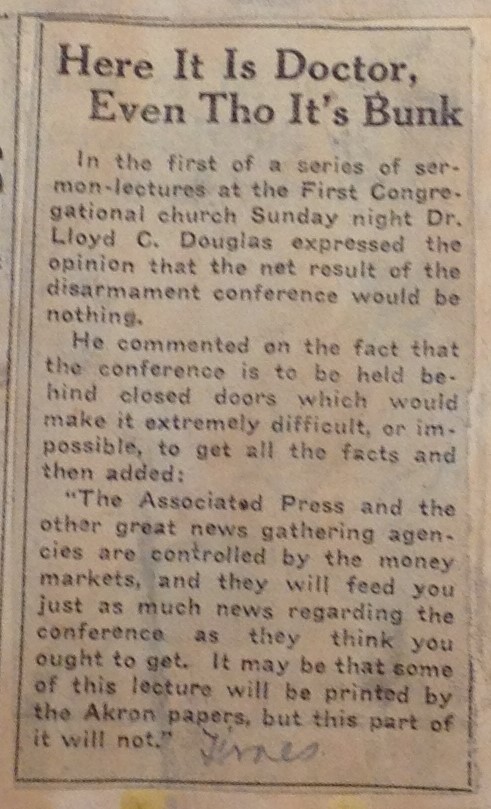
In all these cases (and others besides), it’s clear that local journalists respected Douglas even when they disagreed with them. Here’s my favorite example. In one of his Sunday-night speeches, Douglas claimed that the AP and other wire services were dominated by wealthy individuals who controlled what the newspapers would publish. “It may be that some of this lecture will be printed by the Akron papers,” Douglas said, “but this part of it will not.”

The Akron Times printed it, along with this headline: “Here It Is, Doctor, Even Tho It’s Bunk.”

I’ll tell you more about Douglas’s ministry in Akron in my next post.

For a free PDF copy of the booklet, The Secret Investment of Lloyd C. Douglas, fill out the form below:

Go back

Your message has been sent

Warning
Warning
Warning
Warning.

Inheriting a Scandal

by Ronald R Johnson (www.ronaldrjohnson.com)

When Lloyd Douglas preached his first sermon as the new pastor of Luther Place Memorial Church on October 24, 1909, he knew he had a big job ahead of him. His predecessor, the late Rev. Dr. John G Butler, had engaged in a very ugly fight with his church council during the last several months of his life, and they had taken it to the newspapers. In fact, the scandal was front-page news over the course of several weeks, and it led a number of the members of the church to form a splinter group that began to meet at a location not far from Luther Place. It was a complex and troublesome situation for any new pastor to inherit.

But Douglas was the man for the job.

He did a number of things, right away, that helped the congregation move on.

He took the Press Corps firmly in hand. He started out winning their trust and affection by describing himself as a newspaperman who left the trade to go into the ministry, and then he told them that Luther Place had been too much in the news in recent months and that he would not comment on the earlier trouble. And he stuck to that promise.

He made positive changes to the worship service. He had always tried to create a more aesthetically-pleasing service by skillful use of music, and in the nation’s capital he had access to even more talented individuals who could help him accomplish that goal. Douglas persuaded Prof. Emile Mori, organist at the German-speaking Concordia Lutheran Church, to be his choir director, and Prof. Mori quickly put together an ensemble of twenty trained voices.

He paid due respect to Dr. Butler. In his inaugural sermon, he said, “You hold in solemn and sacred reverence the memory of the man who, through these many years past, labored so tirelessly and efficiently in the interests of this church. I have not come here as his rival, but as his successor.”

He also showed respect for the people themselves. “I have not come here to upset what I have found, or ruthlessly destroy that which has been achieved in the past. Those things that have been dear to you will become dear to me; your traditions will be respected; your customs honored; your church usages kept inviolate.”

But he made his own priorities clear. “I have not come here for the sole and exclusive purpose of writing names in a church book,” he told them. “That we will write many names there I have no doubt, and that we shall be most happy to do so goes without saying. We will strive to make Memorial Church great, and when, by patient application to her trust, she shall have demonstrated her usefulness, her greatness is assured.”

He would focus on being the Church of Jesus Christ in this place, and on projecting that image to the larger community. “Our business—mine as a minister and yours as a layman—is to hold the church with a regard so high and a reverence so deep that her welfare and standing in the community shall be one of the supreme desires of our hearts. It is true that church members do not always see eye to eye. It is true they cannot always bring their ideas of methods, polity, doctrine, and administration into perfect juxtaposition. But that does not impugn their sincerity or reflect upon the honesty of their convictions.”

“You may not care whether I am a Democrat or a Republican,” he said, “whether I am in favor of capital punishment for murderers, what is my personal taste in the matter of books, music, art. You have a right to be interested in my conception of the kingdom of Jesus Christ and my individual belief as to the methods of its advancement.”

Finally, he gave them a promise: “That with God as my guide and helper, I shall endeavor, so far as lies within me, to render to Him and to you an acceptable service. And I should be happy if each one of you might silently offer a pledge at this moment that so long as you believe in my sincerity you will give me your hearty co-operation and support.”

Regarding the split in the church, there was another factor working in his favor: one day earlier (Saturday, October 23), the local synod had voted to accept the splinter group as a legitimate Lutheran congregation. Although some members of Luther Place had hoped that Douglas would find a way to lure them back to the fold, the conference action of the previous day had relieved him of that responsibility. Only one thing remained to be done, and he did it the following Sunday (October 31): he “officially recognized the independent Lutheran congregation,” the Washington Herald reported, “when, in the morning service, he offered prayer that its meditations and efforts might be attended by success.” And that was the end of that.

It started out as front-page news and might have hounded him throughout his pastorate, but Douglas had the wisdom to deal with the issue and put it behind him within the first eight days. And for all practical purposes, he never had to deal with it again.

For a free PDF of the booklet, The Secret Investment of Lloyd C Douglas, fill out the form below:

Go back

Your message has been sent

Warning
Warning
Warning
Warning.

From Cub Reporter to Pastor

by Ronald R Johnson (www.ronaldrjohnson.com)

When he arrived in Washington, DC, to begin his work as pastor of Luther Place Memorial Church in October 1909, Lloyd Douglas made a clever move: he won over the representatives of the DC newspapers by describing himself as a former newspaperman. Although he did spend some time as a reporter for the Springfield Press-Republic in Springfield, Ohio, before attending seminary, he had never put that information to good use before. But now, as he took over the spiritual leadership of a church that had been making headlines for all the wrong reasons, he was able to create a more positive image of the church by hobnobbing with the Press Corps.

The Washington Herald ran this headline on page 1 of their Monday, October 25, 1909 issue:

FORMER REPORTER COMES AS PASTOR

Whoever wrote the article (there were few by-lines in those days) seems to have become a fan. Here is an excerpt:

“From the rattle of typewriters in the city room of a newspaper, from the search of news and the dispassionate probing into the reasons of things, to the pulpit of a house of worship is the story of Rev. Lloyd C. Douglas, who yesterday morning preached his inaugural sermon as the new pastor of Luther Place Memorial Church.

“Immediately after his graduation from college, Mr. Douglas became a reporter on the staff of the Springfield (Ohio) Press-Republic, which has since become the Springfield Daily News. Whatever came up in which the public might be interested, the new reporter was ‘shot out’ on the story. From the rich, in their flesh pots, where freedom from want bred indifference and dried the roots of sympathy, to the poor in their hovels, where poverty had taken crime as its mistress, Douglas made his rounds.”

(See what I mean about going on a bit? But it gets better…)

“His stock in trade consisted of nothing but a soft lead pencil and a bunch of copy paper in an inside pocket; a mind trained to think, and interested in what his fellows did, and a purpose that was destined to bring him, before he was thirty-three years old, to the pulpit of one of the best-known churches of the National Capital, to succeed a man of high caliber, the late Rev. J. G. Butler.

“Mr. Douglas made a good reporter.”

(See what I mean about becoming an instant fan? I wonder if anyone fact-checked that before they printed it…)

“Mr. Douglas made a good reporter. His sympathy gave him an insight into his stories, which won recognition from the city editor. Whether his assignment took him to the chamber of a man who had taken his own life, or to a meeting of prominent citizens in the interests of civic improvement, or to a humble home desolated by sorrow in any one of its many forms, he put ‘human interest’ into the story, and kept his purpose under his hat.

“‘I wanted to get the sort of first-hand experience of life which a newspaper reporter has the best chance to get,’ he said, in explaining his reason for going into the business. ‘I wanted to get at life in the living, to see the seamy side of it, so that I should be better equipped to fight against its unhealthy features later. A newspaper reporter does not have to become calloused and cynical and indifferent, and automatic, unless he wants to; and I did not want to.’

“At the end of a year on the paper, Mr. Douglas made a clean break, and enrolled himself at the Wittenberg Seminary in Springfield, to begin his study of life from the ecclesiastical standpoint…”

This was a clever self-introduction. From that point on, the Press Corps regarded him as one of their own. But it was also an interesting story that surely caught readers’ attention and made them more willing to hear what Douglas had to say. And as I will show in the next blog post, it was an important part of his strategy for overcoming the scandal he had inherited and turning journalists’ thoughts in a more constructive direction.

For a free PDF of the booklet, The Secret Investment of Lloyd C Douglas, fill out the form below:

Go back

Your message has been sent

Warning
Warning
Warning
Warning.

Design a site like this with WordPress.com
Get started