by Ronald R Johnson (www.ronaldrjohnson.com)

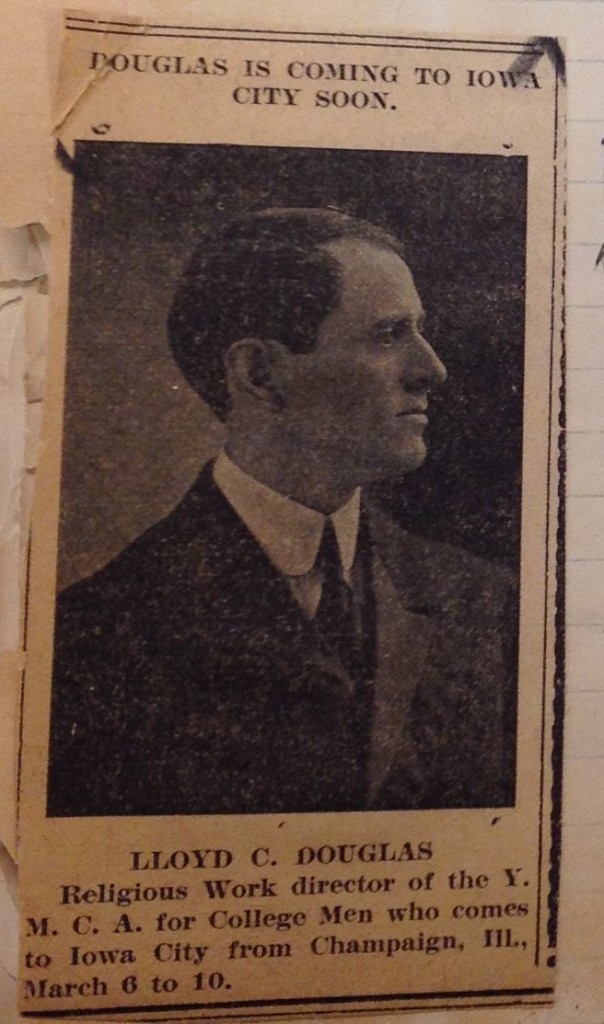
In his 1912 visits to the University of Iowa, Simpson College, and Milliken University, Douglas’s lectures revealed what he was thinking. Professor Edward Diller Starbuck said that Douglas had “thought his world through,” but he really hadn’t – not yet. He was just beginning to do that. He had retired from active ministry and gone to the University of Illinois to start over, and to rethink his theology. The lectures Starbuck and others heard give us some clues about the basic building blocks with which Douglas was working.
(The following quotations are from newspaper reports of those lectures, collected in his 1909-1915 scrapbook.)
“Christianity is not the only religion of value,” Douglas told his audiences. “But Christianity… deserves the support of every believer in progress, liberality of thought, and universal brotherhood.” These were the basic beliefs promoted by the new state colleges: a belief in progress, in academic freedom, and in respect for one another regardless of nationality. Douglas also considered them basic Christian principles. On his view, anyone who accepted the new state-college frame of mind should also recognize the worth of Christianity.
“Take a map of the world,” he said; “draw in red an outline of Christendom and you will have drawn a map of all of the arts, sciences, inventions, and discoveries which are regarded seriously by the great universities.” Unlike many other ministers of his day, he did not feel that Christianity was incompatible with what was being taught in the universities; on the contrary, Christianity had, throughout history, provided the nurturing environment for all humanity’s great discoveries and achievements. As the nation’s colleges passed these accomplishments on to new generations, they were inadvertently paying homage to Christian faith.
As one newspaper reported, Douglas told his listeners “that Jesus was the interpreter of the infinite, and as a practical illustration cited the experiment of connecting a dynamo of infinite power with a motor of limited voltage. Except for a transformer, the little motor would have no efficiency and be torn to pieces. Jesus, he said, was the transformer between God and man, having come to the earth and [having] lived life on a human scale.”
In these lectures, Douglas professed a belief in Christ’s divinity. “The speaker said Jesus was divine and only as a divine character could he make the claims he made concerning himself.” The fact that Christ’s divinity was first embraced by a bunch of Hebrew Monotheists is significant, Douglas argued. They believed in one God, not God the Father and God the Son, but one God. Yet they ended up believing that Jesus was the Son of God. Their experience with Jesus must have been especially powerful to have outweighed their Jewish upbringing.
Douglas also said he believed in the Virgin Birth. “Mr. Douglas conceded, however, that if the ‘virgin birth’ proved a stumbling block to a man’s acceptance of Jesus, let him accept the facts about Jesus which he was sure he could understand and appreciate, and let his faith do the rest.”
It’s clear from these clippings that Douglas was still traditional in his most basic beliefs (that Jesus was both divine and divinely-conceived), but he was trying to find the points of convergence between his faith and the new state-college worldview. He didn’t think it was necessary for his listeners to profess beliefs that contradicted their everyday lives. From physics they could understand the function of a transformer acting as an adapter between a motor of higher voltage and one of limited voltage. By analogy, they could also understand Christ’s function as “the interpreter” of a Higher Power. It was not necessary for his listeners to profess that he was born miraculously as long as they could accept his function as “the interpreter of the infinite” in their own lives.
We also see Douglas trying to make Christ’s message relevant for his audience right now, while they’re still students. “There are a host of specific temptations proposing themselves to student life which exist nowhere else in precisely the same form and proportions,” he said. “Every man should solve his problems as they come to him. The octogenarian need not pride himself upon his chastity. The high school lad need not boast that never, as cashier of a metropolitan bank, had he made off with the loot. There is the problem of the little boy to be a bully, a sneak and a liar. There is the problem of the old man to be misanthropic, sour, sore, bitter, critical. But the student meets… temptations peculiar only to this type of life.”
Among the temptations of students, one newspaper said, Douglas listed indifference. “It was shown that many students… hurry through their student days ‘planless, plotless, breathless, and thoughtless, looking forward to that glorified day of graduation when the whole machinery of life would be set in a safe speed clutch and the symphony of life be pitched in a major key.'” The temptation, according to this reporter, was “failing to realize that the university experience is valuable for its own sake and not merely as a period of preparation for something later on…”
Even today, it would be rare for us to hear a minister say that one of the main temptations of students is to fail to appreciate education for its own sake. The title “Specific Sins of Students” would seem to suggest drinking, or illicit behavior with co-eds, or cheating on tests. But Douglas placed a deep trust in secular education. He recognized the new state colleges as sites where the truth was being discovered and disseminated on a daily basis. We cannot appreciate Douglas’s theology apart from this. He saw a new world coming into being at schools like the University of Iowa, Simpson, Milliken, and the University of Illinois. He did not feel threatened by the New Learning. It inspired him. Everything he taught and wrote throughout the rest of his life must be interpreted with this in mind.
But he wasn’t just developing his theology; he was also pursuing an exciting new path in his creative writing. In terms of finding his voice as a writer, what happened next was one of the most important events of his life.
To receive a free PDF of the booklet, The Secret Investment of Lloyd C. Douglas, fill in your name and email address in the form below.




 The Lloyd C Douglas Page