Lloyd Douglas didn’t win the Christian Century’s essay contest in the summer of 1920; he took second place. But it didn’t matter…
From the July 22, 1920, issue of The Christian Century, p. 22. Available online at The Online Books Page.
…because his participation in the contest had excited the interest of the editor, Charles Clayton Morrison, and Morrison invited Douglas to submit another article to the Century – right away. “Our readers will be particularly interested in an article from you just now when their attention has been put on the qui vive [on the alert] by your taking one of the honors in the series,” Morrison said. “I hope you will feel not only free, but strongly prompted, to write for us at any time.”
Letter from Charles Clayton Morrison to Lloyd C Douglas, July 22, 1920. In 1918 Scrapbook, Lloyd C Douglas Papers, Box 5, Bentley Historical Library, University of Michigan.
Douglas accepted the invitation immediately. And he didn’t just send one article; he sent Part One of a three-part series. It was called, “Wanted: A Congregation,” and it was some of the finest writing he had ever done up to that time.
Letter from Charles Clayton Morrison to Lloyd C Douglas, August 3, 1920. In 1918 Scrapbook, Lloyd C Douglas Papers, Box 5, Bentley Historical Library, University of Michigan.
Upon receiving the first installment, Morrison gushed, “You write splendidly.” He wasted no time publishing it, even announcing it on the front cover (August 5, 1920), and he encouraged Douglas to send the other two installments as soon as possible.
Notice that Douglas now shares the front cover with John Spargo.
Douglas did better than that: he sent three more installments. But first he asked the editor’s permission. Morrison wrote back pretending to be “quite offended that you felt any inhibition at all in the matter of writing a fourth installment when you were prompted to do so.” He wasn’t really offended; he was delighted that Douglas had been “prompted,” either by his Muse or by the Spirit, to add another installment to the series. “The chances are 102 per cent that whatever you write will be available [he probably means ‘accepted’] for publication in The Christian Century.”
So… now Douglas not only had a series running in the Century, but he also had an open invitation from the editor to send him an article anytime, and to expect to see it published in that magazine.
Elesha J Coffman has written, “In 1920, the Century was not yet a magazine that other papers envied or a place where writers could make their names. By the end of the decade, through savvy and serendipity, it would be both.” (The Christian Century and the Rise of the Protestant Mainstream (NY: Oxford University Press, 2013), p. 63.)
That being the case, Douglas and the Century grew up together, for his frequent contributions beginning in 1920 made his non-fiction writing well-known among America’s Protestant clergy, and at the end of that decade, TheChristian Century would play a major role in making him a world-famous novelist.
For a free PDF copy of the booklet, The Secret Investment of Lloyd C. Douglas, fill out the form below:
In his response to John Spargo for The Christian Century’s essay contest in the summer of 1920, Douglas began by trying to make Spargo look ridiculous. He claimed that Spargo wrote his article during “what was evidently an hour of utter exasperation” and that the piece “must have been composed while under stress of very strong emotion. So wrought up is he that he indicts the whole profession.” (I disagree. Spargo’s essay comes across calm and dispassionate; it is Douglas who seems fired up.)
Next, Douglas takes on the manner of an attorney in a courtroom. He harps on Spargo’s use of the term “the average minister,” and uses the following analogy:
Suppose that, instead of attacking the ministry, this author had pointed out the weaknesses of the medical profession. Suppose that he had said, ‘The average doctor is no more competent to diagnose a case or write a prescription than the average patient.’ …. [H]e would be obliged to show precisely how he had arrived at his ‘average.’ …. To the impartial prosecution of the case he should investigate all the various types represented among medical men, as, for example,—specialists (bona fide); specialists (bogus); specialists suspected of being quacks; specialists known to be quacks; doctors who would send a patient to an unscrupulous and unskilled surgeon on the latter’s promise of a ‘split fee’; doctors who work eighteen hours out of every twenty-four, and die poor; surgeons known to be extortionists; surgeons known to be generous; surgeons willing to venture with the untried; surgeons willing to delegate a critical case to a more experienced colleague; general practitioners of good intent but poor training; general practitioners with good training but no conscience; general practitioners who know little and care less; a host who have excellent training at school but very little experience, and as many more who have had wide experience but meager educational advantages.
Lloyd C Douglas, “Preaching and the ‘Average Preacher'”
Notice that Douglas’s analogy is from the medical profession. This is just one example of how science, and especially medical science, has come to dominate his thinking. But it’s also somewhat tedious. This isn’t Douglas at his best. He behaves like someone who’s trying to win a debate. Here’s where he’s going with the analogy:
Having secured all the accessible facts relative to these widely divergent types, a general ‘average’ might be computed. But before Mr. Spargo would dare to predicate any quality, attribute, state of mind, strength or weakness, of ‘the average doctor,’ he would have to be prepared to define and describe this typical medical man. By no means would it be an impertinence if the offended M. D., reading these contemptuous words hurled at ‘the average doctor,’ should inquire of the author, ‘What manner of home produced the average doctor? You ought to know: you struck the average. How old is he? What has been the nature of his experience? What about his training? Did he finish high school—this average doctor? Does he exhibit an interest in the general welfare of his community?’ And—if Mr. Spargo were to decline answering on the ground that no man could collect enough facts to warrant his attempt to answer such direct questions concerning ‘the average doctor’—the indignant medical man would then have a right to reply, ‘That being true, by what rule of audacity do you presume to speak of an “average doctor” at all?’
Ibid
A direct answer to Spargo’s objection would show why laypeople need well-trained ministers to help them understand the Bible and apply it to their lives. But Douglas doesn’t do that; instead, he tries to catch Spargo on a technicality: his use of the term “average minister.”
Douglas’s main point is that the type of minister Spargo describes is not average at all; he’s only talking about pastors of big-city churches, which Douglas says constitutes no more than 10 percent of the Protestant clergy in America. Even at that, Douglas says, Spargo contradicts himself, for he (Spargo) says at one point that these big-city ministers do preach from the scriptures and at another point that they do not. (I honestly don’t see where Spargo contradicted himself, but Douglas insists that he did.)
Believing that he has succeeded in making Spargo look ridiculous, Douglas changes tactics. (Remember, the editor of the Century gave Spargo’s article the provocative title, “The Futility of Preaching,” even though Spargo never actually used that word.)
Heigh-ho-hum! Let us talk about something else.
Let us talk about ‘futilities.’
When, in 1897, the first successful operation ever performed upon the heart was completed, one of the operators is said to have remarked: ‘The path to the human heart is only one inch long, but it has taken surgery twenty-four hundred years to travel it!’ One almost envies a man his proper pride who is able to say that he belongs to a profession possessed of enough faith and perseverance to continue its apparently futile efforts, for twenty-four centuries, undaunted by a consistent record of one hundred per cent failure, until, at length, it has registered a single success.
Ibid
Another medical analogy! His point this time is a bit more relevant, but we have to wait for it. Acknowledging that, throughout those centuries, physicians did succeed at other things (“setting broken bones, amputating crushed fingers, removing malignant growths, and straightening crippled feet”), he says that preachers, too, have had their successes: motivating cities to build hospitals (as Douglas himself had done in Lancaster, Ohio), as well as “the asylum, the orphanage, the home for the indigent and the aged, the reform of the prison, and philanthropies of all sorts.” It was preaching, he says, that finally won women the right to vote. (This was 1920, the very year in which that happened.) The popular conception of “the Brotherhood of Man” originated in the pulpit, and most of the nation’s colleges and universities were started by ministers.
Some day we will contrive to mend the very heart of society. Meanwhile, we will continue to perform such work as we have learned to accomplish. If the surgeons could sustain their faith in the possibility of mending hearts, for twenty-four hundred years, with an unbroken record of failure behind them, we ministers may indulge the hope that our efforts are contributing to the successes of them who take up our instruments after we have put them down, refashioning and readapting them to the needs of a rapidly changing world.
Ibid
Although it wasn’t Douglas’s best work, it caught the eye of the editor, Charles Clayton Morrison, who wrote this in reply, on May 29, 1920:
“My dear Doctor Douglas:
“I thank you very cordially for your communication concerning Mr. Spargo’s article. I have just read it through cursorily and am much impressed with the manner in which you handle him. This is to advise you that the article will appear in an early issue of The Christian Century and will be a candidate for the little premium we are offering.
“Very sincerely yours,”
Letter from Charles Clayton Morrison to Lloyd C Douglas, May 29, 1920. In 1918 Scrapbook, Lloyd C Douglas Papers, Box 5, Bentley Historical Library, University of Michigan
Morrison calls him “Doctor” Douglas. There were times when people assumed (in error) that Douglas had a doctorate, even earlier in his life, but in this case Morrison was right: Douglas received an honorary doctorate from Fargo College that same year (1920). Notice also the phrase “the manner in which you handle him,” meaning Spargo. Morrison has set this contest up as a prize fight, and he is choosing the submissions that he thinks will bloody Spargo’s nose.
The top six essays were published in the Century without by-lines on July 1st. Readers were asked to vote for the top three, without knowing the authors’ names. This was Morrison’s clever way of getting a lot of mileage out of Spargo’s essay, making it a topic of discussion throughout the summer and into the fall. But it also ended up being very good for Lloyd Douglas.
To be continued…
For a free PDF copy of the booklet, The Secret Investment of Lloyd C. Douglas, fill out the form below:
Over the past few posts, I’ve been telling you about the periodicals in which Douglas’s writing appeared during his Ann Arbor years (1915-1921); but his big breakthrough came in 1920, when he began writing for The Christian Century. And that fact is ironic, because in 1920 the Century was still struggling to become an important magazine. To some extent, Douglas added distinction to the Century even as it helped him become more prominent on the national scene.
(For most of what follows, I am indebted to Elesha J Coffman, The Christian Century and the Rise of the Protestant Mainline (NY: Oxford University Press, 2013).)
The Christian Century began as an unimposing little Disciples of Christ paper. In fact, the Disciples of Christ itself began as a nineteenth-century religious movement that was so democratic, it lacked a hierarchy and therefore didn’t have an official “organ.” There were hundreds of papers published throughout the United States in the 1800s by people of that persuasion, most of them with a very small circulation. The Christian Century was just one of many, many such periodicals. And, like most of the others, it had to fight hard just to survive financially.
In 1914, the magazine’s young editor, Charles Clayton Morrison, made the decision to seek a wider audience outside of his denomination: specifically, Protestant ministers and laypeople who valued education and who were willing to think deeply about religious matters. The weekly magazine was published in Chicago, and the people who ran it, including Morrison, were well-connected with professors at the University of Chicago, in both the religion and the philosophy departments. It made sense for them to seek out the more intellectual members of the Protestant clergy and to publish articles on topics that would be of interest to such a group.
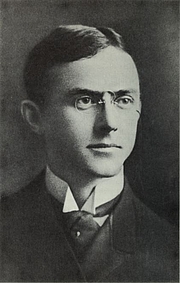
Charles Clayton Morrison, editor of The Christian Century from 1908 to 1947. Although he looks young in this picture, he was several years older than Douglas. (Image from LibraryThing)
I’m unable to say when Douglas began to read the Century. I do know that he was just the kind of reader Morrison was aiming at: one who was committed to higher education and to rethinking the gospel in terms of what was being taught in America’s state colleges. As I told you in an earlier post, Douglas was already following the work of Shailer Mathews as early as 1909, and Mathews led the Department of Religion at the University of Chicago. (He also wrote articles for the Century.) In fact, Mathews’ teachings had prompted Douglas to “go back to school” (first the University of Illinois and then the University of Michigan) and to revise his ideas about God; so Douglas’s career path made him a perfect fit for The Christian Century, not only as a reader but also as a contributor.
In 1919, a few wealthy members of the Disciples of Christ (including William H. Hoover of vacuum-cleaner fame), created an endowment for the magazine, and Morrison initially used these funds to begin advertising in a number of periodicals, including denominational organs like The Congregationalist and secular magazines like The Atlantic Monthly, both of which Douglas was writing for at the time. If the Century wasn’t on his radar prior to 1919, it probably was now.
At any rate, in the spring of 1920, Morrison announced an essay contest. This was just one of the ways in which he tried to increase his list of subscribers. He hoped to inspire ministers and thoughtful laypeople to write on the proposed subject. He would pick the best six entries, then readers would choose the first, second, and third-place winners from those six. (First prize was a whopping $50, second was $25, and third was $10. In fairness, Morrison himself apologized to the contestants for this pitiful remuneration.)
The event may or may not have increased the Century’s readership, but Morrison did snag a talented writer from Ann Arbor, Michigan, who was not yet known on the national stage. It was the beginning of a mutually-beneficial relationship.
To be continued…
For a free PDF copy of the booklet, The Secret Investment of Lloyd C. Douglas, fill out the form below:


 The Lloyd C Douglas Page
